The PoC-to-Production gap
Introduction
The transition of Generative AI (GenAI) initiatives from Proof of Concept (PoC) to Enterprise Production represents a structural chasm where the vast majority of corporate initiatives stall or fail entirely. A PoC operates in a sterile environment, focusing exclusively on model capability under controlled conditions. Production engineering, conversely, demands system predictability at scale, operating under strict constraints of latency, cost, security, and governance.
For CTOs, VPs, and technology directors, bridging this gap requires shifting the paradigm from building model wrappers to engineering resilient, multi-layered software architectures. The model is merely a single component within a complex enterprise ecosystem.
1. The Anatomy of the PoC Illusion
A small team of developers can build a functional Large Language Model (LLM) wrapper over a weekend. The demonstration looks flawless, the stakeholders are impressed, and a false sense of security is established. However, this success is an illusion generated by a highly sanitized environment.
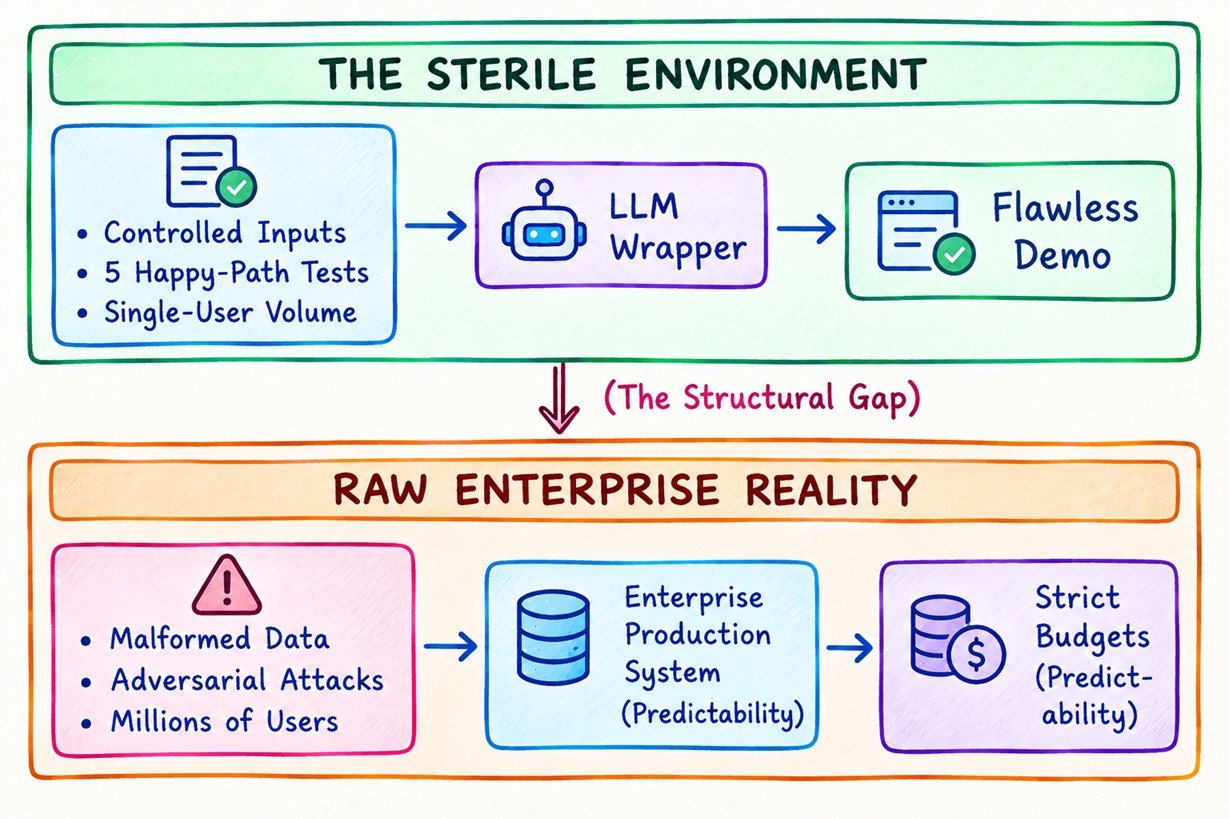
The Sterile Environment vs. Raw Reality
- Controlled Inputs vs. Malformed Data: PoCs rely on the "happy path"—predictable, well-formatted queries engineered by the developers themselves. Production forces the system to confront raw reality: unstructured, incomplete, and highly ambiguous user inputs.
- Limited Volume vs. Concurrent Scale: A demo handles sequential requests from a single presenter. Production requires managing millions of concurrent API calls, introducing thread-safety issues, rate-limiting bottlenecks, and distributed state complexities.
- Optimistic Assumptions vs. Non-Functional Requirements (NFRs): Developers frequently mistake model capability for system readiness. Writing prompts and connecting an API key proves only that the model can perform a task. It does not validate whether the system can perform that task safely, affordably, and within acceptable time limits millions of times.
2. The AI Architectural North Star
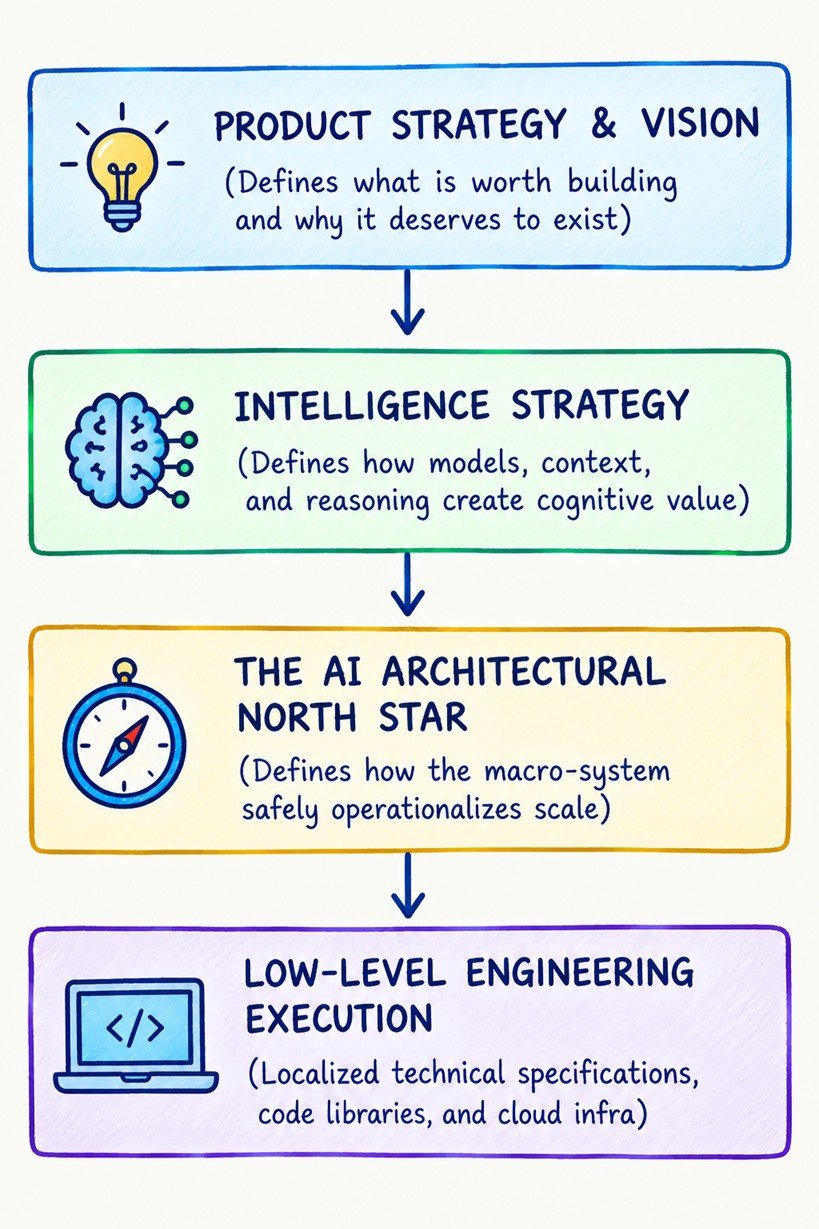
To bridge the chasm between Product Strategy and detailed engineering execution, technology leaders must establish an AI Architectural North Star. The AI Architectural North Star sits precisely at the boundary of vision and execution. It is a strategic mechanism that defines what an AI system must fundamentally become for the Product Vision to succeed.
What It Is vs. What It Is Not
- It Is: A high-level, concrete blueprint that establishes the systemic foundation, core principles, boundaries, and intelligence flows of an AI product before detailed implementation begins.
- It Is Not a Hand-Waving Diagram: It is structurally rigorous and designed to expose hard technical realities, challenge product assumptions, and validate product viability.
- It Is Not a Technology Stack List: It does not mandate specific code libraries, cloud providers, or database vendors.
- It Is Not a Replacement for Detailed Architecture: It provides the strategic direction from which implementation architects and engineering teams can safely develop localized, low-level technical specifications.
The Core Executive Distinction
- Product Vision: Defines what is worth building and why it deserves to exist.
- Intelligence Strategy: Defines how AI capabilities, models, context, reasoning, and human-in-the-loop triggers collaborate to create cognitive value.
- Architectural North Star: Defines how the entire macro-system needs to come together to safely operationalize that intelligence at scale.
The Eight Pillars of the North Star
The AI Architectural North Star provides engineering teams with eight specific dimensions from which they can build toward production without friction:
I. Architectural Intent
The intentional engineering philosophy of the product. It ensures that every technical system directly serves a specific business outcome. For example, if the Product Vision requires sub-second ambient assistance, the Architectural Intent mandates an infrastructure footprint optimized for streaming and token-to-token low latency, completely eliminating batch-processing paradigms from consideration.
II. System Boundaries & Trust Perimeters
AI applications introduce probabilistic behavior and significant security, compliance, and data privacy vectors.
III. Major Design Choices
High-level structural patterns that govern the system's longevity.
IV. Intelligence Flows
The choreography of data and cognition. The North Star maps out the movement of information across the system.
V. Critical Trade-offs
Building an AI system involves constant, conflicting engineering pressures. The North Star explicitly outlines which priorities win over others, removing ambiguity for developers.
VI. Intelligence & Model Strategy
Fleshing out the direct execution patterns of your cognitive infrastructure.
VII. Evaluation, Observability & Reliability
Defining metrics that acknowledge the statistical nature of LLMs.
VIII. Evolution & Governance
How the platform matures over time without transforming into a legacy liability.
Pillars at a glance
| Pillar | Core question |
|---|---|
| I. Architectural Intent | Why are we building it this way? |
| II. System Boundaries & Trust Perimeters | Where are the boundaries and what can be trusted? |
| III. Major Design Choices | What structural decisions govern the system? |
| IV. Intelligence Flows | How does data and cognition move through it? |
| V. Critical Trade-offs | Which competing priorities win? |
| VI. Intelligence & Model Strategy | Where does intelligence come from and how does it evolve? |
| VII. Evaluation, Observability & Reliability | How do we know the system works? |
| VIII. Evolution & Governance | How does the architecture change safely over time? |
3. Structural Barriers to Production Scale
Engineering a system to survive production scale requires addressing four systemic pillars: Predictability, Cost Governance, Security, and Observability.
I. Predictability & Non-Determinism
LLMs are inherently probabilistic, which directly conflicts with the deterministic expectations of enterprise software.
- Prompt Drift: A prompt that works perfectly on version N of a commercial model may fail spectacularly on version N+1 due to unannounced behind-the-scenes weights updates by the provider.
- Output Structural Validation: Production systems require structured data (JSON/Pydantic objects) to feed downstream APIs. LLMs routinely violate these structural schemas without strict, deterministic enforcement mechanisms (like constrained decoding).
II. Financial & Cost Governance
The financial model of a PoC is negligible; the financial model of a production system can easily erode margin if unmanaged.
- The Compounding Token Tax: As conversation history grows, token consumption scales non-linearly. Without aggressive context pruning, semantic caching, and strict window management, API costs escalate exponentially.
- Resource Asymmetry: A sudden spike in user adoption can cause catastrophic cost overruns over a single weekend if hard budget ceilings and rate-limiters are not hardcoded into the architectural fabric.
III. Enterprise Security & Threat Landscapes
Moving to production introduces highly sophisticated vectors of attack that standard web application firewalls (WAFs) cannot mitigate.
- Prompt Injection & Jailbreaking: Adversarial users will attempt to bypass system instructions to extract underlying data, execute unauthorized system actions, or generate toxic content.
- Data Provenance & Privacy: Production pipelines must guarantee that enterprise data used for real-time context retrieval does not inadvertently train public models or leak across multi-tenant boundaries.
IV. Continuous Observability & Evaluation
Traditional APM tools (Application Performance Monitoring) are completely blind to the nuances of generative AI systems.
- The Evaluation Bottleneck: You cannot fix what you cannot measure. Production requires automated evaluation pipelines (LLM-as-a-judge, semantic similarity tracking) to continuously score the quality, accuracy, and safety of responses in real-time.
- Latency Budgets: Breakdowns must be monitored granularly: Time-to-First-Token (TTFT), token generation speed, vector database search latency, and guardrail overhead must all fit within a predefined user experience budget.
4. Strategic Playbook for Technology Leaders
To bridge the gap effectively, CTOs, VPs, and Directors must execute the following strategic transitions:
| Operational Dimension | The PoC Approach (High Failure Rate) | The Production Approach (Enterprise Ready) |
|---|---|---|
| Model Strategy | Hardcoded to a single frontier LLM API. | Model-agnostic abstraction layers with dynamic routing based on North Star Pillar VI. |
| Data Strategy | Raw text pasted directly into the prompt window. | Advanced RAG pipelines with explicit System Boundaries (Pillar II). |
| Testing Paradigm | Manual ad-hoc validation on 5–10 test cases. | Continuous automated evaluation against golden datasets (Pillar VII). |
| Error Handling | Basic try/catch blocks that pass raw errors to users. | Graceful degradation, local fallback models, and deterministic kill-switches (Pillar VIII). |
| Cost Management | Ignored or treated as a post-launch optimization task. | Token budgets, semantic caching, and hard rate-limiting (Pillar III). |
Immediate Next Steps for Engineering Leadership
-
Enforce Abstraction Immediately: Mandate that no application team directly calls an LLM vendor API. All requests must go through an internal model gateway that standardizes logging, authentication, and payload formatting.
-
Establish the Golden Dataset: Prior to approving production funding, require engineering and product teams to co-author a diverse test suite of hundreds of edge cases, adversarial inputs, and malformed queries to evaluate system resilience objectively.
-
Design for Failure: Build the system under the explicit assumption that the model will hallucinate, will time out, and will return malformed data. Establish deterministic code paths to catch and neutralize these failures before they reach the end user.