The CTO's Guide to Thinking in Enterprise Agent Fleet Platforms
Publication Date: October 02, 2026 Last Updated: October 02, 2026
This article is being developed as a multi-day project and will be updated progressively. The content currently published represents the work completed so far, with additional sections, diagrams, architectural details, and technology mappings to be added over the coming days.
Current publication status: Sections 1–1 completed and published.
The article will remain publicly accessible throughout the process and will evolve toward the complete reference architecture.
Target Audience
This article is intended for:
- CTOs, CIOs, and technology executives defining enterprise AI strategy and operating models.
- Chief Architects, Enterprise Architects, and Principal Architects designing enterprise-scale agentic AI platforms.
- Heads of AI, AI Engineering, and AI Platform teams building and operating agent fleets.
- Solution and Software Architects designing agent orchestration, runtime, knowledge, tool, and integration architectures.
- AI Engineers and Platform Engineers responsible for productionizing and scaling agentic AI systems.
- Engineering leaders and technical product leaders evaluating the organizational, operational, governance, and economic implications of agentic AI.
- Technology decision-makers assessing how frameworks such as LangGraph, CrewAI, AutoGen, MCP, and foundation model platforms fit into a broader enterprise agent platform architecture.
The article assumes familiarity with enterprise architecture, cloud platforms, distributed systems, generative AI, and software architecture, but does not require expertise in any particular agent framework or cloud provider.
Section 1: Enterprise Agent Fleet Platform: The Business Perspective
Enterprise AI is moving beyond individual chatbots and isolated AI assistants.
Organizations are beginning to deploy AI agents that can understand business objectives, reason about what needs to be done, retrieve enterprise knowledge, use business tools, collaborate with other agents, make decisions within defined boundaries, and involve humans when necessary.
A single agent can be relatively straightforward to build.
The challenge begins when an enterprise needs hundreds or thousands of agents executing business workflows concurrently.
At that point, the problem is no longer simply, "How do we build an AI agent?"
The real question becomes:
How do we build, deploy, operate, govern, evaluate, and continuously improve an entire fleet of enterprise AI agents?
That is the problem an Enterprise Agent Fleet Platform is designed to solve.
A Concrete Business Scenario: Autonomous Accounts Receivable
Consider a large enterprise that processes thousands of invoices every day.
Suppose a $250,000 customer invoice becomes 30 days overdue.
Today, the collections process might involve several people and systems.
A finance employee receives an overdue-invoice notification, opens the ERP system to inspect the invoice, checks the customer's payment history in the CRM, searches the contract and payment terms, looks for previous correspondence, contacts the customer, investigates the reason for non-payment, coordinates with sales or customer service, and eventually updates the collections system.
If the customer says that payment is blocked because the purchase order number is incorrect, another employee may need to investigate the contract, validate the customer's claim, correct the invoice, obtain approval for the change, and continue following up until payment is received.
Now imagine the enterprise wants to automate this process with AI.
It could create a Collections Agent.
The agent receives an overdue-invoice event and starts investigating.
It retrieves the invoice from the ERP, obtains the customer's account history from the CRM, retrieves the relevant contract and payment terms from the enterprise knowledge base, and analyzes previous communications.
The agent determines that the invoice is genuinely overdue and that the customer has historically paid on time.
It then prepares a communication to the customer.
The customer responds:
"We cannot process this invoice because the purchase order reference does not match our procurement record."
The agent investigates the purchase order, checks the contract, verifies the customer's statement, and determines that the invoice requires a correction.
At this point, the agent could potentially update the ERP.
But changing a financial record is a controlled business action.
The platform therefore determines that this action requires human approval.
A finance employee receives an approval request containing the relevant evidence, proposed change, policy information, and expected impact.
The employee approves it.
The agent resumes execution, updates the ERP, sends the corrected invoice, and continues monitoring the case.
Several days later, the payment event arrives.
The platform correlates the payment with the original workflow, verifies the transaction, updates the collections case, records the business outcome, and closes the workflow.
From a business perspective, this looks like one automated collections process.
Architecturally, however, a significant number of capabilities were involved:
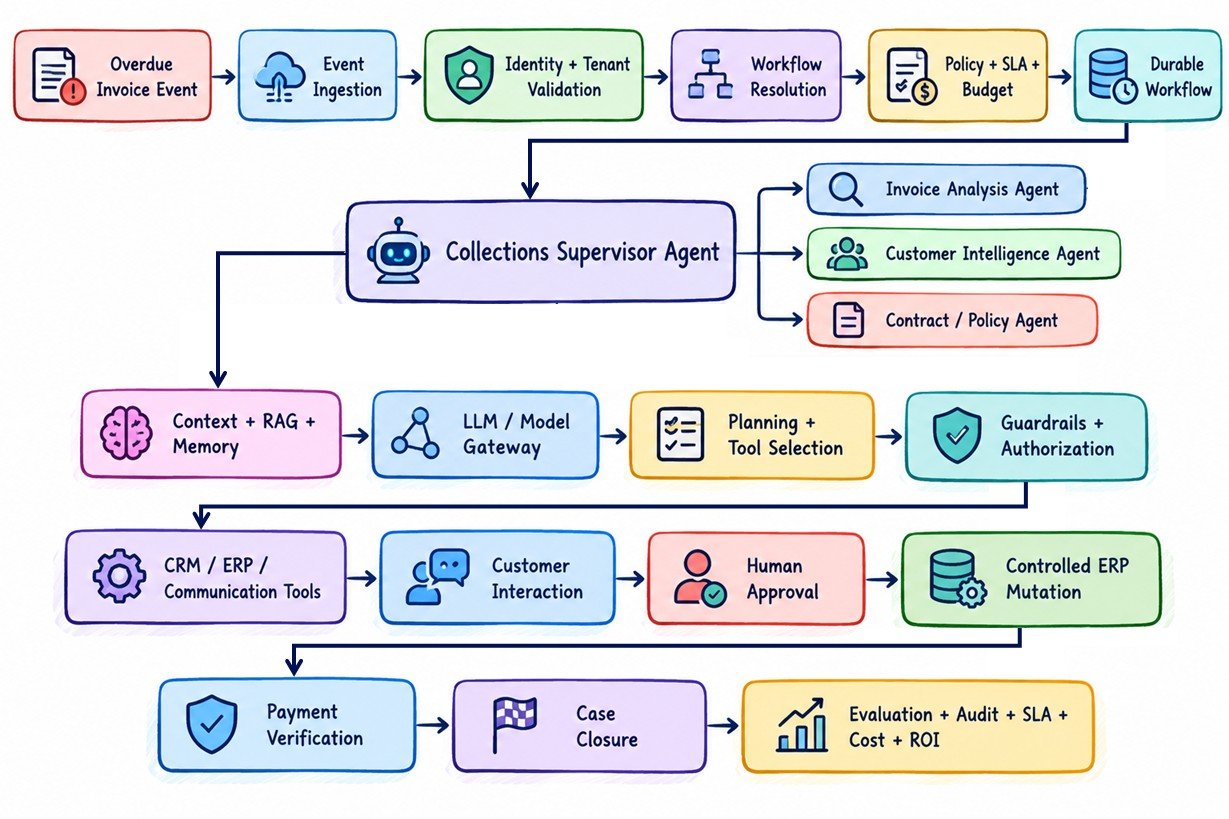
The important observation is that the Collections Agent itself is only one part of the solution.
The business process requires an entire ecosystem around the agent.
Now Scale the Scenario
The real challenge appears when the enterprise has:
- 500,000 active customers
- millions of invoices
- thousands of overdue invoices every day
- multiple ERP and CRM systems
- multiple business units
- multiple geographies
- different collection policies
- different approval thresholds
- different regulatory requirements
- thousands of concurrent agent workflows
And collections is only one business function.
The same enterprise may simultaneously operate:
- Customer Service Agents
- Sales Intelligence Agents
- Procurement Agents
- Accounts Payable Agents
- Fraud Investigation Agents
- Contract Analysis Agents
- IT Operations Agents
- Supply Chain Agents
- Compliance Agents
- HR Operations Agents
- Software Engineering Agents
At this point, creating individual agents is no longer the primary architectural challenge.
The organization needs a common platform capable of operating the entire population of agents.
That is where the concept of an Enterprise Agent Fleet becomes important.
From Individual Agents to an Agent Fleet
An agent fleet is not simply a collection of independent agents.
It is a managed population of AI agents that share common platform capabilities for identity, orchestration, tools, knowledge, memory, governance, evaluation, observability, security, and operations.
In the collections example, the business may have a fleet containing:
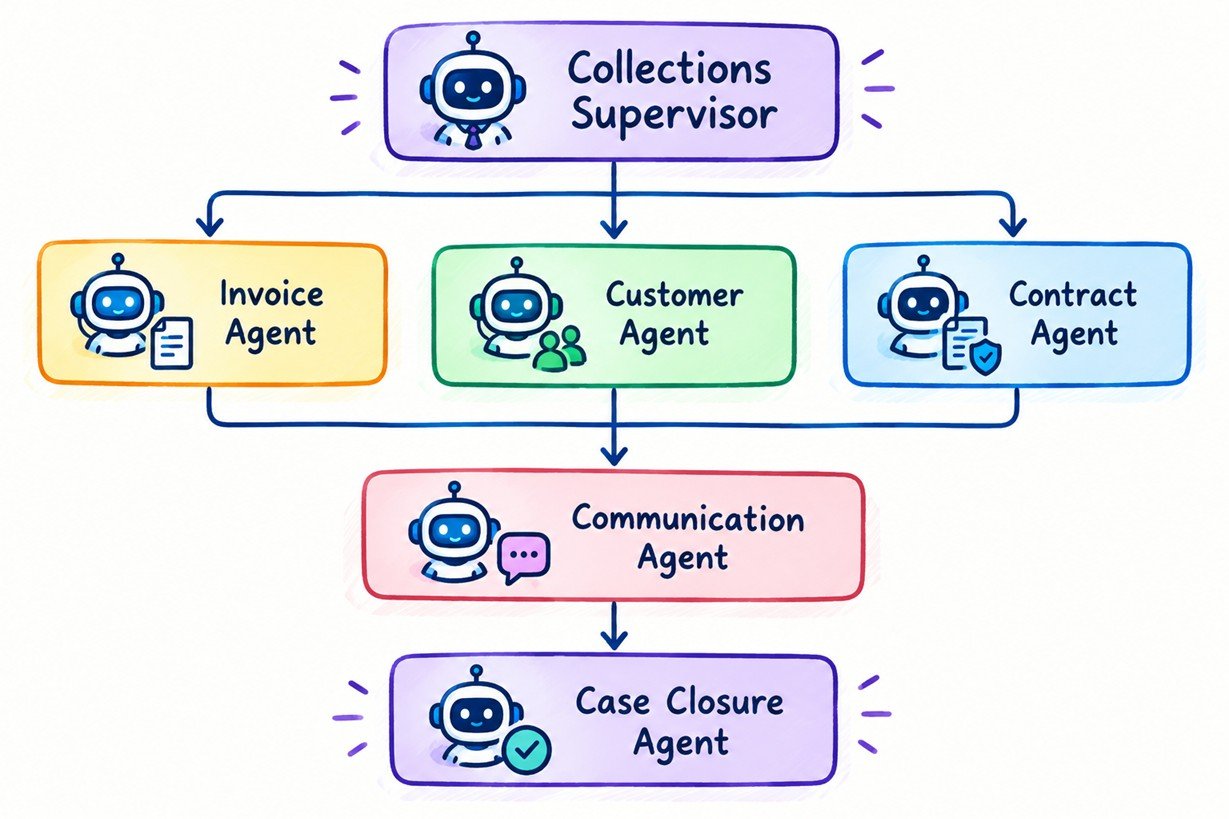
Another business process may use a completely different collection of agents.
The platform should not care whether the workflow is collections, procurement, customer service, or IT operations.
It provides the common capabilities required to execute and govern them.
The Business Problem
Without a common platform, organizations can quickly end up with dozens or hundreds of independently developed AI solutions.
One team may build an agent using LangGraph.
Another may use CrewAI.
Another may build directly against an LLM API.
Another may create its own RAG pipeline.
Another may implement its own tool integration mechanism.
Another may store agent state in a database.
Another may maintain memory in a vector store.
Initially, this looks like innovation.
At enterprise scale, it creates a different problem.
The organization starts accumulating different approaches to authentication, authorization, prompt management, model access, tool access, audit logging, evaluation, human approval, error handling, monitoring, cost management, and data protection.
The result is an AI estate that becomes increasingly difficult to operate and govern.
The Enterprise Agent Fleet Platform addresses this fragmentation by providing common platform capabilities underneath the agents.
What the Platform Actually Provides
The platform provides the environment in which enterprise agents can live and operate.
An agent should not need to solve infrastructure and operational problems every time it is created.
Instead, the platform should provide capabilities such as:
| Capability | Description |
|---|---|
| Agent lifecycle management | Register, version, test, approve, deploy, pause, retire, and replace agents. |
| Agent orchestration | Coordinate complex workflows involving multiple agents, tools, models, events, and human participants. |
| Execution management | Provide durable execution, state management, checkpointing, retries, timeouts, cancellation, concurrency, and recovery. |
| Enterprise knowledge and context | Connect agents to enterprise data, documents, retrieval systems, RAG pipelines, and relevant contextual information. |
| Tool integration | Give agents controlled access to enterprise applications, APIs, databases, SaaS platforms, and external services. |
| Memory | Provide appropriate mechanisms for working memory, episodic memory, semantic memory, and other forms of persistent agent state. |
| Model access | Provide a controlled abstraction over foundation models so agents can use the appropriate model without creating unmanaged direct dependencies on individual model providers. |
| Governance and security | Control what an agent is allowed to see, decide, and execute based on identity, tenant, role, policy, risk, data classification, and business authority. |
| Human-in-the-loop | Allow humans to review, approve, reject, modify, or take over agent actions when the business process requires human judgment or authorization. |
| Evaluation | Continuously measure whether agents are producing accurate, grounded, safe, reliable, and useful outcomes. |
| Exception management | Detect failures and determine whether the system should retry, compensate, escalate, pause, or request human intervention. |
| Observability and SLA management | Give engineering and business teams visibility into agent execution, latency, failures, throughput, quality, cost, and business outcomes. |
| Economics | Measure the cost of running the fleet and connect that cost to business value, allowing the organization to understand the economics of agentic automation. |
From Agent Development to Agent Operations
The platform also changes the enterprise development model.
Without a fleet platform, the lifecycle often looks like:
Build an agent → connect an LLM → connect some tools → deploy it → monitor it manually.
That model does not scale well.
With an Enterprise Agent Fleet Platform, the lifecycle becomes closer to a software platform operating model:
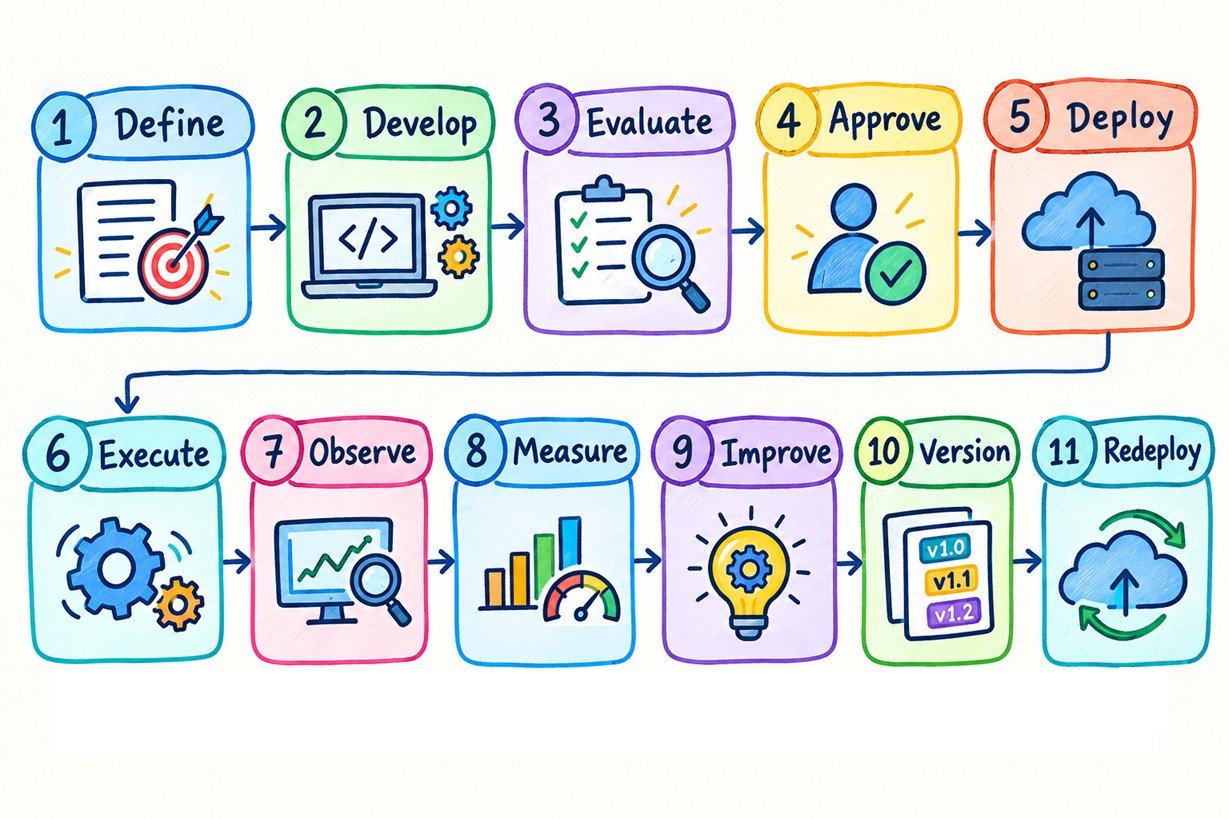
Every agent becomes a managed production artifact.
Its definition, prompts, tools, models, policies, evaluations, dependencies, versions, execution history, and operational metrics become part of its lifecycle.
Autonomous Does Not Mean Uncontrolled
The collections example also illustrates an important enterprise principle.
An agent may be capable of reasoning and taking actions autonomously.
That does not mean it should have unrestricted authority.
The collections agent may be allowed to:
- retrieve an invoice
- analyze payment history
- query the CRM
- retrieve contract terms
- draft an email
- contact a customer within approved communication policies
But it may require human approval before:
- changing contractual terms
- issuing a financial adjustment
- changing a material invoice amount
- modifying sensitive customer information
- taking an action above a defined financial threshold
The platform therefore becomes the mechanism through which the enterprise defines and enforces the boundary between what an agent can reason about, what it can recommend, and what it can actually execute.
The Platform as an Enterprise Operating Layer for Agentic AI
This leads to a useful mental model.
An Enterprise Agent Fleet Platform is not simply an agent framework.
LangGraph, CrewAI, AutoGen, or similar technologies can help developers construct agent workflows. MCP can provide a standardized mechanism for connecting agents with tools.
Those technologies are components within the broader architecture.
The Enterprise Agent Fleet Platform provides the enterprise operating environment around them.
At a high level:
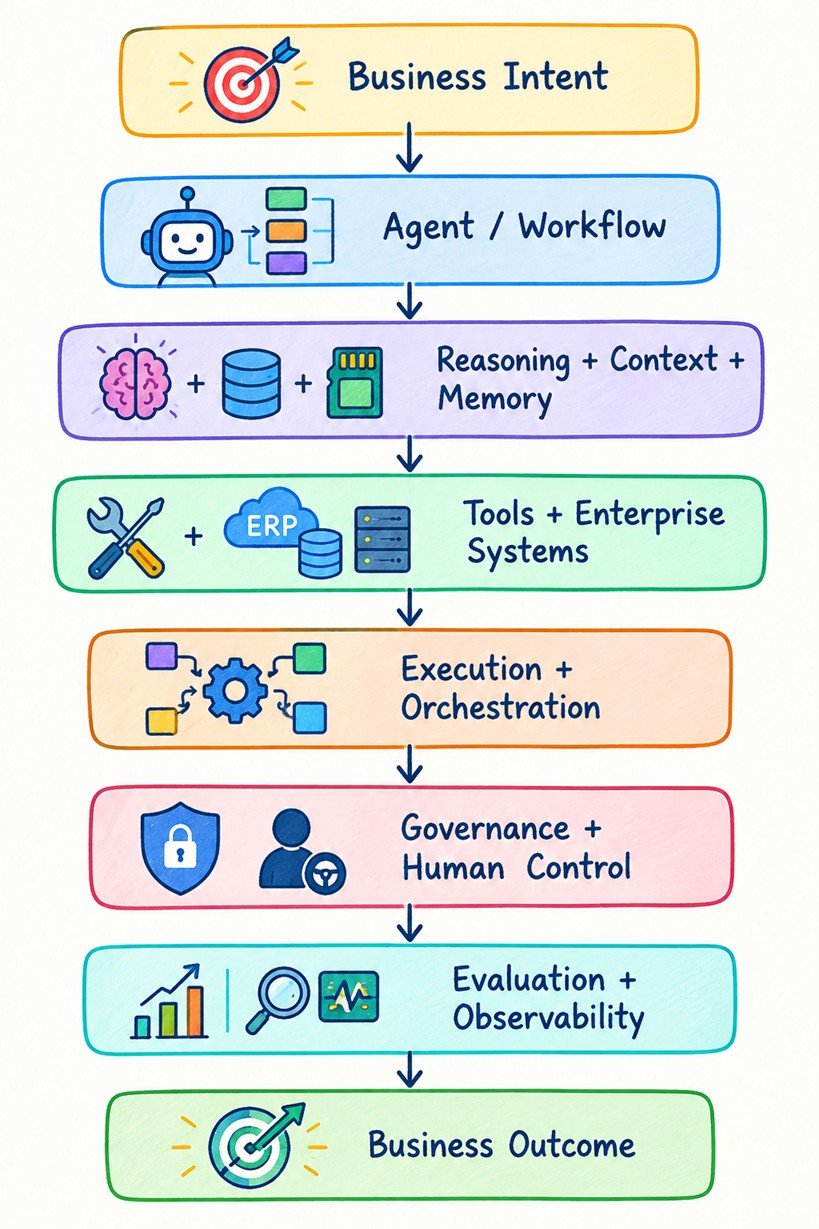
The platform connects these capabilities into one managed ecosystem.
Why "Fleet" Matters
The word fleet is deliberate.
Managing one agent is primarily an engineering problem.
Managing hundreds or thousands of agents becomes a platform engineering, governance, operations, and economics problem.
At fleet scale, the organization needs answers to questions such as:
- Which agents are running?
- Which version of each agent is deployed?
- Who owns each agent?
- Which models does each agent use?
- Which tools can each agent invoke?
- What data can each agent access?
- Which agents are currently executing?
- How many workflows are running concurrently?
- Which agents are failing?
- Which agents are exceeding their SLA?
- Which agents require human intervention?
- How much does each agent cost to operate?
- Are agents producing the intended business outcomes?
- Which agents should be upgraded, restricted, paused, or retired?
These are fleet-level questions.
An Enterprise Agent Fleet Platform provides the capabilities needed to answer them systematically.
The Business Outcome
The ultimate purpose of the platform is not to create more agents.
It is to allow the enterprise to industrialize agentic AI.
The business should be able to move from isolated AI experiments to a managed ecosystem in which new agents can be introduced rapidly while still operating within common standards for security, governance, reliability, quality, and economics.
In that sense, the Enterprise Agent Fleet Platform becomes a foundational enterprise capability.
It provides the common operating environment through which AI agents can move from:
Prototype → Production → Scale → Continuous Improvement
without every business team having to reinvent the underlying architecture.
That is the fundamental problem the platform is solving.
It is not merely a place where agents run.
It is the enterprise operating platform for building, deploying, orchestrating, governing, evaluating, and operating agentic AI at scale.
Section 2: From Business Capability to Platform Architecture
TO-DO
Section 3: Enterprise Agent Fleet Platform: The Six Architectural Planes
TO-DO
Section 4: Enterprise Agent Fleet Platform: Experience Plane
TO-DO
Section 5: Enterprise Agent Fleet Platform: Control Plane
TO-DO
Section 6: Enterprise Agent Fleet Platform: Execution Plane
TO-DO
Section 7: Enterprise Agent Fleet Platform: Context and Knowledge Plane
TO-DO
Section 8: Enterprise Agent Fleet Platform: Tool and Integration Plane
TO-DO
Section 9: Enterprise Agent Fleet Platform: Trust, Quality and Governance Plane
TO-DO
Section 10: Enterprise Agent Fleet Platform: Operations and Platform Plane
TO-DO
Section 11: Plane, Subsytem, Repository, and Technology
TO-DO
Section 12: GitHub Repository Architecture
TO-DO
Section 13: Inside a Platform Repository
TO-DO
Section 14: Enterprise Agent Fleet Platform on AWS
TO-DO
Section 15: Development Architecture
TO-DO
Section 16: CI/CD and Agent Delivery Pipeline
TO-DO
Section 17: End-to-End Agent Lifecycle
TO-DO
Section 18: End-to-End Workflow Through the Platform
TO-DO
Section 19: Designing for Thousands of Concurrent Agent Workflows
TO-DO
Section 20: Security, Governance and Enterprise Controls
TO-DO
Section 21: Evaluation and Quality Engineering for the Agent Fleet
TO-DO
Section 22: Observability and Fleet Operations
TO-DO
Section 23: Economics of an Enterprise Agent Fleet
TO-DO
Section 24: MVP Architecture
TO-DO
Section 25: Scaling the Platform
TO-DO
Section 26: Architectural Principles and Design Decisions
TO-DO
Section 27: The Complete Enterprise Agent Fleet Platform Reference Architecture
TO-DO
Section 28: Closing Perspective
TO-DO
✍️ About the Author
Sanjoy Kumar Malik — Principal AI Architect, Enterprise AI Strategist, and Senior Engineering & Technology Leader with 20+ years of corporate IT experience and a broader 27+ year professional journey, spanning Enterprise Architecture, software architecture, cloud-native systems, engineering leadership, and AI architecture. He is a TOGAF 10 Certified Enterprise Architecture Practitioner and AWS Certified Solutions Architect – Professional.
Sanjoy focuses on translating business strategy and AI opportunity into coherent enterprise architecture and scalable engineering execution. He works at the intersection of business, technology, architecture, and AI, helping organizations establish the architectural foundations, technology capabilities, and engineering systems required to turn AI initiatives into production-grade, scalable, governed, and economically sustainable enterprise capabilities.
He is the creator of The 28-Category AI Architecture Decision Framework (28-CAADF), a systematic approach to making AI architecture decisions in an era where intelligence itself is becoming an architectural capability.