Thinking in Enterprise LLM Application Architecture

Publication Date: September 26, 2026 Last Updated: September 27, 2026
Introduction
If your objective is to develop a mental operating system for Enterprise LLM Application Architecture, I would not organize it around frameworks such as LangChain, LlamaIndex, Semantic Kernel, Bedrock, OpenAI, vector databases, or agent frameworks. Those are implementation choices.
Instead, your inner problem solving machine should allow you to start with an ambiguous business problem and systematically arrive at a production-grade, scalable, reliable, secure, observable, and economically viable LLM application, regardless of the technology stack.
I would structure it as the following.
Business Intent → Intelligence Contract → Application Pattern → Context → Reasoning → Action → State → Runtime → Trust → Evaluation → Reliability → Scale → Economics → Operations
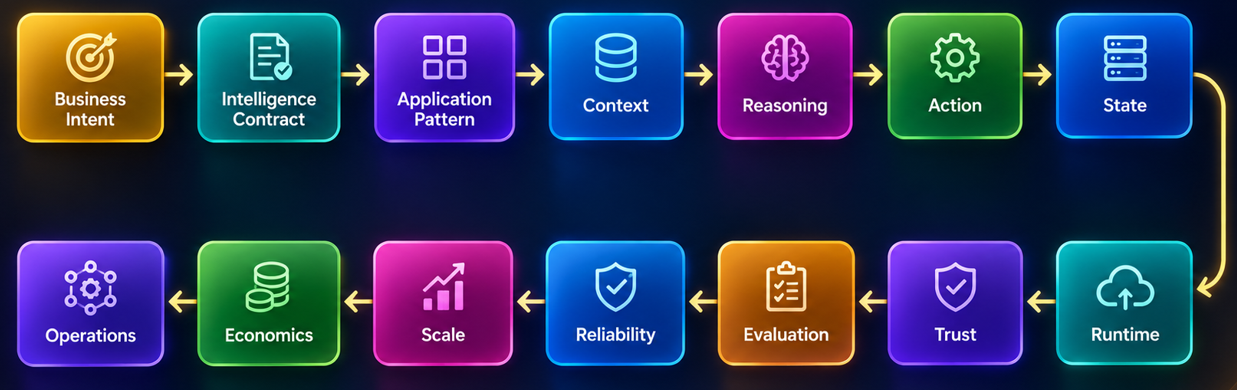
Note: Here I view Trust as the foundational architecture (e.g., security protocols, data privacy filters, alignment guardrails, and compliance standards). Therefore, it comes before Evaluation. You wouldn't evaluate a system that hasn't passed security clearance. However, if you view Trust as the end result (e.g., user confidence and system verification), then it belongs after Evaluation.
This is the core mental model. The core mental model tells the architect how to think.
Section Mapping to the Core Mental Model
The cleanest way to map the sections is to treat the 14-stage core mental model as the architectural spine, while recognizing that several sections are cross-cutting rather than belonging exclusively to one stage.
| Core Mental Model Stage | Primary Section(s) | Secondary / Supporting Section(s) | Architectural Focus |
|---|---|---|---|
| 1. Business Intent | Start With the Business Problem, Not the LLM | Define the Intelligence Contract | Establish the business problem, desired outcome, user, intent, value, and success criteria before selecting AI technology. |
| 2. Intelligence Contract | Define the Intelligence Contract | Start With the Business Problem, Not the LLM Model the Application as an Intelligence Pipeline | Define the intelligence capabilities, reasoning depth, determinism requirements, behavioral expectations, and output requirements the application must satisfy. |
| 3. Application Pattern | Choose the LLM Application Pattern | Model the Application as an Intelligence Pipeline | Select the appropriate application pattern, such as direct generation, RAG, tool-augmented LLM, workflow, agent, or multi-agent architecture, based on the Intelligence Contract. |
| 4. Context | Context Engineering | Model the Application as an Intelligence Pipeline | Determine what information the application needs, where that information comes from, how it is acquired, and how it is assembled into model-ready context. |
| 5. Reasoning | Reasoning Architecture | Define the Intelligence Contract Model the Application as an Intelligence Pipeline Prompt Architecture | Define how the application interprets information, reasons, decomposes problems, plans, evaluates intermediate results, and reaches decisions. |
| 6. Action | Tool and Action Architecture Agent Architecture | Structured Output Human-in-the-Loop Architecture | Define what the application can do, which tools it can invoke, how actions are controlled, and when humans must approve or execute actions. |
| 7. State | State and Memory Architecture | Agent Architecture Human-in-the-Loop Architecture | Define conversation state, working memory, application state, workflow state, agent state, and persistent memory. |
| 8. Runtime | Model Architecture LLM Gateway Deployment Architecture | CI/CD for LLM Applications Version Everything | Define how models, orchestration, application services, infrastructure, and AI components execute in production. |
| 9. Trust | Guardrails Security Architecture | Multi-Tenancy Production Governance Human-in-the-Loop Architecture | Establish security, authorization, safety, policy enforcement, tenant isolation, governance, and human-control boundaries. |
| 10. Evaluation | Evaluation Architecture Evaluation Pyramid | Structured Output The Production Readiness Test | Establish how retrieval, generation, reasoning, agent behavior, safety, task completion, and business outcomes are evaluated. |
| 11. Reliability | Reliability Engineering Reliability Has Two Dimensions Disaster Recovery The Failure-First Mental Model | The Production Readiness Test | Design for model, retrieval, tool, application, infrastructure, and provider failures while addressing both technical and cognitive reliability. |
| 12. Scale | Scalability Architecture Latency Architecture | Caching Architecture Multi-Tenancy | Address concurrency, throughput, latency, bottlenecks, capacity, caching, and scaling behavior under enterprise workloads. |
| 13. Economics | Cost Architecture | Model Architecture LLM Gateway Latency Architecture Caching Architecture | Optimize model, token, retrieval, infrastructure, and operational costs while establishing sustainable unit economics. |
| 14. Operations | Observability CI/CD for LLM Applications Version Everything | Production Governance Disaster Recovery The Production Readiness Test | Operate, monitor, evolve, govern, troubleshoot, release, and recover the LLM application throughout its production lifecycle. |
The 14-stage model provides the thinking sequence, while the sections define the architectural focus for analyzing and designing each stage.
Start With the Business Problem, Not the LLM
One of the most consequential mistakes in enterprise LLM application architecture is asking the technology question before establishing the business question:
We need an LLM. What architecture should we use?
The framing is understandable, but it reverses the order in which an enterprise architecture should be developed. An LLM is a means, not an objective. Architecture exists to enable a business outcome under defined operational, economic, security, and risk constraints.
The more useful question is:
What business outcome are we trying to produce, and where in that outcome can intelligence create meaningful leverage?
This question establishes the architectural starting point.
It forces the organization to determine whether an LLM is actually required, where intelligence belongs in the workflow, what role the system should play, and what boundaries must surround it. It also prevents a common failure mode in enterprise AI: designing an impressive technical capability and then searching for a business problem that can justify it.
Every major architectural decision follows from this initial understanding. Model selection, retrieval strategy, context construction, orchestration, tool use, human oversight, evaluation, latency targets, security controls, and cost ceilings are not independent choices. They are consequences of the business problem, the workflow in which it occurs, and the role intelligence is expected to play.
If the problem is framed incorrectly at the beginning, downstream engineering can optimize the wrong system with remarkable efficiency. The result may be technically sophisticated, operationally reliable, and architecturally elegant, yet still fail to create meaningful business value.
Enterprise LLM architecture therefore begins before the LLM enters the conversation.
Define the Business Objective
Before making a single architectural decision, establish the business objective with enough precision that it can survive technical scrutiny, operational scrutiny, and executive scrutiny.
At minimum, establish:
- Business problem: What problem actually exists? State it in the language of the business process, not in terms of an AI capability.
- Affected stakeholders: Who experiences the problem directly, and who absorbs its downstream consequences?
- Current economic impact: What does the problem cost today in time, revenue, operational effort, risk exposure, compliance exposure, or customer trust?
- Decision or workflow: Which decision, task, or workflow is constrained by the problem?
- Current-state behavior: What happens today when the problem occurs, before AI is introduced?
- Desired outcome: What specifically should improve, change, accelerate, or become possible?
- Success measures: How will the organization determine whether the intervention actually produced the intended business result?
This distinction between a business objective and a technology objective is fundamental.
"Improve the quality of LLM responses" is not a business objective. It is a technology concern.
"Reduce average claim-resolution time from four days to same-day resolution for claims below a defined complexity threshold" is a business objective. It establishes an outcome, a baseline, a target state, and a measurable boundary.
That precision becomes increasingly valuable as architecture decisions become more consequential. If response quality improves but resolution time does not, the system may be performing well according to an AI metric while failing according to the business metric that justified the investment.
The architecture must therefore be traceable to the outcome.
A useful chain of reasoning is:
Business problem → Business outcome → Workflow change → Intelligence requirement → Architectural requirement
This sequence creates architectural traceability. It allows a team to explain not only what it built, but why each major architectural decision exists and which business requirement it serves.
It also provides a disciplined basis for rejecting unnecessary complexity. If a proposed model, retrieval mechanism, agentic workflow, or orchestration layer cannot be connected to a meaningful requirement, its architectural necessity should be questioned.
The objective is not to maximize the amount of intelligence in the system.
The objective is to place the right intelligence at the right point in the business process to produce a measurable outcome.
Understand the User Before the Use Case
An enterprise LLM application is not built for "users" in the abstract. It is built for a person or group performing a particular role, within a particular business process, under particular operational constraints.
The same capability can require radically different architecture depending on who consumes the output and what that person or system is authorized to do with it.
Before designing the application, establish the user's operating context:
- User: Who specifically interacts with the system?
- User role: What function does the user perform within the business process?
- User intent: What is the user trying to accomplish at the moment of interaction?
- User context: What information, prior actions, constraints, and time pressures surround the interaction?
- User authority: What decisions or actions is the user authorized to make, and which require escalation or additional approval?
- User expectations: What does a useful outcome look like from the user's perspective?
- User error tolerance: What is the operational, financial, legal, regulatory, or reputational consequence of an incorrect response or action?
The final dimension is particularly important.
An LLM response does not carry the same risk simply because the words look similar. Risk is determined in part by what happens after the response is produced.
Consider a customer service representative who asks:
"Why was this customer's claim rejected?"
The system is providing information to a human decision-maker. The representative can review the explanation, consider supporting evidence, challenge the result, and apply business judgment before taking action.
Now consider a system instructed to:
"Automatically approve this claim."
The architectural problem has changed fundamentally.
The second system is not merely generating information. It is participating in a business decision and potentially executing an action with financial consequences. The system may now require stronger authorization controls, deterministic policy enforcement, explicit approval boundaries, comprehensive auditability, stronger evaluation, and a different approach to failure handling.
The distinction can be expressed simply:
Inform → Recommend → Decide → Act
These are not merely different user experiences. They represent progressively different levels of system responsibility.
An application that informs a user can tolerate a degree of imperfection that would be unacceptable in an application authorized to act on the business's behalf. As system responsibility increases along this progression, the architecture must strengthen its controls around authority, evidence, validation, observability, escalation, and human oversight in lockstep.
This is why the user's role cannot be treated as an interface concern to be addressed after the model has already been selected. By the time architecture decisions reach the interface layer, the questions that actually determine system design have already been answered, correctly or not.
The user defines the operational context in which intelligence will be consumed. Their authority establishes what the system may safely recommend or execute. Their tolerance for error shapes evaluation thresholds and control requirements. Their workflow determines whether the system should answer, recommend, request clarification, seek approval, or act outright.
User understanding must therefore precede model selection, retrieval design, orchestration, and prompt engineering. Skipping this step does not remove the decision; it only defers it to a point in the process where it is far more expensive to revisit.
These distinctions, informational versus autonomous, high tolerance versus low tolerance, are not yet the Intelligence Contract itself. They are the raw material the Intelligence Contract will formalize into explicit decision rights, addressed next.
Define the Role of Intelligence in the Workflow
Once the business objective and user context are established, the next question is not yet which LLM should we use?
The question is:
What role should intelligence play in the workflow?
This distinction prevents an enterprise from treating the LLM as the application itself.
In one workflow, intelligence may be responsible for interpreting unstructured information. In another, it may synthesize enterprise knowledge. In another, it may recommend an action to a human operator. In a more autonomous workflow, it may plan a sequence of actions and invoke enterprise systems through controlled tools.
These are materially different architectural responsibilities.
For each candidate use of intelligence, establish:
- Input: What information does the system receive?
- Interpretation: What does the system need to understand or infer?
- Knowledge: What information must it retrieve or ground against?
- Reasoning: What form of analysis or decision support is required?
- Action: Does the system merely generate an answer, or does it initiate an external action?
- Authority: Who or what is ultimately authorized to make the decision?
- Verification: What must be validated before the result is accepted?
- Escalation: Under what conditions must control return to a human or another deterministic system?
This analysis begins to reveal the actual architecture.
A simple information-assistance workflow may require an LLM, enterprise knowledge retrieval, access controls, and response evaluation.
A recommendation workflow may additionally require evidence presentation, confidence handling, policy validation, and human approval.
An autonomous action workflow may require tool authorization, transaction controls, policy enforcement, state management, idempotency, audit trails, action verification, and explicit failure and rollback behavior.
The model may be similar in all three cases. The architecture is not.
Establish the Business and Architectural Boundaries
Enterprise LLM applications operate within systems that already have sources of truth, business rules, authorization models, transaction boundaries, and accountable owners.
The LLM should therefore not be allowed to implicitly redefine those boundaries.
Before proceeding into detailed architecture, establish:
- System of record: Which enterprise systems own authoritative data?
- Decision authority: Which human or system owns the final business decision?
- Policy authority: Which rules are deterministic and must not be delegated to probabilistic generation?
- Action boundary: Which actions may the LLM recommend, and which may it execute?
- Data boundary: What information may enter the model context?
- Security boundary: Which identities, permissions, and access controls govern the interaction?
- Evidence boundary: What evidence must support a response or recommendation?
- Human boundary: Where must a human remain in the loop?
- Operational boundary: What latency, availability, throughput, and cost constraints must the application satisfy?
These boundaries are architectural constraints, not implementation details.
They determine whether the system should be primarily generative, retrieval-grounded, workflow-driven, agentic, or some combination of these patterns. They also determine where deterministic controls must surround probabilistic components.
The central principle is straightforward:
Use intelligence where ambiguity, interpretation, synthesis, or reasoning creates value. Use deterministic systems where certainty, authority, and control are required.
A mature enterprise LLM architecture does not attempt to make every part of the workflow intelligent. It deliberately separates probabilistic intelligence from deterministic control and assigns each responsibility to the architectural mechanism best suited to it.
Trace Every Architectural Decision Back to the Outcome
Once the business problem, user, workflow, intelligence role, and boundaries are established, architectural decisions become easier to reason about.
The question changes from:
"Which LLM architecture should we build?"
to:
"What architecture is required to produce this outcome, for this user, within these constraints?"
That shift is fundamental.
It provides a basis for deciding whether retrieval is necessary, whether an agent is justified, whether a human approval step is required, whether multiple models provide meaningful value, whether a particular latency target is acceptable, and how much the organization should spend per transaction.
It also establishes a decision chain that can be revisited as the system evolves:
Business Outcome → User and Workflow → Intelligence Role → Constraints → Architecture Decisions → Measurable Result
This chain should remain visible throughout the architecture lifecycle.
Models will change. Retrieval technologies will change. orchestration frameworks will change. Context strategies will evolve. New foundation models will emerge. What should remain stable is the business outcome the system exists to produce and the architectural reasoning that connects the outcome to the implementation.
That is the foundation of enterprise LLM application architecture.
Start with the problem. Understand the user. Define the role of intelligence. Establish the boundaries. Then design the system.
Define the Intelligence Contract
One of the most consequential steps in enterprise LLM application architecture is also one of the most frequently skipped.
Teams often move directly from "we understand the user" to "let's choose a model" without first defining what intelligence the system is actually expected to provide. The omission may not be visible during early development. It becomes visible in production, when the system produces outputs, recommendations, or actions that nobody explicitly intended to authorize.
The Intelligence Contract closes this gap.
It is the explicit architectural statement that answers one question before model selection begins:
What intelligence must this system provide, and under what terms?
The term contract is deliberate. A contract establishes obligations, boundaries, and conditions under which actions are permitted. The Intelligence Contract performs the same function for an LLM application. It defines the capability the system requires, the depth of intelligence justified by the business problem, and the degree of determinism required for correctness.
Without this contract, these decisions do not disappear. They simply become implicit. They are made incrementally through prompts, model choices, framework defaults, and implementation decisions. The result is an architecture whose actual behavior may exceed its intended responsibility.
That is particularly dangerous in enterprise systems because capability tends to expand silently. An application introduced to summarize information may gradually begin answering questions, making recommendations, invoking tools, and eventually taking actions. Each expansion may appear reasonable in isolation, yet the aggregate system can end up operating beyond the boundaries originally intended.
The Intelligence Contract establishes those boundaries before implementation begins.
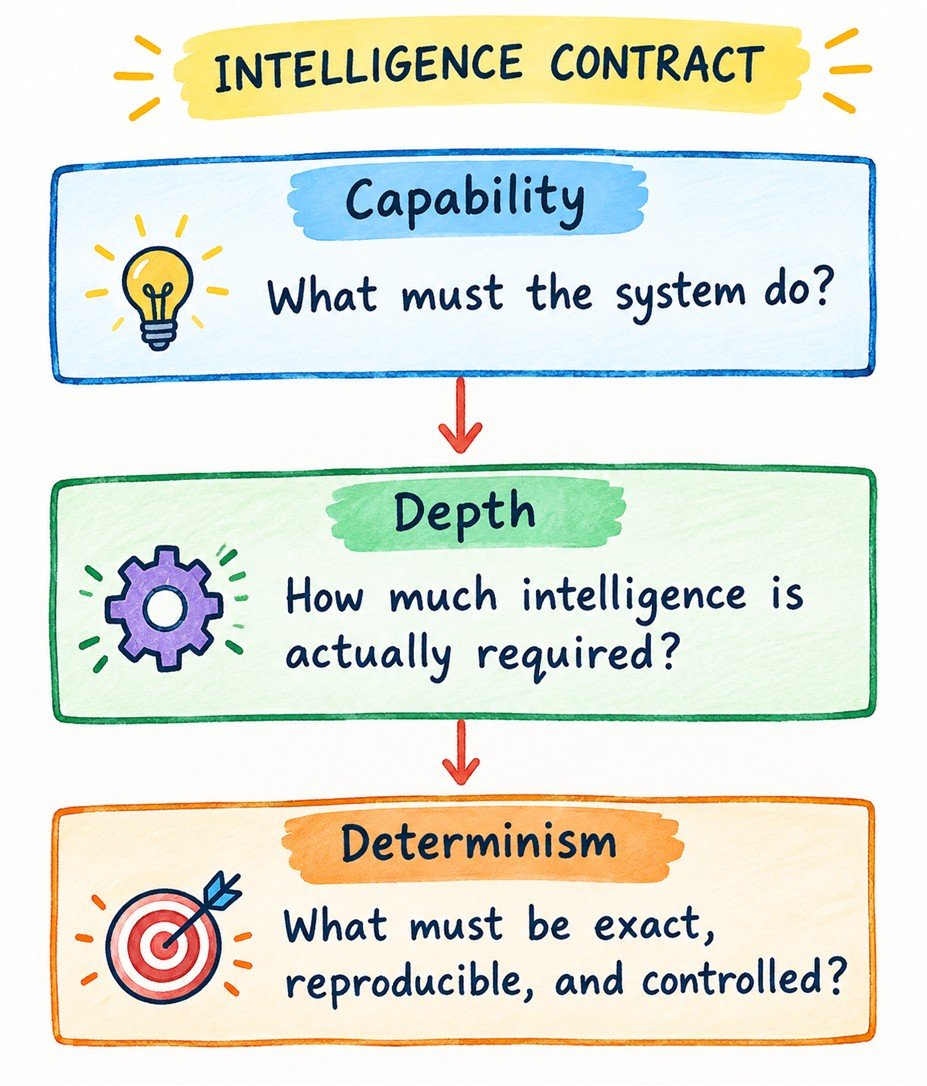
It consists of three fundamental dimensions:
- Intelligence Capability: What kind of intelligence does the system need to provide?
- Intelligence Depth: How much reasoning and autonomy does the problem actually require?
- Determinism Requirement: Which parts of the outcome must be predictable, reproducible, and conventionally verifiable?
Together, these dimensions define the intelligence envelope within which the application should operate.
Intelligence Capability
The first term of the contract is capability.
Before selecting a model or designing an orchestration layer, identify the specific form of intelligence the business process requires. The objective is not to identify everything an LLM can do. The objective is to establish what the application must do.
Common intelligence capabilities include:
- Classification: Assigning an input to one or more predefined categories.
- Extraction: Identifying and structuring information from unstructured content.
- Summarization: Condensing information while preserving the meaning relevant to the task.
- Transformation: Converting content from one representation, structure, or format into another.
- Information synthesis: Combining information from multiple sources into a coherent representation.
- Question answering: Producing an answer to a specific question using the information available to the system.
- Recommendation: Proposing an option or course of action without executing it.
- Prediction: Estimating an unknown or future value based on available evidence.
- Reasoning: Working through a problem that requires analysis, inference, comparison, or judgment rather than straightforward retrieval.
- Planning: Determining a sequence of steps required to achieve a defined objective.
- Tool use: Invoking external systems or services to obtain information or perform controlled operations.
- Workflow execution: Coordinating and completing multiple steps within a defined business process.
- Autonomous action: Taking action on behalf of the business without requiring a human checkpoint for each individual action.
These capabilities should not be treated as a progression that every application should climb.
They define a boundary.
A system designed for extraction should not silently become a reasoning system simply because the model happens to be capable of reasoning. A system designed to provide recommendations should not acquire authority to execute those recommendations without an explicit architectural decision.
Many production problems begin with precisely this kind of capability drift.
A document-processing application may begin by extracting fields from contracts. Later, someone asks it to interpret ambiguous clauses. Then it is asked to recommend an outcome. Eventually, it is connected to a workflow that acts on that recommendation. At each stage, the change may appear incremental. Architecturally, however, the system has crossed several capability boundaries.
The Intelligence Contract makes those boundaries explicit.
For every capability, the architect should be able to answer:
- Why is this capability required?
- What business outcome does it support?
- What inputs does it depend on?
- What output does it produce?
- Who consumes that output?
- What authority, if any, does the output carry?
- What happens when the system cannot perform the capability reliably?
The final question is particularly important.
An intelligence capability is not completely defined until its failure behavior is defined. A system that cannot extract a required value should not necessarily infer one. A system that cannot answer from sufficient evidence should not necessarily generate a plausible response. A system that cannot determine whether an action is safe should have an explicit escalation path.
Capability therefore includes both what the system is allowed to do and what it must do when it cannot do it reliably.
Intelligence Depth
Capability answers what the system does.
Depth answers how much intelligence is required to do it.
These dimensions are related, but they are not interchangeable. A capability such as question answering can range from simple retrieval and synthesis to complex multi-step reasoning involving tools, planning, and external actions.
An approximate intelligence-depth hierarchy is:
Pattern Recognition
       ↓
Information Extraction
       ↓
Information Synthesis
       ↓
Reasoning
       ↓
Planning
       ↓
Tool-Augmented Reasoning
       ↓
Agentic Execution
Moving downward through this hierarchy generally increases the system's capability. It also increases the architectural burden.
Greater intelligence depth can introduce:
- Higher inference cost
- Greater latency
- More complex orchestration
- Larger failure surfaces
- More difficult evaluation
- More complicated state management
- Greater observability requirements
- More extensive security controls
- More difficult debugging and incident analysis
- Greater uncertainty around end-to-end behavior
The architectural mistake is to treat greater intelligence depth as inherently better architecture.
It is not.
A system operating at the level of pattern recognition may be comparatively narrow and predictable. A system operating through agentic execution has a much larger behavioral surface. It may interpret a goal, construct a plan, select tools, invoke external systems, observe results, revise its plan, and continue until it determines that the task is complete.
That capability may be justified in some workflows. It should never be introduced merely because the technology makes it possible.
The governing principle is:
Use the minimum intelligence depth necessary to produce the required business outcome reliably.
This principle is stronger than use the simplest architecture possible. The objective is not simplicity for its own sake. The objective is to avoid introducing reasoning, planning, autonomy, and orchestration where they provide no corresponding business value.
Consider an application that needs to identify whether an incoming document belongs to one of five predefined categories. Introducing an autonomous agent to perform that task adds complexity without establishing a corresponding requirement.
Likewise, an application that must coordinate several enterprise systems, reason over intermediate results, and adapt its next action based on those results may genuinely require planning and tool-augmented reasoning. In that case, deeper intelligence is not architectural excess. It is part of the problem definition.
The question is therefore not:
"How intelligent can we make the application?"
It is:
"What is the minimum intelligence depth required to solve the problem within the required reliability, latency, cost, and control boundaries?"
That question creates a useful discipline for architecture reviews. Every increase in intelligence depth should have a corresponding business or technical justification.
Agentic behavior should be earned by the problem, not assumed by the architecture.
Determinism Requirement
The third term of the contract is determinism.
This dimension is frequently overlooked when LLM application design is approached primarily as a prompting problem. An LLM is probabilistic by nature. Enterprise systems, however, often contain operations for which variability is unacceptable.
The key question is simple:
Does the same input need to produce the same result every time?
If the answer is yes, the architecture should determine whether that responsibility can be moved outside the LLM and implemented using deterministic computation, rules, databases, or conventional software.
This does not diminish the role of the LLM. It defines the role more precisely.
LLMs are well suited to interpreting language, resolving ambiguity, synthesizing information, and producing natural-language responses. They are not a substitute for deterministic computation when the business requires exact, reproducible results.
Consider a financial application that receives the instruction:
"Calculate the customer's final settlement amount."
The model may understand the instruction, identify the relevant information, and explain the result. But the calculation itself should generally be performed by a deterministic service governed by explicit business rules.
The architectural flow becomes:
LLM
  ↓
Interpret intent
  ↓
Deterministic service
  ↓
Apply business rules and calculate
  ↓
LLM
  ↓
Explain result
rather than:
LLM
  ↓
Interpret intent
  ↓
Calculate everything
The distinction is architectural.
In the first design, each responsibility is assigned to the mechanism best suited to perform it. The LLM handles language and interpretation. The deterministic service handles calculation. The LLM may then translate the verified result into an explanation appropriate for the user.
This separation also creates a clearer control boundary. The calculation can be tested independently, reproduced from the same inputs, audited against explicit rules, and changed without changing the model's behavior.
The principle generalizes beyond arithmetic.
If correctness can be expressed and verified through conventional software, conventional software should generally own that responsibility.
Examples include:
- Arithmetic and financial calculations
- Database lookups for authoritative values
- Threshold and eligibility checks
- Policy enforcement
- Identity and authorization decisions
- Schema validation
- Transaction processing
- Referential integrity
- Deterministic routing
- State transitions governed by explicit business rules
The LLM can interpret the request, determine which deterministic capability is needed, and explain the resulting outcome. It should not become the hidden implementation of rules that the enterprise already knows how to express explicitly.
This separation is especially important in regulated, financial, operational, and safety-sensitive workflows. When an outcome must be reproduced or defended later, the organization should not have to reconstruct why a probabilistic model produced a particular value when a deterministic mechanism could have produced that value directly.
The architectural rule is therefore straightforward:
Use probabilistic intelligence for ambiguity, interpretation, synthesis, and reasoning. Use deterministic mechanisms for rules, calculations, authoritative state, and outcomes that must be reproducible.
The boundary will not always be absolute. Some business decisions contain both deterministic and judgment-intensive components. In such cases, the architecture should separate those components rather than forcing the entire decision into either the LLM or conventional software.
The Intelligence Envelope
The three dimensions of the Intelligence Contract should be considered together.
Capability establishes what the system is expected to do.
Depth establishes how much intelligence is justified.
Determinism establishes where probabilistic behavior must give way to controlled, reproducible computation.
Together, they define the application's intelligence envelope.
In the first design, each responsibility is assigned to the mechanism best suited to perform it. The LLM handles language and interpretation. The deterministic service handles calculation. The LLM may then translate the verified result into an explanation appropriate for the user.
This separation also creates a clearer control boundary. The calculation can be tested independently, reproduced from the same inputs, audited against explicit rules, and changed without changing the model's behavior.
The principle generalizes beyond arithmetic.
If correctness can be expressed and verified through conventional software, conventional software should generally own that responsibility.
Examples include:
- Arithmetic and financial calculations
- Database lookups for authoritative values
- Threshold and eligibility checks
- Policy enforcement
- Identity and authorization decisions
- Schema validation
- Transaction processing
- Referential integrity
- Deterministic routing
- State transitions governed by explicit business rules
The LLM can interpret the request, determine which deterministic capability is needed, and explain the resulting outcome. It should not become the hidden implementation of rules that the enterprise already knows how to express explicitly.
This separation is especially important in regulated, financial, operational, and safety-sensitive workflows. When an outcome must be reproduced or defended later, the organization should not have to reconstruct why a probabilistic model produced a particular value when a deterministic mechanism could have produced that value directly.
The architectural rule is therefore straightforward:
Use probabilistic intelligence for ambiguity, interpretation, synthesis, and reasoning. Use deterministic mechanisms for rules, calculations, authoritative state, and outcomes that must be reproducible.
The boundary will not always be absolute. Some business decisions contain both deterministic and judgment-intensive components. In such cases, the architecture should separate those components rather than forcing the entire decision into either the LLM or conventional software.
Choose the LLM Application Pattern
I have tried my best to maintain a stronger architectural taxonomy without turning this section into a catalog of AI patterns.
Only after the business intent has been established and the intelligence contract has been defined should you decide what kind of LLM application you are actually building.
The ordering matters.
Choosing an application pattern before understanding the problem creates two predictable forms of architectural waste. Teams build agentic systems for tasks that a single model call could have handled, introducing unnecessary orchestration, latency, cost, and failure modes. Conversely, teams sometimes build rigid prompt pipelines for problems that require retrieval, tool access, iterative reasoning, or dynamic execution.
The pattern should therefore be a consequence of the intelligence contract, not an architectural preference stated in advance.
A useful way to think about the application space is to distinguish three broad capabilities:
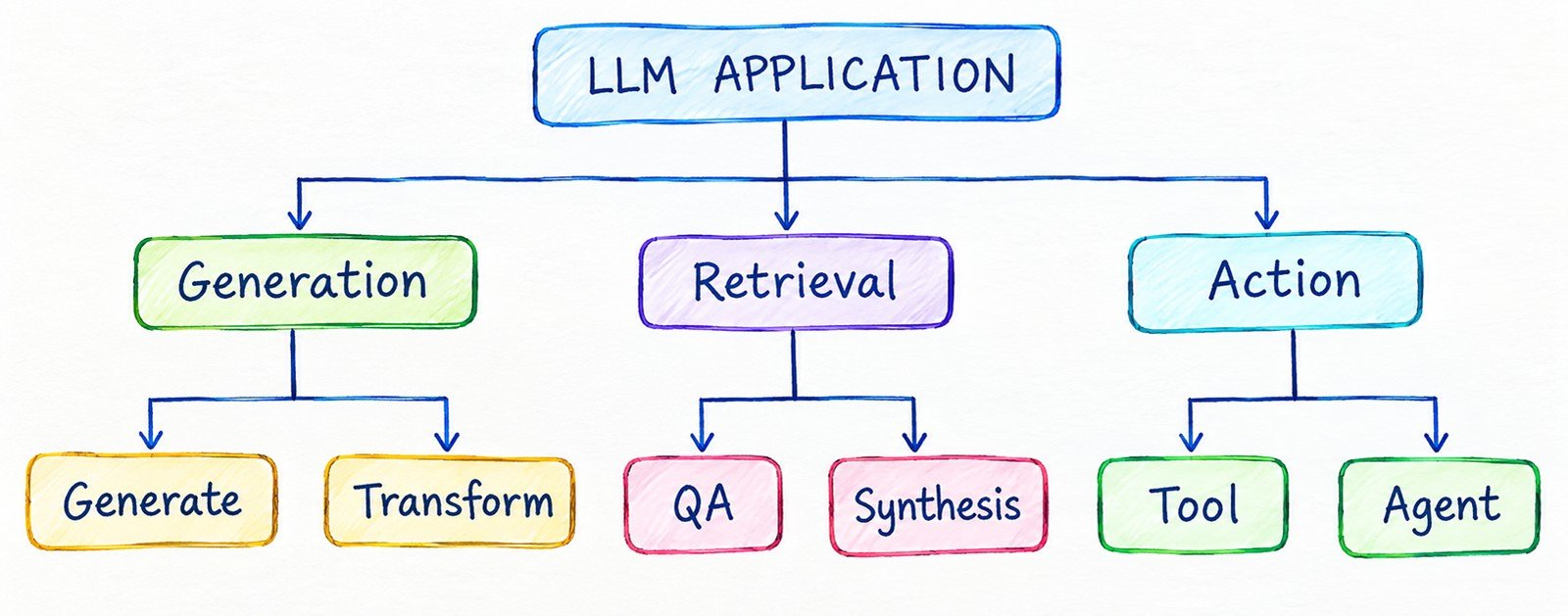
Generation produces or transforms information.
Retrieval grounds the model in information supplied by the application rather than relying solely on the model's parametric knowledge.
Action extends the model beyond language into the execution of deterministic operations, business processes, or autonomous task completion.
These capabilities can be combined. A production application may retrieve information, invoke tools, execute a workflow, and use an evaluator before returning its final response. The purpose of the taxonomy is therefore not to force every system into a single box. It is to establish a vocabulary for identifying the dominant execution pattern and, more importantly, the degree of autonomy and architectural complexity that the application actually requires.
The following patterns provide that vocabulary.
Pattern A: LLM-Only
User
  ↓
LLM
  ↓
Response
This is the simplest application pattern and, in practice, one of the most frequently overlooked.
An LLM-only application is appropriate when the model's existing capabilities are sufficient to perform the task and the application does not require external knowledge, deterministic computation, tool invocation, or multi-step execution.
Typical examples include:
- Summarization
- Rewriting
- Classification
- Translation
- Content generation
- Extraction from supplied text
- Style or format transformation
- Simple question answering based on information already present in the prompt
The architectural principle is straightforward:
If the model can solve the problem reliably from the supplied input, do not add infrastructure merely because more infrastructure is available.
This pattern should not be regarded as an immature architecture. In the right problem domain, it is the most appropriate architecture because it minimizes latency, cost, operational complexity, and failure surface.
The important question is not whether the application uses an LLM-only pattern. The question is whether the pattern satisfies the intelligence contract.
Pattern B: Prompt with Structured Context
User
  ↓
Context Construction
  ↓
LLM
  ↓
Response
The distinction between this pattern and Pattern A is subtle but architecturally important.
The application constructs a deliberate context envelope before invoking the model. That context may contain user attributes, conversation state, business rules, product information, application state, preferences, structured records, or selected portions of a document.
The model is therefore no longer operating solely on the user's request. It is operating within a system-constructed context.
This pattern is particularly useful when the required information is:
- Small enough to assemble directly
- Known at request time
- Highly structured
- User-specific
- Operational rather than corpus-scale
- Unlikely to require semantic search across a large knowledge base
For example, an enterprise assistant may receive a user's request together with their role, account information, current workflow state, permissions, and relevant business rules. No vector database is required simply because the application is context-aware.
This distinction matters because context engineering is often confused with retrieval. They are related, but they are not interchangeable.
Context construction answers: What information should the model receive for this interaction?
Retrieval answers: Which information should the system discover from a larger knowledge space?
That distinction becomes increasingly important as enterprise applications grow.
Pattern C: Retrieval-Augmented Generation
User
  ↓
Query Understanding
  ↓
Retrieval
  ↓
Context Assembly
  ↓
LLM
  ↓
Grounded Answer
RAG becomes appropriate when the information required to answer a request resides outside the model's reliable parametric knowledge and cannot reasonably be supplied as static context.
Typical examples include:
- Enterprise policies
- Product documentation
- Technical knowledge bases
- Contracts
- Case histories
- Product catalogs
- Operational records
- Frequently changing business information
- Large document collections
The architectural significance of RAG is often underestimated.
RAG is not simply:
Documents → Embeddings → Vector Database → LLM
A production retrieval system may involve document processing, metadata extraction, access-control filtering, query rewriting, lexical retrieval, vector retrieval, hybrid retrieval, reranking, context compression, citation handling, and retrieval evaluation.
The model can only reason over the context it receives. Consequently, retrieval quality becomes part of application intelligence.
A useful architectural equation is:
Answer Quality
    ≈
Retrieval Quality × Context Quality × Model Capability
The exact relationship is not mathematically linear, but the architectural implication is important. A more capable model does not compensate indefinitely for poor retrieval.
RAG should therefore be treated as a knowledge-access architecture, not as a database feature.
Pattern D: Tool-Augmented LLM
User
  ↓
LLM
  ↓
Tool Selection
  ↓
Tool
  ↓
Tool Result Validation
  ↓
LLM
  ↓
Response
The model now reaches beyond language into deterministic capabilities.
It may invoke an API, execute a calculation, query an enterprise system, retrieve a customer record, check inventory, obtain a current exchange rate, or perform another bounded operation.
This pattern is particularly important when the intelligence contract contains a determinism requirement.
The model interprets intent and decides what information or operation is required. The tool performs the operation that should not be entrusted to probabilistic generation.
For example:
LLM:
"What is the customer's outstanding balance?"

        ↓

Billing API:
"₹184,250"

        ↓

LLM:
"The current outstanding balance is ₹184,250."
The model should not be expected to calculate or invent the authoritative balance when the enterprise system already owns that fact.
This creates an important architectural boundary:
Use the model for interpretation and language; use deterministic systems for authoritative computation and state mutation.
Tool use also introduces new failure modes. Tool schemas must be explicit, authorization must be enforced outside the model, inputs must be validated, outputs must be checked, timeouts must be controlled, and consequential operations must be auditable.
The tool call is therefore not merely an extension of prompting. It is an integration boundary.
Pattern E: Workflow
Input
  ↓
Step 1
  ↓
LLM
  ↓
Step 2
  ↓
Deterministic Service
  ↓
Step 3
  ↓
Validation
  ↓
Output
A workflow defines the sequence of execution in advance.
The LLM may perform one or more intelligent stages within the process, but the overall control flow remains deterministic and application-owned.
For example:
Receive claim
    ↓
Extract claim information
    ↓
Validate required fields
    ↓
Retrieve policy
    ↓
Classify claim
    ↓
Apply business rules
    ↓
Route for approval
The model may perform extraction or classification, but it does not decide the overall process topology.
This constraint is the principal strength of the workflow pattern.
When the business process is known, repeatable, and governed by explicit rules, deterministic orchestration generally provides stronger predictability, auditability, testing, and operational control than autonomous execution.
A workflow also provides an important architectural middle ground between simple prompting and agents. Many systems described as "agentic" are, on closer inspection, better implemented as workflows with a few intelligent steps.
The distinction is worth making explicit:
A workflow follows a path designed by the system. An agent determines its path at runtime.
Pattern F: Router-Based Application
                         ┌──→ LLM-Only
                         │
User → Router ───────────┼──→ Contextual LLM
                         │
                         ├──→ RAG
                         │
                         ├──→ Tool
                         │
                         └──→ Workflow
The Router pattern deserves explicit recognition because it is increasingly common in production applications.
Rather than forcing every request through the same architecture, the application first determines what kind of processing the request requires.
For example:
"What does this paragraph mean?"
        → LLM-Only

"What does our travel policy say?"
        → RAG

"What is my current order status?"
        → Tool

"Process this expense claim."
        → Workflow
Routing can be implemented through deterministic rules, classifiers, a lightweight model, an LLM-based router, or a combination of these mechanisms.
The architectural objective is appropriate path selection.
A router can reduce unnecessary model calls, retrieval operations, tool invocation, and agentic execution. It can also provide a natural place to enforce policy boundaries before a request reaches a more capable execution path.
In larger systems, routing may become hierarchical:
Request
   ↓
Domain Router
   ↓
Capability Router
   ↓
Execution Pattern
The router therefore acts as an architectural control plane for application intelligence.
Pattern G: Evaluator-Optimizer
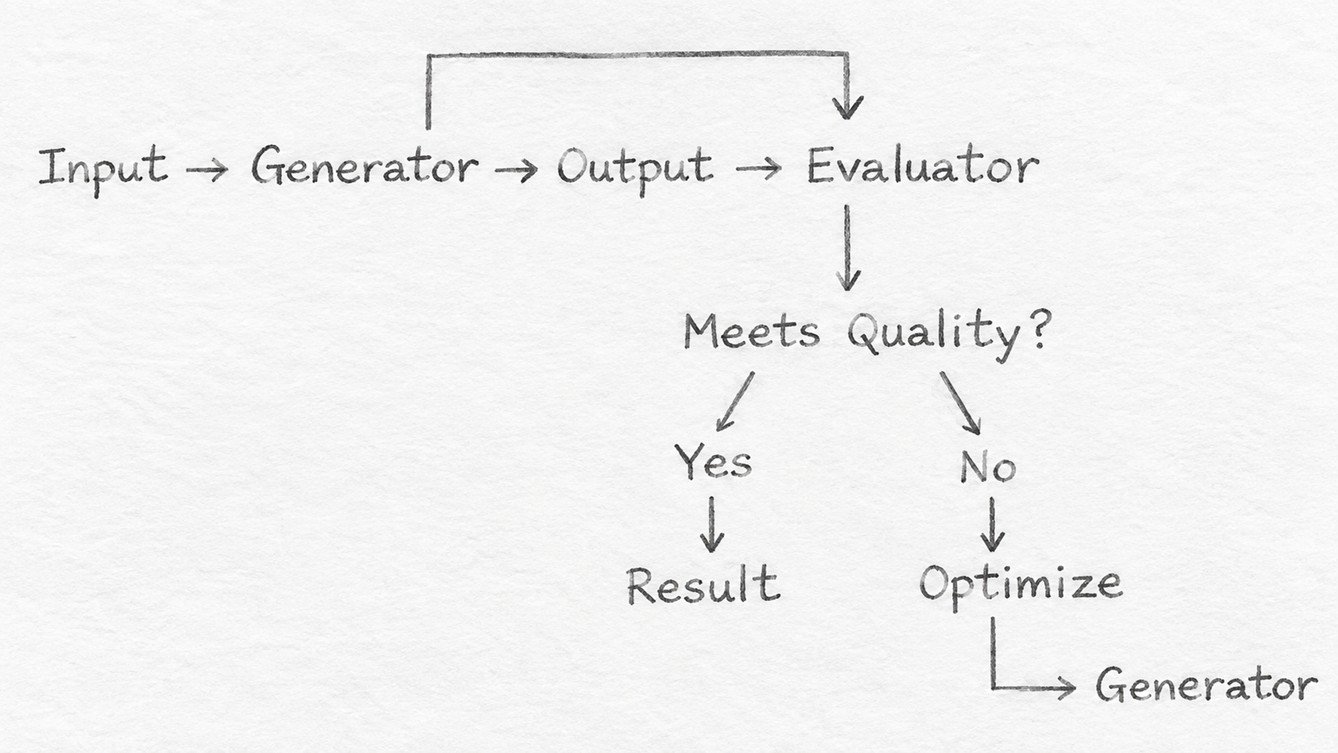
A single model call is not always sufficient to achieve the required quality bar.
The Evaluator-Optimizer pattern introduces a second evaluation step that examines the generated result against explicit criteria. If the result does not satisfy those criteria, the system can revise, regenerate, or escalate it.
The evaluator may be:
- Another LLM
- A deterministic validator
- A schema validator
- A business-rule engine
- A safety classifier
- A domain-specific scoring function
- A combination of these mechanisms
The pattern is particularly useful for outputs such as:
- Structured extraction
- Code generation
- Long-form technical content
- Complex reasoning
- Compliance-sensitive responses
- Customer-facing communications
- Outputs with explicit quality thresholds
The key architectural principle is that generation and evaluation are separate concerns.
The system should not assume that because a model produced an answer, the answer is therefore acceptable.
This pattern also introduces an important trade-off. Evaluation improves quality only when the evaluator itself is sufficiently reliable. It adds latency and cost, and it can create feedback loops if the acceptance criteria are poorly defined.
The quality threshold should therefore be specified as part of the intelligence contract rather than added after implementation.
Pattern H: Agentic Application
Goal
  ↓
Agent
 ├── Reason
 ├── Retrieve
 ├── Plan
 ├── Invoke Tool
 ├── Observe
 ├── Re-plan
 └── Act
       ↓
    Result
An agentic application changes the fundamental control model.
Instead of receiving a predefined sequence of operations, the system receives a goal and determines the next step dynamically.
The agent may:
- Interpret the goal
- Form a plan
- Select a tool
- Execute the tool
- Observe the result
- Revise the plan
- Continue until a termination condition is reached
This flexibility is valuable for problems whose execution path cannot be reliably specified in advance.
However, agentic architecture should not be equated with architectural maturity.
The freedom to choose a path introduces additional uncertainty:
- More possible execution paths
- Greater token consumption
- Variable latency
- More tool calls
- More opportunities for failure
- More complex evaluation
- More difficult debugging
- Greater authorization requirements
- Greater difficulty reproducing failures
The architecture therefore needs explicit boundaries around:
- Tool permissions
- Data access
- Maximum iterations
- Execution budgets
- Timeouts
- Termination conditions
- Human approval
- State management
- Auditability
- Error recovery
An agent should be introduced when the problem requires runtime decision-making about how to accomplish a goal, not simply because the application has multiple steps.
Pattern I: Multi-Agent System
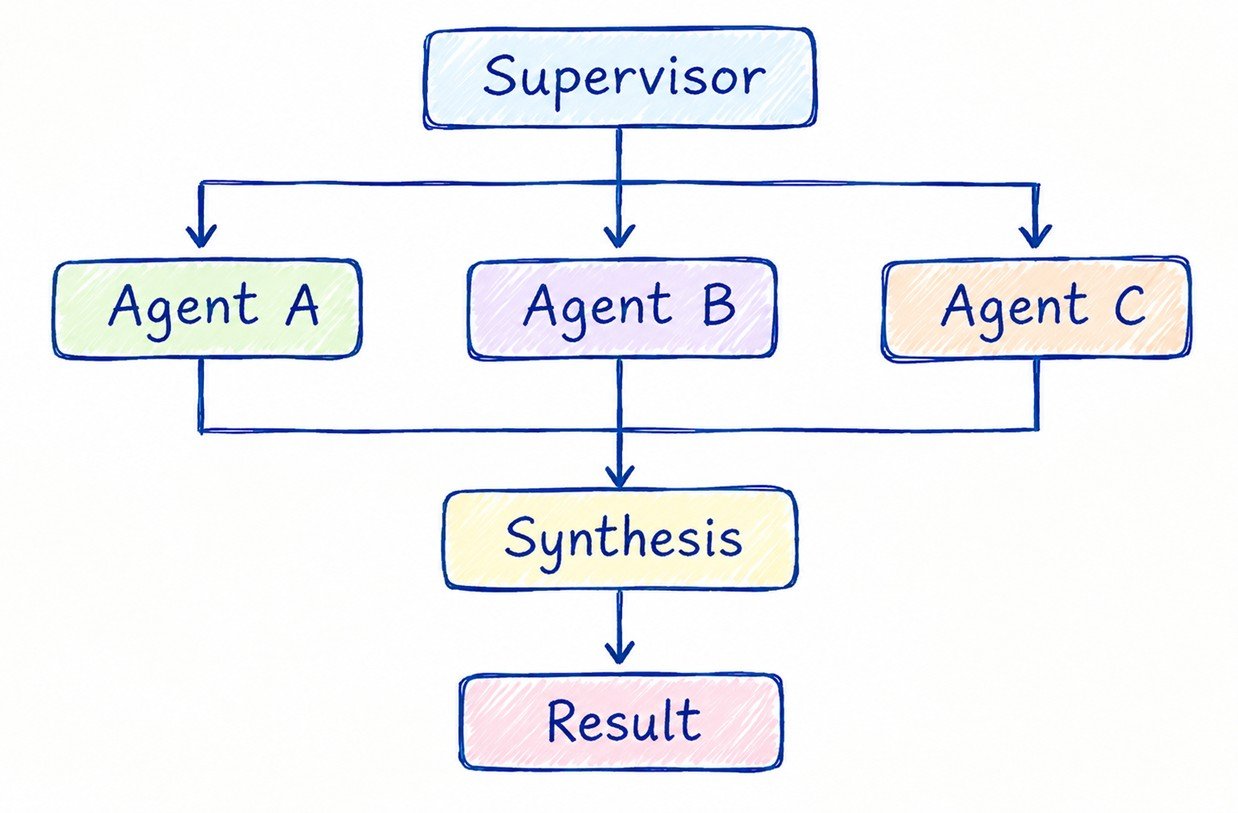
A multi-agent system decomposes a larger problem across multiple specialized agents.
One agent may research, another may analyze, another may execute a domain-specific operation, and a supervisor may coordinate the overall task.
This pattern can be useful when:
- The problem naturally decomposes into independent domains
- Different sub-problems require different tools or knowledge
- Separate execution contexts are beneficial
- Parallel execution materially improves throughput
- Organizational or security boundaries require separation
- A single agent's context or responsibility becomes too broad
However, multi-agent architecture introduces another layer of distributed-system complexity.
Communication between agents becomes an architectural concern. So do shared state, message contracts, failure propagation, duplicate work, coordination, authorization, observability, and result synthesis.
A multi-agent system should therefore not be justified merely by the number of tasks involved.
The relevant question is:
Does decomposition into independently reasoning components create a capability that a single agent or workflow cannot provide efficiently and safely?
If not, the additional agents are architecture without sufficient architectural value.
Pattern Selection Is Not a Linear Progression
These patterns should not be interpreted as maturity levels:
LLM-Only
   ↓
Context
   ↓
RAG
   ↓
Tool
   ↓
Workflow
   ↓
Agent
   ↓
Multi-Agent
That would create exactly the wrong mental model.
A multi-agent system is not inherently more mature than a workflow. An agent is not inherently better than a tool-augmented LLM. RAG is not an upgrade to prompting.
These are different execution architectures for different problem characteristics.
A useful decision model is:
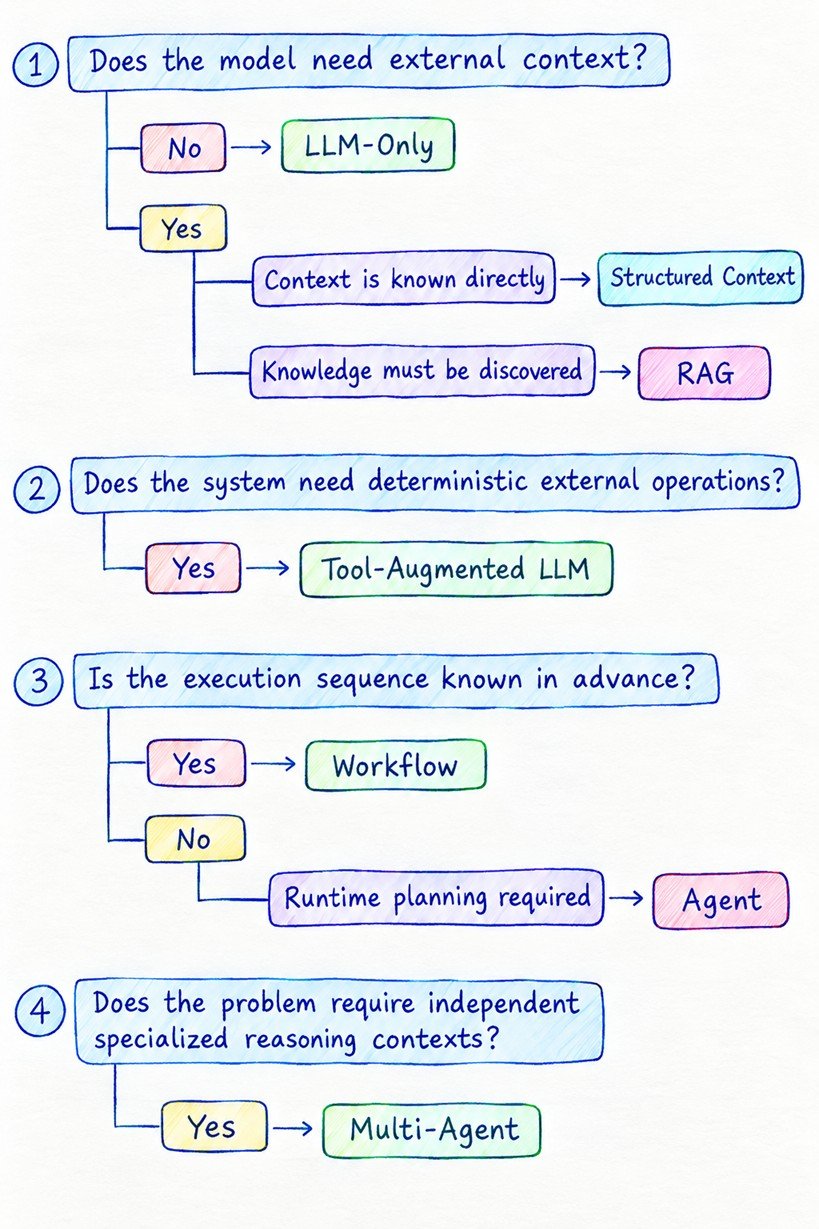
Real systems will combine these patterns.
A production architecture might therefore look like:
User
  ↓
Router
  ↓
Context Construction
  ↓
RAG
  ↓
Agent
  ├── Tool A
  ├── Tool B
  └── Workflow
        ↓
   Evaluator
        ↓
   Response
The presence of several patterns does not make the architecture inherently sophisticated. It simply reflects the number of distinct responsibilities the application must perform.
The Governing Principle
Across all of these patterns, one principle should govern the architectural decision:
Choose the least complex execution pattern that fully satisfies the intelligence contract.
This principle has several consequences.
Do not introduce RAG when the required context is already known.
Do not introduce tools when the model can reliably perform the task without external state or deterministic computation.
Do not introduce a workflow when a single model invocation is sufficient.
Do not introduce an agent when the execution path can be defined deterministically.
Do not introduce multiple agents when one agent or a workflow can satisfy the requirement.
And do not introduce an evaluator merely because evaluation sounds like a mature AI architecture. Introduce it when the required quality threshold justifies the additional cost and latency.
The objective is not minimum technology. It is minimum necessary complexity.
This distinction is fundamental to enterprise LLM architecture. Every additional architectural mechanism introduces another failure boundary, another operational responsibility, another surface for evaluation, and another component whose behavior must be understood over time.
Architectural sophistication should therefore be earned by the problem.
From Pattern to Architecture
The pattern selected here establishes the execution topology for everything that follows.
It determines whether the application needs retrieval infrastructure, tool interfaces, workflow orchestration, agent state, multi-agent coordination, evaluation loops, or some combination of these capabilities.
It also establishes where the system must preserve determinism and where probabilistic intelligence is acceptable.
The next architectural question is therefore not simply how the model will respond. It is how context, reasoning, and action will be organized within the selected execution pattern.
That is where the architecture moves from choosing a pattern to designing the system itself.
Model the Application as an Intelligence Pipeline
Once the application pattern has been identified, the next architectural task is decomposition.
An enterprise LLM application is not a single black box that receives a prompt and returns an answer. It is a sequence of distinct cognitive and operational stages. Each stage performs a different kind of work, has different failure modes, and may require a different implementation strategy.
This distinction is fundamental.
Architects who skip decomposition often produce systems that perform convincingly in a demonstration but become difficult to control in production. A demonstration hides the seams between interpretation, retrieval, reasoning, decision-making, execution, and verification. Production exposes them.
A useful and sufficiently general model treats the application as an eight-stage intelligence pipeline:
INPUT
  ↓
UNDERSTAND
  ↓
CONTEXTUALIZE
  ↓
REASON
  ↓
DECIDE
  ↓
ACT
  ↓
VERIFY
  ↓
RESPOND
The sequence is deliberately simple. Its purpose is not to prescribe a particular technology or orchestration framework. It provides an architectural lens through which the work performed by the application can be separated into explicit responsibilities.
At each stage, the architect should be able to answer three questions:
- What work is being performed?
- What type of component should perform that work?
- What evidence establishes that the work was performed correctly?
Those questions turn an LLM application from an undifferentiated model interaction into an engineered system.
Why the Pipeline View Matters
The value of the pipeline is not the diagram itself. Its value lies in the discipline it imposes on architectural decisions.
At every stage, the architect must determine whether the problem is best solved through inference, retrieval, deterministic computation, business rules, external action, validation, or some combination of these mechanisms.
That distinction is important because language models are powerful precisely where language, ambiguity, synthesis, and probabilistic reasoning are involved. They are not inherently reliable mechanisms for enforcing exact business constraints, performing deterministic calculations, maintaining transactional guarantees, or proving that an external action actually occurred.
Consider a simple enterprise workflow. A user asks an application to modify an account. The model may be entirely appropriate for interpreting the request and determining what the user means. It may also be useful for reasoning over relevant account information. But whether the requested modification is permitted, whether the target account exists, whether the caller has sufficient authority, whether the transaction was successfully committed, and whether the resulting state is valid are different architectural concerns.
Sending all of those concerns through the same model call does not simplify the system. It merely hides the boundaries.
Those hidden boundaries eventually reappear as production failures:
- a plausible interpretation of an ambiguous request becomes the wrong action;
- retrieved information is confused with authoritative system state;
- a business rule is inconsistently applied because it exists only in a prompt;
- a tool invocation is interpreted as successful without confirmation;
- an incorrect result is presented with the same confidence and formatting as a verified result.
The pipeline view makes these boundaries explicit before they become operational problems.
Assigning an Implementation Strategy to Each Stage
Once the pipeline is established, each stage should receive an implementation strategy appropriate to the nature of the work.
The choice is not binary. A stage may be deterministic, probabilistic, or hybrid. The architect should make that choice deliberately based on the domain, error tolerance, regulatory requirements, operational consequences, latency objectives, and cost of failure.
| Stage | Function in the Pipeline | Representative Implementation |
|---|---|---|
| Understand | Interpret the input and extract intent, entities, constraints, and relevant structure from unstructured or semi-structured language. | Large language model, classifier, parser, or hybrid |
| Contextualize | Obtain the information required for the task but not contained in the input or model context, including policies, customer history, product data, and enterprise knowledge. | Vector retrieval, keyword search, structured queries, knowledge graph, or hybrid retrieval |
| Reason | Combine the interpreted request with contextual evidence to develop a candidate solution or course of action. | Large language model, reasoning model, or structured reasoning workflow |
| Decide | Convert the candidate reasoning into a bounded and auditable decision among defined alternatives. | Rules engine, policy engine, deterministic logic, model-assisted decisioning, or hybrid |
| Act | Execute an approved operation against an external system or system of record. | API invocation, tool execution, workflow engine, transaction, or system-of-record write |
| Verify | Establish that the intended action was authorized, executed successfully, produced the expected state, and satisfies applicable safety or business constraints. | Deterministic validation, state inspection, transaction confirmation, policy checks, and model-assisted review where appropriate |
| Respond | Translate the verified outcome into a coherent response appropriate to the requester, channel, and interaction context. | Large language model, template engine, or hybrid response generation |
The important architectural observation is that the pipeline does not require an LLM at every stage.
In fact, a well-designed system often uses the LLM selectively.
The model is particularly valuable at the boundaries where the system must interpret human language or express an outcome in human language. It is also valuable in the reasoning stage, where evidence must be synthesized and a candidate course of action constructed.
Other stages have different requirements.
Retrieval provides access to information rather than asking the model to manufacture it. Deterministic logic enforces rules rather than asking the model to remember them. External systems provide authoritative state rather than asking the model to infer whether an action occurred. Verification establishes evidence rather than assuming that a plausible model response represents a successful execution.
This separation is not an attempt to work around the limitations of language models. It is the architectural foundation for using them effectively.
From Model Capability to System Responsibility
This pipeline also changes how an architect evaluates technology.
The question is no longer:
Which model should power the application?
The more useful question is:
Which component should be responsible for each kind of work?
That shift is subtle but consequential.
Model selection remains important, but it becomes one decision within a larger architecture rather than the architecture itself. A highly capable model may be appropriate for complex reasoning but unnecessary for straightforward classification. A smaller model may be sufficient for intent extraction. A deterministic query may be preferable when the required information already exists in a structured system. A rules engine may be mandatory when the decision must be applied consistently and audited independently of model behavior.
The architecture therefore becomes a composition of capabilities rather than a wrapper around a model.
This is also where the distinction between knowledge and intelligence becomes important.
Retrieval supplies contextual knowledge. The model applies intelligence to interpret and reason over that knowledge. Deterministic components establish constraints. External systems provide authoritative state. Verification establishes whether the intended outcome actually occurred.
Each capability has a different responsibility.
When these responsibilities are collapsed into a single prompt, the system becomes difficult to reason about because the source of an outcome is no longer clear. When they are separated, the architect can ask a much more useful question:
Why did the system produce this outcome, and which architectural component was responsible for it?
That question is essential for debugging, governance, evaluation, security, compliance, and operational accountability.
The Governing Principle
The purpose of this decomposition is to prevent one of the most pervasive design errors in LLM application architecture:
Treating the entire application as an LLM with a prompt.
That framing is attractive because it makes the initial architecture appear simple. It is also misleading.
An enterprise application cannot delegate interpretation, knowledge acquisition, reasoning, policy enforcement, transaction execution, state management, verification, and response generation to a single probabilistic component and expect the resulting system to inherit enterprise-grade reliability automatically.
The consequences of this approach are predictable.
Without a retrieval boundary, the model may be forced to generate information that should have been obtained from an authoritative source. Without a decision boundary, business policy can become implicit prompt logic rather than an independently enforceable constraint. Without an execution boundary, a generated intention can be confused with a completed action. Without a verification boundary, the system has no reliable mechanism for distinguishing a successful operation from a plausible description of one.
The problem is not that the model failed to behave like a traditional application component.
The problem is that the architecture asked it to be one.
Stage-based decomposition addresses this problem by assigning each responsibility to the mechanism best suited to perform it. It creates explicit boundaries between probabilistic inference and deterministic control, between contextual knowledge and authoritative state, and between intended action and verified outcome.
Those boundaries become architectural control points.
They provide places where the system can be evaluated, observed, governed, secured, tested, and audited. They also provide a vocabulary for failure analysis. Instead of asking why "the AI failed," an architect can ask whether the failure occurred during interpretation, retrieval, reasoning, decisioning, execution, verification, or response generation.
That is a much more actionable question.
The Pipeline as an Architectural Contract
The eight-stage pipeline should therefore be treated as more than a conceptual diagram. It can serve as an architectural contract for the application.
Each stage establishes a responsibility boundary. Each boundary can have its own inputs, outputs, controls, evaluation criteria, latency expectations, and failure handling.
For example, the Understand stage can be evaluated for intent accuracy and entity extraction. Contextualize can be evaluated for retrieval relevance, completeness, and authorization filtering. Reason can be evaluated for logical consistency and evidence use. Decide can be evaluated against explicit policy constraints. Act can be evaluated through execution status and transaction state. Verify can establish whether the resulting state matches the intended outcome. Respond can then communicate only what the preceding stages have established.
This creates an important architectural property:
The system does not have to trust the model merely because the model produced the answer.
Trust can instead be constructed through the architecture.
The model can propose. Retrieval can provide evidence. Rules can constrain. Systems of record can establish state. Execution components can perform actions. Verification can establish outcomes. The response layer can communicate the resulting truth.
That is the difference between an LLM application that merely generates plausible output and an enterprise intelligence system that can be engineered, controlled, and defended in production.
The pipeline is therefore not a diagram to place on a presentation slide. It is a working discipline for deciding where intelligence belongs, where determinism is required, where evidence must be obtained, where actions must be controlled, and where outcomes must be proven.
An enterprise LLM application should not be designed as a model surrounded by infrastructure. It should be designed as an intelligence pipeline in which every responsibility has an explicit architectural home.
Context Engineering
In an enterprise LLM system, the model is rarely the only constraint. More often, the constraint is the context surrounding it.
Many teams still begin with a narrow implementation question: "Do we use RAG?" That question starts too far down the architectural stack. It assumes that retrieval is the answer before establishing what the system actually needs to know.
A more useful question is:
What information does the model need at inference time to perform this task correctly, and where does that information come from?
This shift in perspective changes the architecture.
Context is no longer treated as text assembled around a prompt. It becomes a first-class architectural subsystem with defined sources, ownership, lifecycle, access controls, transformation rules, quality requirements, and failure modes.
The objective of context engineering is therefore not simply to provide more information to the model. It is to provide the right information, at the right granularity, at the right time, within the constraints of the inference environment.
The Sources of Context
Enterprise context is rarely singular. It is assembled from multiple sources, each representing a different kind of information and each carrying different architectural characteristics.
Common sources include:
- User Context: identity, role, permissions, preferences, and relevant history
- Conversation Context: prior exchanges, current intent, unresolved questions, and conversational state
- Enterprise Knowledge: policies, procedures, product documentation, organizational knowledge, and institutional records
- Transactional Data: the current state of orders, accounts, cases, claims, tickets, and other business transactions
- Real-Time Data: information whose validity depends on the moment at which it is retrieved
- Tool Results: information returned by APIs, databases, services, or other tools invoked during execution
- Policy Context: constraints governing what the system may disclose, retrieve, recommend, or execute
- System Instructions: the operational intent and behavioral boundaries established for the application
- Domain Rules: business logic, constraints, and specialized knowledge that may not exist in the underlying model
- Previous Actions: actions already performed during the current interaction or workflow
- Agent State: the current position, objectives, intermediate results, and outstanding steps within a multi-step process
These sources differ not only in content, but also in volatility, ownership, authority, access requirements, retrieval cost, and trust characteristics.
That distinction matters.
A policy document may remain valid for months. An account balance may become stale within seconds. A conversation may exist only for the duration of a session. An agent's state may change after every tool invocation.
Treating all of these as an undifferentiated collection of "context" hides the architectural decisions that determine whether the resulting system can be trusted.
Context engineering begins by making those differences explicit.
Structuring Context by Volatility
A useful architectural distinction is not simply where context originates, but how quickly its validity changes.
Volatility determines how information should be stored, refreshed, retrieved, cached, and assembled.
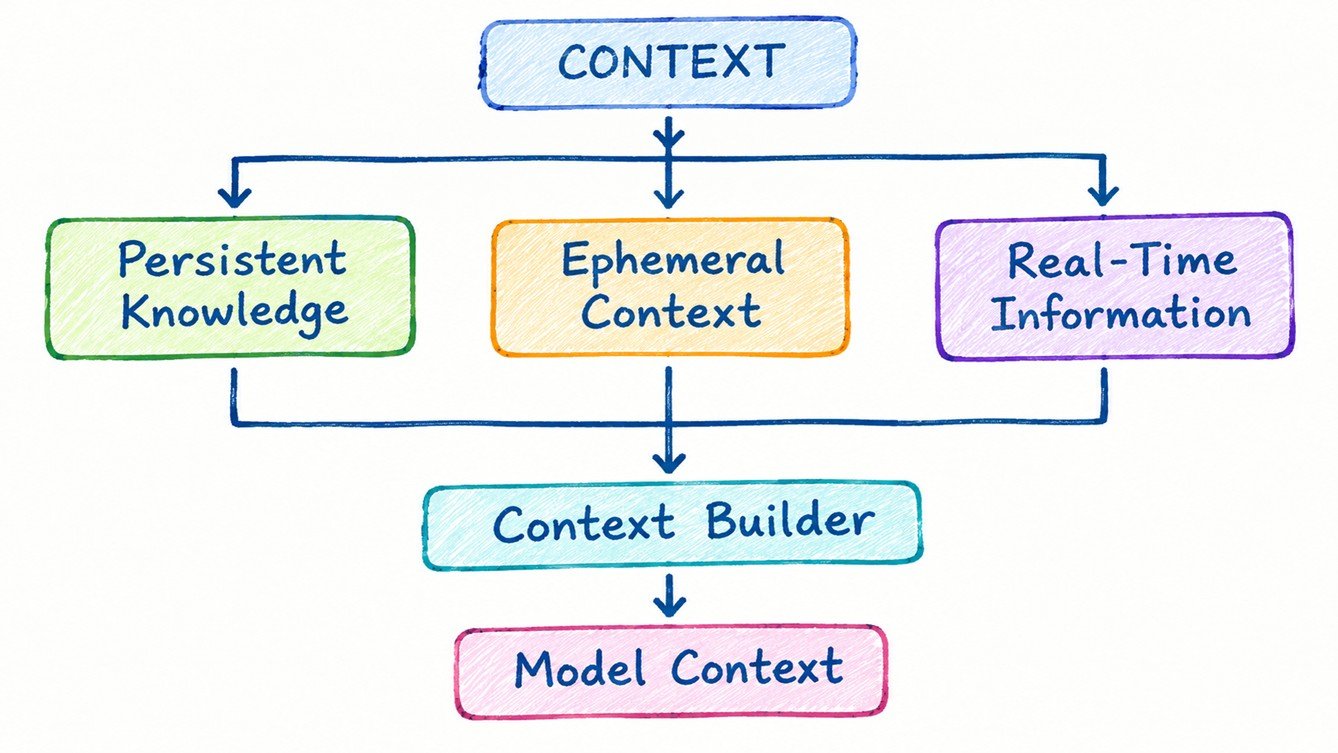
Persistent Knowledge changes relatively slowly. Product documentation, policy manuals, organizational structures, technical specifications, and similar information can be indexed, governed, cached, and reused across many requests.
Ephemeral Context is associated with the current interaction or workflow. Conversation history, immediate user intent, intermediate reasoning state, and current task state generally exist for the duration of the interaction and may have limited value beyond it.
Real-Time Information derives its value from being current. Account balances, inventory availability, transaction status, operational telemetry, and live system state may become incorrect as soon as the underlying system changes. For such information, indiscriminate caching is not merely a performance decision. It can become a correctness problem.
The Context Builder is the architectural component that reconciles these streams. It determines what information should be included, what should be excluded, how sources should be prioritized, how much information should be carried forward, and how the resulting context should be assembled within the model's context and latency budgets.
Its output is the Model Context, the information the LLM actually receives and reasons over.
This leads to a central architectural principle:
Context engineering is not prompt construction. It is the systematic design of the information pipeline that determines what the model can know at inference time.
That pipeline must answer two fundamental questions. First, how is the required knowledge made available? Second, how is the relevant portion of that knowledge selected for the current task?
The first is the domain of Knowledge Architecture. The second is the domain of Retrieval Thinking.
Knowledge Architecture
When enterprise knowledge must be made available to an LLM, the immediate reaction is often to introduce a vector database.
That is an implementation decision made too early.
Before selecting a storage or retrieval technology, the architecture must answer three more fundamental questions:
- What is the source of knowledge?
- How is that knowledge transformed into a usable representation?
- How will the system retrieve the information required by each class of task?
The answers define the knowledge architecture.
Enterprise knowledge rarely resides in a single repository or arrives in a uniform structure.
A realistic knowledge landscape may include:
- Documents
- Databases
- APIs
- SaaS platforms
- Event streams
- Knowledge graphs
- Data warehouses
- Emails
- Tickets
- Source code
- Policies and procedures
Each source has a different access pattern, update cadence, schema, ownership model, security boundary, and governance requirement.
The architecture therefore begins with a knowledge inventory, not a vector index.
A system designed primarily around documents, for example, may work well until a user asks a question that requires combining a policy document with the current state of a transaction. At that point, the limitation is not the language model. The limitation is the knowledge architecture.
The fundamental question is:
Where does authoritative knowledge live, and what is the system of record for each knowledge domain?
Without a clear answer, retrieval quality cannot be made reliable because the system does not yet know what "authoritative" means.
Making enterprise knowledge usable by an LLM is not a single ingestion step. It is a transformation pipeline.
Source
  ↓
Ingestion
  ↓
Parsing
  ↓
Normalization
  ↓
Metadata
  ↓
Chunking
  ↓
Embedding / Indexing
  ↓
Knowledge Store
Every stage creates architectural consequences downstream.
Parsing determines whether the original structure survives. Tables, headings, lists, code blocks, relationships, and document hierarchy can carry meaning that is lost when content is reduced to unstructured text.
Normalization determines whether equivalent information from different systems can be represented consistently.
Metadata determines whether knowledge can later be filtered by attributes such as date, owner, business unit, geography, classification, sensitivity, or validity period.
Chunking determines the semantic unit available to retrieval. Chunks that are too large increase noise and context consumption. Chunks that are too small can destroy the relationships required to interpret the information correctly.
Embedding and indexing determine how the resulting representations can be discovered through different retrieval mechanisms.
These decisions cannot simply be deferred to the retrieval layer. Once information has been flattened, stripped of metadata, or fragmented incorrectly, the retrieval system cannot reliably reconstruct what the ingestion pipeline failed to preserve.
Knowledge architecture therefore establishes the retrieval potential of the system long before a user submits a query.
"Vector search" is one retrieval mechanism. It is not a definition of retrieval.
Depending on the nature of the question, an enterprise application may require:
Keyword Retrieval
Vector Retrieval
Hybrid Retrieval
Metadata Filtering
Graph Retrieval
SQL Retrieval
Semantic Retrieval
Multi-Hop Retrieval
Hierarchical Retrieval
Temporal Retrieval
Different questions impose different retrieval requirements.
A question asking for the exact wording of a policy clause may benefit from keyword and metadata filtering. A question involving conceptual similarity may benefit from vector retrieval. A question requiring relationships between entities may require graph or multi-hop retrieval. A question where recency determines correctness may require temporal retrieval.
The architecture should therefore select retrieval mechanisms according to the information need, not according to the popularity of a particular technology.
A mature enterprise architecture may use several retrieval mechanisms within the same application and may combine them within a single retrieval pipeline.
The retrieved information must then be transformed into context:
Retrieve
  ↓
Filter
  ↓
Rank
  ↓
Compress
  ↓
Construct Context
Retrieval is therefore not complete when a search engine returns documents. It is complete when the system has produced a sufficiently relevant, authoritative, and appropriately sized information set for the downstream reasoning task.
One of the most persistent architectural errors in enterprise RAG implementations is treating retrieval-augmented generation primarily as a search problem.
It is better understood as a context acquisition problem.
A search problem is solved when the relevant document is found.
A context acquisition problem is solved only when the right information, at the right granularity, from an authoritative source, is available to the model at the right point in the task.
That distinction is fundamental.
Search is a mechanism within the pipeline. Context acquisition is the architectural objective.
This is why a system can have a sophisticated vector database, strong embeddings, and a technically correct RAG implementation and still produce unreliable answers. The system may retrieve something relevant without retrieving what the model actually needs to reason correctly.
Retrieval Thinking
Knowledge Architecture establishes how enterprise knowledge becomes available to the system. Retrieval Thinking establishes how the system decides what knowledge to bring forward for a particular task.
Retrieval therefore deserves the same architectural discipline applied to any other production subsystem.
It can be understood as three sequential concerns:
- Query Understanding
- Retrieval
- Context Optimization
Each addresses a different failure mode.
User Query
    ↓
Intent
    ↓
Query Decomposition
    ↓
Search Queries
The literal wording of a user request and the information required to satisfy it are often different.
A user may ask a single question that implicitly contains several information requirements. The retrieval system may therefore need to identify intent, determine the relevant entities and constraints, decompose the request, and generate one or more targeted retrieval queries.
For example, a question about whether a customer is eligible for a particular service may require several distinct pieces of information:
- the applicable policy,
- the customer's current attributes,
- the effective date of the policy,
- and the current status of the customer's account.
A single semantic search against a document collection does not necessarily express that information need.
Query understanding transforms the user's request into a retrieval problem the system can actually execute.
Candidate Generation
        ↓
Filtering
        ↓
Ranking
        ↓
Reranking
Retrieval is a funnel rather than a single lookup.
Candidate generation casts a sufficiently broad net to preserve recall.
Filtering removes candidates that violate explicit constraints such as access permissions, metadata conditions, time ranges, or business rules.
Ranking orders the remaining candidates according to relevance.
Reranking applies a more precise relevance assessment when the additional computational cost is justified.
This staged approach allows the architecture to balance recall, precision, latency, and cost.
Collapsing all of these concerns into a single retrieval operation often produces systems that appear effective in controlled demonstrations but become less reliable as the knowledge base, query diversity, and production workload increase.
Retrieved Information
        ↓
Deduplication
        ↓
Relevance Filtering
        ↓
Compression
        ↓
Context Assembly
Retrieving the right information is necessary, but it is not sufficient.
The retrieved material must still be prepared for the model.
Duplicate passages consume context without adding information. Marginally relevant material introduces noise. Excessively verbose source content consumes tokens that could otherwise carry more important evidence. Conflicting information may require prioritization based on authority, recency, or applicability.
Context optimization therefore determines the final information set presented to the model.
This is where Retrieval Thinking reconnects with the Context Builder introduced in Section Structuring Context by Volatility.
The retrieval subsystem discovers candidate knowledge. The Context Builder determines what ultimately becomes part of the model's working context.
That distinction is important because retrieval results are not the same thing as model context.
The architectural discipline becomes particularly important when evaluating system quality.
Before asking:
Did the LLM answer correctly?
ask the preceding question:
Did the system retrieve the information required to answer correctly?
These are different questions.
A response can be wrong because the system retrieved the wrong information. It can also be wrong because the model failed to reason correctly over information that was retrieved appropriately. It can fail because both occurred simultaneously.
Separating these failure domains creates two distinct quality dimensions:
Retrieval Quality
        +
Generation Quality
        =
Application Quality
Retrieval Quality concerns whether the system identified and supplied the information required for the task.
Generation Quality concerns whether the model used that information appropriately to produce the intended response.
An application with strong retrieval and weak generation may have the necessary evidence but express it poorly, misunderstand the task, or reason incorrectly. An application with strong generation and weak retrieval may produce a fluent, coherent, and persuasive answer based on incomplete or incorrect evidence.
The user experiences both failures as an incorrect application outcome, but the engineering response is different.
That is why retrieval and generation must be evaluated independently.
For enterprise LLM architecture, this separation is more than a testing convenience. It establishes a fundamental principle of system design:
The quality of an LLM application is bounded not only by the intelligence of its model, but by the quality of the context made available to that model.
Context Engineering therefore sits at the intersection of knowledge, retrieval, application state, policy, and model inference. Its responsibility is not to maximize the amount of information sent to the LLM. Its responsibility is to ensure that the model receives the information required to perform the task, in a form that is relevant, authoritative, timely, and operationally viable.
Reasoning Architecture
Once the data foundation and retrieval strategy are established, a more consequential question emerges:
How should the system reason over the information it has been given?
This is not a prompting decision. It is an architectural decision.
The reasoning strategy determines how much computation the system performs, how many inference steps it requires, whether intermediate states must be maintained, whether external tools are needed, and how failure propagates through the application. These choices directly affect latency, cost, reliability, observability, and the kinds of errors the system produces in production.
The central architectural challenge is therefore not to maximize reasoning capability. It is to match reasoning complexity to problem complexity.
A system that applies insufficient reasoning may produce an answer before the problem has been adequately understood. A system that applies excessive reasoning may introduce unnecessary latency, cost, and operational complexity. One under-reasons. The other over-engineers.
Both are architectural failures.
The Spectrum of Reasoning Strategies
Enterprise LLM applications can employ a broad spectrum of reasoning strategies. They range from a single inference step to increasingly structured processes involving decomposition, planning, verification, iteration, and external execution.
The appropriate strategy depends on the nature of the task, the consequences of error, and the constraints under which the application must operate.
Direct Generation. The model produces an answer in a single inference pass, without an explicit intermediate reasoning process. This is appropriate for narrow, well-bounded tasks where the required information is already available and the primary operation is interpretation, transformation, or response generation.
Structured Reasoning. The application guides the model through a defined reasoning structure before producing the final result. This can improve consistency and reduce avoidable errors when a task requires several logical steps but does not justify a more elaborate execution architecture.
Decomposition. A complex problem is divided into smaller sub-problems that can be addressed independently before their results are combined. Decomposition reduces cognitive and contextual complexity by turning one difficult problem into a collection of more manageable problems.
Planning. The system determines an explicit sequence of actions or reasoning steps before execution begins. Planning becomes valuable when the path to the desired outcome is not known in advance and must be determined dynamically.
Self-Checking. The system evaluates its own output against predefined criteria before returning the result. This introduces a verification stage that can identify omissions, inconsistencies, or violations without necessarily requiring a separate model or external evaluator.
Critique and Reflection. A separate evaluation pass examines an initial result and identifies weaknesses or required corrections. The evaluator may be the same model, a different model, or a specialized evaluation component. The resulting feedback can then be incorporated into a subsequent generation step.
Voting. Multiple independent generations are produced and compared before a result is selected or synthesized. Agreement across independent attempts can provide an additional signal for tasks where multiple reasoning paths are possible, although it increases inference cost and does not guarantee correctness.
Iterative Refinement. The system generates an initial result and repeatedly improves it through successive passes. Each iteration uses the previous result as an input to the next stage, allowing the application to progressively improve quality against defined criteria.
Tool-Assisted Reasoning. The model delegates specific operations to external tools rather than attempting to perform them through generation alone. Calculation, database queries, code execution, API calls, and enterprise-system interactions are examples where deterministic or authoritative external capabilities can complement model reasoning.
Workflow-Based Reasoning. Reasoning is embedded within an explicit sequence of application stages, each with a defined responsibility, input, output, and transition condition. This approach is particularly useful when portions of the reasoning process benefit from deterministic control, explicit governance, predictable execution, or auditable state transitions.
These strategies are not mutually exclusive.
A production system may combine them. A workflow may use decomposition, invoke tools for specific subtasks, apply a verification step, and then perform a final generation. The architectural question is therefore not which reasoning pattern to adopt universally, but which combination is appropriate for a particular class of work.
Reasoning as an Architectural Trade-Off
Reasoning introduces capability, but capability is not free.
Additional reasoning steps generally introduce additional inference calls, intermediate state, orchestration logic, token consumption, and failure opportunities. More sophisticated reasoning can improve the quality of difficult tasks while simultaneously making the overall system slower, more expensive, and harder to operate.
The architect must therefore evaluate reasoning along several dimensions:
| Dimension | Architectural Question |
|---|---|
| Complexity | How difficult is the problem to solve correctly? |
| Latency | How much additional inference time can the user or workflow tolerate? |
| Cost | How much additional model and tool execution can the workload sustain? |
| Reliability | Does additional reasoning reduce or introduce failure modes? |
| Determinism | Does the task require predictable execution or allow probabilistic behavior? |
| Risk | What is the consequence of an incorrect result or action? |
| Observability | Can the reasoning process be measured, traced, and diagnosed? |
| Control | Which parts of the process must remain deterministic or policy-controlled? |
These dimensions prevent reasoning from becoming an isolated model-level decision.
A reasoning strategy that appears superior when measured only by answer quality may be inappropriate when evaluated against production latency, cost, reliability, or operational constraints.
The Governing Principle
No reasoning strategy is inherently superior.
Each is a mechanism for addressing a particular class of problem. The architect's responsibility is to select the minimum reasoning architecture capable of satisfying the task's quality and risk requirements.
The governing principle is:
Reasoning complexity should be proportional to problem complexity.
A simple FAQ does not require a planner, critic, iterative loop, or multi-agent execution architecture. If the required information is already available and the transformation is straightforward, direct generation may be sufficient.
A complex task involving multiple sources, dependencies, decisions, external actions, and significant consequences may require decomposition, planning, tool use, verification, and iterative refinement.
The objective is not to make every application more intelligent by adding more reasoning.
The objective is to make the reasoning fit the work.
This distinction matters because unnecessary reasoning compounds across every request. Additional inference calls increase latency. Additional context increases token consumption. Additional orchestration introduces more state and more failure points. Additional tools create more integration surfaces. Additional loops make debugging and observability more difficult.
Complexity therefore has an operational cost.
At the same time, insufficient reasoning has a different cost. If the application attempts to solve a multi-step problem through a single generation when the task requires decomposition, planning, verification, or tool use, the resulting system may produce answers that are fluent but incomplete, inconsistent, or incorrect.
The architectural objective lies between these extremes.
Use enough reasoning to satisfy the problem's complexity, risk, and quality requirements, but no more than the system can justify operationally.
That is the discipline of Reasoning Architecture.
The architect should understand the full spectrum of reasoning strategies, know the conditions under which each becomes valuable, and design explicit boundaries around when the system should reason directly, decompose, plan, invoke tools, verify, reflect, or stop.
The most sophisticated reasoning architecture is not necessarily the one with the most stages.
It is the one in which every stage exists for a reason.
Prompt Architecture
There is a persistent habit, even among experienced teams, of treating a prompt as a string: a paragraph written in natural language, refined through trial and error, and deployed once the responses appear satisfactory.
That approach may work for experimentation. It does not scale to production.
A prompt is not merely a string. It is an application control surface. It belongs to the same architectural category as an API contract, configuration schema, policy definition, or workflow specification.
It influences what the model is expected to do, what constraints it must observe, what information it can use, what external information has been supplied to it, and what form its response must take.
Once prompts become part of a production system, they acquire the characteristics of software. They have dependencies, versions, interfaces, security boundaries, failure modes, and operational consequences.
Treating them as prose hidden inside application code creates predictable problems: behavior becomes difficult to trace, changes become difficult to review, regressions become difficult to reproduce, and seemingly minor edits can alter downstream application behavior.
The architectural question is therefore not:
"What prompt should we write?"
It is:
"How should the application construct, govern, secure, evaluate, and evolve the instructions and context presented to the model?"
The Composition Stack
A production prompt is rarely a single block of text. It is a runtime composition of distinct information and instruction layers.
A useful conceptual model is:
System Instructions
        +
Policy Instructions
        +
Task Instructions
        +
User Input
        +
Retrieved Context
        +
Tool Results
        +
Output Contract
These layers are not interchangeable. They have different purposes, different trust characteristics, different owners, and different lifecycles.
System Instructions establish the fundamental operating boundary of the model within the application. They define what the system is expected to do, what it must not do, and the behavioral constraints that apply across requests.
Policy Instructions express organizational, regulatory, security, privacy, and compliance requirements. These constraints exist independently of the immediate task and must continue to apply regardless of what the user requests or what external content is retrieved.
Task Instructions define the work being performed during the current invocation. They describe the objective, workflow, decision criteria, required behavior, and task-specific output expectations.
User Input represents the request supplied by the user. It is essential application input, but it must not automatically acquire the authority of an instruction simply because it appears in the prompt.
Retrieved Context provides information acquired from enterprise knowledge sources. It supplies evidence or reference material for the task, but retrieved content should generally be treated as data to be interpreted rather than as instructions that can redefine application behavior.
Tool Results contain information returned by external systems during execution. Database records, API responses, calculations, search results, and other tool outputs become part of the model's available evidence, subject to the application's trust and validation rules.
Output Contract defines what the model is expected to return. This may be a JSON schema, structured object, fixed response format, classification set, or other machine-consumable representation required by downstream components.
These layers answer different architectural questions:
- System Instructions: What operating boundaries apply?
- Policy Instructions: What organizational constraints must be enforced?
- Task Instructions: What must be accomplished now?
- User Input: What does the user want?
- Retrieved Context: What relevant information is available?
- Tool Results: What did external systems return?
- Output Contract: What must the result look like?
The distinction matters because instruction and information are not the same thing.
A retrieved document may contain a sentence that looks like an instruction. A user may deliberately include text that attempts to redefine system behavior. A tool may return content originating from an untrusted external source.
If the architecture does not distinguish these categories, the model receives an ambiguous mixture of instructions and data. That ambiguity creates an attack surface and makes behavior substantially harder to reason about.
Prompt architecture therefore begins with composition and trust boundaries, not wording.
Prompt Composition Is an Architectural Concern
The prompt shown to the model is often assembled dynamically.
System policies may come from one configuration source. Task instructions may come from an application workflow. User input arrives at runtime. Retrieved context comes from the knowledge layer. Tool results may arrive later during execution. The final output contract may be determined by the downstream service consuming the response.
The resulting prompt is therefore better understood as a runtime artifact than as a static document.
Policies
   +
Task Definition
   +
Runtime Inputs
   +
Retrieved Context
   +
Tool Results
   +
Output Contract
   ↓
Prompt Composition
   ↓
Model Invocation
This has an important architectural consequence:
Prompt composition belongs in the application's orchestration layer, not in the category of ad hoc prose.
Composition logic must be deterministic enough to inspect, version, test, and reproduce.
When a production response is incorrect, the engineering team should be able to determine what instructions, policies, user inputs, retrieved passages, tool results, and output constraints were present at the time of inference.
Without that capability, prompt behavior becomes difficult to diagnose because the effective prompt exists only transiently inside a running request.
What the Architecture Demands
Once prompts are treated as architectural artifacts, several requirements become unavoidable.
Instruction Hierarchy
When two instructions conflict, the system must have a defined precedence model.
Which constraints are authoritative? Which inputs are untrusted? Which policies cannot be overridden by a user request? Which application rules take precedence over task-specific instructions?
These decisions should be explicit.
A production system should never depend on the model arbitrarily resolving conflicting instructions. Instruction precedence is part of the application architecture and should be reinforced through both prompt structure and application-level controls.
Prompt Composition
The application must define how the different layers are assembled at runtime.
This includes templates, conditional sections, reusable components, model-specific adaptations, and orchestration logic. Prompt construction should be treated with the same discipline applied to other application code because a change in composition can change application behavior.
Variable Injection
Dynamic values must be introduced safely.
User attributes, transaction data, retrieved content, workflow state, and tool results should enter clearly defined locations within the prompt structure. The architecture must prevent dynamic data from unintentionally becoming higher-authority instructions.
This is particularly important when content originates outside the application's trusted control boundary.
Context Boundaries
The system must make the boundaries between instructions and data explicit.
User input, retrieved documents, tool responses, and other external content should be structurally distinguishable from application instructions. Clear delimiters can improve model interpretation, but they should not be treated as a complete security control. Trust must ultimately be enforced through the surrounding application architecture.
Prompt Versioning
Prompts evolve.
A production system therefore needs version control, change history, release discipline, rollback capability, and traceability.
When application behavior changes, the team should be able to answer a basic operational question:
Which prompt version produced this result?
Without that information, prompt changes become difficult to correlate with regressions, evaluation results, or changes in production behavior.
Prompt Testing
A prompt contains behavioral logic and should be evaluated accordingly.
Testing should include representative cases, edge cases, adversarial inputs, regression scenarios, structured-output validation, and known failure modes.
The objective is not to prove that a prompt is correct for every possible input. It is to establish measurable evidence that a change has not degraded known requirements.
Prompt evaluation should therefore become part of the application's continuous engineering lifecycle rather than an informal activity performed by someone manually testing a few examples in a chat interface.
Prompt Security
Prompts are part of the application's attack surface.
They may contain sensitive instructions, business rules, policy constraints, or information about system behavior. They may also be influenced indirectly by external content entering through users, documents, websites, APIs, tools, or other systems.
Security architecture must therefore consider what information can enter the prompt, what authority that information has, and what actions can result from the model's interpretation of it.
Prompt Injection
Prompt injection is a direct consequence of failing to maintain a reliable distinction between trusted instructions and untrusted content.
An attacker may place adversarial instructions in user input, retrieved documents, web content, tool responses, or other data sources and attempt to influence the model's behavior.
The important architectural insight is that prompt injection is not merely a prompting problem.
It is a trust-boundary problem.
Defenses therefore need to extend beyond prompt wording to include input handling, content isolation, authorization, tool permissions, output validation, retrieval controls, and application-level enforcement of security-critical decisions.
A prompt should not be the sole security boundary protecting a consequential operation.
Output Contracts
The model's output is frequently not the final product. It is input to another component.
A downstream service may expect a specific JSON structure, a controlled vocabulary, a set of fields, or a particular decision representation. If the model produces an unexpected structure, the failure may occur several components away from the prompt that caused it.
An output contract makes that interface explicit.
The contract should define the expected schema, required fields, permissible values, validation rules, and failure behavior. Where possible, the application should validate the model's output before allowing it to enter a downstream workflow.
This turns model output from loosely structured prose into an explicit application interface.
From Prompt to Control Surface
These concerns change the way prompts should be designed.
A prompt should not be viewed as a piece of prose that happens to control a model. It should be viewed as a versioned, testable, observable, and security-sensitive application artifact.
The distinction is subtle but consequential.
A prose artifact is optimized primarily for readability.
A production control surface must also be optimized for determinism, traceability, security, evaluation, maintainability, and change management.
This is why prompt engineering alone is insufficient for enterprise LLM applications. Prompt architecture must account for the entire lifecycle of the model interaction:
Compose
   ↓
Validate
   ↓
Invoke
   ↓
Observe
   ↓
Evaluate
   ↓
Version
   ↓
Evolve
The prompt is the interface through which application intent, policy, context, and runtime information meet the model.
Once that interface becomes part of a production system, it deserves the same architectural discipline as every other critical interface in the application.
The objective is not to create the cleverest prompt.
It is to create a controlled and evolvable prompt architecture that produces reliable model behavior under real production conditions.
Structured Output
There is a natural temptation, especially during early experimentation, to let the model respond freely and interpret its output the way a human would.
That approach works well enough in a demonstration.
It becomes fragile as soon as the model's response must trigger a workflow, populate a database, invoke another service, update application state, or make a downstream decision without a human interpreting the result first.
Enterprise applications therefore need a clear boundary between human-readable generation and machine-consumable output.
The principle is straightforward:
When downstream systems depend on the model's output, prefer structured output over free-form text.
Free-form language is optimized for human interpretation. Machine interfaces require explicit structure.
The Distinction in Practice
Consider a model evaluating a customer interaction and recommending the next action.
A structured response might be:
{
  "decision": "escalate",
  "confidence": 0.91,
  "reason": "Customer reported repeated billing errors across three consecutive cycles.",
  "next_action": "route_to_billing_specialist"
}
The same semantic conclusion expressed as free-form text might be:
I think the customer should probably be escalated to a billing
specialist, since it looks like there have been repeated billing
errors over the past few cycles, and I'm fairly confident about this.
Both responses communicate approximately the same meaning.
They do not provide the same architectural value.
The structured response exposes explicit fields with defined semantics. A downstream system can inspect decision, validate confidence, record reason, and execute next_action without first interpreting natural language.
The free-form response requires an interpretation layer. That layer may be a human, a regular-expression parser, another model, or application-specific heuristics. Each introduces additional complexity and another potential failure point.
Terms such as "probably," "I think," and "fairly confident" may communicate useful nuance to a person, but they do not constitute a reliable machine interface. A defined confidence field with an agreed representation can be validated, stored, monitored, and used by downstream logic.
The difference is not presentation.
It is interface design.
What Structure Buys You
Structured output turns the model response into an explicit application contract. That enables capabilities that are difficult to achieve reliably with unrestricted natural language.
Schema Validation. The response can be validated against a defined schema before it enters the next stage of the application. Required fields, data types, permissible values, and structural constraints can be checked at the boundary rather than allowing malformed output to propagate downstream.
Deterministic Routing. Explicit decision fields can drive application logic directly. A workflow can branch on a defined value rather than attempting to infer intent from a paragraph of prose.
API Integration. Structured model output can conform to service interfaces and application contracts, allowing the LLM to participate in an existing architecture without requiring every downstream component to understand natural language.
Automated Testing. Structured fields provide concrete assertions for evaluation and regression testing. Tests can verify whether a decision, classification, field value, or required property is present and valid.
Observability. Structured outputs make model behavior measurable. Decision categories, confidence indicators, reason codes, classifications, and other fields can be logged, aggregated, compared, and monitored over time.
This enables questions that are difficult to answer reliably from transcripts alone:
- How frequently is each decision produced?
- How often does the model return an invalid structure?
- Which decision categories are changing over time?
- Where are confidence values concentrated?
- Which outputs require human escalation?
- Which model or prompt version produced a particular result?
Downstream Processing. Workflow engines, databases, event pipelines, analytics systems, and other services can consume structured data directly. The model becomes another component in the application pipeline rather than a special case that requires interpretation before every handoff.
Structure Is a Contract, Not a Guarantee
Structured output solves an important problem, but it does not solve every problem.
A response can be structurally valid and still be semantically wrong.
For example:
{
  "decision": "escalate",
  "confidence": 0.91,
  "reason": "Customer reported repeated billing errors across three consecutive cycles.",
  "next_action": "route_to_billing_specialist"
}
The JSON may conform perfectly to its schema while the underlying decision is incorrect because the model misunderstood the customer interaction or because the retrieved context was incomplete.
This distinction is fundamental:
Schema validation establishes structural correctness. It does not establish semantic correctness.
The architecture therefore needs both.
Model Generation
       ↓
Schema Validation
       ↓
Semantic Evaluation
       ↓
Policy / Business Validation
       ↓
Downstream Action
The exact pipeline will vary by use case. A low-risk summarization task may require only structural validation. A high-consequence decision may require additional business-rule validation, confidence thresholds, human review, or independent evaluation before an action is permitted.
Structured output creates the interface. It does not remove the need for application controls.
The Underlying Principle
The cleanest way to reason about structured output is to separate two responsibilities:
The LLM generates semantic intent. The schema defines structural form.
The model is responsible for interpreting the available information and producing the intended semantic result.
The schema defines how that result must be represented so that another component can consume it predictably.
The application remains responsible for determining whether the result is valid, authorized, safe, and appropriate to act upon.
These responsibilities should not be collapsed into a single assumption that "valid JSON means a valid answer."
A useful architectural boundary is therefore:
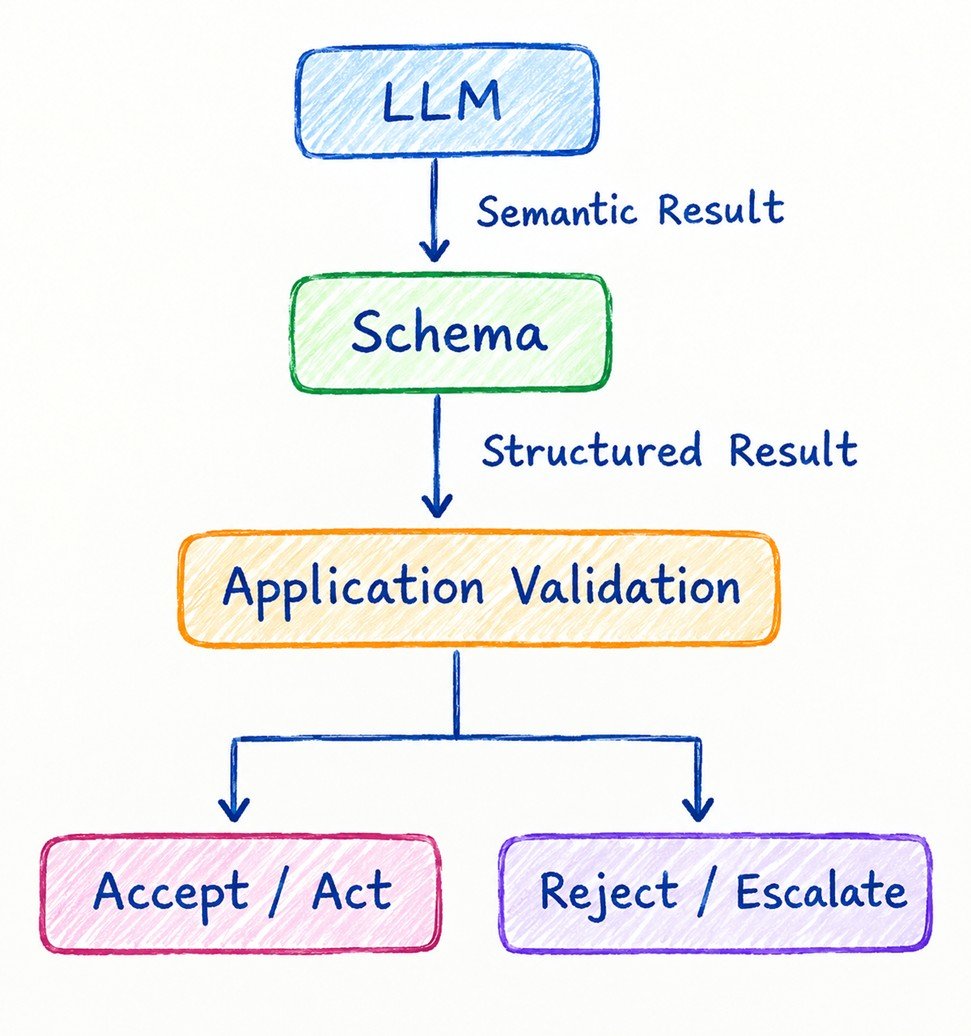
This separation changes the role of the LLM within the enterprise architecture.
The model is no longer treated as an unpredictable text generator whose output must be interpreted after the fact. It becomes a reasoning component operating behind an explicit interface.
That interface makes the model easier to integrate, test, observe, govern, and evolve.
The objective is not to eliminate natural language from an LLM application.
It is to use natural language where humans need language, and structured contracts where machines need reliable interfaces.
That is the boundary between an LLM response and a production application component.
Tool and Action Architecture
Up to this point, the model has primarily performed a bounded set of activities: interpreting information, reasoning over context, and generating a response.
The moment the model can act, the architecture changes fundamentally.
Searching a customer record, creating a ticket, sending an email, updating an account, approving a transaction, or invoking an external service moves the LLM from an information-processing component into an action-taking component.
The distinction matters.
A system that generates text can produce a bad answer. A system that can act can produce a bad outcome.
The architectural question is therefore no longer simply:
What should the model say?
It becomes:
What is the model permitted to do, under what conditions, with what authority, and with what controls around the action?
The useful mental model is not that "the LLM has tools."
It is that the LLM has been granted a set of controlled capabilities, each representing a deliberate and bounded delegation of authority.
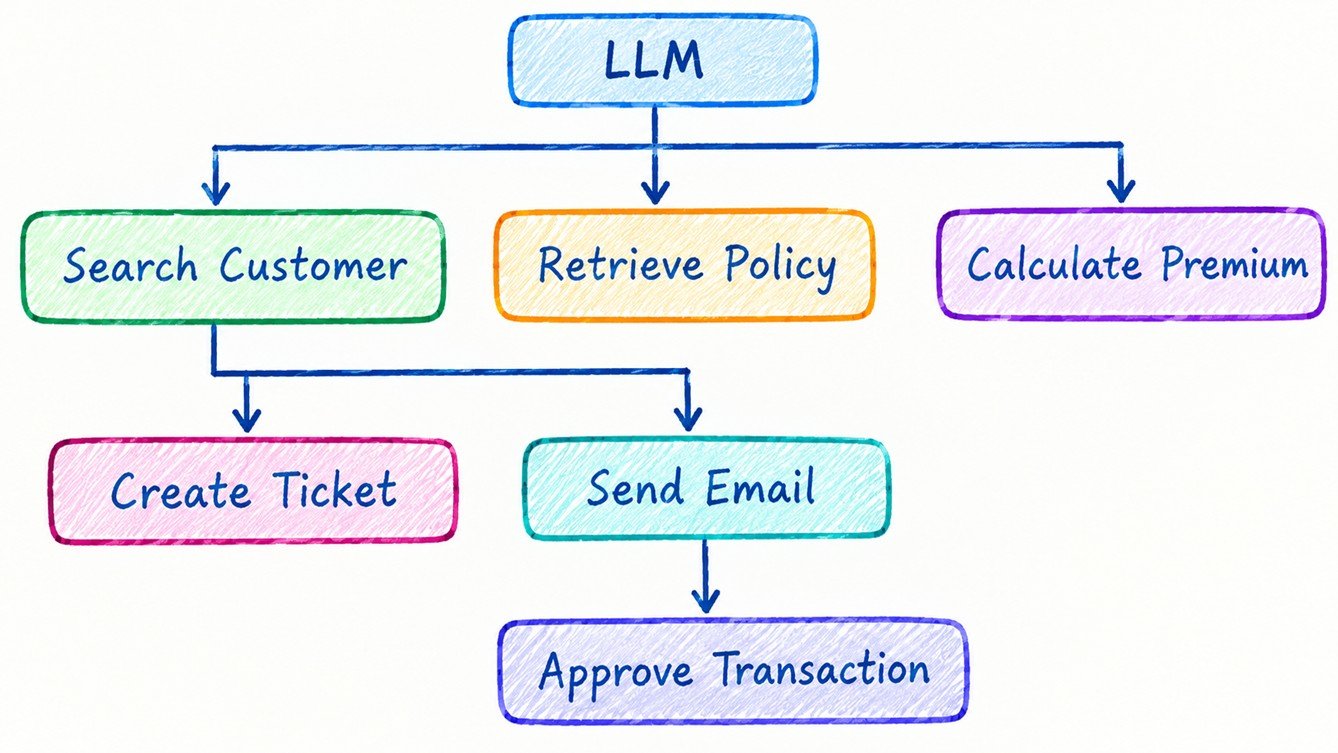
The apparent symmetry in this diagram is misleading.
These capabilities have materially different risk profiles.
Searching a customer record is generally a read operation. Retrieving a policy is informational. Calculating a premium may produce a consequential recommendation without changing state. Sending an email creates an external communication. Approving a transaction may commit money, alter records, or create an obligation for the organization.
They should therefore not be treated as equivalent simply because they are all represented as "tools."
The Action Spectrum
A useful architectural distinction is to classify tools according to the authority they exercise:
Read
  ↓
Calculate
  ↓
Recommend
  ↓
Write
  ↓
Communicate
  ↓
Commit
The boundaries will vary by domain, but the principle remains consistent: the closer an action is to changing external state or creating an irreversible consequence, the stronger the controls around that action should be.
This distinction also affects the degree of autonomy the application should permit.
A read-only operation may be executed automatically when the appropriate authorization exists. A write operation may require additional validation. A high-consequence action may require explicit policy checks, transaction controls, or human approval before execution.
The important point is that the model should not determine its own authority.
The application architecture determines what the model is allowed to do.
What Every Tool Requires
A tool exposed to an LLM should be treated as production infrastructure, not as a convenience function attached to a prompt.
The model is an unpredictable caller. It may select the wrong tool, supply inappropriate arguments, repeat an operation, misunderstand a tool result, or continue operating after a downstream failure.
The tool boundary must therefore provide its own controls.
At minimum, every production tool should address the following concerns.
Explicit Schema. The tool requires a precise input and output contract. Input parameters, data types, required fields, permissible values, and output semantics should be explicit. The model should not have to infer the interface from ambiguous descriptions.
Authorization Boundary. The tool must define exactly what authority it grants. Authorization should be enforced at the tool or service boundary rather than relying on the prompt to persuade the model not to perform an unauthorized operation.
Input Validation. Every argument supplied by the model is untrusted input. The tool must validate it before execution, just as it would validate input from any other external caller.
Output Contract. Tool results should have a predictable structure and well-defined semantics. The model's subsequent reasoning should operate on explicit data rather than attempting to interpret arbitrary response formats.
Timeout. Every external operation needs a bounded execution time. A stalled dependency should not hold an agentic reasoning loop indefinitely.
Retry Policy. Retries must be explicitly defined. The system should determine which failures are retryable, how many attempts are permitted, and what backoff strategy applies. The model should not improvise retry behavior.
Idempotency. Any operation that changes state must account for duplicate execution. A retry, timeout, network ambiguity, or repeated model decision must not accidentally create two tickets, send two payments, or apply the same transaction twice.
Auditability. Tool invocation should produce a durable record of what was called, with which parameters, under whose authority, at what time, and with what result. For consequential actions, the audit trail should support reconstruction of the complete decision and execution path.
Rate Limits. Tool invocation must be bounded. A reasoning loop that repeatedly calls a dependency can exhaust downstream capacity, create unexpected costs, or amplify an otherwise minor failure.
Error Semantics. Failure must be represented as structured information. The model needs to know whether a call failed because of invalid input, authorization, timeout, unavailable data, a transient dependency problem, or a business-rule rejection. Different failures require different responses.
These are not optional refinements.
They define the boundary between a model that can merely request an action and an enterprise system that can safely execute one.
Tool Descriptions Are Part of the Interface
There is an additional concern that becomes important in LLM-based systems: the model must understand what a tool does before deciding whether to invoke it.
Tool descriptions therefore form part of the model-facing interface.
A good description should make clear:
- what the tool does,
- when it should be used,
- when it should not be used,
- what inputs it requires,
- what the inputs mean,
- what it returns,
- what side effects it creates,
- and what conditions prevent execution.
Ambiguous tool descriptions create an architectural problem because the model may select a tool based on an incorrect interpretation of its purpose.
This is especially important when several tools provide related capabilities. A model should not have to guess whether a tool merely previews an action, recommends an action, or actually commits it.
The distinction between query, simulate, recommend, and execute should be explicit wherever those operations have materially different consequences.
Separate Reasoning From Authority
A critical architectural boundary is the separation between the model's ability to decide that an action is appropriate and the application's authority to permit that action to occur.
For example, a model may determine:
Customer appears eligible for refund.
That does not mean the model should be permitted to execute:
Issue Refund
A safer architecture separates the two:
LLM Reasoning
      ↓
Proposed Action
      ↓
Policy Validation
      ↓
Authorization
      ↓
Business Validation
      ↓
Execution
      ↓
Audit
The model proposes.
The application validates.
The authorization layer permits.
The execution service acts.
The audit layer records.
This separation prevents the model from becoming the ultimate authority over consequential operations.
It also creates a much clearer failure boundary. A model can make an incorrect recommendation without that recommendation automatically becoming an irreversible action.
The Governing Constraint
All of these controls support one fundamental architectural principle:
The LLM should never receive more authority than the task requires.
This is least privilege applied to probabilistic software.
A model that can search a customer record does not require the authority to modify that customer's account. A model that can draft an email does not necessarily require the ability to send it. A model that can recommend a transaction does not necessarily require permission to commit it.
Authority should be explicit, bounded, contextual, and revocable.
This also means that tool access should not be treated as a permanent capability of the model. Capabilities can be granted according to the current workflow, user authorization, transaction context, environment, or risk level.
A production architecture might therefore distinguish:
Capability
    ↓
Authorization
    ↓
Policy
    ↓
Validation
    ↓
Execution
    ↓
Audit
Each stage answers a different question:
- Capability: What can the system technically do?
- Authorization: Who or what is permitted to request it?
- Policy: Under what conditions is the action allowed?
- Validation: Is this particular request valid?
- Execution: Can the action now be performed?
- Audit: Can the decision and action later be reconstructed?
This distinction is critical because technical capability and business authority are not the same thing.
The fact that a model can invoke a tool does not mean it should invoke it. The fact that a user is authorized to perform an operation manually does not necessarily mean that an autonomous system should perform it without additional controls.
Bound the Blast Radius
Tool architecture is ultimately about controlling the consequences of model decisions.
A model will sometimes misunderstand a request. It will sometimes select an inappropriate tool. It will sometimes produce invalid arguments. External dependencies will fail. Retries will occur. Context will be incomplete. The objective is not to design a system that assumes none of these things will happen.
The objective is to design a system in which the consequences of those failures are bounded.
That means limiting permissions, validating inputs, constraining tool scope, separating read and write capabilities, enforcing transaction boundaries, requiring approval where appropriate, making state-changing operations idempotent, and maintaining an auditable record of execution.
The strongest tool architecture is therefore not the one that gives an LLM the greatest number of capabilities.
It is the one that gives the model exactly the capabilities required to accomplish its task, under controls that prevent those capabilities from exceeding their intended authority.
That is the architectural foundation for safe action execution in an enterprise LLM system.
Agent Architecture
Everything discussed so far, reasoning strategy, prompt composition, structured output, and individual tool design, describes a system that fundamentally responds. It receives an input, performs a bounded set of operations, and produces an output.
Agentic systems introduce a different operating model.
An agent does not simply answer a request. It pursues a goal across multiple steps, observes the outcome of each step, evaluates what it has learned, and determines what to do next. The system therefore moves from single-pass inference to goal-directed execution.
A simplified agent loop looks like this:
GOAL
  ↓
PLAN
  ↓
SELECT TOOL
  ↓
EXECUTE
  ↓
OBSERVE
  ↓
EVALUATE
  ↓
CONTINUE / STOP
The loop is deceptively simple.
In production, every arrow represents a potential decision boundary, and every decision boundary introduces another opportunity for failure, unintended behavior, or uncontrolled authority. The architectural challenge is therefore not simply to make the loop work. It is to make the loop bounded, observable, recoverable, and governable.
The critical shift is this:
An agent is not defined by its ability to call tools. It is defined by its ability to make and execute decisions across multiple steps toward a goal.
That distinction matters because the system now has temporal behavior. A single incorrect response may be wrong once. An incorrect decision inside an agent loop can influence the next observation, the next plan, the next action, and every subsequent decision.
The Agent Loop as a Control Structure
An agent loop should therefore be treated as an architectural control structure, not simply as an LLM orchestration pattern.
Each iteration typically contains several distinct responsibilities:
Goal
  ↓
Planning
  ↓
Action Selection
  ↓
Authorization
  ↓
Execution
  ↓
Observation
  ↓
State Update
  ↓
Evaluation
  ↓
Continue / Stop / Escalate
The addition of authorization, state, and explicit control decisions is significant.
The model may propose the next action, but the application should determine whether that action is permitted. The execution layer should perform the action. The resulting observation should be recorded as state or evidence. The control layer should then determine whether the agent continues, terminates, retries, or escalates.
This creates an important architectural separation:
The model decides what it might do. The system decides what it may do.
That separation becomes increasingly important as the number of iterations, tools, data sources, and external side effects increases.
The Questions That Actually Matter
Once a system operates this loop, the architectural conversation changes.
The question is no longer only whether the model can produce a good answer. The question becomes whether the complete system can pursue a goal across multiple autonomous cycles while remaining within explicitly defined boundaries.
Seven questions become fundamental.
Autonomy. How much can the agent do without human approval?
Autonomy is not a binary property. It exists on a spectrum. A system might independently retrieve information and generate recommendations while requiring approval before modifying enterprise records or communicating externally.
The appropriate level of autonomy should be determined by the consequence, reversibility, risk, and authorization requirements of the action, not by how confident the model appears.
Delegation. Can the agent delegate work to other agents, workflows, processes, or tools?
Delegation introduces another layer of control. Once responsibility passes from one component to another, the architecture must preserve the identity of the initiating agent, the delegated objective, the permissions granted, the actions performed, and the resulting outcomes.
Otherwise, responsibility becomes progressively opaque as the execution chain grows.
Authority. What is the agent actually authorized to do?
Authority must be defined across the entire agent runtime, not only within individual tools. An agent with access to ten individually constrained tools can still create excessive risk through the combination of those capabilities.
Least privilege therefore applies to the agent's effective capability, not merely to the permissions of each tool in isolation.
Boundaries. What must the agent never do?
These are hard constraints, not preferences. They should remain outside the model's discretion regardless of how the goal is expressed, how the plan evolves, or what intermediate observations suggest.
Examples might include:
Never expose confidential information
Never modify financial records without approval
Never exceed a defined transaction limit
Never call an external system outside the approved scope
Never bypass a required human approval
The important architectural principle is that critical boundaries should be enforced by the application and its control mechanisms, not merely described in the prompt.
Termination. When does the loop stop?
A production agent requires explicit termination conditions. These may include successful completion, maximum iteration count, token or cost budget, elapsed-time limit, repeated failure, policy violation, insufficient evidence, or inability to make meaningful progress.
An agent without a defined stopping policy does not become more capable by continuing indefinitely. It accumulates latency, cost, state, and opportunities for failure.
Recovery. What happens when something goes wrong?
Tool failures, timeouts, malformed responses, authorization failures, stale information, partial execution, and downstream service failures are normal operating conditions in distributed systems.
An agent therefore needs defined recovery semantics.
Depending on the failure, the system may retry, select an alternative tool, revise the plan, compensate for a partial transaction, revert to a safe state, escalate to a human, or terminate execution.
The important point is that recovery should be an architectural behavior, not an improvisation delegated to the model.
Escalation. When does control return to a human?
Human-in-the-loop should not be treated as a generic safety button added after the agent is built. Escalation should be part of the control model.
Triggers may include high-risk actions, insufficient confidence, conflicting evidence, policy exceptions, ambiguous intent, repeated failures, exceeded budgets, or actions with irreversible consequences.
The architecture should define not only when escalation occurs, but also what information is presented to the human so that the human can make an informed decision.
From Tool Calling to Goal-Oriented Execution
There is an important distinction between a system that can call tools and an agent that can pursue a goal.
A tool-enabled application may follow a predetermined workflow:
Receive Request
    ↓
Call Tool A
    ↓
Call Tool B
    ↓
Generate Response
An agent may instead determine the sequence dynamically:
Receive Goal
    ↓
Determine What Is Needed
    ↓
Select Action
    ↓
Observe Result
    ↓
Reassess
    ↓
Select Next Action
    ↓
...
The second architecture introduces a new source of variability: the execution path itself becomes partially dynamic.
That has consequences for testing, observability, security, cost management, and incident analysis. Traditional request-response testing is no longer sufficient because the same goal may produce different execution paths depending on retrieved information, tool outcomes, model decisions, and intermediate state.
Agent evaluation therefore needs to consider not only the final answer, but also the path taken to reach it.
Agent State Is Part of the Control Model
An agent operating across multiple steps needs state.
At minimum, the system may need to retain:
- Current goal
- Current plan
- Completed actions
- Tool results
- Intermediate findings
- Decisions already made
- Errors and retries
- Authorization context
- Remaining budget
- Escalation status
- Termination conditions
This state should not automatically be treated as model memory.
There is an architectural distinction between state required by the runtime and information supplied to the model for reasoning. The runtime may maintain authoritative execution state while selectively exposing relevant portions of that state to the model.
That separation prevents the model from becoming the sole source of truth about what the system has actually done.
Observability Must Follow the Loop
Agent observability must capture more than request and response.
For meaningful production diagnosis, the system should be able to reconstruct the execution trajectory:
Goal
  ↓
Plan
  ↓
Decision
  ↓
Tool Selection
  ↓
Authorization
  ↓
Execution
  ↓
Observation
  ↓
State Change
  ↓
Evaluation
  ↓
Next Decision
This creates an execution trace rather than merely a model trace.
The trace should make it possible to determine what the agent attempted, what information it had available, which tools it invoked, what permissions were applied, what each tool returned, what state changed, why execution continued, and why the system eventually stopped or escalated.
Without this level of observability, an agent can be operationally active while remaining architecturally opaque.
Why This Distinction Matters
When these questions are answered deliberately and encoded into the architecture, something fundamental changes about the system being built.
This is where an LLM application becomes an AI control system rather than merely an inference application.
An inference application primarily transforms input into output.
A control system governs behavior over time. It operates within defined authority, maintains state, evaluates intermediate outcomes, handles failure, enforces boundaries, and determines whether execution should continue, stop, or return control to a human.
The difference is not simply that one system performs more steps.
The difference is that the system now has responsibility for managing its own execution path under architectural constraints.
That is why agentic architecture cannot be reduced to prompting, tool calling, or adding a loop around an LLM. The loop is only the visible mechanism. The real architecture lies in the controls surrounding it.
A production agent should therefore be understood as:
Goal
  +
Planning
  +
Reasoning
  +
Tools
  +
State
  +
Authorization
  +
Policy
  +
Evaluation
  +
Recovery
  +
Termination
  +
Human Escalation
  +
Observability
The objective is not maximum autonomy.
The objective is bounded autonomy: enough freedom for the system to accomplish the intended goal, combined with enough control to ensure that its behavior remains within the authority, risk, cost, and reliability boundaries defined by the architecture.
Enterprises that treat agentic architecture as an extension of prompting will eventually encounter a critical gap between what the model was instructed to do and what the system was actually capable of doing.
That gap is where production incidents begin.
The architectural task is to eliminate that gap before the agent reaches production.
State and Memory Architecture
"Memory" is one of the most casually used words in enterprise LLM architecture, and that casualness creates architectural risk.
Teams often say, "the system needs memory," as though memory were a single capability that can be added by connecting a database or enabling a persistence layer. It is not.
An enterprise LLM application does not have one kind of memory. It has multiple forms of state and persistence, each with a different purpose, lifecycle, authority, security model, and retention requirement.
At a minimum, the architecture should distinguish:
Conversation State
        +
User State
        +
Application State
        +
Workflow State
        +
Agent State
        +
Long-Term Knowledge
These categories may be implemented using different technologies, or in some cases share infrastructure. They should not, however, be treated as the same architectural concept.
That distinction matters because the question is not simply:
What should the system remember?
The more important questions are:
What information must exist, for what purpose, for how long, under whose authority, and with what lifecycle?
If these categories are collapsed into a single undifferentiated "memory store," predictable problems follow. Information that should have expired at the end of a session persists indefinitely. Information that should survive across sessions disappears when the conversation ends. Temporary workflow state becomes indistinguishable from durable business data. Agent execution state becomes confused with user memory. And enterprise knowledge begins to look like application data that the application is free to modify.
The result is not simply poor memory design. It is loss of control over the information lifecycle.
State and Memory Are Not the Same Thing
A useful architectural distinction is to separate state from memory.
State represents what the system needs to know about an interaction, task, workflow, or execution now.
Memory represents information deliberately retained because it may be useful later.
This distinction can be expressed simply:
State   = What is true about the current execution?
Memory  = What is intentionally retained beyond the current execution?
The distinction is not absolute. Some state may be persisted for recovery. Some memory may be loaded into active state during execution. The architectural responsibility is to make the transition explicit rather than allowing persistence to happen simply because the application happened to store something.
This is particularly important for agentic systems. An agent may maintain a plan, intermediate results, tool outcomes, retry counts, authorization context, and execution status. That information is necessary for the agent to continue operating, but it does not automatically become something the system should remember about the user.
The Categories, Distinguished
Conversation State
Conversation state represents the immediate interaction context.
It includes the messages, references, decisions, clarifications, and other information required to maintain coherence within the current conversation or session.
Its defining characteristic is interaction scope.
Conversation state should not automatically become persistent user memory. A statement made during one conversation may be relevant only to that conversation and may have no legitimate reason to influence future interactions.
The architectural question is therefore not simply how to retain conversation history. It is how to determine what portion of that history should remain active, what can be summarized or compressed, and what, if anything, is permitted to cross the session boundary.
User State
User state represents information associated with the user that legitimately persists across interactions.
Examples may include explicitly established preferences, user-configured settings, recurring choices, or other durable attributes that the application is authorized to retain.
Its defining characteristic is user scope.
User state requires clear ownership, provenance, update semantics, and access control. The system should know not only what it believes about the user, but why that information exists, when it was established, and how it can be corrected or removed.
A model inference about a user should not automatically become durable user state.
Application State
Application state represents information required by the application to operate correctly.
It may include configuration, session-independent application conditions, business process status, feature state, or other information required by the application runtime.
Its defining characteristic is application scope.
Application state should be governed by application semantics rather than model behavior. An LLM may consume application state as context, but it should not become the authority that determines whether that state is valid or may be changed.
Workflow State
Workflow state represents the current position and accumulated results of a business process.
For example:
Request Received
      ↓
Eligibility Verified
      ↓
Documents Requested
      ↓
Documents Validated
      ↓
Approval Pending
      ↓
Completed
The workflow engine must know which stage has been completed, which actions remain, what information has been collected, what failed, and whether the process is waiting for a human or an external system.
Its defining characteristic is process scope.
Workflow state should remain authoritative within the workflow architecture. An LLM may recommend the next transition, but the workflow engine should determine whether that transition is valid.
Agent State
Agent state represents the information required to manage an agent's ongoing execution.
It may include:
- Current goal
- Current plan
- Completed actions
- Tool results
- Intermediate findings
- Execution status
- Retry history
- Remaining budget
- Authorization context
- Escalation status
- Termination conditions
Its defining characteristic is execution scope.
Agent state is particularly important because an agent operates over time. The model may need selected portions of this state to determine its next action, but the model should not become the authoritative store for what actually happened.
The runtime should remain authoritative.
This creates an important boundary:
Runtime State
      ↓
Select Relevant Context
      ↓
Model
      ↓
Proposed Decision
      ↓
Runtime Validation
      ↓
State Transition
The model reasons over state. It does not own the truth of state.
Long-Term Knowledge
Long-term knowledge represents information intentionally retained beyond a particular interaction or execution because it has continuing value.
This may include durable user information, historical application information, learned organizational context, or other knowledge that the system is explicitly permitted to retain.
Its defining characteristic is persistence beyond an individual execution.
Long-term knowledge requires stronger lifecycle management than temporary context. The architecture must address provenance, freshness, update mechanisms, retention, access control, correction, and deletion.
Persistence alone does not make information trustworthy.
Enterprise Knowledge Is Different
Enterprise knowledge deserves separate treatment because it is not simply another form of application memory.
Enterprise knowledge represents authoritative organizational information such as:
- Policies
- Product information
- Pricing
- Compliance requirements
- Operating procedures
- Organizational rules
- Technical standards
- Approved business definitions
Its defining characteristic is organizational authority.
The critical distinction is that enterprise knowledge is generally something the application consumes, not something a conversation or agent is permitted to redefine.
This creates a fundamental separation:
User Memory
      ≠
Application State
      ≠
Agent State
      ≠
Enterprise Knowledge
A user saying, "Our refund policy is now 90 days," does not change the organization's refund policy.
An agent discovering a new fact does not automatically make that fact enterprise knowledge.
A conversation containing an assumption does not become authoritative organizational data simply because it has been persisted.
The architecture must preserve these distinctions.
The Lifecycle Questions
Each category carries a different answer to a common set of architectural questions.
Retention. How long must the information exist?
A workflow value that survives indefinitely may become unnecessary retained data. A durable user preference that disappears when the session ends represents a product failure.
Security. Who or what is permitted to access it?
Conversation history, user information, agent execution state, and enterprise policy data may require entirely different access models.
Ownership. Who is accountable for its accuracy and lifecycle?
The application team may own application state. A business function may own policy information. A workflow engine may own process state. A user may control certain categories of personal information.
Consistency. What level of consistency is required?
Some execution state must be immediately consistent because an incorrect transition could corrupt a workflow. Some conversational context can tolerate eventual persistence or summarization.
Update. How may the information change?
A user changing a preference, an agent updating workflow state, and a compliance function revising a policy are fundamentally different update operations. They should not share an implicit write path.
Provenance. Where did the information come from?
This becomes particularly important when LLM-generated information enters persistent storage. The architecture should distinguish user-provided facts, system-generated state, retrieved enterprise knowledge, tool results, model inferences, and human-approved information.
Freshness. How current must the information be?
A product price, regulatory requirement, inventory position, and historical conversation may have very different freshness requirements. Persistence without freshness semantics can create a false sense of reliability.
Deletion. How is the information removed?
Deletion must be an explicit lifecycle operation, including propagation to dependent stores where applicable. "We delete it eventually" is not a lifecycle policy that survives serious operational, contractual, or regulatory requirements.
Access Control. At what granularity is access restricted?
Authorization may need to operate at the tenant, user, role, record, attribute, document, or field level. The control should be enforced at the appropriate data boundary rather than assumed to exist because an application component is expected to behave correctly.
Memory Is an Architectural Contract
The deeper principle is that memory should not be designed as a storage feature.
It should be designed as a contract between information, purpose, authority, and lifecycle.
For every persisted piece of information, the architecture should be able to answer:
What is it?
Why does it exist?
Who owns it?
Who can access it?
Who can change it?
How long should it exist?
How current must it be?
Where did it come from?
How is it validated?
How is it deleted?
These questions transform "memory" from an ambiguous AI capability into an explicit architectural concern.
The distinction becomes even more important as enterprise LLM applications become agentic. A system that can reason, act, maintain state, and operate across multiple executions cannot afford an undifferentiated memory layer.
The architecture must know the difference between what the system is doing, what the user has told it, what the application currently knows, what the workflow has completed, what the agent has observed, and what the enterprise has declared to be true.
That is the foundation of trustworthy persistence in an LLM application.
Do not ask whether the system has memory. Ask what it remembers, why it remembers it, who controls it, and when it must forget.
Human-in-the-Loop Architecture
There is a persistent assumption in AI programs that human involvement is temporary. The system begins with humans reviewing every decision, gradually gains confidence, and eventually reaches a state where the human can be removed.
That is not a mature enterprise architecture model.
Human involvement is not necessarily a transitional phase on the way to autonomy. In many systems, it is a deliberate and permanent control boundary.
The architectural question is therefore not:
How do we remove the human from the loop?
It is:
Where should human judgment remain part of the system, and where should the system be trusted to act without it?
A production LLM application should make that decision explicitly.
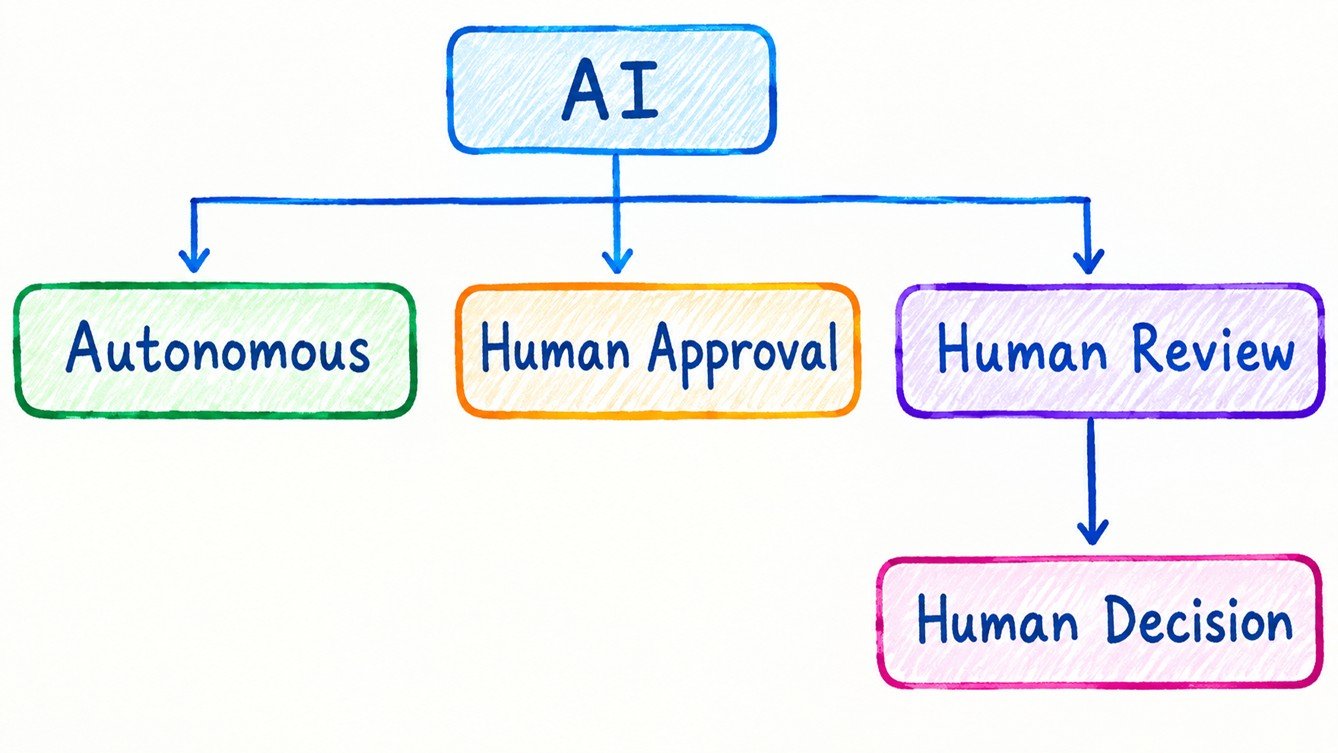
These are not maturity levels. They are distinct operating modes.
A mature system does not attempt to maximize autonomous execution. It assigns each action to the operating mode appropriate to its consequence, reversibility, uncertainty, regulatory context, and business impact.
Four Operating Modes
Autonomous
The system executes the action without human intervention.
This mode is appropriate when the action is sufficiently low risk, bounded in scope, reversible where practical, and supported by demonstrated system reliability.
Technical capability alone is not sufficient justification for autonomy.
The fact that an LLM can perform an action does not mean the architecture should allow it to perform that action autonomously.
Human Approval
The system prepares or proposes an action, but execution requires explicit human authorization.
AI Proposes
    ↓
Human Reviews
    ↓
Approve / Reject
    ↓
Execute
This pattern is appropriate when the system can perform the analysis or preparation but the consequence of execution warrants an explicit authorization boundary.
The approval should be meaningful. The human should have enough context, evidence, and explanation to understand what is being approved, why the action was proposed, and what the consequences will be.
A simple "Approve" button without meaningful decision context is not a strong human-control mechanism.
Human Review
The system executes the action, but the resulting decision or output is subsequently reviewed by a person.
This pattern is fundamentally different from human approval.
Approval is a pre-execution control.
Review is a post-execution control.
Human review can support quality assurance, compliance sampling, operational monitoring, and detection of systematic failure patterns. It is particularly useful where individual actions are low enough risk to execute automatically but the aggregate behavior still requires oversight.
Review should therefore feed back into evaluation and system improvement rather than exist as a passive audit activity.
Human Decision
The system does not execute the consequential action.
Instead, it provides analysis, evidence, recommendations, or decision support, while the human remains the decision authority.
This mode is appropriate when the decision involves significant judgment, material consequences, ambiguity, or a level of accountability that the organization has deliberately retained with a human decision-maker.
The AI can inform the decision without owning it.
Human Control Is an Architectural Boundary
Once human involvement is treated as an architectural control rather than a user-interface feature, several additional questions emerge.
The system must know:
- What triggers human involvement?
- Who is authorized to approve or decide?
- What information must be presented?
- What evidence supports the proposed action?
- What happens if the human rejects it?
- What happens if the human does not respond?
- Can the action expire while awaiting approval?
- Can another person approve it?
- Is the human decision recorded?
- Can the action be safely resumed afterward?
These questions become especially important in agentic systems.
An agent may formulate a plan and reach a point at which human intervention is required. The system must preserve the relevant execution state, suspend further action, present the decision context to the authorized human, capture the decision, and resume or terminate the workflow according to that decision.
Human-in-the-loop therefore requires more than a screen placed in front of an LLM.
It requires a controlled state transition.
Agent Execution
      ↓
Control Boundary Detected
      ↓
Execution Suspended
      ↓
Evidence + Proposed Action
      ↓
Authorized Human
      ↓
Approve / Reject / Modify
      ↓
State Transition
      ↓
Resume / Compensate / Terminate
Setting the Threshold
The critical architectural decision is determining which actions require which level of human control.
That threshold should not be determined by convenience, by the apparent confidence of the model, or by the desire to demonstrate maximum autonomy.
It should be established through explicit risk criteria.
Risk
What is the realistic consequence if the action is wrong?
The assessment should consider both the severity of the outcome and the likelihood of occurrence based on observed system performance.
Confidence
How reliable is the system's estimate of its own uncertainty?
Model confidence should not be treated as an objective measure of correctness. Where confidence is used as a control signal, it should be calibrated against empirical evaluation data.
Financial Impact
What is the potential financial exposure?
This includes both the direct transaction value and downstream effects such as remediation cost, customer compensation, operational disruption, or repeated errors at scale.
Regulatory and Contractual Requirements
Does law, regulation, policy, or contractual obligation require human involvement?
Where such requirements exist, the architecture must enforce them independently of the model's confidence or apparent capability.
Reversibility
Can the action be undone?
Reversibility should be assessed in practical terms. An action may technically be reversible while still imposing material cost, delay, customer disruption, or reputational consequences.
Customer Impact
Does the action directly affect a customer?
Actions involving customer access, financial consequences, commitments, sensitive information, or material service decisions may warrant stronger controls than equivalent internal actions.
Control Thresholds Should Be Action-Specific
One of the common mistakes in human-in-the-loop design is assigning a single autonomy policy to an entire application.
An application may contain dozens of actions with radically different risk profiles.
For example:
Retrieve Account Information        → Autonomous
Generate Customer Summary           → Autonomous
Recommend Resolution                → Human Review
Issue Customer Credit              → Human Approval
Change Contractual Terms            → Human Decision
Terminate Customer Relationship     → Human Decision
The important point is not the particular classification of these examples. It is the principle behind them.
Human control should be assigned to the action, not merely to the application.
This becomes even more important when an agent has access to multiple tools. The same agent may be permitted to retrieve information autonomously while requiring explicit approval before performing an external write operation.
The Human Must Remain an Informed Control Point
Human involvement does not automatically make a system safer.
A human who receives an opaque recommendation, incomplete evidence, excessive information, or an artificially compressed explanation may simply become a rubber stamp.
Effective human control therefore requires decision quality, not merely human presence.
The human should receive enough information to understand:
What is being proposed?
Why was it proposed?
What evidence supports it?
What uncertainty remains?
What will happen if approved?
What are the material consequences?
The system should also distinguish between evidence retrieved from authoritative sources, information supplied by the user, model-generated inferences, and actions already performed.
This preserves the human's ability to exercise actual judgment rather than merely ratify the model's recommendation.
Escalation Is Part of the Architecture
Escalation should not be treated as an exception path added after the primary workflow is designed.
It is part of the normal control model.
An agent may need to escalate because:
- Risk exceeds a defined threshold
- Evidence is contradictory
- Required information is unavailable
- The system detects ambiguity
- A policy boundary has been reached
- A transaction exceeds an authorized limit
- Repeated retries have failed
- The action is irreversible
- A regulatory requirement requires human involvement
- The system cannot establish sufficient confidence
The architecture should define what happens next.
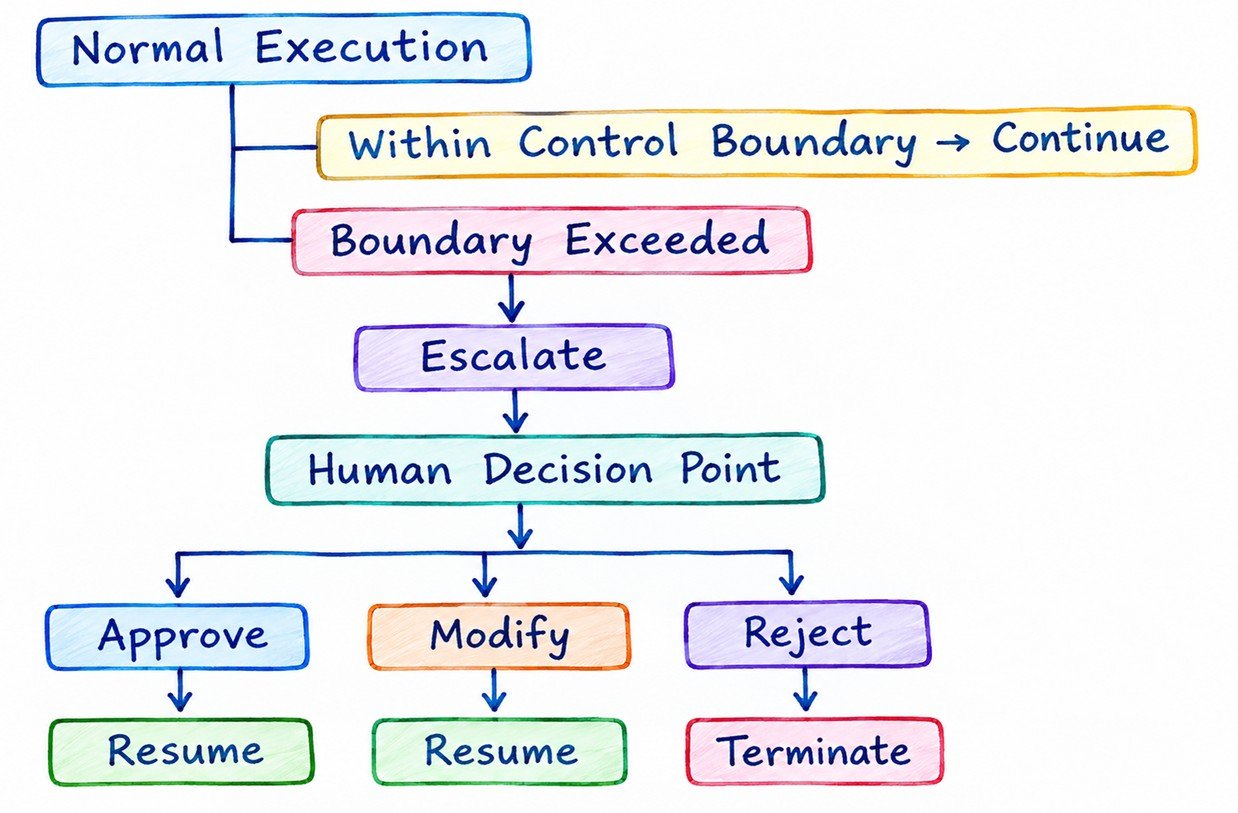
This turns escalation from a vague safety mechanism into a defined architectural behavior.
The Governing Principle
Across these operating modes, one principle provides the most useful calibration:
The less reversible and more consequential the action, the stronger the human control should be.
This principle is more durable than any fixed rule about which AI capabilities should or should not be autonomous.
A low-risk action that can be cleanly reversed may reasonably operate autonomously.
An action that changes financial position, creates a contractual obligation, exposes sensitive information, materially affects a customer, or produces an irreversible outcome may require explicit human control.
The architecture should therefore optimize not for maximum autonomy, but for appropriate autonomy.
The objective is not to keep humans involved everywhere. Nor is it to remove them wherever technically possible.
The objective is to place human judgment precisely where the consequences of automated judgment justify it.
That is the role of human-in-the-loop architecture in an enterprise LLM application: not a temporary safety net, but an explicit mechanism for allocating authority, accountability, and decision rights between humans and machines.
Model Architecture
Only after reasoning strategy, prompt architecture, output contracts, tools, agentic execution, state, memory, and human oversight have been defined should the architecture make its model decision.
That ordering is deliberate.
The model is an implementation component of the application architecture. It should satisfy the requirements established by the system, not define those requirements by virtue of what a particular model happens to support.
Teams that select a model first often end up designing the application around the model's capabilities, context limits, APIs, and interaction patterns. The architecture gradually becomes an extension of the model provider's platform.
A more disciplined approach works in the opposite direction:
Business Intent
      ↓
Intelligence Contract
      ↓
Application Pattern
      ↓
Context + Reasoning + Action
      ↓
Runtime Requirements
      ↓
Model Selection
      ↓
Model Routing
The model is selected because it satisfies the requirements of the architecture.
And that leads to a second important shift.
Do not think primarily in terms of the model.
Think in terms of a model portfolio.
Enterprise applications rarely have one model that is optimal for every workload. Different tasks have different requirements for capability, latency, context, reasoning, cost, modality, availability, and operational risk.
A representative architecture might look like this:
                     Model Gateway
                          │
          ┌───────────────┼───────────────┐
          ↓               ↓               ↓
     Small Model     General Model    Reasoning Model
          │               │               │
   Classification      Generation       Complex Reasoning
   Extraction          Summarization    Planning
   Routing             Transformation   Multi-step Analysis
The model gateway becomes the architectural boundary between the application and the underlying model providers.
That boundary is important because it allows model selection to evolve without forcing every application component to understand provider-specific endpoints, credentials, request formats, model identifiers, or operational policies.
Model Selection Is a Task-Level Decision
A small model handling classification is not a compromise.
It is often the correct architectural choice.
If a task can reliably be completed by a smaller, faster, less expensive model, using a frontier model adds cost and latency without necessarily adding meaningful business value.
Conversely, routing a genuinely complex reasoning problem to a model that cannot meet the required quality threshold simply because it is cheaper can create downstream costs through retries, human intervention, incorrect actions, and operational remediation.
The objective is therefore not to minimize model cost or maximize model capability in isolation.
It is to achieve the required quality at the required cost, latency, reliability, and risk level.
This is a task-level decision.
The Selection Criteria
Model selection should be based on a consistent set of architectural criteria rather than the model's reputation, benchmark position, or release date.
Capability
Can the model reliably perform the specific task at the required quality level?
General model capability is not enough. A model may be strong at generation but unsuitable for structured extraction, tool calling, multilingual processing, or a particular reasoning workload.
Capability must therefore be evaluated against the actual workload.
Latency
How quickly must the result be available?
Interactive applications, synchronous APIs, agent loops, and background batch processes impose very different latency requirements.
Latency should also be evaluated at the application level. A model that appears fast in isolation may become slow when combined with retrieval, multiple reasoning steps, tool calls, and validation.
Context Capacity
Can the model accommodate the actual context required by the application?
This includes system instructions, retrieved information, conversation history, tool results, intermediate state, and output requirements.
The relevant question is not simply whether the model advertises a large context window. It is whether the model can reliably operate within the application's required context envelope without creating unacceptable latency or cost.
Structured Output
Can the model reliably produce the schemas required by downstream systems?
If an application depends on structured output for routing, persistence, workflow transitions, or tool invocation, schema support and empirical adherence matter.
The model should not become a recurring source of structural failure that the application must continuously repair.
Tool Calling
Can the model reliably generate valid tool calls when the application requires external action?
Tool support should be evaluated not merely by whether an API exists, but by how reliably the model selects tools, constructs arguments, handles tool results, and operates within the application's authorization boundaries.
Reasoning Capability
Does the workload actually require advanced reasoning?
Not every task benefits from a reasoning-oriented model.
Classification, extraction, simple transformation, routing, and straightforward generation may not justify the additional latency and cost of a reasoning model.
The correct question is:
What level of reasoning does this task require to meet its quality and risk threshold?
Multimodality
Does the application need to process images, documents, audio, video, or other non-text modalities?
Multimodal capability should be selected because the workload requires it, not because the model happens to provide it.
Availability and Reliability
Can the model support the application's operational requirements?
This includes availability, rate limits, throughput, regional availability, service-level commitments where applicable, and behavior under degraded conditions.
A model that performs exceptionally well but cannot reliably serve production traffic is not a production-ready dependency.
Throughput
Can the model sustain expected traffic under realistic peak conditions?
Capacity must be considered against concurrency, request size, response size, agent iteration counts, retry behavior, and workload growth.
Average traffic is rarely the correct sizing point for an enterprise system.
Cost
What is the effective cost of completing the business task?
Per-token pricing alone is insufficient.
The architecture should consider:
Model Cost
+
Retrieval Cost
+
Reasoning Iterations
+
Tool Execution
+
Retries
+
Validation
+
Observability
+
Human Intervention
A cheaper model that requires additional calls or generates more failures may produce a higher total cost per successful task than a more capable model.
The relevant metric is therefore often cost per successful business outcome, not merely cost per model invocation.
Data Residency and Privacy
Where is data processed?
What data retention policies apply? Is customer data used for provider training? What controls exist for sensitive information? Which regions are available?
These are architecture and governance concerns, not procurement details to be addressed after implementation.
Vendor Dependency
How tightly does the application depend on a specific provider or model family?
A model choice creates an architectural dependency.
The architecture should therefore consider provider-specific APIs, proprietary features, model-specific prompt behavior, embeddings, tool formats, evaluation baselines, and migration effort.
Portability does not mean pretending every model is interchangeable. It means deliberately deciding where provider-specific behavior belongs and containing that dependency behind appropriate architectural boundaries.
Model Routing
Once multiple models exist in the architecture, model selection becomes a runtime decision.
This leads naturally to model routing.
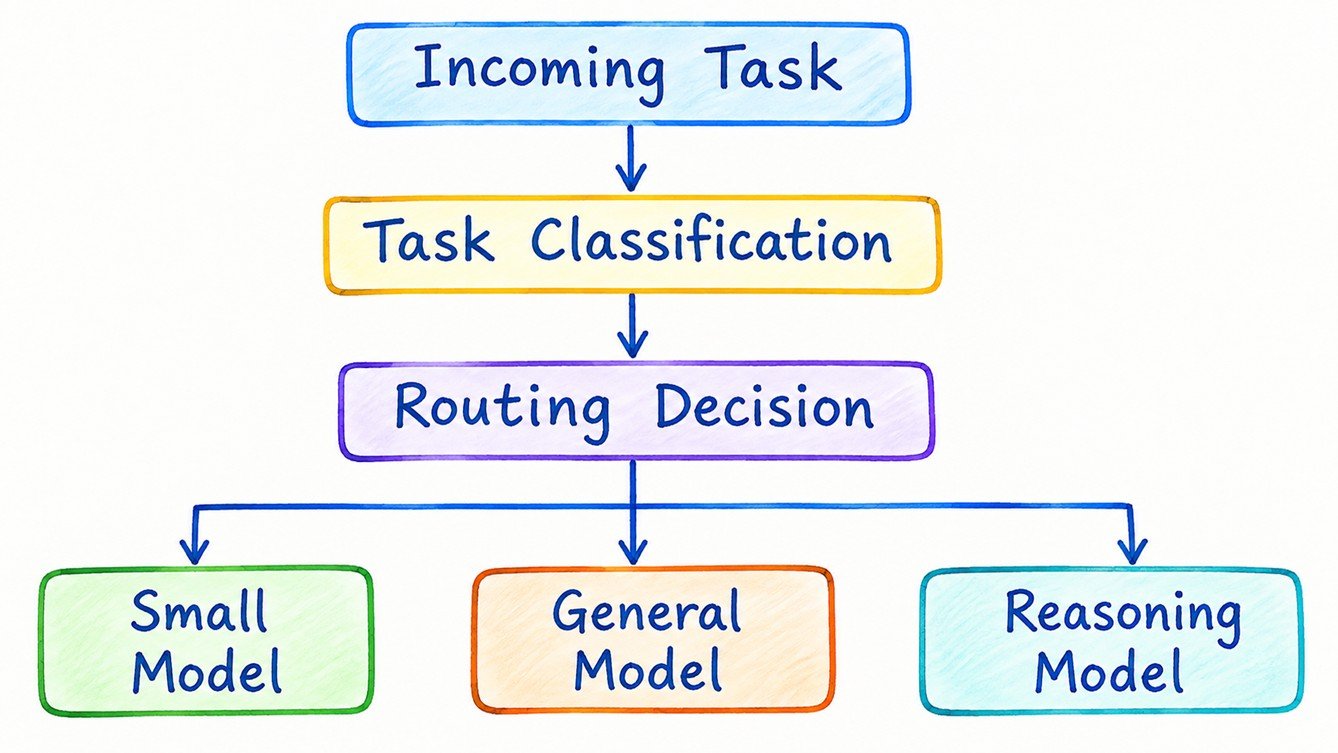
The router determines which model is appropriate for the task.
A simple routing policy might distinguish:
Classification
Extraction
Simple Transformation
        ↓
   Small Model

General Generation
Summarization
Standard Analysis
        ↓
  General Model

Complex Reasoning
Planning
Multi-step Analysis
High-complexity Decisions
        ↓
 Reasoning Model
The routing mechanism itself should remain simple where possible. Its purpose is not to solve the business problem. Its purpose is to classify the workload and select an appropriate execution path.
As the system matures, routing can incorporate additional signals:
Task Type
+
Complexity
+
Risk
+
Context Size
+
Latency Requirement
+
Cost Budget
+
Data Sensitivity
+
Model Availability
        ↓
Routing Decision
This makes model selection an explicit architectural policy rather than an implicit consequence of application code.
Model Routing Is an Economic Control
Model routing is not merely a performance optimization.
It is an economic control mechanism.
Consider an enterprise application processing one million requests. If every request is routed to the most capable model, the architecture effectively assumes that every task deserves the maximum available inference cost.
That assumption rarely survives production economics.
A better architecture reserves higher-cost inference for workloads that actually require it and uses smaller models for tasks that do not.
This creates a useful relationship:
Required Capability
        ↓
Minimum Sufficient Model
        ↓
Required Quality
        ↓
Acceptable Cost
        ↓
Production Scale
The principle is straightforward:
Use the least capable model that reliably satisfies the task's requirements.
"Least capable" does not mean "cheapest."
It means the minimum model capability that consistently satisfies the required quality, reasoning, latency, reliability, and risk thresholds.
Model Fallback and Resilience
Once the model becomes a runtime dependency, the architecture must also account for model failure.
What happens when the preferred model is unavailable?
A production model architecture may require:
Primary Model
     ↓
Failure / Capacity / Policy Constraint
     ↓
Fallback Model
     ↓
Reduced Capability Mode
     ↓
Human Escalation
Fallback should not be treated as a simple substitution.
A fallback model may have different reasoning capability, context capacity, structured-output behavior, tool-calling semantics, latency, or data-handling characteristics.
The architecture must therefore define which capabilities may degrade and which must not.
For example, a lower-capability model might be acceptable for summarization but unacceptable for a high-risk decision or an action requiring complex reasoning.
This creates an important distinction between availability resilience and capability equivalence.
A fallback model may keep the application available without being functionally equivalent to the primary model.
Model Selection Must Be Empirical
Model documentation and benchmark results provide useful starting points, but enterprise model selection ultimately requires workload-specific evaluation.
The relevant question is not:
"Which model is best?"
It is:
"Which model satisfies this workload's Intelligence Contract under our required quality, latency, cost, security, and reliability constraints?"
That requires representative evaluation data and measurable acceptance criteria.
The evaluation should test the model under realistic conditions, including the actual prompts, context, structured-output requirements, tools, latency expectations, and failure modes of the application.
A model that performs well on a public benchmark may still be unsuitable for a particular enterprise workload.
The Architectural Principle
Model architecture is therefore not the act of selecting a model.
It is the design of a model abstraction, selection, routing, evaluation, and resilience layer that allows the application to use the right model for the right workload under the right conditions.
The model should be replaceable where practical, routable where useful, measurable under real workloads, and bounded by the requirements established earlier in the architecture.
The mature enterprise question is not:
"Which model should we build around?"
It is:
"What model capability does each workload require, and how should the architecture provide that capability reliably and economically?"
That shift changes model selection from a technology preference into an architectural decision.
And once the model is treated as a runtime dependency rather than the center of the architecture, the application can evolve as models improve, prices change, providers emerge, workloads shift, and enterprise requirements become more demanding.
The architecture remains in control.
LLM Gateway
There is a recurring architectural mistake in enterprise AI programs: applications integrate directly with model providers.
It usually begins innocently. A team needs an LLM for a new feature, so a developer adds the provider's SDK to the application, configures an API key, makes the model call, and moves on to the next requirement.
Another team does the same thing a few weeks later.
Then another.
Over time, the organization accumulates multiple applications, multiple providers, multiple credentials, multiple integration patterns, and multiple interpretations of what authentication, retries, timeouts, logging, rate limiting, and failure handling should look like.
The immediate feature works.
The architecture gradually fragments.
The problem is not that an application can call an LLM directly. The problem is that provider integration becomes an application responsibility.
A more durable architecture introduces a dedicated LLM gateway between application workloads and model providers:
Applications
     ↓
LLM Gateway
     ↓
Model Routing
     ↓
┌──────────┬──────────┬──────────────┬─────────────────┐
Provider A Provider B  Provider C    Self-Hosted Model
The application expresses an inference requirement through a governed interface. The gateway determines how that requirement is fulfilled.
This creates an architectural boundary between application intent and model-provider implementation.
The application should not need to know which provider endpoint is being used, how credentials are managed, how retries are performed, how provider failover works, or how model usage is attributed to a business unit.
Those concerns belong at the platform boundary.
The Gateway Is More Than a Proxy
It is tempting to implement an LLM gateway as a thin reverse proxy that forwards requests from applications to providers.
That misses most of its architectural value.
A useful gateway becomes the control plane for enterprise model consumption.
It provides a consistent interface to the application while centralizing the concerns that must otherwise be implemented repeatedly across every consuming service.
The distinction is important:
Application
    │
    │  "I need this inference capability"
    ↓
LLM Gateway
    │
    ├── Policy
    ├── Routing
    ├── Security
    ├── Reliability
    ├── Observability
    ├── Cost
    └── Provider Integration
    │
    ↓
Model Provider
The gateway therefore becomes a strategic architectural boundary, not merely an integration convenience.
What the Gateway Centralizes
Authentication and Credential Management
Provider credentials should not be distributed across application code, configuration files, deployment pipelines, and individual service environments.
The gateway centralizes provider authentication, credential rotation, access control, and provider-specific authorization.
Applications authenticate to the enterprise gateway according to enterprise identity and access policies. The gateway manages the credentials required to interact with downstream model providers.
This establishes a cleaner separation:
Application Identity
        ↓
Enterprise Authorization
        ↓
LLM Gateway
        ↓
Provider Credential
Provider credentials become infrastructure concerns rather than application concerns.
Model Routing
The model routing strategy described earlier belongs naturally at the gateway boundary.
Applications should express what they require rather than hardcode which provider model must satisfy the request.
For example:
Task
 ↓
Capability Requirement
 ↓
Routing Policy
 ↓
Selected Model
This allows routing decisions to evolve without modifying every consuming application.
A change from one model to another should ideally be a platform policy change, not a distributed application migration.
Quotas and Rate Limits
The gateway provides a central enforcement point for consumption limits.
Quotas can be applied by:
- Application
- Team
- Business unit
- Tenant
- Environment
- Model
- Provider
- Cost center
Rate limiting protects both the organization and the downstream providers.
Without centralized control, one rapidly scaling application can consume a disproportionate share of provider capacity or exhaust a shared budget before other workloads have an opportunity to operate.
Caching
Some workloads produce repeatable or sufficiently stable requests where caching is appropriate.
Caching can reduce:
- Model invocation cost
- Response latency
- Provider load
- Repeated computation
Caching policy must, however, respect context sensitivity, data classification, freshness requirements, and tenant isolation.
Not every LLM request should be cached.
The gateway should therefore treat caching as a governed capability rather than a generic performance optimization.
Observability and Logging
A centralized gateway provides a common telemetry boundary for model interactions.
Depending on data sensitivity and applicable policy, telemetry may capture:
- Application identity
- Model selected
- Provider
- Request metadata
- Token usage
- Latency
- Response metadata
- Errors
- Retries
- Fallbacks
- Cost
- Policy decisions
- Correlation identifiers
This enables the organization to answer questions that become difficult when model integrations are scattered across applications:
Which applications are using which models?
How much inference are we consuming?
Where is latency increasing?
Which providers are failing?
How often are fallbacks occurring?
Which workloads are generating the highest cost?
Which applications are exceeding their quotas?
The gateway turns model interaction from an application-specific implementation detail into an observable enterprise capability.
Policy Enforcement
The gateway also provides a strategic location for enforcing policies consistently.
Policies may govern:
- Approved models
- Approved providers
- Data classification
- Regional processing requirements
- Sensitive-data handling
- Model usage restrictions
- Application entitlements
- Maximum token budgets
- Allowed capabilities
- Logging requirements
- Regulatory controls
This does not mean every AI policy belongs in the gateway.
Application-specific business rules should remain in the application or domain layer.
The gateway should enforce cross-cutting model consumption policies that need to apply consistently across workloads.
That distinction prevents the gateway from becoming an unstructured dumping ground for every form of business logic.
Reliability and Fallback
A production model dependency will eventually encounter throttling, provider degradation, capacity constraints, network failures, or service outages.
A gateway provides a natural location for resilience policies:
Request
   ↓
Primary Model
   │
   ├── Success → Response
   │
   └── Failure
          ↓
     Retry Policy
          ↓
     Fallback Model
          ↓
     Alternate Provider
          ↓
     Degraded Mode
          ↓
     Human Escalation
Fallback must not be treated as a blind substitution.
A different model may have different capabilities, context limits, structured-output behavior, tool-calling semantics, latency, or safety characteristics.
The gateway should therefore understand capability compatibility, not merely provider availability.
The question is not:
"Can another model answer?"
It is:
"Can another model satisfy the application's required contract under the conditions in which the fallback is being invoked?"
Cost Attribution
Model usage becomes difficult to manage when provider invoices are the primary source of cost visibility.
The gateway can associate inference consumption with application and organizational dimensions such as:
Application
   ↓
Team
   ↓
Business Unit
   ↓
Cost Center
   ↓
Model Usage
   ↓
Inference Cost
This creates the foundation for chargeback, showback, budget controls, optimization, and capacity planning.
More importantly, it allows architecture teams to reason about AI economics at the workload level rather than treating model expenditure as a single enterprise-wide technology bill.
Provider Abstraction
Provider abstraction is one of the gateway's most strategically important responsibilities.
Without a gateway, provider-specific integration tends to leak into application architecture:
Application
 ├── Provider SDK
 ├── Provider Authentication
 ├── Provider API
 ├── Provider Error Handling
 └── Provider Model Configuration
With a gateway:
Application
      ↓
Enterprise LLM Interface
      ↓
LLM Gateway
      ↓
Provider-Specific Integration
This does not make models interchangeable.
They are not.
Different providers expose different capabilities, APIs, context limits, tool interfaces, multimodal capabilities, pricing structures, and operational characteristics.
The purpose of abstraction is therefore not to hide every difference.
It is to contain provider-specific differences behind a deliberate architectural boundary.
That containment reduces the blast radius of provider changes.
The Gateway as an Architectural Control Plane
Once model interactions are centralized, the gateway becomes more than shared infrastructure.
It becomes a control plane for enterprise inference.
A useful conceptual model is:
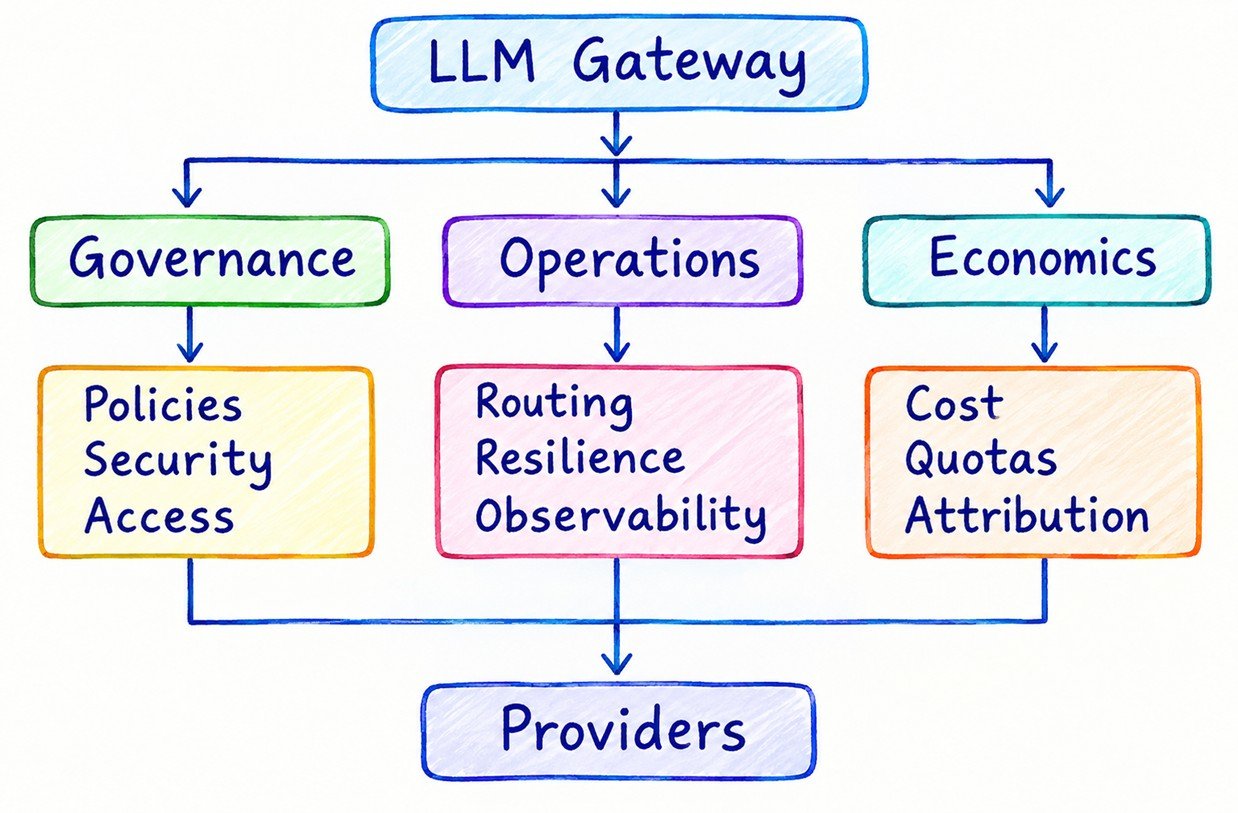
This is where the gateway earns its place in enterprise architecture.
It establishes one governed boundary through which model consumption can be controlled, observed, measured, and evolved.
What the Gateway Should Not Become
Centralization creates its own risk.
A gateway should not become a monolithic business-logic layer through which every application-specific decision is forced.
The architecture should preserve clear responsibility boundaries:
Application
    │
    ├── Business Logic
    ├── Domain Rules
    └── User Experience
          ↓
LLM Gateway
    │
    ├── Model Access
    ├── Routing
    ├── Cross-Cutting Policy
    ├── Reliability
    ├── Observability
    └── Cost Controls
          ↓
Providers
Business-specific authorization, workflow logic, domain decisions, and application state should remain with their appropriate owners.
The gateway governs model consumption. It should not become the enterprise's universal orchestration engine.
The Strategic Payoff
None of these capabilities is particularly exotic in isolation.
Authentication can be implemented in an application. Logging can be implemented in an application. Rate limiting can be implemented in an application. Cost tracking can be implemented in an application.
The architectural value emerges from centralization and consistency.
Without a gateway, every application develops its own interpretation of model integration.
With a gateway, the organization develops a common enterprise capability.
That difference becomes significant as AI adoption expands.
The organization can introduce a new provider without modifying every application. It can change routing policy without redeploying every consumer. It can establish a new usage control centrally. It can observe model consumption across workloads. It can implement provider fallback without requiring every application team to understand every provider's failure semantics.
The gateway therefore changes the unit of architecture.
Without it, the organization has a collection of applications that happen to use LLMs.
With it, the organization begins to operate LLM consumption as an enterprise platform capability.
That is the strategic purpose of the LLM Gateway.
It is not merely a proxy.
It is the architectural boundary that separates enterprise AI applications from the volatility of the model-provider layer, while providing the governance, routing, reliability, observability, and economic controls required to operate inference at scale.
Guardrails
There is a common but costly assumption that guardrails mean one thing: a content filter positioned between the model and the user, checking the final response before it leaves the system.
That is a useful control, but it is not a guardrail architecture.
A final-response filter operates at the end of the inference path, after the system may already have accepted malicious input, retrieved unauthorized information, exposed sensitive context to the model, invoked an inappropriate tool, or taken an irreversible action. At that point, prevention has already given way to detection.
Enterprise guardrails must therefore be designed as a distributed control system, with controls positioned at the points where risk is introduced, transformed, or acted upon.
A useful architecture is:
Input Guardrails
       ↓
Context Guardrails
       ↓
Model Guardrails
       ↓
Tool Guardrails
       ↓
Output Guardrails
       ↓
Business Policy Guardrails
Each layer has a distinct responsibility. The objective is not to repeat the same check six times. It is to ensure that each control addresses a class of risk that the other layers are not designed to address.
This creates an important architectural principle:
A guardrail should be positioned as close as possible to the point where the risk is introduced, and before that risk can propagate to a more consequential layer.
An invalid request rejected at the input boundary consumes little more than the cost of the validation itself. The same problem discovered after retrieval, reasoning, tool invocation, and downstream execution may have already consumed significant compute, exposed sensitive information, changed application state, or created an external side effect.
The economic and operational consequence is straightforward: early controls prevent work; later controls contain damage.
A mature guardrail architecture therefore uses multiple layers of defense rather than relying on a single final filter.
Input Guardrails
Input guardrails establish the first trust boundary. They examine what enters the system before the request is allowed to participate in downstream processing.
PII detection identifies personally identifiable information in incoming requests so that sensitive data can be handled according to policy. Depending on the classification, the system may mask, tokenize, restrict, or reject the information before it reaches logs, prompts, or model context.
Malicious prompt detection identifies adversarial input patterns, including attempts to manipulate system behavior, bypass restrictions, or introduce prompt injection content. Detection at this boundary does not eliminate the need for downstream defenses, but it prevents known classes of hostile input from receiving unnecessary access to deeper layers of the system.
Content policy establishes the baseline boundary for what the application is prepared to process. Requests that are clearly prohibited, unsupported, or outside the application's intended scope should be rejected or redirected before the system spends resources reasoning about them.
Input guardrails answer a fundamental question:
Should this request be allowed to enter the application workflow at all?
Context Guardrails
Once a request is admitted, the next question is not what the model should answer. It is what information the model is permitted to see.
This is where context guardrails become critical.
Authorization verifies that the requesting identity has the required rights to access the information or invoke the capability associated with the request. Authorization should be enforced by the application and its policy infrastructure, not inferred by the model from natural-language instructions.
Tenant isolation prevents data, conversation history, retrieved documents, embeddings, metadata, or other contextual information belonging to one tenant from becoming available to another. In a multi-tenant enterprise platform, this is a fundamental security boundary, not merely a retrieval concern.
Retrieval filtering ensures that only information the requesting identity is authorized to access becomes eligible for retrieval and context construction. Access control must therefore participate in retrieval itself rather than being applied only after the model has already received the information.
This produces an important distinction:
The model may know what was retrieved.
The application must decide what may be retrieved.
Context guardrails answer:
What information is this system permitted to provide to the model for this request?
Model Guardrails
Model-level guardrails govern the inference boundary itself. They constrain how the model is allowed to process the supplied instructions and context and provide another layer of defense against unsafe or unintended behavior.
This layer can include system instruction enforcement, model safety policies, jailbreak detection, topic restrictions, response constraints, and model-specific safety controls.
Model guardrails are particularly important because the model is probabilistic. Even when the input is valid and the retrieved context is authorized, the resulting inference may still violate application expectations.
The architectural objective is not to assume that the model will always follow instructions correctly. It is to establish explicit boundaries around what the model is expected and permitted to produce.
This leads to a broader principle:
Model alignment is not a substitute for application controls.
The application must remain responsible for enforcing security, authorization, and business policy even when the model itself provides safety mechanisms.
Tool Guardrails
The moment an LLM can invoke a tool, the architecture moves from information processing into controlled execution.
Tool guardrails therefore govern what the system is permitted to do, under what authority, and within what operational boundaries.
Permission checks verify at invocation time that the requested action is authorized for the specific identity, tenant, workflow, resource, and context involved. Authorization should be evaluated when the action is actually requested, not merely assumed because the tool was available to the application.
Parameter validation verifies that arguments supplied by the model conform to the tool contract and remain within acceptable business and technical bounds. A syntactically valid request can still be operationally invalid.
Action limits constrain the volume, frequency, value, or scope of actions that can occur within a request, workflow, or session. These limits prevent an incorrect reasoning loop from multiplying a small error into a large operational consequence.
Additional controls may include idempotency, transaction boundaries, approval requirements, rate limits, timeout policies, and explicit separation between read and write capabilities.
The governing principle is simple:
The model may propose an action, but the application must decide whether that action is authorized and permitted to execute.
Tool guardrails answer:
What is the system allowed to do, and under what conditions may it do it?
Output Guardrails
Output guardrails examine the result after inference and any permitted execution have completed, but before the response is delivered to a user or passed to another system.
Schema validation verifies that the response conforms to the structural contract defined by the application. This prevents malformed model output from being interpreted as a valid downstream instruction.
Sensitive data filtering examines outbound content for information that should not leave the application's trust boundary. This is particularly important when the model has access to broad enterprise knowledge or information originating from multiple systems.
Grounding and factuality checks evaluate whether material claims are supported by retrieved evidence, verified sources, or other application-defined evidence. A response can be structurally valid and policy-compliant while still being factually unsupported.
Output controls therefore represent more than content moderation. They provide the final opportunity to prevent an invalid or unsafe result from crossing an application boundary.
But they should remain the last line of defense, not the primary line of defense.
Business Policy Guardrails
Technical safety does not guarantee business correctness.
A model can produce a valid response, invoke an authorized tool, and operate within technical limits while still violating an organization's business rules.
Business policy guardrails address that distinction.
Policy rules enforce organizational decisions that are independent of model behavior. These may include eligibility rules, approval requirements, segregation of duties, pricing policies, escalation requirements, or restrictions on specific business actions.
Transaction limits constrain financial or operational exposure. A system may be highly confident in a recommendation and still be prohibited from executing a transaction above a defined threshold without additional authorization.
Regulatory constraints enforce obligations imposed by law, regulation, contractual commitments, or industry-specific requirements. These controls must be implemented as explicit application and platform policies rather than delegated to the model's interpretation of compliance requirements.
This distinction is fundamental:
Model correctness
        ≠
Business correctness
        ≠
Regulatory compliance
A model can be correct according to its information and reasoning while the resulting action remains impermissible under organizational policy.
Business policy guardrails answer:
Even if the model is correct, is the proposed outcome permitted?
Guardrails as a Layered Control System
The six layers should not be understood as six independent filters placed sequentially in a pipeline. They form a defense-in-depth architecture, with each layer controlling a different trust boundary.
                    Enterprise AI Application
                              │
                              ↓
                    ┌───────────────────┐
                    │ Input Guardrails  │
                    └─────────┬─────────┘
                              ↓
                    ┌───────────────────┐
                    │ Context           │
                    │ Guardrails        │
                    └─────────┬─────────┘
                              ↓
                    ┌───────────────────┐
                    │ Model Guardrails  │
                    └─────────┬─────────┘
                              ↓
                    ┌───────────────────┐
                    │ Tool Guardrails   │
                    └─────────┬─────────┘
                              ↓
                    ┌───────────────────┐
                    │ Output            │
                    │ Guardrails        │
                    └─────────┬─────────┘
                              ↓
                    ┌───────────────────┐
                    │ Business Policy   │
                    │ Guardrails        │
                    └─────────┬─────────┘
                              ↓
                       External World
The layers also operate at different stages of the application's decision path.
Request
  ↓
Can we accept it?
  ↓
What may the system know?
  ↓
What may the model produce?
  ↓
What may the system execute?
  ↓
What may leave the system?
  ↓
What is the organization permitted to do?
This is the deeper architectural value of guardrails. They convert an inherently probabilistic system into a system with explicit control boundaries.
A mature design also recognizes that not every guardrail should produce the same response. Depending on the risk, a control may allow, transform, redact, restrict, challenge, require approval, escalate, or terminate execution.
That makes guardrails part of the application's control flow rather than a collection of filters operating outside it.
The Architectural Takeaway
A system with only output guardrails effectively waits until the end of the pipeline and asks whether the damage can still be prevented.
An enterprise-grade system distributes controls across the lifecycle of the request:
Input
  ↓
Context
  ↓
Inference
  ↓
Action
  ↓
Output
  ↓
Business Decision
Each boundary has a different risk profile and therefore requires a different control strategy.
The objective is not to make the system incapable of acting. The objective is to make its behavior bounded, observable, authorized, and recoverable.
This leads to the central principle:
Guardrails are not a safety net placed around an LLM. They are the control architecture that determines what the AI system may receive, know, infer, do, return, and ultimately change.
The strongest guardrail architecture does not assume that one control will catch every failure. It assumes that failures will occur and places controls so that they are detected as early as practical, contained before they propagate, and prevented from crossing boundaries where their consequences become more expensive or irreversible.
That is what makes guardrails an architectural capability rather than a decorative safety layer.
Security Architecture
Security teams approaching LLM applications from a conventional application security background often begin with a familiar checklist: authentication, authorization, encryption in transit, encryption at rest, secrets management, network controls, and auditability. Those controls remain essential. They simply do not cover the entire system.
An LLM application introduces a new security surface because the system does not merely execute deterministic application logic. It interprets language, reasons over information, selects actions, invokes tools, maintains state, and generates outputs. Each of those capabilities creates opportunities for an attacker to influence behavior without necessarily exploiting a conventional software vulnerability.
LLM security is therefore not a replacement for application security. It is an extension of it.
The conventional security stack still applies, but the architecture grows additional control boundaries:
Identity
   ↓
Authentication
   ↓
Authorization
   ↓
Tenant Isolation
   ↓
Data Protection
   ↓
Prompt Security
   ↓
Tool Security
   ↓
Model Security
   ↓
Output Security
   ↓
Audit and Forensics
The first four layers remain familiar. Identity establishes who or what is requesting access. Authentication establishes that identity. Authorization determines what that identity is permitted to access or execute. Tenant isolation prevents one security domain from crossing into another.
The fundamental difference begins once information and instructions enter the model's inference path.
The security question is no longer only:
Can this identity access this resource?
It also becomes:
What can this identity cause the AI system to know, infer, reveal, and do?
That is the security problem introduced by LLM applications.
The New Attack Surface
A conventional application is primarily attacked through interfaces, data, dependencies, infrastructure, and executable code. An LLM application adds another dimension: the interpretation of information and instructions.
The model may treat user input, retrieved documents, tool results, web content, application state, and system instructions as part of the same reasoning process. An attacker therefore does not always need to compromise the underlying system. In some cases, influencing what the model believes, prioritizes, or attempts to do can be enough.
This creates a distinct class of attack surfaces.
Prompt injection occurs when an attacker introduces instructions intended to alter the model's behavior or override the application's intended instruction hierarchy. The attack may attempt to bypass restrictions, expose information, or redirect execution toward an unintended objective.
Indirect prompt injection is more subtle. The malicious instruction does not originate in the user's request. It is embedded in information the application retrieves or processes, such as a document, webpage, email, ticket, knowledge-base record, or other external content. The application believes it is retrieving data, while the model may interpret part of that data as an instruction.
This creates a critical architectural distinction:
Data for the Application
        ≠
Instructions for the Model
A secure architecture must not assume that retrieved content is trustworthy simply because it came from an approved data source.
Data exfiltration occurs when the system is manipulated into revealing information that the requester should not receive. The target may include system instructions, confidential enterprise knowledge, internal context, credentials, another user's information, or data belonging to another tenant.
Excessive agency occurs when an AI system is granted more authority than its business task requires. Broad tool access, unrestricted write capabilities, excessive transaction limits, or autonomous execution can transform a model error from an incorrect response into an operational incident.
This is why least privilege applies to AI systems just as it applies to conventional software:
An AI system should receive only the capabilities required to accomplish its authorized objective.
Tool abuse occurs when a legitimate capability is used for an illegitimate purpose. An attacker may manipulate the model into invoking a sanctioned tool in a way that violates the intended business purpose of that tool. The underlying API may be functioning exactly as designed. The security failure occurs because the AI system was permitted to connect intent to execution without sufficient controls.
Privilege escalation occurs when an AI workflow obtains access beyond its intended authority. In an agentic system, this may not require a single obvious vulnerability. A sequence of individually authorized operations can sometimes be composed into an outcome that was never intended to be authorized as a whole.
This makes compositional authorization particularly important for agentic architectures. Security cannot always be established by validating each tool independently. The system must also consider what a sequence of actions can accomplish collectively.
Sensitive data leakage occurs when confidential information crosses a boundary where it should not. The cause may be incorrect retrieval filtering, excessive context, insufficient tenant isolation, inappropriate tool results, weak output controls, or simply granting the model access to information that the requesting workflow did not actually require.
The architectural principle is straightforward:
Access to Data
        ≠
Need for Data
A model should not receive information merely because the application technically has access to it.
Cross-tenant contamination is particularly serious in shared AI platforms. Data, embeddings, retrieval results, conversation state, cached responses, tool results, or memory from one tenant must never become available to another tenant outside explicitly authorized sharing boundaries.
Tenant isolation therefore needs to extend beyond databases and APIs into the entire AI context path.
Poisoned knowledge occurs when information used by the AI system has been deliberately manipulated. If compromised content enters a trusted retrieval system, the model may faithfully reason over false information and produce a response that appears authoritative precisely because the architecture has treated the poisoned source as trusted knowledge.
This creates a security dependency that conventional application architectures rarely face in the same form:
Source Integrity
      ↓
Ingestion Integrity
      ↓
Knowledge Integrity
      ↓
Retrieval Integrity
      ↓
Inference Integrity
      ↓
Output Integrity
Security must therefore extend into the knowledge lifecycle, not stop at the application boundary.
Malicious documents represent another variation of this problem. A document uploaded for summarization, analysis, extraction, or retrieval may contain embedded instructions designed to influence the model processing it. File ingestion therefore cannot be treated as a passive data operation. Parsing, content extraction, metadata handling, indexing, retrieval, and model consumption all become part of the security boundary.
Model supply-chain risk extends the attack surface beyond the organization's own infrastructure. Foundation models, model weights, inference infrastructure, open-source libraries, model-serving frameworks, plugins, datasets, and other dependencies can introduce risks that the consuming organization did not create and may not be able to fully inspect.
Model selection is therefore also a supply-chain decision.
Organizations need visibility into provenance, provider controls, data handling, model versions, dependency chains, isolation mechanisms, update practices, and the contractual boundaries surrounding model usage.
Security Must Follow the Inference Path
The defining characteristic of LLM security is that the attack surface follows the path through which information and authority move.
Consider the basic execution flow:
User Input
    ↓
Prompt Construction
    ↓
Context Retrieval
    ↓
Model Inference
    ↓
Tool Selection
    ↓
Tool Execution
    ↓
State Change
    ↓
Output
Each transition creates a different security question.
Input
  → Can this request enter?

Context
  → What information may this request access?

Inference
  → What instructions and content may influence the model?

Action
  → What is the model allowed to invoke?

Execution
  → Is this specific operation authorized?

State
  → What may this operation change?

Output
  → What information may leave the boundary?
This is why security cannot be implemented as a single control surrounding the model. The model is only one component within a larger chain of information, reasoning, authority, and execution.
Security Boundaries Must Follow Authority
One of the most important architectural consequences of agentic AI is that security boundaries must follow authority, not merely components.
A model may have access to ten tools, but a particular task may require only one. A user may have access to a business application, but that does not mean every AI workflow operating on the user's behalf should inherit all of that user's capabilities.
Similarly, a retrieval system may have access to an entire knowledge repository, but a particular request may be authorized to retrieve only a subset of that information.
The architecture should therefore establish explicit boundaries between:
Identity
   ↓
User Authority
   ↓
Application Authority
   ↓
AI Workflow Authority
   ↓
Tool Authority
   ↓
Data Authority
These boundaries should not be collapsed simply because the AI system is acting on behalf of a user.
The model is an interpreter of instructions and context. It should not become the authority that determines its own permissions.
Security Controls Must Be Enforced Outside the Model
A recurring architectural mistake is to place security requirements inside prompts and assume that the model will enforce them.
A system instruction might say:
Do not disclose confidential information.
That instruction can be useful, but it is not an authorization mechanism.
Likewise:
Only call this tool when appropriate.
That is not a permission boundary.
Security-critical controls must be enforced by deterministic components wherever practical.
Model
  ↓
Proposed Intent
  ↓
Policy Engine
  ↓
Authorization
  ↓
Validation
  ↓
Execution
The model can recommend an action. The application determines whether the action is authorized.
The model can identify relevant information. The retrieval layer determines whether that information may be provided.
The model can generate an output. The application determines whether that output may cross the relevant boundary.
This separation preserves a fundamental security principle:
The model may participate in a security decision, but it should not be the sole enforcement point for a security decision.
From Security Checklist to Security Architecture
Traditional security reviews often ask whether the application has authentication, authorization, encryption, vulnerability management, logging, and network controls.
Those questions remain necessary. They are no longer sufficient.
An enterprise LLM security review should additionally examine:
- Prompt security: Can untrusted content influence system instructions or model behavior?
- Context security: Can unauthorized information enter the model's context?
- Retrieval security: Are access controls enforced before information reaches the model?
- Tool security: Can the model invoke capabilities outside its intended authority?
- Agent security: Can multiple individually valid actions combine into an unauthorized outcome?
- State security: Can model-driven execution modify state outside its authorized boundary?
- Output security: Can sensitive or untrusted information leave the system?
- Knowledge security: Can poisoned or manipulated content become trusted enterprise knowledge?
- Model supply-chain security: What dependencies and provider risks are inherited?
- Auditability: Can the organization reconstruct what the system knew, decided, invoked, changed, and returned?
The last question is particularly important.
For conventional applications, an audit trail often focuses on who accessed what and when. For AI applications, incident investigation may also require reconstructing the decision trajectory:
Identity
   ↓
Input
   ↓
Retrieved Context
   ↓
Model Decision
   ↓
Tool Selection
   ↓
Authorization Decision
   ↓
Tool Execution
   ↓
State Change
   ↓
Output
Without this evidence, an organization may know that an AI system performed an unauthorized action without being able to determine why it happened or which control failed.
The Architectural Takeaway
LLM security is not conventional application security with a model added to the architecture.
It is conventional security extended into the inference, context, reasoning, action, and knowledge paths created by AI.
The critical shift is from protecting only the application and its resources to protecting the entire chain through which an AI system can transform information into action.
Identity
   ↓
Access
   ↓
Data
   ↓
Context
   ↓
Inference
   ↓
Action
   ↓
State
   ↓
Output
   ↓
Audit
Each boundary must have an explicit security owner, enforceable controls, observable decisions, and a defined failure behavior.
The organizations that approach LLM security this way do not assume that the model will behave correctly simply because it has been instructed to do so. They design the surrounding architecture so that an incorrect, manipulated, or compromised inference cannot automatically become an unauthorized action.
That is the fundamental security posture for enterprise LLM applications:
Do not secure only the model. Secure everything the model can see, influence, invoke, change, and cause the system to do.
Evaluation Architecture
Evaluation is perhaps the most important distinction between conventional software engineering and enterprise LLM application engineering.
It is also one of the most underestimated.
Traditional applications are generally built around a deterministic contract:
Input
  ↓
Expected Output
Given the same input, a correctly functioning deterministic application should produce the same result, subject to known environmental conditions. A unit test captures this relationship. If the implementation has not changed, the test should continue to produce the same result.
This assumption has shaped software testing for decades.
LLM applications operate under a fundamentally different contract:
Input
  ↓
Probabilistic Output
The same input can produce different outputs across executions, and more than one output may be acceptable.
This is not necessarily a defect. It is an inherent characteristic of probabilistic inference.
The architectural consequence is significant. The question is no longer simply:
Did the system produce the expected output?
It becomes:
Did the system produce an acceptable outcome, within the required quality, safety, reliability, and business boundaries?
That distinction changes the role of testing.
Unit tests, integration tests, contract tests, and end-to-end tests remain necessary. They validate deterministic components and known system behavior. They do not, by themselves, establish confidence in the behavior of a probabilistic AI system.
An enterprise LLM application therefore requires an evaluation architecture, not merely a larger test suite.
Evaluation Is a System, Not a Metric
A common mistake is to select one metric and treat it as the quality score for the entire application.
That approach is fundamentally inadequate because an AI system can perform well along one dimension while failing catastrophically along another.
A retrieval system can find the right documents while the model misinterprets them.
A model can produce a factually correct answer that fails to address the user's actual intent.
An agent can complete a task while taking an unnecessarily expensive or risky path.
A response can be technically correct while exposing confidential information.
And an application can perform well across all of these technical dimensions while failing to produce the business outcome for which it was built.
Evaluation must therefore be multidimensional.
A useful evaluation architecture spans at least five dimensions:
Retrieval
    ↓
Generation
    ↓
Agent Behavior
    ↓
Safety
    ↓
Business Outcome
These dimensions are related, but they are not interchangeable.
Retrieval Evaluation
For retrieval-augmented applications, retrieval quality establishes an important constraint on everything that follows.
If the required information is never retrieved, the model cannot reliably reason over it. Generation quality cannot compensate for a retrieval system that consistently supplies the wrong evidence.
The evaluation therefore begins before the model generates a response.
Recall measures how much of the relevant information the retrieval system successfully surfaces from the available candidate set. Low recall means that relevant evidence is being missed.
Precision measures how much of the retrieved material is actually relevant. Low precision means that the model is being given unnecessary or distracting information.
MRR, or Mean Reciprocal Rank, measures how early the first relevant result appears in the ranked results. This matters because relevant information positioned deep in the result set may be less useful than relevant information surfaced immediately.
NDCG, or Normalized Discounted Cumulative Gain, evaluates the quality of the ranking across multiple results, giving greater importance to highly relevant material appearing near the top.
Retrieval relevance provides the qualitative dimension. It asks whether the retrieved information actually addresses the intent of the request rather than merely matching terms or semantic similarity.
The retrieval evaluation chain can therefore be viewed as:
Candidate Generation
      ↓
Recall
      ↓
Filtering
      ↓
Precision
      ↓
Ranking
      ↓
MRR / NDCG
      ↓
Context Relevance
This leads to an important principle:
Retrieval evaluation should measure whether the system found the right evidence, not merely whether it found something.
Generation Evaluation
Once relevant context has been assembled, the next question is whether the model used that information correctly.
Generation evaluation must separate several properties that are often collapsed into a single judgment of whether an answer "looks good."
Correctness evaluates whether the factual and logical content of the response is accurate.
Faithfulness evaluates whether the response remains consistent with the evidence supplied to the model. A fluent response that introduces unsupported claims is not faithful simply because the claims sound plausible.
Relevance evaluates whether the response addresses the actual intent of the request rather than answering a nearby or superficially related question.
Completeness evaluates whether the response covers the information required to satisfy the task. An answer can be correct and relevant while remaining incomplete.
Groundedness evaluates whether material claims can be traced to supporting evidence, retrieved sources, or other authoritative information available to the application.
These dimensions expose an important distinction:
Fluency
  ≠
Correctness
  ≠
Faithfulness
  ≠
Groundedness
A polished response is not necessarily a reliable response.
For enterprise systems, generation evaluation should therefore examine not only what the model said, but why the system had sufficient evidence to say it.
Agent Evaluation
Agentic applications introduce another dimension because the final answer is only one part of the system's behavior.
An agent may call multiple tools, modify state, retry failed operations, revise its plan, and make intermediate decisions before producing an outcome.
Consequently:
For an agent, the trajectory is part of the result.
Task completion measures whether the agent achieved the intended objective.
Tool selection evaluates whether the agent selected appropriate tools for the task and used them within their intended purpose.
Trajectory correctness evaluates whether the sequence of decisions and actions was appropriate, not merely whether the final state happened to be acceptable.
Unnecessary actions identify steps that contributed little or nothing to the objective while adding latency, cost, or risk.
Failure recovery evaluates how the agent responds when a tool fails, information is missing, an assumption proves incorrect, or an intermediate action produces an unexpected result.
A useful agent evaluation model is:
Goal
  ↓
Plan
  ↓
Tool Selection
  ↓
Authorization
  ↓
Execution
  ↓
Observation
  ↓
State Update
  ↓
Next Decision
  ↓
Completion / Recovery / Escalation
Evaluation should therefore capture the trajectory rather than evaluating only the final response.
This becomes particularly important as autonomy increases. An agent that reaches the correct outcome through an unnecessarily long or risky trajectory may appear successful in a simple outcome metric while remaining operationally unsuitable for production.
Safety Evaluation
Safety represents another independent dimension.
A system can be factually correct and still be unsafe. It can complete the requested task and still violate security policy. It can produce an excellent answer and still disclose information the user was never authorized to receive.
Jailbreak resistance evaluates whether the system maintains its intended behavior when users deliberately attempt to circumvent its controls.
Prompt injection resistance evaluates whether the system can maintain the distinction between trusted instructions and untrusted content, particularly when retrieved documents, webpages, emails, or other external information contain adversarial instructions.
Data leakage evaluates whether sensitive or restricted information can escape through model output, tool responses, retrieval, context assembly, memory, logs, or other application paths.
Safety evaluation should also include the system's behavior under adversarial conditions rather than relying exclusively on normal test cases.
The objective is not to prove that a system can never be attacked. It is to determine how the system behaves when its boundaries are deliberately tested.
Business Evaluation
Technical evaluation ultimately serves a larger purpose.
The business did not deploy an LLM application to maximize retrieval recall, improve ranking metrics, or produce fluent responses. It deployed the application to accomplish something valuable.
That makes business outcome evaluation the final dimension of the architecture.
The fundamental question is:
Did the AI application produce the business outcome it was designed to produce?
Depending on the application, that may mean:
- reducing customer-support handling time
- increasing first-contact resolution
- improving lead qualification
- accelerating document processing
- reducing operational cost
- improving approval accuracy
- increasing employee productivity
- reducing compliance exceptions
- improving customer conversion
- shortening time to decision
The exact metric is domain-specific, but the architectural principle is universal.
A technically impressive system can still be a business failure.
For example, an enterprise support assistant may achieve strong retrieval and generation metrics while failing to reduce resolution time. An AI approval workflow may produce highly accurate classifications while creating unacceptable escalation volume. An agent may achieve a high task-completion rate while consuming too much compute or requiring excessive human intervention.
This creates a hierarchy of evaluation:
Technical Quality
       ↓
System Quality
       ↓
Operational Quality
       ↓
Business Outcome
The layers should not be treated as substitutes for one another.
Evaluation Sets and Production Evidence
A mature evaluation architecture also distinguishes between pre-production evaluation and production evaluation.
Pre-production evaluation uses controlled datasets, curated scenarios, adversarial cases, regression suites, and benchmark workloads to establish whether a system is ready for deployment.
Production evaluation examines whether that behavior remains acceptable under real workloads.
A useful lifecycle is:
Define Evaluation Criteria
        ↓
Build Evaluation Dataset
        ↓
Establish Baseline
        ↓
Evaluate
        ↓
Deploy
        ↓
Observe Production Behavior
        ↓
Collect Failures
        ↓
Expand Evaluation Set
        ↓
Re-evaluate
        ↓
Evolve
Production failures should therefore become evaluation assets.
When a real interaction exposes a retrieval failure, hallucination, policy violation, unnecessary agent trajectory, or business outcome failure, that scenario should not disappear into an incident report. It should become part of the evaluation corpus where appropriate.
This creates a continuous learning loop for the application architecture:
Production Failure
       ↓
Root Cause
       ↓
Evaluation Case
       ↓
Regression Test
       ↓
Architecture / Model / Prompt Change
       ↓
Re-evaluation
       ↓
Production
The evaluation dataset consequently becomes an architectural asset. Its value increases as it captures the actual failure modes of the system rather than only synthetic examples created before deployment.
Evaluation Must Follow the Architecture
Evaluation should not be added after the system has been designed.
Each architectural decision introduces something that must eventually be evaluated.
Retrieval Architecture
        → Retrieval Evaluation

Prompt Architecture
        → Instruction / Behavior Evaluation

Structured Output
        → Schema / Semantic Evaluation

Tool Architecture
        → Tool Selection / Execution Evaluation

Agent Architecture
        → Trajectory / Task Evaluation

State and Memory
        → State Consistency / Recall Evaluation

Guardrails
        → Safety / Policy Evaluation

Model Architecture
        → Capability / Quality / Cost Evaluation

Business Workflow
        → Outcome Evaluation
This creates a powerful design principle:
Every significant AI architecture decision should have a corresponding evaluation strategy.
If an architecture introduces a capability that cannot be evaluated, the organization has introduced behavior it cannot reliably govern.
The Architectural Takeaway
Evaluation is not the final testing phase of an LLM application. It is the mechanism by which an organization establishes whether a probabilistic system remains within its intended quality envelope.
The distinction can be summarized simply:
Traditional Software

Input
  ↓
Expected Output
  ↓
Test Pass / Fail


Enterprise LLM Application

Input
  ↓
Context
  ↓
Inference
  ↓
Action
  ↓
Probabilistic Outcome
  ↓
Multi-Dimensional Evaluation
  ↓
Business Outcome
The objective is therefore not to eliminate variability. It is to establish acceptable behavior across the dimensions that matter.
That requires evaluation of retrieval, generation, agent behavior, safety, operational characteristics, and business outcomes. It requires representative datasets, adversarial scenarios, production evidence, regression evaluation, and explicit acceptance thresholds.
Most importantly, it requires a change in engineering mindset.
You do not test a probabilistic AI system into certainty. You evaluate it into controlled confidence.
That confidence must be earned continuously through evidence, not assumed from a successful demonstration or a single benchmark score.
In enterprise LLM architecture, evaluation is therefore not an after-the-fact quality gate. It is the feedback mechanism that allows the architecture to determine whether the system remains correct enough, safe enough, reliable enough, economical enough, and valuable enough to operate in the real world.
Evaluation Pyramid
The previous section established the dimensions across which an enterprise LLM application must be evaluated. This section addresses a different question, and in practice a more consequential one:
How do those dimensions relate to one another, and which level of evaluation ultimately determines whether the system is succeeding?
A list of metrics does not answer that question.
The useful mental model is a hierarchy, not a checklist. Think of evaluation as a pyramid in which each layer provides a foundation for the layer above it, while the value of the entire structure is ultimately determined at the top.
                  Business Outcome
                       ▲
                       │
                    Task Success
                       ▲
                       │
                Application Quality
                       ▲
                       │
             Generation / Reasoning
                       ▲
                       │
                    Retrieval
                       ▲
                       │
                  Infrastructure
The pyramid has an important architectural property: dependency flows upward, but value is realized upward.
Infrastructure provides the execution foundation. Retrieval provides the information foundation. Generation and reasoning determine how that information is interpreted. Application quality reflects how the resulting behavior is experienced within the application. Task success determines whether the system actually accomplished what it was asked to accomplish. Business outcome determines whether that accomplishment created the value for which the system was built.
Each layer matters.
No layer, however, should be mistaken for the objective of the layers above it.
Infrastructure: The Foundation
Infrastructure sits at the base because everything above it depends on the system being available and capable of operating within its required technical envelope.
Availability, latency, throughput, error rates, resource utilization, capacity, and infrastructure resilience are familiar engineering concerns. Most mature organizations already have established monitoring, observability, service-level objectives, and operational practices for these dimensions.
They remain essential for AI applications.
But infrastructure quality answers a foundational question:
Can the system operate reliably?
It does not answer whether the system operates correctly or creates business value.
A highly available AI application can still provide incorrect answers. A low-latency application can still retrieve irrelevant information. A resilient service can still execute the wrong business action.
Infrastructure is therefore a necessary condition for higher-level quality, not evidence of it.
Retrieval: The Information Foundation
Above infrastructure sits retrieval.
For applications that depend on enterprise knowledge, retrieval determines whether the model receives the information required to perform its task. Recall, precision, ranking quality, relevance, freshness, filtering accuracy, and grounding therefore become important measures of system quality.
But retrieval metrics answer a narrower question:
Did the system provide the right information to the model?
They do not establish whether the model interpreted that information correctly or whether the resulting answer solved the user's problem.
A retrieval system can achieve excellent precision and recall while the application still produces poor outcomes.
This distinction matters because engineering teams naturally optimize what they can measure. Retrieval metrics are concrete and useful, but improving them is valuable only when the improvement propagates into the quality of the application.
Generation and Reasoning: Turning Information into Intelligence
The next layer evaluates what the model does with the information it receives.
Generation and reasoning quality include correctness, faithfulness, groundedness, relevance, completeness, reasoning quality, structured-output compliance, and appropriate use of tools or intermediate steps.
The central question becomes:
Did the system reason appropriately over the information available to it?
This is where the probabilistic nature of LLM applications becomes especially visible.
The system may retrieve the correct information and still interpret it incorrectly. It may generate a fluent answer that is insufficiently grounded. It may reach the correct conclusion through an unnecessarily expensive reasoning path. An agent may eventually complete a task while taking actions that introduce unnecessary risk.
The quality of the model's response therefore cannot be inferred from retrieval quality alone.
Application Quality: The User's Experience of the System
Application quality sits above individual retrieval and generation components because users do not experience those components independently.
They experience an application.
Application quality considers whether the complete interaction behaves as intended across context, reasoning, structured output, tools, state, memory, latency, safety, and error handling.
The question is:
Does the AI application behave coherently and reliably as a complete system?
This distinction is particularly important because a collection of individually strong components does not automatically produce a strong application.
A retrieval subsystem can be accurate.
A model can be capable.
A tool can be reliable.
A state store can be consistent.
Yet the overall application can still fail because the components interact incorrectly.
This is a recurring property of distributed AI systems: component quality does not automatically compose into system quality.
Application-level evaluation is where those interactions become visible.
Task Success: Did the System Actually Do the Job?
Task success moves the evaluation from system behavior to user intent.
The question is no longer whether the individual components performed well. It is whether the application accomplished the task for which the user invoked it.
Consider an AI support assistant.
It may retrieve highly relevant documentation, generate factually correct responses, maintain low latency, and pass every technical quality threshold. If it fails to resolve the customer's issue, the system has not succeeded at its primary task.
Task success therefore provides a crucial bridge between technical quality and business value.
Technical Quality
       ↓
Application Behavior
       ↓
Task Completion
This is where evaluation begins to resemble the way users and business stakeholders actually judge an AI system.
Business Outcome: The Apex
At the top of the pyramid sits business outcome.
This is the level at which the organization determines whether the AI application is producing the value that justified its development and operation.
The relevant measures depend on the business problem.
They may include:
- reduced customer-support handling time
- increased first-contact resolution
- improved lead qualification
- increased conversion
- reduced processing cost
- faster decision cycles
- improved approval accuracy
- reduced operational exceptions
- increased employee productivity
- improved customer retention
The specific metric is less important than the principle:
The ultimate evaluation of an AI application is whether it creates the intended business outcome within acceptable risk and economic boundaries.
A technically sophisticated system that does not improve the business process it was designed to improve has not established its value simply because its technical metrics are impressive.
The Direction the Pyramid Points
The shape of the pyramid matters.
Each layer depends on the layers beneath it, but success at a lower layer does not imply success at a higher layer.
This is the central discipline the model is designed to enforce:
Do not optimize the bottom while losing sight of the top.
Engineering organizations naturally gravitate toward the lower layers because those layers are familiar.
Infrastructure dashboards already exist.
Latency is easy to measure.
API availability is easy to report.
Retrieval precision can be benchmarked.
Model response time can be tracked.
These metrics are valuable because they reveal system conditions. They become problematic only when they are treated as evidence that the AI product itself is succeeding.
Consider a simple example:
A system can have 99.9% availability and still be a poor AI product.
The availability figure may represent strong infrastructure engineering. It tells us that the service is operational and accessible for almost all of the measurement period.
It tells us nothing about whether the system answers correctly.
It tells us nothing about whether users can complete their intended tasks.
And it tells us nothing about whether the business outcome has improved.
A system that reliably produces the wrong answer has not solved the problem merely because it produces that answer with excellent uptime.
This is why evaluation must move upward through the pyramid.
Metrics Should Serve Decisions
The pyramid also provides a useful way to think about executive reporting.
Different stakeholders need different levels of evidence.
An infrastructure team may need latency, availability, throughput, saturation, and error rates.
An AI engineering team may need retrieval quality, groundedness, reasoning quality, model performance, tool behavior, and evaluation-set results.
A product organization may need task completion, user success, adoption, and failure rates.
An executive sponsor ultimately needs evidence that the application is producing the intended business outcome at an acceptable level of risk and cost.
These are not competing measurement systems. They are different views of the same system.
The mistake is to allow the easiest metrics to become the most important metrics simply because they are the metrics already available.
Evaluation Is a Causal Chain
The pyramid should not be interpreted as saying that every improvement at the bottom automatically produces an improvement at the top.
The relationship is conditional.
Infrastructure
    enables
Retrieval
    enables
Generation / Reasoning
    enables
Application Quality
    enables
Task Success
    contributes to
Business Outcome
The word enables matters.
Improving infrastructure availability from 99.5% to 99.9% may have little effect on business outcome if the dominant problem is retrieval quality.
Improving retrieval precision may have little business impact if users abandon the application because the workflow itself is poorly designed.
Improving model quality may have little value if the application cannot complete the business task.
The pyramid therefore prevents a common category error: assuming that improving a technical metric automatically means improving the business.
What This Demands of Leadership
The practical implication is straightforward.
Executive evaluation should not stop at the level where measurement is easiest. A report containing infrastructure availability, retrieval precision, token consumption, and model latency may be useful, but it is not by itself an evaluation of the AI product.
Leadership needs to see the complete chain:
Infrastructure Health
        ↓
Retrieval Quality
        ↓
Generation / Reasoning Quality
        ↓
Application Quality
        ↓
Task Success
        ↓
Business Outcome
This does not mean that every executive dashboard must contain every underlying metric. It means that the organization must understand the causal relationship between the metrics it reports and the outcome it is trying to achieve.
Every lower layer should answer a useful question about the layer above it.
If task success is declining, the organization should be able to investigate whether the cause lies in application behavior, generation, retrieval, infrastructure, or another part of the architecture.
If business outcome is declining, the organization should be able to trace the problem downward rather than debating isolated technical metrics.
That is what makes the pyramid useful as an architectural model.
The Architectural Takeaway
The Evaluation Pyramid establishes a simple but important hierarchy:
                    Business Value
                         ▲
                         │
                    Task Success
                         ▲
                         │
                  Application Quality
                         ▲
                         │
                Generation / Reasoning
                         ▲
                         │
                      Retrieval
                         ▲
                         │
                    Infrastructure
The bottom of the pyramid tells us whether the system can operate.
The middle tells us whether the AI system behaves with sufficient quality.
The upper layers tell us whether it actually accomplishes the work users and the business need accomplished.
The apex determines whether the investment is creating the intended value.
Every layer beneath it exists to enable the layers above it.
That ordering should shape not only how an AI application is evaluated, but also how it is managed. Technical metrics are necessary because they explain system behavior. Business metrics are necessary because they establish whether that behavior matters.
The discipline is to keep the two connected.
Measure the foundation, evaluate the system, verify the task, and ultimately prove the outcome.
That is the purpose of the Evaluation Pyramid. It prevents an organization from confusing a healthy AI platform with a successful AI product, and it provides a structured path from infrastructure telemetry to evidence of business value.
Observability
Traditional observability was designed around systems whose behavior can, in principle, be reconstructed from three primary sources:
Logs
Metrics
Traces
Logs tell us what happened.
Metrics tell us how often, how quickly, and at what scale it happened.
Traces tell us the path a request took through the system.
For conventional applications, this triad provides a strong foundation because the application's decision logic is primarily expressed in code. When something goes wrong, engineers can inspect the code path, correlate it with logs and traces, and reconstruct the sequence of events that produced the failure.
An LLM application changes that assumption.
A meaningful part of the system's behavior is produced through probabilistic inference rather than deterministic application code. The application may determine the model, construct the prompt, retrieve information, and invoke tools, but the model determines its response through an inference process that is not directly inspectable in the same way as conventional application logic.
Traditional telemetry can tell us that a request was slow, that a model call failed, or that a particular API endpoint was invoked.
It may not tell us why the system retrieved one set of documents rather than another, why a particular tool was selected, whether the model received the right context, or why the resulting response failed an evaluation.
Observability therefore has to expand.
The objective is not simply to observe the infrastructure around the model. It is to establish sufficient evidence to reconstruct the AI execution path.
From System Telemetry to AI Observability
An enterprise LLM application requires the traditional observability foundation plus telemetry specific to the inference and decision pipeline:
Logs
Metrics
Traces
        +
Prompt
Context
Retrieved Documents
Model
Tokens
Latency
Tool Calls
Evaluation
Cost
Together, these provide visibility across the path from request to outcome.
The distinction is important:
Traditional observability tells us what the system did. AI observability must also provide evidence about the information and decisions that shaped what it did.
That does not mean capturing everything indiscriminately. The objective is sufficient observability with controlled data exposure.
Prompt
Capture the rendered prompt or instruction payload actually supplied to the model, rather than only the prompt template.
The template tells us what the application was designed to send. The rendered prompt tells us what the model actually received for this particular execution.
Where prompts contain sensitive information, observability controls must apply the same classification, masking, retention, and access policies used elsewhere in the system.
Context
Capture the material context supplied to the model, or an appropriately redacted representation of it.
Context is the model's effective information boundary for a particular inference call. Without visibility into that boundary, it is difficult to determine whether a failure originated from missing information, irrelevant information, excessive information, or incorrect model interpretation.
Context observability should therefore make it possible to answer:
What information was the model permitted and expected to reason over for this request?
Retrieved Documents
Capture the documents, records, or knowledge items returned by the retrieval layer, together with relevant metadata such as source, ranking, filtering decisions, and retrieval scores where available.
This creates the evidence required to separate retrieval failures from generation failures.
Wrong Answer
     ↓
Was the right information retrieved?
     ↓
Yes ─────────→ Examine Generation
     │
     No
     ↓
Examine Retrieval
Without retrieval visibility, every failure can be incorrectly attributed to the model.
Model
Capture the model identity, provider, version, configuration, and relevant invocation parameters.
This becomes increasingly important in multi-model architectures and model-routing environments.
When behavior changes, the organization needs to determine whether the cause was a prompt change, retrieval change, application change, model change, routing decision, or some combination of them.
Model identity therefore becomes part of the evidence required for reproducibility.
Tokens
Capture input and output token consumption, and where useful, cache-related token usage or other provider-specific consumption measures.
Token telemetry serves two purposes.
First, it provides visibility into context and inference behavior. Unexpected token growth can indicate excessive context, inefficient prompting, unnecessary reasoning iterations, or runaway agent behavior.
Second, it provides the fundamental usage signal for model-cost attribution where token-based pricing applies.
Latency
Capture latency at the stage level rather than only at the request level.
For example:
Total Request Latency
       │
       ├── Input Processing
       ├── Retrieval
       ├── Context Construction
       ├── Model Inference
       ├── Tool Execution
       ├── Validation
       └── Output Processing
A total response time tells us that the request was slow.
Stage-level latency tells us where the time was spent.
This distinction becomes essential when optimizing complex LLM workflows, where retrieval, multiple model calls, tool execution, retries, and validation may all contribute to the final response time.
Tool Calls
Tool invocation is one of the most important additions to AI-native observability.
For every significant tool call, the trace should capture the tool invoked, relevant parameters subject to data-protection controls, authorization decision, execution result, latency, errors, retries, and resulting state changes where applicable.
This extends observability beyond inference into action.
Model Decision
      ↓
Tool Selection
      ↓
Authorization
      ↓
Tool Invocation
      ↓
Tool Result
      ↓
State Change
For agentic applications, the tool trajectory is often as important as the final response.
Reasoning and Decision Evidence
Reasoning requires particular care.
The objective of observability is not to indiscriminately capture private model reasoning or assume that raw chain-of-thought should become an application log.
Some models and providers do not expose raw reasoning traces. Where reasoning information is available, retaining it may introduce privacy, security, intellectual-property, or compliance concerns.
A better architectural approach is to capture decision evidence rather than assume that raw internal reasoning must be retained.
Depending on the model and application, this may include:
- selected tool
- model decision or action type
- structured intermediate state
- plan identifiers
- retrieved evidence
- validation results
- policy decisions
- confidence or uncertainty signals where available
- termination or escalation reason
- evaluation results
The governing principle is:
Observe enough of the decision process to explain and evaluate system behavior without treating internal model reasoning as an unrestricted telemetry stream.
This distinction becomes particularly important for regulated or security-sensitive enterprise applications.
Output
Capture the final output actually returned to the user or downstream system, subject to appropriate data-classification and retention policies.
The output is the artifact against which downstream evaluation, user experience, business outcome, and incident investigation are often measured.
Where structured output is used, observability should capture both the generated structure and the validation result.
This makes it possible to distinguish:
Model Generated Output
        ↓
Schema Validation
        ↓
Semantic / Policy Validation
        ↓
Released Output
The output that the model generated and the output the system ultimately released are not necessarily the same artifact.
That distinction matters during incident analysis.
Evaluation
Evaluation results should be attached to the execution trace whenever practical.
This may include automated quality scores, groundedness assessments, safety checks, policy outcomes, human-review decisions, or business-task results.
Doing so connects the evaluation architecture directly to observability.
Instead of maintaining two disconnected systems, the organization can ask:
What happened during this execution, and how did that execution evaluate?
This makes individual failures traceable to the evidence that explains them.
Cost
Capture the cost associated with the execution at a sufficiently granular level to support operational and business attribution.
Depending on the architecture, this may include model inference, retrieval, embedding, tool execution, storage, observability, and other AI-related consumption.
The objective is to move from aggregate provider billing toward execution-level economics:
Request
   ↓
Model Cost
   +
Retrieval Cost
   +
Tool Cost
   +
Storage / Processing Cost
   +
Other AI Runtime Cost
   ↓
Total Cost per Execution
Once cost is attached to traces, organizations can analyze cost by application, workflow, tenant, team, model, feature, or business process.
Cost therefore becomes an observability dimension, not merely a finance report.
Assembling the AI Trace
None of these signals provides sufficient understanding in isolation.
Their value emerges when they are correlated into a coherent execution trace.
A conventional distributed trace might show:
Request
  ↓
Service A
  ↓
Service B
  ↓
Database
  ↓
Response
An AI-native trace needs to expose a richer execution path:
Request
 │
 ├── Intent / Classification
 │
 ├── Prompt Construction
 │
 ├── Retrieval
 │    ├── Query
 │    ├── Filters
 │    ├── Documents
 │    └── Ranking
 │
 ├── Model Invocation
 │    ├── Model
 │    ├── Context
 │    ├── Tokens
 │    └── Latency
 │
 ├── Tool Invocation
 │    ├── Tool
 │    ├── Authorization
 │    ├── Parameters
 │    └── Result
 │
 ├── Validation
 │
 ├── Evaluation
 │
 ├── Cost
 │
 └── Final Output
This trace turns an otherwise opaque inference path into an inspectable sequence of evidence.
When a user receives an incorrect answer, the investigation can move through concrete questions:
- Was the request interpreted correctly?
- Was the correct prompt constructed?
- Was the required information retrieved?
- Were unauthorized or irrelevant documents included?
- Which model and configuration handled the request?
- Was the model given sufficient context?
- Did the model select an appropriate tool?
- Was the tool invocation authorized?
- Did the tool return correct information?
- Did validation reject or modify the generated result?
- What evaluation signals were produced?
- What did the execution cost?
- What output was ultimately released?
Each question corresponds to an observable stage.
The failure no longer has to be described simply as:
The AI got it wrong.
It can be investigated as a failure of retrieval, context construction, model behavior, tool selection, authorization, validation, orchestration, or another identifiable stage.
That is the real value of AI-native observability.
Observability Is Also a Security Boundary
The expansion of observability introduces an important architectural tension.
The more information the system captures, the more useful the trace becomes for debugging and evaluation. But the more information it captures, the greater the potential exposure of sensitive data.
Prompts may contain personal information.
Context may contain confidential enterprise data.
Tool parameters may contain transaction details.
Outputs may contain regulated information.
Evaluation traces may contain customer interactions.
Therefore, observability itself must be governed.
A mature design should consider:
- Data classification
- Redaction and masking
- Access control
- Encryption
- Retention periods
- Tenant isolation
- Auditability
- Data residency
- Sensitive-field suppression
- Least-privilege access to traces
This produces an important principle:
Observability must provide sufficient evidence for diagnosis without becoming a secondary channel for data leakage.
The observability platform therefore becomes part of the security architecture.
Observability for Agentic Systems
The need becomes even more pronounced as applications become agentic.
A single request may produce multiple inference calls, tool invocations, retries, state transitions, and decisions.
A useful agent trace might therefore look like:
Goal
 ↓
Plan
 ↓
Decision 1
 ↓
Tool A
 ↓
Observation
 ↓
State Update
 ↓
Decision 2
 ↓
Tool B
 ↓
Failure
 ↓
Recovery
 ↓
Decision 3
 ↓
Completion
The trace must preserve the relationships between these events.
Without that correlation, an agent's behavior appears as a collection of unrelated model calls and tool invocations.
With it, the organization can reconstruct the execution trajectory.
This is especially important for diagnosing:
- infinite or excessive loops
- unnecessary tool calls
- repeated retries
- incorrect tool selection
- authorization failures
- state corruption
- excessive cost
- latency amplification
- premature termination
- inappropriate escalation
Agent observability is therefore not simply request tracing at a higher volume. It is trajectory observability.
From Observability to Explainability
Observability should not be confused with explainability.
Observability asks:
What evidence do we have about what happened?
Explainability asks:
Can we provide an understandable account of why the system produced this outcome?
The first is an architectural prerequisite for the second.
Without a trace containing the relevant request, context, retrieval results, model identity, tool activity, validation decisions, and output, meaningful explanation becomes speculation.
The objective is not necessarily to reproduce every internal computation of a foundation model. In many cases that is neither technically possible nor appropriate.
The objective is to establish an evidence chain sufficient to understand the application's behavior.
Request
   ↓
Context
   ↓
Model Invocation
   ↓
Decision Evidence
   ↓
Action
   ↓
Validation
   ↓
Output
   ↓
Evaluation
This is the level of explanation an enterprise application can realistically govern.
The Architectural Takeaway
Traditional observability remains necessary.
LLM applications simply require more of it.
The classical model:
Logs
+
Metrics
+
Traces
must be extended with evidence from the AI execution path:
Logs
+
Metrics
+
Traces
+
Prompt
+
Context
+
Retrieval
+
Model
+
Tokens
+
Tool Calls
+
Evaluation
+
Cost
The purpose is not to capture every possible artifact. It is to create enough correlated evidence to answer the questions that matter when an AI system behaves unexpectedly.
A mature observability architecture should allow an engineer, operator, security investigator, or auditor to move from outcome to evidence to cause.
Outcome
   ↓
Execution Trace
   ↓
Evidence
   ↓
Failure Point
   ↓
Root Cause
   ↓
Corrective Action
That is the architectural shift.
For conventional applications, observability explains the execution path. For LLM applications, observability must also expose the information, decisions, actions, and evaluations that shaped that path.
The model does not have to become transparent for the application to become observable.
The architecture has to make the surrounding evidence visible.
Reliability Engineering
Every production LLM application rests on two uncomfortable truths. The model will sometimes be wrong, and the systems around it will sometimes fail. Neither condition can be engineered away. They are permanent characteristics of the environment in which the application operates. The architectural objective is therefore not to eliminate failure, but to contain it, detect it, recover from it, and prevent a local failure from becoming a system-wide incident.
This distinction matters because many teams designing their first LLM application optimize for the happy path. They prove that a prompt produces a useful response, demonstrate a successful tool call, or show that a retrieval pipeline can answer a question. Failure handling is then treated as a later concern, something to be added after the prototype has demonstrated its value.
That sequence is particularly dangerous with LLM systems.
A conventional service typically exposes relatively explicit failure semantics. An API returns a valid response, an error code, or a timeout. An LLM application can fail without producing any of these signals. A model can return a fluent, well-structured, and entirely incorrect answer. A retriever can return plausible but irrelevant documents. A tool can execute successfully while leaving the model with an incorrect understanding of what happened. The application can therefore be operationally healthy while being semantically wrong.
Reliability engineering for LLM applications begins with this recognition: correctness and availability are separate dimensions of reliability.
The system must remain available when dependencies fail, but availability alone is insufficient. It must also prevent invalid model outputs, stale context, incomplete tool executions, and other semantic failures from propagating into decisions or actions. Reliability therefore begins at the architecture table, not in the incident postmortem.
Categories of Failure
Failure in an LLM application does not originate from a single layer. It emerges across several interacting layers, each with a different failure signature and a different set of controls. Treating them as one generic category called "LLM failure" makes the system harder to reason about and usually leads to incomplete mitigation.
Model Failures
The model is the least deterministic component in the stack, and its failure modes have few direct analogues in conventional software.
It can hallucinate, producing statements that are fluent, plausible, and false. It can generate malformed output that violates a schema expected by a downstream service. It can refuse a legitimate request. It can produce inconsistent answers for materially equivalent inputs. It can exceed latency or token budgets. It can become temporarily unavailable because the model provider is experiencing capacity constraints or an outage.
These failures require different responses. Schema violations may require validation and repair. Hallucinations may require grounding and verification. Provider outages may require failover. Excessive latency may require timeouts, cancellation, or model substitution.
The architectural principle is common to all of them:
A model response is an untrusted computational result until the application has validated it for the context in which it will be used.
The validation boundary becomes especially important when model output can trigger external actions. A response intended for human consumption and a response that can authorize a payment, modify a record, invoke an API, or initiate an enterprise workflow should never be held to the same reliability standard.
Retrieval Failures
Retrieval-augmented generation introduces another class of failure because the model's answer becomes dependent on the quality of the context supplied to it.
A query may return no documents. It may retrieve documents that are lexically relevant but semantically unhelpful. It may retrieve information that is accurate but obsolete. It may retrieve conflicting versions of the same policy. It may retrieve a document that contains the correct information but omit the section required to interpret it correctly.
The dangerous characteristic of retrieval failure is that it is often silent.
The system does not necessarily crash. The model receives context, constructs a coherent response, and returns it successfully. From an infrastructure perspective, the request has completed. From a user's perspective, however, the answer may be materially wrong.
This means retrieval quality must be treated as a reliability concern rather than merely a search-quality concern. Production systems need mechanisms for detecting empty retrievals, measuring relevance, identifying stale or conflicting content, enforcing metadata and authorization filters, and deciding when insufficient evidence should result in abstention rather than generation.
A useful architecture therefore does not ask only, "Did retrieval return documents?" It asks, "Did retrieval return sufficient, authorized, current, and relevant evidence to support the response we are about to generate?"
Tool Failures
Once an LLM can invoke tools or external functions, the application inherits the failure modes of distributed systems while retaining the model's uncertainty about how and when those tools should be used.
A tool invocation can time out, return an error, produce malformed data, or succeed only partially. A multi-step workflow can fail after several operations have already completed. An external system can accept a request while the acknowledgment is lost, leaving the caller uncertain about whether the operation actually occurred.
That last case is particularly important. A timeout does not necessarily mean that an operation failed. The system may have completed the operation and lost the response. A naive retry can therefore transform an ambiguous failure into a duplicated side effect.
There is another failure dimension that is specific to LLM applications: state divergence.
The external system may have one state while the model believes it has another. If an order was successfully cancelled but the model never received the confirmation, it may continue reasoning as though the order remains active. Conversely, if a tool call failed but the model assumes success, subsequent actions may be based on a fictional state.
Tool reliability therefore requires more than reliable APIs. It requires explicit contracts for invocation, validation of tool results, idempotency for side effects, state reconciliation, and clear boundaries between what the model believes and what the system has actually confirmed.
Infrastructure Failures
Beneath the model, retrieval, and tool layers sits the infrastructure on which the entire application depends: networks, databases, caches, message brokers, vector stores, identity services, observability systems, and third-party providers.
These components fail in familiar ways. Connections are dropped. Queues become saturated. Databases become unavailable. Network partitions occur. Dependency latency increases. Capacity limits are reached.
LLM applications do not receive an exemption from these realities. In many cases, they amplify them.
Model invocations are often comparatively expensive and slow. A request that remains alive while a downstream dependency is failing can consume connection pools, compute resources, tokens, and provider quota simultaneously. A single dependency failure can therefore create a feedback loop in which retries increase load, increased load increases latency, latency consumes more resources, and resource exhaustion produces further failures.
Reliability architecture must break that loop.
The Reliability Pattern Stack
Knowing where failures occur is only the first step. The next question is more consequential: which architectural mechanism prevents each failure from propagating?
The following patterns form a reliability stack rather than a collection of independent techniques. Mature LLM applications typically combine them across different layers. A timeout may protect a model call. A retry may recover from a transient network error. A circuit breaker may prevent a failing provider from consuming the entire request pool. Idempotency may make the retry safe. Human escalation may provide the final boundary when automated recovery is no longer appropriate.
The important design exercise is not to implement every pattern everywhere. It is to determine where each pattern belongs, what failure it is intended to absorb, and what happens when that pattern itself is insufficient.
Timeout
Every call to a model, retriever, database, or external tool must have an explicit upper bound.
Without a timeout, a slow dependency can hold connections, threads, workers, and user requests indefinitely. In an LLM system, this can also consume model tokens and provider capacity while the application waits for an answer that may never arrive.
Timeouts should therefore be designed around the application's overall latency budget rather than selected independently for each dependency. A downstream call that consumes the entire request budget leaves no time for validation, fallback, or response generation.
A timeout is not merely a performance control. It is a failure-containment mechanism.
Retry
Transient failures often recover without intervention. A dropped connection, temporary rate limit, or momentary network interruption may succeed on a subsequent attempt.
Retries allow the system to recover automatically, but indiscriminate retrying can turn a temporary problem into a larger outage. Retry only when the failure is understood to be potentially transient, and bound both the number of attempts and the total retry time.
Most importantly, distinguish transport failure from semantic failure.
Retrying a failed HTTP request may be appropriate. Retrying a hallucinated answer is not. A model that produces an invalid business decision does not become correct merely because it is asked the same question again.
Backoff
Retries should normally be separated by increasing delays.
Immediate retries are particularly harmful when the dependency is already under pressure. Exponential backoff gives the failing dependency time to recover and reduces synchronized retry storms from large numbers of clients.
In distributed LLM systems, backoff is especially important around provider rate limits, overloaded retrieval infrastructure, and shared enterprise services. Jitter should generally be added so that many concurrent requests do not wake and retry at precisely the same time.
Fallback
When the primary path cannot succeed, a fallback provides a deliberately degraded alternative.
The fallback might invoke a smaller or different model, use a cached result, return a previously verified response, use a simpler deterministic workflow, or ask the user to retry later. The appropriate fallback depends on the business context and the consequences of failure.
The key architectural principle is that degraded service is often preferable to unavailable service, but only when the degraded behavior remains within an explicitly acceptable boundary.
A fallback that silently produces lower-quality output for a high-stakes workflow is not resilience. It is hidden risk.
Circuit Breaker
Repeatedly calling a dependency that is already failing consumes resources without improving the outcome.
A circuit breaker detects repeated failures and temporarily stops sending requests to the affected dependency. The system can then fail fast, invoke a fallback, or route traffic elsewhere while the dependency recovers.
Circuit breakers are particularly valuable for external model providers, vector databases, enterprise APIs, and other shared dependencies. They protect the calling system from turning dependency degradation into resource exhaustion.
The important distinction is between failing fast and failing slowly. A controlled failure that occurs within the application's latency budget is often safer than an apparently healthy request that consumes every available resource before eventually timing out.
Bulkhead
A bulkhead isolates resources so that failure or overload in one workload cannot consume the capacity required by another.
In an LLM application, separate resource pools may be appropriate for interactive user requests, background ingestion, retrieval, tool execution, agent workflows, and administrative operations.
Without isolation, a surge in one workload can starve all others. A slow retrieval service, for example, should not be able to consume the worker capacity required to execute a time-sensitive business transaction.
Bulkheads transform some failures from system-wide failures into localized failures.
Idempotency
Retries create a fundamental problem for operations that produce side effects.
If a request is sent twice, the system must know whether the operation should occur once or twice. For read operations, this distinction may not matter. For payments, orders, account changes, notifications, or workflow transitions, it can be critical.
Idempotency provides the contract that makes repeated execution safe. A unique operation identifier, durable request state, and idempotent downstream APIs can allow the system to distinguish a legitimate retry from a new operation.
For LLM applications, this becomes especially important because models may initiate tool calls under uncertain network conditions. Never allow uncertainty about whether a side effect occurred to become an invitation to perform that side effect again.
Compensation
Not every distributed operation can be made atomic.
Consider a workflow that updates a customer record, creates an order, reserves inventory, and initiates fulfillment. If the third operation succeeds and the fourth fails, simply returning an error does not restore consistency.
Compensation provides a mechanism for reversing or offsetting completed steps where true rollback is impossible. The compensating action might release inventory, cancel an order, reverse a reservation, or restore a previous state.
Compensation is particularly important in agentic workflows because the model may coordinate multiple tools across systems that have no shared transaction boundary.
The architecture should therefore define not only the forward path, but also the recovery path for every consequential multi-step operation.
Human Escalation
Automation should not be confused with autonomy.
Some failures should terminate in human review rather than another automated attempt. This is especially true when confidence is low, the available evidence is contradictory, the action carries material consequences, or the system has exhausted its automated recovery strategies.
Human escalation should be designed as an explicit architectural path. The system should preserve the relevant request, evidence, model output, tool history, failure state, and attempted recovery actions so that the human receives sufficient context to make a decision without reconstructing the incident from scratch.
A human handoff that discards the system's accumulated context is not graceful degradation. It simply transfers the failure to another interface.
Reliability Is a Control Loop
These patterns become significantly more powerful when viewed as a control system rather than a collection of defensive techniques.
The architecture detects a failure, limits its propagation, attempts recovery, verifies the result, and escalates when automated recovery is no longer trustworthy. Each stage should produce observable evidence that can be used to improve the next iteration of the system.
This makes observability part of reliability rather than an operational afterthought. A production LLM system should be able to answer questions such as:
- Which dependency failed?
- Was the failure transient or persistent?
- How many retries occurred?
- Did a fallback execute?
- Was the model response validated?
- What evidence was retrieved?
- Which tool calls actually completed?
- Was a side effect confirmed?
- Did the system return a degraded response?
- Was a human escalation triggered?
Without these signals, reliability patterns become difficult to validate and even harder to improve.
Designing for Failure Before Designing for Scale
The deeper lesson is that reliability in an LLM application is not a final hardening phase. It is an architectural property.
The model is probabilistic. Retrieval is imperfect. Tools are distributed dependencies. Infrastructure will eventually fail. Production reliability emerges from the boundaries placed between these components and from the behavior the system exhibits when those boundaries are crossed.
Timeouts limit exposure. Retries recover from transient faults. Backoff prevents retry storms. Fallbacks preserve useful service. Circuit breakers contain failing dependencies. Bulkheads prevent resource starvation. Idempotency makes repeated execution safe. Compensation restores consistency where transactions cannot. Human escalation provides a controlled boundary when automation should stop.
Taken together, these patterns form the load-bearing structure of a production LLM application.
The discipline is not to implement them as a checklist and declare reliability complete. The discipline is to map them deliberately to the failure modes of the architecture, define the conditions under which each mechanism activates, verify that recovery does not introduce a second failure, and establish a clear boundary beyond which the system must stop acting autonomously.
A reliable LLM application is not one that rarely fails. It is one whose failures are bounded, observable, recoverable, and safe.
Reliability Has Two Dimensions
Most engineering organizations already know how to measure reliability. They have spent decades instrumenting availability, tracking latency, measuring throughput, and conducting incident reviews when a service fails. That discipline remains essential in the age of LLMs. But it is no longer sufficient.
Applying conventional reliability engineering to an LLM application without extending it to account for the behavior of the intelligence layer leaves an entire class of failures invisible.
The distinction is straightforward but fundamental:
Reliability in an LLM system has two dimensions: technical reliability and cognitive reliability.
A system can perform exceptionally well on one dimension while failing quietly on the other.
Technical Reliability
Technical reliability is the dimension that infrastructure and operations teams already know how to engineer. It asks whether the system is available, whether it responds within an acceptable time, whether it can sustain the required workload, and whether it can recover when one of its dependencies fails.
The familiar measures include:
- Availability: Is the service accessible when it is needed?
- Latency: Does it respond within the required time budget?
- Throughput: Can it sustain the expected volume of requests and workloads?
- Failure recovery: Can it detect, contain, and recover from operational failures?
These measures remain foundational. An intelligent system that cannot be reached, cannot meet its latency objectives, or collapses under production load delivers little practical value.
But technical reliability answers only one question:
Can the system operate?
It does not answer the question that matters just as much for an LLM application:
Can the system be trusted to operate correctly?
Cognitive Reliability
Cognitive reliability concerns the behavior and quality of the intelligence produced by the system. This is the dimension that becomes essential when software can interpret language, synthesize evidence, make recommendations, reason over enterprise knowledge, and initiate actions.
Its core properties include:
- Correctness: Is the response materially accurate?
- Groundedness: Is the response supported by authoritative evidence available to the system?
- Consistency: Does the system behave predictably across materially equivalent inputs and circumstances?
- Policy compliance: Does the system remain within the organization's defined rules, constraints, and authorization boundaries?
- Decision quality: When the system recommends or initiates an action, is that action appropriate to the evidence, context, and business objective?
These properties describe something fundamentally different from whether a request completed successfully.
A response can be syntactically valid, delivered in 800 milliseconds, and generated without a single infrastructure error while still being wrong. A retrieval pipeline can return documents successfully while supplying stale or irrelevant evidence. A model can produce a persuasive explanation supported by citations that do not actually substantiate its claims. An agent can complete a workflow successfully while making a poor decision along the way.
From an infrastructure perspective, these are successful transactions.
From a business perspective, they may be failures.
The Green Dashboard Problem
This creates one of the most important reliability traps in enterprise LLM architecture.
Consider an application with 99.99 percent availability, predictable latency, healthy throughput, and no significant infrastructure incidents. Every operational dashboard is green.
Now suppose the application is systematically providing incorrect answers to a particular class of questions.
Nothing necessarily changes on the infrastructure dashboard.
Requests continue to arrive. Models continue to respond. Databases remain healthy. Network calls succeed. Latency remains within budget. Error rates remain low.
The system is technically healthy while becoming operationally dangerous.
This is the green dashboard problem: conventional monitoring can tell you that the system is functioning while telling you very little about whether the intelligence being produced is trustworthy.
The same problem appears in more subtle forms. Retrieval can remain available while retrieval quality deteriorates. A policy can change while the knowledge base continues serving an older version. A model can be upgraded without causing an outage while its behavior changes on critical workflows. An agent can continue completing tasks while its decision quality gradually declines.
These are not traditional infrastructure incidents. They are failures of the intelligence layer.
Reliability Is Not the Same as Availability
The distinction becomes clearer when reliability is viewed as a two-dimensional space rather than a single metric.
A system can be:
Technically reliable, cognitively unreliable. The application is fast, available, scalable, and operationally stable, but produces incorrect, poorly grounded, inconsistent, or policy-violating results.
Technically unreliable, cognitively reliable. The system may produce high-quality results when it runs, but frequent outages, excessive latency, capacity limitations, or dependency failures prevent users from obtaining those results consistently.
Reliable on both dimensions. The system is operationally dependable and produces outputs that meet the required standards for correctness, evidence, consistency, policy compliance, and decision quality.
The first condition is particularly dangerous because it can remain hidden for a long time. Traditional operational telemetry is designed to detect service degradation, not intellectual degradation.
That is why cognitive reliability cannot be delegated to infrastructure monitoring, prompt engineering, or model evaluation alone. It requires its own engineering discipline.
From Model Evaluation to System Reliability
There is also an important architectural distinction between evaluating a model and establishing the reliability of an LLM application.
A model may perform well on a benchmark and still behave poorly within a particular enterprise application. The application introduces its own prompts, retrieval mechanisms, tools, policies, data sources, orchestration logic, and user context. Reliability therefore has to be evaluated at the system level.
For example, an enterprise assistant may depend on:
User request → retrieval → authorization filtering → context assembly → model inference → tool invocation → output validation → business action
A failure at any point can compromise the final outcome.
The model may be correct given the context it receives, but the retrieval layer may have supplied the wrong document. The retrieval layer may have found the right document, but authorization filtering may have removed critical context. The model may generate a correct recommendation, but output validation may fail to detect that a downstream action violates a business constraint.
Cognitive reliability is therefore not simply a property of the model.
It is an emergent property of the entire intelligence pipeline.
This is why reliability engineering for LLM applications must extend beyond model benchmarks and include evaluation of retrieval quality, grounding, tool behavior, policy adherence, workflow outcomes, and end-to-end decisions.
A Two-Dimensional Reliability Model
The resulting model is simple enough to remember and broad enough to guide architecture:
Production AI Reliability = Technical Reliability + Cognitive Reliability
The equation is not intended as a mathematical formula. It is an architectural principle.
Technical reliability determines whether the system can continue operating under real-world conditions. Cognitive reliability determines whether the system's behavior remains trustworthy while it operates.
Neither dimension is optional.
A technically unreliable system cannot deliver its intelligence consistently. A cognitively unreliable system can deliver its intelligence consistently and still cause harm at scale.
This changes the responsibility of the architecture team.
Reliability can no longer be assigned entirely to infrastructure engineering while correctness is left to the model team. Nor can cognitive quality be treated as something that evaluation teams inspect after the architecture is complete. Both dimensions must be designed into the system from the beginning, instrumented explicitly, tested continuously, and governed against business outcomes.
The reliability roadmap should therefore contain two parallel tracks.
One track measures whether the system remains operational.
The other measures whether the system remains trustworthy.
The first tells you when the application is down.
The second tells you when it is going wrong.
Enterprise-grade LLM architecture requires both signals, because the most dangerous production failure is not always the one that stops the system.
Sometimes it is the one that leaves the system running perfectly while quietly making the wrong decisions.
The goal is not simply to build an LLM application that stays up. The goal is to build one that remains dependable in both operation and judgment.
Scalability Architecture
The wrong question sends every subsequent decision in the wrong direction, and there is no better example than the way organizations approach scalability.
They ask, "Can the API scale?"
It is a comforting question because it usually has a reassuring answer. Public cloud infrastructure has made horizontal scaling of an API layer comparatively straightforward. Add instances, distribute traffic, increase capacity, and the endpoint continues to accept more requests.
The problem is that an enterprise LLM application is not an API.
It is a distributed pipeline.
A request may pass through an API gateway, authentication and authorization services, orchestration logic, retrieval services, vector or search infrastructure, one or more model calls, tool invocations, databases, caches, queues, and external providers before a response can be returned. Each component has a different capacity curve, a different scaling mechanism, a different failure threshold, and a different economic model.
The API can scale almost perfectly while the application behind it is already at its limit.
That is why the question that matters is not:
"Can this service scale?"
It is:
"Which component becomes the bottleneck as demand grows, what resource reaches its limit first, how does that constraint propagate through the system, and what will it cost to remove it?"
That is the starting point for scalability architecture.
The Pipeline, Not the Endpoint
Every request in a production LLM application travels through a chain of components, and every link in that chain has its own capacity characteristics.
Users
  ↓
API Gateway
  ↓
Authentication / Authorization
  ↓
Orchestration
  ↓
Retrieval
  ↓
Vector / Search Infrastructure
  ↓
LLM
  ↓
Tools / External Services
  ↓
Databases / State
The exact pipeline will vary by application, but the architectural principle does not.
The components do not scale at the same rate, in the same way, or for the same price.
The API layer may scale horizontally with near-linear economics. A vector index may become increasingly expensive as the corpus grows. A database may reach a connection or write-throughput ceiling. A tool may be governed by a third-party rate limit. A model provider may impose a token-per-minute quota that cannot be increased simply by adding compute to your own environment.
A scalability architecture must therefore analyze each component individually and then reason about the behavior of the entire chain under simultaneous load.
For every major component, eight questions should be answered explicitly:
- Throughput: How much work can the component sustain per unit of time?
- Concurrency: How many operations can remain in flight before performance or stability degrades?
- Latency: How does response time change as utilization increases?
- Scaling model: Does the component scale horizontally, vertically, partitionally, elastically, or not at all?
- Bottleneck: Which resource reaches saturation first?
- Quota: What hard limit exists outside the team's direct control?
- Backpressure: What happens when demand exceeds available capacity?
- Caching: What work can be avoided altogether through reuse?
A production scalability design must go one step further.
For each component, the architecture should also establish:
- the expected workload range
- the normal operating point
- the saturation point
- the maximum sustainable capacity
- the scaling trigger
- the scaling time
- the cost of additional capacity
- the failure behavior at saturation
- the recovery behavior after the load subsides
Without these answers, a system may be scalable in theory but unpredictable in production.
Scalability Begins With a Workload Model
Before selecting infrastructure, define the workload.
This is one of the most frequently skipped steps in LLM architecture. Teams often estimate scalability in terms of requests per second and stop there. For conventional APIs, that can be a useful approximation. For LLM applications, it is inadequate.
Two requests are not necessarily equivalent.
One request might contain a 200-token prompt and produce a 100-token answer. Another might carry 20,000 tokens of retrieved context and produce a 3,000-token answer. Both count as one request, but they impose dramatically different loads on the model, network, orchestration layer, observability pipeline, and cost structure.
The workload model therefore needs several dimensions:
- Requests per second
- Requests per minute
- Concurrent sessions
- Average input tokens per request
- Average output tokens per request
- Peak input tokens
- Peak output tokens
- Retrieval requests per user request
- Tool calls per workflow
- Database operations per request
- Cache hit rate
- Background ingestion volume
- Document and vector growth
- Geographic distribution
- Interactive versus asynchronous workloads
- Peak-to-average traffic ratio
- Expected growth over time
The distinction between request volume and work volume is particularly important.
A system processing 100 requests per second may be lightly loaded if most requests are cache hits. The same system may be severely constrained if every request triggers multiple retrieval operations, several tool calls, and a large model invocation.
Capacity planning should therefore be based on the work generated by a request, not merely on the number of requests.
Capacity Is a Budget, Not a Number
Capacity is often discussed as though a system has a single number such as "10,000 requests per second."
Production systems rarely behave that cleanly.
A component may support 10,000 requests per second under one workload and only 2,000 under another. Latency may remain acceptable at 60 percent utilization but increase sharply beyond 80 percent. A model provider may support a high request rate but impose a much lower token-per-minute limit. A database may have sufficient CPU capacity while its connection pool is already exhausted.
Capacity should therefore be modeled as a multidimensional budget.
For an LLM application, that budget can include:
Compute capacity CPU, GPU, memory, network bandwidth, and accelerator availability.
Concurrency capacity Workers, connections, threads, asynchronous tasks, and in-flight workflows.
Token capacity Input tokens, output tokens, tokens per minute, context-window limits, and provider quotas.
Data capacity Documents, vectors, index size, storage, partitions, replicas, and metadata.
Dependency capacity Database throughput, tool rate limits, external API quotas, and provider constraints.
Economic capacity The maximum cost the business is willing to sustain for a given workload.
This last dimension deserves particular attention.
An architecture that can technically scale to ten times its current traffic but becomes economically unsustainable at three times the current load is not scalable in the business sense.
Scalability is constrained by the first critical limit reached across performance, capacity, availability, and economics.
API Layer
The API layer is usually the easiest component to scale and, for precisely that reason, one of the easiest places to become distracted.
Modern gateways and stateless application servers can generally scale horizontally behind a load balancer. Authentication, request validation, routing, and basic policy enforcement can be distributed across multiple instances with comparatively predictable behavior.
But the API layer has an important responsibility beyond accepting traffic.
It must control how much traffic the rest of the system is allowed to see.
Rate limiting, admission control, request prioritization, connection limits, and request-size limits are therefore scalability mechanisms, not merely security controls.
A system that accepts unlimited traffic at the front door while its model provider, database, or retrieval infrastructure has finite capacity is not scalable. It is simply moving the overload deeper into the architecture.
Admission Control
One of the most important principles in high-scale LLM systems is:
Do not accept work that the system cannot responsibly complete.
Admission control can reject, defer, or downgrade requests when capacity is constrained.
For example, the system might:
- reject requests above a defined concurrency threshold
- place noninteractive workflows into a queue
- prioritize premium or business-critical traffic
- reduce retrieval depth during capacity pressure
- route simple requests to a smaller model
- disable nonessential tool calls
- return a controlled "try again later" response
This is fundamentally different from allowing every request into the system and allowing downstream components to fail unpredictably.
API-Level Caching
Caching at the API boundary can be one of the highest-leverage scalability mechanisms available.
A cache hit can eliminate the entire downstream pipeline.
Instead of:
API
 ↓
Orchestration
 ↓
Retrieval
 ↓
LLM
 ↓
Tools
 ↓
Database
the request becomes:
API
 ↓
Cache
 ↓
Response
The challenge is determining when two requests are sufficiently equivalent to share a response.
For deterministic informational workloads, exact response caching may be appropriate. For dynamic enterprise applications, cache validity may depend on user identity, authorization, data freshness, tenant, locale, policy version, or conversation state.
Caching therefore becomes an architectural correctness problem as much as a performance problem.
Orchestration Layer
Orchestration is where the scalability problem becomes considerably more difficult.
The orchestration layer coordinates retrieval, model calls, tools, validation, state transitions, retries, and potentially multiple agent steps. A single user request may therefore become dozens of internal operations.
The external request rate can remain constant while the internal work factor increases dramatically.
If one request generates:
- two retrieval calls
- three model calls
- four tool calls
- five database operations
then 1,000 incoming requests per second do not represent 1,000 internal operations per second.
They may represent tens of thousands.
This amplification factor should be explicitly modeled.
Work Amplification
Let:
- R = incoming request rate
- M = average model calls per request
- V = average retrieval calls per request
- T = average tool calls per request
- D = average database operations per request
Then the approximate internal operation rate is:
Internal work ≈ R × (M + V + T + D)
The equation is intentionally simple. Its value is not mathematical precision but architectural visibility.
An agentic workflow that increases the average number of model and tool calls per request from 3 to 12 has effectively multiplied the workload even if the external request rate has not changed.
This is why scalability architecture must consider workflow complexity, not just traffic.
Stateless Orchestration
The orchestration layer should generally remain stateless from the perspective of the compute instance.
Workflow state should live in durable or shared infrastructure such as:
- a workflow store
- a database
- a distributed cache
- a durable queue
- an event log
- a state machine service
This allows orchestration workers to scale horizontally without pinning a workflow to a particular process.
Stateful workers create several problems:
- uneven load distribution
- difficult failover
- inefficient autoscaling
- instance affinity
- poor utilization
- complicated recovery
Externalizing state separates workflow identity from compute identity.
That is one of the most important architectural moves for large-scale orchestration.
Synchronous Versus Asynchronous Execution
Not every workflow should remain synchronous.
Interactive requests naturally require synchronous execution, but long-running workflows should often become asynchronous.
For example:
Interactive
User → API → Orchestrator → LLM → Response
versus:
Long-running
User → API → Job Queue → Worker Fleet → Workflow
                         ↓
                       Events
                         ↓
                    Completion Store
Asynchronous execution provides several scalability advantages:
- work can be queued during bursts
- worker pools can scale independently
- long-running tasks do not occupy interactive capacity
- retries can be isolated
- workloads can be prioritized
- capacity can be provisioned independently for different task classes
The architectural mistake is treating every LLM workflow as an HTTP request.
Concurrency Is Often More Important Than Throughput
Traditional capacity planning tends to emphasize requests per second. LLM applications require equal attention to concurrency.
Consider two workloads that each receive 100 requests per second.
If the first has a 100-millisecond average latency, approximately 10 requests may be active at a given instant under steady conditions.
If the second has a 10-second average latency, approximately 1,000 requests may be active.
The request rate is identical.
The concurrency requirement is not.
A useful approximation is provided by Little's Law:
Concurrency ≈ Throughput × Average Latency
This relationship has profound implications for LLM architecture.
If latency increases because model generation becomes slower under load, concurrency rises. Higher concurrency consumes more connections and memory, which can increase latency further. That can create a positive feedback loop:
Higher Load
    ↓
Higher Latency
    ↓
Higher Concurrency
    ↓
More Resource Consumption
    ↓
Higher Latency
    ↓
Resource Exhaustion
Scalability architecture must therefore prevent latency from becoming an uncontrolled multiplier of concurrency.
Backpressure and Queueing
Every component has a finite capacity.
When incoming work exceeds that capacity, the architecture has only a few choices:
- process it immediately
- queue it
- shed it
- degrade it
- reject it
Pretending there is a sixth option called "keep accepting everything" is how systems collapse.
Queueing
Queues are valuable because they absorb temporary bursts.
If traffic arrives faster than a worker pool can process it, a queue allows the system to continue accepting work while workers drain the backlog.
But queues do not create capacity.
They exchange immediate failure for delayed execution.
A queue therefore needs explicit controls:
- maximum depth
- maximum waiting time
- priority
- expiration
- retry policy
- dead-letter handling
- consumer scaling
- overload behavior
A queue that grows without bound is not resilience. It is deferred failure.
Backpressure
Backpressure communicates capacity constraints upstream.
If a downstream model provider can process only a certain token rate, the orchestration layer should slow the production of model requests rather than generating an unlimited queue of requests that will eventually be rejected.
Backpressure should therefore propagate through the architecture:
Provider Capacity
       ↑
Model Gateway
       ↑
Orchestrator
       ↑
API / Admission Control
       ↑
Clients
This prevents overload from propagating invisibly through the system.
Load Shedding
When capacity is exhausted, not all work has equal value.
A mature enterprise architecture should define what can be sacrificed first.
For example:
- background summarization may be delayed
- analytics enrichment may be skipped
- nonessential retrieval may be reduced
- low-priority agent workflows may be queued
- interactive business transactions may retain capacity
Load shedding should be intentional and policy-driven.
Retrieval Layer
The retrieval layer is often underestimated because it appears to be a relatively thin service between orchestration and search infrastructure.
In production, it can become a substantial computational pipeline.
Retrieval may include:
- query normalization
- query rewriting
- embedding generation
- metadata filtering
- vector search
- keyword search
- hybrid ranking
- result merging
- reranking
- authorization filtering
- context assembly
Every step consumes resources.
Retrieval Fan-Out
A single user query may generate multiple retrieval operations.
For example:
User Query
    ↓
Query Rewriting
    ↓
 ┌───────────┬───────────┬───────────┐
 ↓           ↓           ↓
Vector      Keyword     Metadata
Search      Search      Search
 └───────────┴───────────┴───────────┘
              ↓
           Reranker
              ↓
         Context Builder
This fan-out increases internal workload and can become a major scalability constraint.
The architecture should therefore track not only retrieval latency but also retrieval operations per request.
Reranking
Reranking is a frequent hidden bottleneck.
A vector search may return 100 candidates quickly, while a computationally expensive reranker evaluates each candidate individually.
The retrieval system may therefore appear healthy during small-scale testing and degrade sharply when:
- corpus size increases
- candidate count increases
- concurrent users increase
- reranking models become larger
The solution may involve reducing candidate counts, batching inference, using a smaller reranker, caching results, or separating retrieval tiers.
The important point is that retrieval quality and retrieval scalability must be designed together.
Vector and Search Infrastructure
Vector and search infrastructure frequently becomes one of the most important scaling boundaries in an enterprise RAG system.
The challenge is not simply storing more vectors. It is maintaining acceptable query latency and recall as the corpus, dimensionality, metadata, tenant count, and concurrent query volume grow.
Several variables interact:
- number of vectors
- vector dimensionality
- index type
- metadata cardinality
- filter selectivity
- replica count
- shard count
- memory availability
- query concurrency
- top-k
- reranking depth
- ingestion rate
Approximate nearest-neighbor algorithms such as HNSW provide significant performance benefits by trading exactness for speed, but that trade-off must be understood rather than treated as an implementation detail.
Sharding
Vector search introduces a difficult scaling problem.
In a naive architecture, a query may need to be sent to multiple shards and the results merged. Increasing the shard count can therefore reduce the amount of data stored per node while increasing query fan-out.
The architecture must balance:
Storage scale
against
Query fan-out
against
Recall
against
Latency
against
Operational complexity
Partitioning by tenant, domain, geography, document type, or another meaningful dimension can sometimes reduce unnecessary search scope.
This is particularly important in enterprise systems where authorization and tenancy boundaries can naturally provide routing opportunities.
Index Lifecycle
Vector scalability is also an ingestion problem.
A production system must accommodate:
- continuous document ingestion
- re-embedding
- index rebuilds
- schema changes
- model changes
- deletion
- retention
- reindexing
- historical versions
An architecture that scales query traffic but cannot rebuild or update its index without disrupting production is incomplete.
Index operations should therefore be treated as a separate workload with its own compute pool, queues, scheduling policy, and capacity budget.
The Model Layer
The LLM is unlike most components in a conventional application because the model may not be operated inside your infrastructure at all.
Its scaling behavior is often governed as much by commercial contract as by engineering.
The key dimensions include:
- requests per minute
- tokens per minute
- input token volume
- output token volume
- concurrent requests
- context-window limits
- provider capacity
- regional availability
- model-specific quotas
- batching capabilities
- latency characteristics
- cost per token
Tokens Are a Scaling Unit
For LLM systems, requests per second can be a misleading measure.
A more meaningful capacity model considers tokens.
Suppose a system receives 100 requests per second.
If each request consumes an average of 2,000 input tokens and 500 output tokens, the system requires approximately:
200,000 input tokens per second
and
50,000 output tokens per second
The model infrastructure is therefore processing a substantial token workload even though the API sees only 100 requests per second.
This is why token budgets should be treated as first-class capacity constraints.
Context Growth
Context is one of the most dangerous sources of hidden scalability cost.
As conversations become longer, as retrieval returns more documents, and as agent workflows accumulate intermediate results, the amount of context supplied to the model can grow rapidly.
This produces several consequences:
- higher token consumption
- higher latency
- higher provider cost
- greater memory pressure
- lower effective throughput
- increased probability of hitting context limits
A scalable architecture therefore needs context management, not merely a large context window.
Useful strategies include:
- conversation summarization
- retrieval filtering
- top-k optimization
- context compression
- duplicate removal
- selective tool results
- hierarchical memory
- task-specific context windows
The goal is not to maximize the amount of context sent to the model.
The goal is to provide the minimum sufficient context required to produce a reliable result.
Model Routing
A single model should not necessarily serve every workload.
A production architecture may route requests based on:
- task complexity
- latency requirement
- accuracy requirement
- context size
- privacy classification
- geography
- cost
- availability
- business priority
For example:
                 Request
                    ↓
              Model Router
             /      |       \
            ↓       ↓        ↓
         Small    General   Large
         Model     Model    Model
This creates a scalable model tier rather than a single universal dependency.
Simple classification or extraction tasks do not necessarily need the same model used for complex reasoning. Routing simpler workloads to smaller models can reduce cost and increase total system capacity.
Multi-Provider Architecture
A provider quota is a hard scalability boundary.
If the application depends entirely on one provider, that provider's quota becomes part of the application's effective maximum capacity.
Multi-provider or multi-region model routing can therefore provide additional capacity and resilience.
But provider abstraction should not mean pretending that all models behave identically.
Different models have different:
- context limits
- latency profiles
- tool-use behavior
- output formats
- reasoning characteristics
- safety behavior
- token economics
A model gateway should therefore provide policy-based routing rather than merely a generic API wrapper.
Model Gateway
At enterprise scale, a dedicated model gateway can become an important architectural boundary.
The gateway can centralize:
- provider routing
- authentication
- quota management
- rate limiting
- token accounting
- retries
- circuit breaking
- model selection
- fallback
- caching
- observability
- cost attribution
This separates application logic from provider-specific scaling constraints.
The application asks for a capability or model class.
The gateway determines where and how the request should execute.
That separation becomes increasingly valuable as model providers, regions, and model versions multiply.
Tool Scaling
Once an LLM can invoke external tools, the application inherits the scaling characteristics of every tool it can reach.
A workflow might invoke:
LLM
 ↓
CRM API
 ↓
Database
 ↓
Payment Service
 ↓
Notification Service
The system is now bounded by the capacity and latency of all of these dependencies.
Tool Fan-Out
Agentic systems create an additional problem: tool fan-out.
A single model response may request several independent tools.
If the architecture executes them sequentially:
Tool A → Tool B → Tool C → Tool D
latency accumulates.
If they are independent, parallel execution may reduce latency:
           ┌→ Tool A ─┐
Request ───┼→ Tool B ─┼→ Aggregate
           ├→ Tool C ─┤
           └→ Tool D ─┘
But parallelism increases concurrency and downstream pressure.
This creates a classic scalability trade-off:
Parallelism reduces latency while increasing instantaneous load.
The architecture must therefore apply bounded concurrency rather than unrestricted parallel execution.
Tool-Specific Capacity Policies
Different tools should have different policies.
A read-only search API may tolerate aggressive parallelism.
A transactional system may require strict concurrency limits.
A third-party service may impose a hard rate limit.
A financial or operational system may require sequential execution.
Tool orchestration should therefore maintain per-tool:
- concurrency limits
- timeout policies
- retry policies
- rate limits
- circuit breakers
- idempotency requirements
- caching rules
A single generic policy is rarely appropriate.
Database and State Architecture
Databases in LLM applications experience workload patterns that differ materially from many traditional applications.
They may store:
- user state
- conversation history
- workflow state
- tool results
- agent memory
- document metadata
- embeddings
- evaluation records
- audit logs
- model interactions
- policy decisions
The volume can grow rapidly.
Conversation Growth
Conversation history is a particularly common scaling problem.
If every request retrieves the complete conversation history and sends it to the model, the system creates two forms of growth simultaneously:
- database read volume
- model token volume
The same data therefore creates pressure on both the persistence layer and the model layer.
Conversation state should be managed intentionally through:
- summarization
- rolling windows
- semantic memory
- selective retrieval
- archival
- retention policies
Audit Data
Enterprise AI systems often require detailed auditability.
Logging every prompt, response, tool call, retrieval result, policy decision, and workflow event can generate enormous data volumes.
The architecture should distinguish:
- operational telemetry
- security audit data
- compliance records
- debugging traces
- evaluation datasets
Not every record needs the same retention period, storage class, queryability, or replication strategy.
Treating all telemetry as equally durable can create unnecessary cost and storage pressure.
Caching Architecture
Caching is one of the most powerful scalability mechanisms in an LLM system because it can remove work rather than merely execute work faster.
The cache hierarchy may include:
Client Cache
    ↓
API Response Cache
    ↓
Semantic / Query Cache
    ↓
Retrieval Cache
    ↓
Tool Result Cache
    ↓
Prompt / Context Cache
    ↓
Database Cache
Each layer has a different purpose.
Exact Caching
Exact caching works when identical requests should produce reusable results.
It is simple and predictable.
Semantic Caching
Semantic caching attempts to reuse results for queries that are not textually identical but are sufficiently similar in meaning.
This can significantly reduce model and retrieval load for repetitive workloads.
But semantic caching introduces correctness risks.
Two semantically similar questions may have different answers because of:
- user identity
- permissions
- time
- tenant
- current state
- policy version
- data freshness
Semantic cache keys must therefore include the dimensions that determine response validity.
Cache Invalidation
The old rule remains true:
There are few things harder than knowing when cached information is no longer valid.
In enterprise LLM systems, invalidation may depend on:
- document version
- policy version
- tenant
- authorization state
- model version
- prompt version
- tool state
- data freshness requirements
Caching should therefore be designed together with the application's correctness model.
Multi-Tenancy and Noisy Neighbors
Enterprise LLM platforms frequently serve multiple business units, customers, or applications.
Multi-tenancy creates another scalability concern: one tenant must not be allowed to consume the capacity required by everyone else.
A large customer, a runaway agent, a batch process, or an unexpectedly popular application can become a noisy neighbor.
The architecture should therefore consider tenant-level:
- rate limits
- concurrency limits
- token budgets
- storage quotas
- retrieval quotas
- priority classes
- model budgets
- workflow limits
A shared platform without tenant isolation can be technically scalable while being operationally unfair and economically unpredictable.
Workload Isolation
Not every workload should share the same capacity pool.
At minimum, enterprise LLM platforms often benefit from separating:
- interactive user traffic
- asynchronous workflows
- batch processing
- document ingestion
- embedding generation
- index rebuilding
- evaluation workloads
- analytics
- administrative operations
A batch embedding job should not be able to consume the model quota required by an executive-facing assistant.
A large document ingestion process should not starve interactive retrieval.
A reliability test should not compete with production traffic.
Workload isolation converts resource contention from an uncontrolled event into an architectural policy.
Autoscaling
Autoscaling is useful, but it is not magic.
The wrong metric can cause an autoscaling system to react too late, too early, or to the wrong signal.
CPU utilization may be a reasonable signal for a conventional web service.
It may be almost irrelevant for an LLM orchestration worker waiting on model responses.
More meaningful signals can include:
- active requests
- queue depth
- queue age
- tokens per second
- concurrent model calls
- model-provider utilization
- retrieval latency
- database connection utilization
- cache hit rate
- workflow execution time
Autoscaling should also account for scale-up time.
If demand can increase from 1,000 to 10,000 requests per second in ten seconds but the infrastructure requires two minutes to provision capacity, reactive autoscaling alone cannot protect the system.
The architecture needs a combination of:
- baseline capacity
- predictive scaling
- burst capacity
- admission control
- queueing
- load shedding
Autoscaling is one control in a larger capacity-management system.
The Danger of Autoscaling Everything
Uncontrolled autoscaling can make an outage worse.
Suppose a downstream model provider becomes slow.
The orchestration layer observes increased latency and automatically creates more workers.
More workers create more concurrent model requests.
The provider becomes even more overloaded.
Latency increases further.
Autoscaling creates still more workers.
The result is a positive feedback loop.
Dependency Degradation
        ↓
Higher Latency
        ↓
Autoscaling
        ↓
More Concurrency
        ↓
More Dependency Pressure
        ↓
Further Degradation
Autoscaling must therefore understand dependency constraints.
Scaling a caller does not necessarily increase the capacity of the dependency it calls.
Scaling Stateful Systems
Stateless services are easy to scale because any instance can handle any request.
Stateful systems are harder.
LLM applications accumulate state in several places:
- conversations
- workflows
- agent memory
- sessions
- tool execution state
- retrieval state
- caches
- intermediate artifacts
The architecture should deliberately classify state as:
Ephemeral state Safe to lose and recreate.
Recoverable state Can be reconstructed from another source.
Durable state Must survive process and infrastructure failure.
Authoritative state Represents the actual business truth.
This distinction becomes particularly important for agentic systems.
The model's internal reasoning is not the source of truth.
The external system of record is.
A scalable architecture must therefore prevent important business state from becoming trapped inside a model context or a worker process.
Geographic Scalability
Enterprise applications may eventually need to operate across regions.
Regional distribution can improve:
- latency
- availability
- data locality
- disaster recovery
- capacity
- regulatory compliance
But multi-region architecture introduces complexity.
The design must address:
- model availability by region
- provider quotas by region
- data residency
- cross-region replication
- cache locality
- routing
- failover
- consistency
- regional capacity
- tenant placement
A global API with a single regional database is not genuinely global.
The architecture must identify which components are:
- globally distributed
- regionally distributed
- centralized
- replicated
- asynchronously replicated
- region-local
Multi-region should therefore be introduced because the workload or business requirements justify it, not because a diagram looks more sophisticated.
Graceful Degradation
A scalable system should not have only two states:
Fully operational
or
Down
Production systems need intermediate states.
For example:
Normal
  ↓
Capacity Pressure
  ↓
Reduced Retrieval
  ↓
Smaller Model
  ↓
Async Processing
  ↓
Request Queuing
  ↓
Selective Load Shedding
  ↓
Controlled Failure
This is graceful degradation.
The architecture decides in advance what functionality can be reduced while preserving the most important business capabilities.
Possible degradation strategies include:
- smaller model
- lower retrieval depth
- cached response
- asynchronous execution
- reduced tool fan-out
- delayed enrichment
- read-only mode
- reduced context
- reduced output length
The critical point is that degradation must be intentional.
A system should not discover its degraded behavior for the first time during an outage.
Scalability and Reliability Are Interdependent
Scalability and reliability are often discussed as separate architectural concerns.
In LLM systems, they are tightly coupled.
A system operating close to saturation has:
- higher latency
- larger queues
- more timeouts
- more retries
- greater resource contention
- greater probability of cascading failure
Conversely, reliability mechanisms can influence scalability.
Retries consume capacity.
Circuit breakers reduce capacity consumption.
Caching reduces workload.
Bulkheads reserve capacity.
Backpressure controls concurrency.
Timeouts release resources.
The two disciplines therefore have to be designed together.
A system that is scalable only under perfect conditions is not production-scalable.
Cost Is a Scalability Constraint
At enterprise scale, scalability cannot be separated from economics.
Suppose traffic doubles.
If infrastructure cost doubles while business value also doubles, the architecture may have reasonable scaling economics.
If traffic doubles but token consumption quadruples because context grows with every request, the system has a scaling problem even if latency remains acceptable.
Cost drivers can include:
- model input tokens
- model output tokens
- embedding generation
- vector storage
- vector queries
- reranking
- database operations
- network traffic
- observability storage
- tool invocation
- cross-region traffic
- idle capacity
This makes cost observability part of scalability observability.
Every major workload should have a measurable relationship between:
Traffic → Work → Resources → Cost
Without that relationship, capacity planning becomes guesswork.
Observability for Scalability
A scalable system cannot be managed through one dashboard.
Each layer needs its own capacity signals.
API
- requests per second
- concurrent requests
- request rejection rate
- rate-limit events
- latency percentiles
Orchestration
- active workflows
- workflow duration
- queue depth
- workflow fan-out
- worker utilization
Retrieval
- queries per second
- retrieval latency
- candidate count
- reranking latency
- cache hit rate
Vector Infrastructure
- query throughput
- shard utilization
- memory utilization
- index size
- replica utilization
- query queue depth
Model Layer
- requests per minute
- tokens per minute
- input tokens
- output tokens
- provider throttling
- model latency
- queue time
- model error rate
Tools
- calls per tool
- concurrency
- rate-limit events
- timeout rate
- average execution time
Databases
- query throughput
- connection utilization
- read/write latency
- storage growth
- replication lag
The objective is not simply to collect metrics.
The objective is to understand where the next bottleneck will appear.
Load Testing Must Test the System, Not the Components
A common mistake is to benchmark each component independently and assume the production system will behave accordingly.
It will not.
Components interact.
The correct scalability test exercises the full request path under realistic workload distributions.
Testing should include:
- normal traffic
- peak traffic
- burst traffic
- sustained traffic
- long-running workflows
- large contexts
- high concurrency
- dependency throttling
- cache misses
- cache failures
- retrieval degradation
- model-provider throttling
- tool failures
- database pressure
- regional failure
- traffic recovery
Test the Knee of the Curve
The most important point in a scalability test is not the absolute maximum throughput.
It is the point at which the system begins to degrade rapidly.
As utilization approaches saturation, latency often remains stable for a while and then increases sharply.
That transition is the knee of the curve.
Production capacity should generally be established with sufficient headroom before that point rather than operating continuously at theoretical maximum throughput.
Capacity Planning Is a Continuous Discipline
Scalability is not certified once.
Every significant architectural change can move the bottleneck.
Add caching at the API layer and the model becomes busier.
Optimize retrieval and the model quota may become the new constraint.
Increase model capacity and the database may become the bottleneck.
Add parallel tool execution and downstream APIs may become saturated.
Reduce latency and the system may suddenly support much higher concurrency, exposing a previously hidden capacity limit.
This is normal.
Bottlenecks move.
That is why scalability architecture must be treated as a continuous engineering discipline rather than a launch milestone.
Capacity models should be revisited when:
- user volume changes
- traffic patterns change
- models change
- prompts change
- context size increases
- retrieval corpora grow
- new tools are introduced
- workflows become more autonomous
- new tenants are onboarded
- regions are added
- provider contracts change
The Bottleneck Is a Moving Target
The most important mental model for enterprise scalability is that the bottleneck is rarely permanent.
Consider a system with this initial profile:
API          20% utilized
Orchestrator 30%
Retrieval    70%
Vector DB    90%
Model        50%
Database     40%
The vector database appears to be the immediate constraint.
The architecture team improves indexing and adds capacity.
The profile may become:
API          20%
Orchestrator 40%
Retrieval    45%
Vector DB    55%
Model        90%
Database     45%
Now the model provider is the constraint.
The team increases model capacity or introduces routing.
The profile changes again.
This is not architectural failure.
It is the expected behavior of a multi-stage system.
The objective is not to eliminate bottlenecks permanently. That is impossible.
The objective is to make bottlenecks:
- visible
- measurable
- predictable
- isolated
- economically understood
- recoverable
- replaceable
That is what mature scalability architecture looks like.
Scalability Architecture as a System of Control
The strongest scalability architectures share a common property: they control demand as carefully as they provision supply.
They do not simply add more infrastructure.
They determine:
- what work should be accepted
- what work should be delayed
- what work should be cached
- what work should be parallelized
- what work should be downgraded
- what work should be rejected
- which workloads receive priority
- which dependencies can be substituted
- which state must remain durable
- where capacity should be reserved
- when the system should stop accepting additional work
This creates a closed-loop capacity system:
Observe
   ↓
Measure Demand
   ↓
Identify Constraint
   ↓
Control Admission
   ↓
Scale / Route / Cache
   ↓
Measure Result
   ↓
Reassess Constraint
The system continually learns where its next constraint is likely to appear.
That is fundamentally different from simply deploying autoscaling policies and assuming the cloud provider will solve the problem.
The Enterprise Scalability Blueprint
For an enterprise LLM platform, scalability should ultimately be designed across several layers.
1. Traffic Scalability
The system must absorb growth in users, requests, sessions, and geographic distribution.
Key mechanisms include:
- load balancing
- rate limiting
- admission control
- autoscaling
- request prioritization
- load shedding
2. Compute Scalability
The application must scale its stateless processing and orchestration capacity.
Key mechanisms include:
- horizontal scaling
- asynchronous execution
- worker pools
- workload isolation
- bounded concurrency
- externalized state
3. Model Scalability
The intelligence layer must scale independently of application compute.
Key mechanisms include:
- model routing
- provider quotas
- token budgets
- model gateways
- multi-provider capacity
- prompt and response caching
- context optimization
4. Retrieval Scalability
The knowledge layer must scale with corpus size and query volume.
Key mechanisms include:
- partitioning
- replication
- hybrid search
- index optimization
- retrieval caching
- reranking control
- asynchronous ingestion
- index lifecycle management
5. Data Scalability
The state layer must support increasing conversation, workflow, audit, and enterprise data.
Key mechanisms include:
- partitioning
- replication
- archival
- retention policies
- read scaling
- write isolation
- durable event storage
6. Integration Scalability
The tool ecosystem must support increasing workflow volume without overwhelming dependencies.
Key mechanisms include:
- per-tool concurrency limits
- rate limiting
- asynchronous integration
- circuit breakers
- idempotency
- caching
- dependency-specific backpressure
7. Economic Scalability
The system must grow without allowing cost to increase faster than business value.
Key mechanisms include:
- model routing
- token budgets
- caching
- context optimization
- workload prioritization
- cost attribution
- tenant quotas
- FinOps controls
8. Geographic Scalability
The platform must support regional growth while respecting latency, availability, residency, and regulatory requirements.
Key mechanisms include:
- regional deployment
- intelligent routing
- regional model capacity
- data locality
- replication
- failover
- disaster recovery
The Architecture Principle
The central lesson is simple.
An LLM application does not scale because its API scales. It scales when every critical stage of the workload has a deliberate capacity model, a defined saturation behavior, an appropriate scaling mechanism, and a controlled response to overload.
The API may be elastic.
The orchestrator may be stateless.
The retrieval layer may be optimized.
The vector index may be partitioned.
The model layer may use multiple providers.
Tools may have bounded concurrency.
Databases may be replicated.
Queues may absorb bursts.
Caches may eliminate redundant work.
Autoscaling may provision additional capacity.
None of these mechanisms, individually, constitutes scalability.
Scalability emerges from how they work together.
The most important shift in thinking is therefore from component scalability to system scalability.
A component can scale while the system cannot.
A system can scale technically while becoming economically unsustainable.
A system can sustain throughput while latency becomes unacceptable.
A system can remain available while queues grow without bound.
A system can process more requests while each request consumes progressively more tokens and downstream operations.
The architecture must account for all of these dimensions simultaneously.
The right question is no longer:
"How many requests per second can this application handle?"
The better question is:
"How does this architecture behave as users, concurrency, context, data, workflow complexity, dependency load, geographic distribution, and cost all increase at the same time?"
That is the question that separates a scalable prototype from a scalable production platform.
And there is one final principle worth carrying into every architecture review:
Scalability is not the ability to handle today's load. It is the ability to absorb tomorrow's workload without allowing demand, complexity, latency, failure, or cost to grow faster than the architecture can control them.
Latency Architecture
In production systems, latency is not a single number to be minimized. It is a budget to be allocated, defended, measured, and spent deliberately.
Every enterprise LLM application operates within a latency ceiling established by the business, whether or not the architecture team has made that ceiling explicit. A customer-facing support assistant that takes twelve seconds to respond may be abandoned. A document-reasoning agent that takes ninety seconds may be entirely acceptable if the user can see meaningful progress throughout the interaction. A batch-oriented knowledge extraction workflow may tolerate several minutes because its users are not waiting synchronously for an answer.
The architectural problem, therefore, is not simply to make the system faster. It is to determine how much latency the business can afford, where that latency may be spent, what must happen within the critical path, and what the system should do when the budget is exhausted.
This is the essence of latency architecture.
Latency must be treated as a first-class architectural constraint alongside scalability, availability, security, cost, and correctness. If it is postponed until after the functional architecture has been established, the system will usually accumulate latency through a series of individually reasonable decisions: another retrieval stage, another reranker, another policy check, another tool call, another model invocation, another service boundary. Each addition may appear inexpensive in isolation. Collectively, they can make the user experience unacceptable.
The fundamental discipline is therefore simple:
Every operation on the request path must justify the latency it consumes.
That principle becomes increasingly important as enterprise LLM applications move from simple request-response patterns to retrieval-augmented generation, tool-using agents, multi-step reasoning, and autonomous workflows.
The Latency Equation as a Budget, Not a Description
For a single-turn enterprise LLM request, total user-perceived latency can be represented as:
Total Latency =
    Network
  + Retrieval
  + Reranking
  + Model
  + Tool Calls
  + Post-processing
This equation is intentionally simple. Its value is not mathematical precision but architectural accountability.
Once the business establishes an acceptable ceiling for total latency, every term becomes a budget that engineering must negotiate against.
If the response must begin within two seconds, retrieval cannot quietly consume 800 milliseconds because a vector database was configured for convenience. If the total response must complete within eight seconds, a reranking stage cannot be introduced merely because it improves relevance without measuring whether that improvement justifies its latency cost. If compliance requires an additional validation model, that model becomes part of the latency budget rather than an invisible architectural afterthought.
The budget forces these trade-offs into the open.
Without one, teams tend to optimize components independently. The retrieval team reports that retrieval takes 120 milliseconds. The model team reports that inference takes 2.5 seconds. The platform team reports that the API gateway adds only 50 milliseconds. Each component appears healthy.
The user may still wait seven seconds.
This is the central architectural problem: local optimization does not guarantee end-to-end latency performance.
The system must therefore be optimized as a request path, not as a collection of independent services.
Start With a Latency Contract
A mature enterprise architecture should define a latency contract before implementation rather than discovering acceptable latency after deployment.
The contract should specify at least four dimensions:
- Time to first meaningful response
- Time to completion
- Tail-latency target
- Behavior when the target cannot be met
For example:
| Interaction Type | First Response Target | Completion Target | Tail Target |
|---|---|---|---|
| Conversational assistant | < 1–2 sec | < 5–8 sec | Defined p95/p99 |
| Enterprise search | < 1–2 sec | < 4–6 sec | Defined p95/p99 |
| Complex reasoning | < 3 sec | < 15–30 sec | Defined p95/p99 |
| Agentic workflow | < 3 sec | Task-dependent | Bounded |
| Batch processing | Not applicable | Minutes may be acceptable | Throughput-oriented |
These values are illustrative rather than universal. The correct values depend on the interaction model, user expectations, business process, and operational context.
The important architectural point is that "acceptable latency" must be defined by workload class rather than by one global number.
A synchronous customer interaction, an internal analyst workflow, and an overnight document-processing pipeline should not inherit the same latency contract simply because they use the same LLM platform.
Decomposing the Latency Budget
Each component of the latency equation introduces different architectural constraints and failure modes.
Network Latency
Network latency encompasses the round trips between the client, application services, retrieval systems, tool services, and model endpoints.
In a well-designed architecture, this term should be relatively small and predictable. It becomes significant when the system crosses multiple regions, clouds, networks, or service boundaries.
Consider an architecture in which:
User
  ↓
API Gateway
  ↓
Application Service
  ↓
Retrieval Service
  ↓
Vector Database
  ↓
Reranker
  ↓
LLM Gateway
  ↓
Model Provider
Every synchronous boundary introduces another opportunity for network delay, queueing, serialization, connection establishment, and failure.
The architectural objective is not to eliminate service boundaries. Enterprise systems require boundaries for security, ownership, resilience, and scalability. The objective is to ensure that service decomposition does not become request-path fragmentation.
Several principles follow:
- Keep latency-sensitive components geographically close.
- Prefer persistent connections where appropriate.
- Avoid unnecessary synchronous service hops.
- Minimize serialization and payload size.
- Avoid crossing regions unless there is a deliberate architectural reason.
- Co-locate retrieval and inference where workload characteristics justify it.
- Use asynchronous processing for work that does not belong on the critical path.
Network latency is often treated as infrastructure trivia. At scale, it becomes architecture.
Retrieval Latency
Retrieval is the cost of finding the context required to answer the request.
In a production RAG system, retrieval may involve considerably more than a vector search:
Query Processing
      ↓
Embedding Generation
      ↓
Vector Search
      ↓
Metadata Filtering
      ↓
Keyword Search
      ↓
Result Fusion
      ↓
Deduplication
      ↓
Context Construction
Hybrid architectures may additionally query structured databases, enterprise search platforms, graph stores, or transactional systems.
Retrieval latency is deceptively easy to underestimate during a proof of concept. An index containing several thousand documents behaves very differently from an enterprise index containing millions of documents, high-cardinality metadata, concurrent workloads, and strict access-control filtering.
Production retrieval architecture therefore needs to consider:
- Index structure
- Sharding
- Partitioning
- Replication
- Metadata filtering
- Filter selectivity
- Vector dimensionality
- Search parameters
- Query fan-out
- Result count
- Hybrid search strategy
- Index locality
- Concurrent request volume
A retrieval architecture that is fast in isolation may still become a bottleneck when thousands of requests arrive concurrently.
The key distinction is between average retrieval latency and retrieval latency under production concurrency.
Reranking: Accuracy Has a Latency Price
Reranking exists because initial retrieval is often approximate.
A typical architecture may retrieve twenty or fifty candidates and then apply a more computationally expensive model to determine which documents are actually most relevant.
That can materially improve answer quality.
It also adds another inference stage.
Reranking should therefore be treated as a conditional architectural capability, not an automatic requirement.
The right question is not:
"Should production RAG use a reranker?"
The better question is:
"Does the measured improvement in retrieval quality justify the latency and cost introduced by reranking for this workload?"
Some requests may benefit substantially from reranking. Others may not.
Possible architectural strategies include:
- Rerank only when retrieval confidence is low.
- Rerank only for complex queries.
- Use smaller or faster reranking models for high-volume workloads.
- Reduce the candidate set before reranking.
- Skip reranking when a high-confidence cache or deterministic lookup is available.
The principle is straightforward: accuracy improvements belong inside the latency budget, not outside it.
Model Latency Is More Than Inference Time
Model latency itself contains several distinct components:
Model Latency =
    Queueing
  + Request Processing
  + Time to First Token
  + Token Generation
For a streaming application, time to first token (TTFT) is particularly important.
Users experience the period before the first meaningful output as waiting. Once useful information begins appearing, perceived latency changes significantly even though the underlying generation process may continue for several more seconds.
This creates an important distinction:
System Latency
        ≠
Perceived Latency
Streaming can substantially improve perceived responsiveness without reducing total compute time.
However, streaming should not become an excuse to ignore completion latency. A system that emits a token quickly and then takes thirty seconds to produce the answer has improved responsiveness, but not necessarily the overall interaction.
A mature latency architecture therefore measures both:
- Time to first token
- Time to first meaningful token
- Time to completion
- Tokens per second
- Total generated tokens
- Model queueing time
- Provider-side latency
The first token matters to the user.
The complete response matters to the business.
Both belong in the architecture.
Tool Calls Introduce External Latency
Tool calls introduce a different category of latency risk because they frequently cross boundaries outside the direct control of the LLM application.
An internal database may have predictable performance characteristics.
A third-party API may not.
A legacy enterprise application may have a five-second response time under normal conditions and a thirty-second response time under load. A search provider may temporarily throttle requests. An external API may retry internally before returning an error.
Agentic architectures are especially exposed to this problem because the model can dynamically decide to invoke tools.
Every tool therefore needs an explicit latency contract.
At minimum, tool integrations should define:
- Connection timeout
- Request timeout
- Retry policy
- Retry count
- Backoff strategy
- Circuit-breaking behavior
- Fallback behavior
- Maximum response payload
- Idempotency requirements
A retry is not free.
If an external call takes three seconds and is retried twice, the request may already have consumed nine seconds before the system reaches its next reasoning step.
Retries can therefore transform a recoverable dependency problem into a latency amplification problem.
Post-Processing Is Part of the User Experience
Post-processing often receives less architectural attention because it occurs after the model has produced an answer.
In enterprise systems, it may include:
- Output validation
- Policy enforcement
- Safety checks
- PII detection
- Content filtering
- Citation validation
- Schema validation
- Formatting
- Audit logging
- Authorization checks
- Grounding verification
These operations may be individually inexpensive.
Together, they can become significant.
A compliance-heavy enterprise application may therefore spend a meaningful portion of its latency budget after the model has already completed generation.
The architecture should distinguish between controls that must block the response and controls that can execute asynchronously.
For example:
Synchronous Critical Path
    ↓
Security Validation
    ↓
Required Policy Checks
    ↓
Response Delivery

Asynchronous Path
    ↓
Detailed Analytics
    ↓
Audit Enrichment
    ↓
Usage Telemetry
    ↓
Offline Evaluation
Not every valuable operation belongs on the critical path.
This distinction is one of the most effective ways to reduce latency without removing enterprise controls.
The Critical Path Is the Real Architecture
Latency architecture becomes much easier to reason about when the request is modeled as a dependency graph rather than a sequential list.
Consider:
Authenticate
    ↓
Retrieve Context
    ↓
Rerank
    ↓
Model
    ↓
Validate
    ↓
Respond
If every stage depends on the previous stage, total latency is approximately the sum of all stages.
But many enterprise workflows contain independent operations.
For example:
             ┌── Vector Search ───┐
             │                    │
Query ───────┼── Keyword Search ──┼── Fusion
             │                    │
             └── Metadata Query ──┘
The three operations can potentially execute concurrently.
The latency becomes closer to:
max(Vector Search,
    Keyword Search,
    Metadata Query)
+ Fusion
rather than:
Vector Search
+ Keyword Search
+ Metadata Query
+ Fusion
This distinction is fundamental.
Sequential work adds latency. Independent work should compete for time, not consume time one after another.
The architecture team should therefore explicitly identify the critical path for every major workload.
The Agentic Multiplier Problem
Agentic systems fundamentally change the latency equation.
A conventional request may invoke the model once.
An agent may invoke it repeatedly:
User Request
     ↓
Reason
     ↓
Tool
     ↓
Observe
     ↓
Reason
     ↓
Retrieve
     ↓
Reason
     ↓
Tool
     ↓
Final Response
The latency can therefore be expressed conceptually as:
Total Latency =
    Σ(Model Calls)
  + Σ(Tool Calls)
  + Σ(Retrieval)
  + Σ(Other Sequential Operations)
The summation signs are the important part.
An agent that reasons for eight steps, performs three tool calls, and retrieves context twice is not simply "a little slower" than a single-turn application. It has multiplied the number of opportunities for latency to accumulate.
A 200-millisecond inefficiency in a single request may be insignificant.
Repeated across eight sequential steps, it becomes 1.6 seconds.
If several of those steps also invoke external services, the tail can become considerably worse.
This creates the agentic multiplier problem.
Every additional step must therefore justify its existence.
The architecture should explicitly control:
- Maximum reasoning iterations
- Maximum tool calls
- Maximum retrieval operations
- Maximum wall-clock execution time
- Maximum token budget
- Maximum parallel tool executions
- Tool-specific timeouts
- Termination conditions
Reasoning depth should scale with task complexity, not with the model's unrestricted willingness to continue planning.
Simple requests should bypass the agent loop entirely when a deterministic or retrieval-based path can satisfy them.
For example:
                 ┌── Simple Query ──→ Direct Path
User Request ────┤
                 └── Complex Query ─→ Agent Path
This architectural pattern is often more effective than attempting to make the agent itself faster.
Parallelism: The Most Underused Latency Lever
One of the simplest ways to reduce latency is to stop doing independent work sequentially.
Suppose an application needs information from three independent systems:
CRM
ERP
Knowledge Base
A sequential implementation produces:
CRM → ERP → Knowledge Base
If each takes 300 milliseconds:
Total ≈ 900 ms
A parallel implementation produces:
          ┌── CRM ──────────┐
Request ──┼── ERP ──────────┼── Aggregate
          └── Knowledge ────┘
The theoretical latency approaches the slowest dependency:
Total ≈ max(300, 300, 300)
      ≈ 300 ms
Real systems incur orchestration and coordination overhead, so the result will not be exactly 300 milliseconds.
The architectural principle remains.
Parallelism should be considered wherever operations are independent.
This applies to:
- Multi-source retrieval
- Tool calls
- Metadata lookups
- Authorization checks
- Independent policy evaluations
- Model preparation tasks
- Document retrieval
- Feature computation
The challenge is to avoid uncontrolled parallelism. If an agent launches twenty expensive tool calls concurrently, latency may improve while downstream systems become overloaded.
Parallelism must therefore be bounded by concurrency controls and dependency-aware orchestration.
Tail Latency: Why Averages Lie
Median latency is useful for understanding the typical request.
It is insufficient for designing enterprise systems.
Enterprise latency architecture must pay particular attention to the p95, p99, and, where appropriate, p99.9 percentiles.
Consider a system with the following behavior:
p50 = 2.0 sec
p95 = 4.0 sec
p99 = 12.0 sec
The median looks healthy.
One percent of requests are taking twelve seconds or more.
At one million requests, one percent represents ten thousand requests.
That is not an edge case.
It is an operational workload.
Tail latency commonly originates from:
- Slow vector shards
- Uneven partition distribution
- Database contention
- Model-provider queueing
- External API variability
- Connection exhaustion
- Retry storms
- Garbage collection pauses
- Cold starts
- Resource saturation
- Noisy neighbors
- Large or pathological prompts
- Agent loops that fail to terminate quickly
The correct response is not merely to make the average case faster.
It is to bound the worst case.
Every dependency on the critical path should therefore have:
Timeout
Fallback
Retry Policy
Circuit Breaker
Observability
Without these controls, latency failures propagate through the architecture.
Queueing Is Latency Too
A request does not need to be actively executing to consume user time.
It may be waiting.
This distinction becomes increasingly important under production load.
A model endpoint may have a two-second inference time under low load and a five-second effective response time when requests are queued. A vector database may answer in 50 milliseconds when lightly loaded and several hundred milliseconds when its shards are saturated.
Therefore:
Observed Latency =
    Queueing Time
  + Processing Time
This is one reason why latency testing against a single request is almost meaningless for production architecture.
Performance testing must model realistic concurrency.
The architecture team should understand:
- Concurrent requests
- Requests per second
- Burst traffic
- Queue depth
- Worker utilization
- Connection-pool saturation
- Model-provider quotas
- Rate limits
- Backpressure behavior
A system can have excellent single-request latency and poor production latency because it has no capacity discipline.
Concurrency Changes the Latency Equation
As concurrency increases, the architecture may cross a saturation threshold.
Before saturation:
More Load → Similar Latency
After saturation:
More Load → Queue Growth → Tail Latency Growth
This is why capacity and latency cannot be designed independently.
An enterprise LLM platform should define concurrency limits at multiple layers:
API
 ↓
Application Workers
 ↓
Agent Runtime
 ↓
Retrieval
 ↓
Tool Gateway
 ↓
Model Gateway
 ↓
Model Provider
Each layer should have an explicit concurrency policy.
Without one, the system may allow a sudden traffic burst to propagate through every downstream dependency simultaneously.
The result is often not graceful degradation.
It is a latency cascade.
Caching: Eliminate Work Before Optimizing It
The fastest operation is the operation that does not happen.
Caching is therefore one of the most powerful latency mechanisms available to an LLM architecture.
Caching can operate at several layers:
Request Cache
     ↓
Semantic Cache
     ↓
Retrieval Cache
     ↓
Prompt / Context Cache
     ↓
Model Response Cache
     ↓
Tool Result Cache
Each layer solves a different form of repeated work.
Exact Request Caching
Identical requests can sometimes be served directly from a cache.
This is straightforward but has limited applicability in conversational systems where requests frequently vary.
Semantic Caching
Semantic caching identifies requests that are sufficiently similar to a previous request to reuse an existing result.
This can be powerful for repetitive enterprise workloads such as:
- Frequently asked policy questions
- Product information
- Internal procedures
- Standard operational queries
However, semantic caching introduces correctness considerations.
A cached response must remain valid for the user's authorization context, source freshness requirements, and business state.
A stale answer is not a successful latency optimization.
Retrieval Caching
Retrieval results can often be cached independently of model generation.
This is particularly valuable when multiple users ask related questions against a relatively stable knowledge corpus.
Tool Result Caching
Some tool operations are expensive and relatively stable.
For example, retrieving a product catalog or organizational configuration may not require a fresh backend call for every request.
The architecture must, however, define freshness and invalidation semantics explicitly.
Caching therefore requires three questions:
Can the result be reused?
For how long?
Under what conditions must it be invalidated?
Model Routing: Latency Should Follow Complexity
One of the most common architectural mistakes is sending every request to the most capable model available.
Model capability and model latency are not independent.
A simple intent classification does not necessarily require the same model used for complex multi-step reasoning.
A mature architecture can introduce model routing:
                     ┌── Small / Fast Model
                     │
Request → Classifier ┼── Mid-Tier Model
                     │
                     └── High-Capability Model
Routing can consider:
- Query complexity
- Required reasoning depth
- Context size
- Accuracy requirements
- Risk classification
- User tier
- Workload type
- Latency budget
- Cost budget
The objective is not to use the smallest model possible.
The objective is to use the least expensive and least latent model that can reliably satisfy the task's quality requirements.
This creates a useful architectural relationship:
Task Complexity
      ↓
Model Selection
      ↓
Latency + Cost + Quality
Model routing therefore becomes both a latency mechanism and a cost-control mechanism.
Prompt Size Is a Latency Architecture Concern
Prompt construction is often treated as an application concern rather than a performance concern.
That is a mistake.
Every additional token can affect:
- Input processing time
- Context-window utilization
- Model cost
- Attention computation
- Output quality
- Time to first token
RAG systems are particularly vulnerable because retrieval pipelines can continuously increase the amount of context injected into the prompt.
More context is not automatically better.
A production architecture should therefore control:
- Number of retrieved chunks
- Chunk size
- Duplicate context
- Conversation history
- System prompt size
- Tool descriptions
- Agent scratchpad size
- Unnecessary metadata
Context engineering is consequently part of latency engineering.
The objective is not to maximize the amount of context provided to the model.
It is to provide the minimum sufficient context required for a reliable answer.
Streaming: Optimize the User's Perception of Time
Streaming does not necessarily reduce total model execution time.
It changes when the user begins receiving useful information.
That distinction is architecturally important.
Without streaming:
Request
   ↓
Model Generates Entire Response
   ↓
Response Delivered
With streaming:
Request
   ↓
Model
   ↓
First Token
   ↓
First Meaningful Content
   ↓
Continued Generation
   ↓
Completion
For interactive applications, this can dramatically improve perceived responsiveness.
But streaming introduces its own architectural requirements:
- Connection management
- Cancellation handling
- Partial-response safety
- Token buffering
- Error handling after response initiation
- Client reconnection
- Moderation strategy
- Audit semantics
Streaming should therefore be treated as an architectural capability rather than a UI feature.
Bounded Agent Loops
An agent should never be allowed to consume an unlimited amount of time simply because it has not reached a termination condition.
A production agent runtime should define explicit execution boundaries:
Maximum Iterations
Maximum Wall-Clock Time
Maximum Tool Calls
Maximum Tokens
Maximum Cost
Maximum Parallel Calls
For example:
Start
  ↓
Reason
  ↓
Tool?
 ┌───────┐
 │ Yes   │────→ Execute Tool
 └───────┘             ↓
      ↑                Observe
      │                 ↓
      └────────────── Reason
                         ↓
                     Terminate
The runtime should enforce the boundary independently of the model.
This is an important architectural distinction.
The model can propose another action.
The runtime decides whether another action is permitted.
That separation protects the system from uncontrolled latency amplification.
Graceful Degradation
Some requests will exceed their ideal latency budget regardless of how well the system is designed.
The architecture must define what happens next.
Possible responses include:
- Return a partial answer.
- Skip optional reranking.
- Fall back to a faster model.
- Reduce retrieval depth.
- Skip nonessential tools.
- Return previously cached information.
- Continue processing asynchronously.
- Ask the user to wait while showing meaningful progress.
- Terminate the operation with a clear explanation.
This is graceful degradation.
For example:
Normal Path
   ↓
Full Retrieval
   ↓
Reranking
   ↓
High-Capability Model
   ↓
Full Validation
Under latency pressure:
Latency Budget at Risk
          ↓
Skip Optional Reranking
          ↓
Fast Model Route
          ↓
Reduced Context
          ↓
Response
The important point is that degradation should be designed, not improvised.
A latency architecture without a degradation strategy is effectively saying:
"If something takes too long, we will let the user wait."
That is not a resilience strategy.
Latency-Aware Architecture Requires Observability
Latency cannot be governed if it cannot be decomposed.
A production LLM platform should trace the complete request:
Request
 ├── Authentication
 ├── Query Processing
 ├── Retrieval
 │    ├── Vector Search
 │    ├── Keyword Search
 │    └── Metadata Filter
 ├── Reranking
 ├── Model Call
 │    ├── Queue Time
 │    ├── TTFT
 │    └── Generation
 ├── Tool Calls
 │    ├── Tool A
 │    └── Tool B
 ├── Output Validation
 └── Response
For each stage, capture at least:
- Start time
- End time
- Duration
- Success/failure
- Retry count
- Queue time
- Payload size where appropriate
- Model and model version
- Token counts
- Tool identity
- Cache hit/miss
- Retrieval result count
- Agent iteration number
The objective is to answer one question immediately when latency deteriorates:
Where did the budget go?
Without distributed tracing, teams often see only:
Request took 11 seconds.
With proper instrumentation, they can see:
Network       0.3 sec
Retrieval     0.8 sec
Reranking     1.1 sec
Model         3.2 sec
Tool Calls    4.9 sec
Post-process  0.7 sec
---------------------
Total        11.0 sec
That transforms latency from a complaint into an engineering problem.
Latency Budgets Must Be Allocated Hierarchically
A single end-to-end latency target is not sufficient.
If the total target is eight seconds, the architecture should allocate the budget internally.
For example:
End-to-End Budget: 8.0 sec

Network          0.5 sec
Retrieval        1.0 sec
Reranking        0.8 sec
Model            4.0 sec
Tools            1.2 sec
Post-processing  0.5 sec
-------------------------
Total            8.0 sec
These numbers are illustrative.
The important principle is that every team responsible for the request path receives a measurable allocation.
The budget should then be monitored at the percentile that matters.
If retrieval consumes 1.8 seconds against a 1.0-second allocation, the architecture has a budget violation even if the overall system occasionally remains below eight seconds.
This creates accountability before the user experience deteriorates.
Latency and Reliability Are Coupled
Latency cannot be separated from reliability.
Retries can improve availability while making latency worse.
Timeouts can protect latency while reducing completion rates.
Aggressive parallelism can reduce response time while increasing downstream failures.
Caching can reduce latency while introducing stale-data risk.
Model fallback can preserve responsiveness while reducing answer quality.
Every latency decision therefore creates a trade-off across multiple dimensions:
Latency
   ↕
Reliability
   ↕
Accuracy
   ↕
Cost
   ↕
Freshness
The architecture must make those trade-offs explicit.
There is no universally optimal latency configuration.
There is only an architecture appropriate to a particular workload, business requirement, and risk profile.
Latency Architecture for Production
A production-grade latency architecture should therefore establish the following controls before the system reaches scale:
1. Define Workload Classes
Separate conversational, search, reasoning, agentic, transactional, and batch workloads.
Each class should have its own latency contract.
2. Define End-to-End Budgets
Establish measurable targets for first response, completion, p95, and p99.
3. Decompose the Critical Path
Identify every synchronous operation contributing to user-perceived latency.
4. Allocate Component Budgets
Assign explicit latency allocations to retrieval, reranking, models, tools, and post-processing.
5. Minimize Sequential Dependencies
Parallelize independent work wherever concurrency and downstream capacity permit.
6. Bound Agent Execution
Enforce limits on iterations, tool calls, tokens, wall-clock time, and parallelism.
7. Eliminate Repeated Work
Apply appropriate caching at request, semantic, retrieval, prompt, and tool layers.
8. Route by Complexity
Use model routing so simple workloads do not inherit the latency of complex reasoning workloads.
9. Control Context Growth
Treat prompt size and retrieved context as explicit latency variables.
10. Stream Interactive Workloads
Optimize time to meaningful response as well as total completion time.
11. Bound External Dependencies
Every external tool should have timeouts, retry policies, circuit breakers, and fallbacks.
12. Design Graceful Degradation
Define what the system does when the normal latency budget cannot be met.
13. Measure Tail Latency
Monitor p50, p95, p99, and workload-specific tail behavior rather than relying on averages.
14. Test Under Concurrency
Measure latency under realistic traffic, not merely in isolated functional tests.
15. Trace the Complete Request
Make every significant latency contributor visible through distributed tracing.
Latency Architecture Is an Operating Discipline
The final step is organizational as much as technical.
A latency budget has value only when it is written down, assigned to specific components, monitored continuously, and treated as an architectural constraint.
Mature teams do not ask only:
"How fast is the application?"
They ask:
"Where is the latency budget being spent?"
They ask:
"Which component is consuming more than its allocation?"
They ask:
"What happens to p99 latency when concurrency doubles?"
They ask:
"What happens when the model provider slows down?"
They ask:
"What happens when a tool call times out?"
They ask:
"Can the system still provide useful progress when the complete answer cannot be produced within the normal budget?"
These questions move latency from performance testing into architecture governance.
A new feature should not simply be evaluated for whether it works. It should be evaluated for what it adds to the request path.
A new retrieval stage consumes budget.
A new guardrail consumes budget.
A new agent step consumes budget.
A new external tool consumes budget.
A larger context window consumes budget.
A more capable model may consume budget.
Every architectural decision spends from the same finite resource.
This is particularly important in enterprise LLM systems because latency compounds as the architecture becomes more sophisticated. RAG introduces retrieval. Advanced RAG introduces reranking and query transformation. Enterprise governance introduces policy enforcement. Tool use introduces external dependencies. Agentic orchestration introduces repeated reasoning. Multi-agent architectures introduce additional coordination and communication.
Each capability may be valuable.
None is free.
The architecture must therefore distinguish between value-adding latency and accidental latency.
Value-adding latency is time spent performing work that materially improves the outcome.
Accidental latency is time created by unnecessary hops, repeated computation, poorly bounded retries, sequential execution of independent operations, excessive context, inefficient routing, or architectural defaults that were never challenged.
The objective of latency architecture is not to eliminate all latency.
It is to eliminate the latency that does not buy business or technical value.
The Architectural Principle
Latency architecture, in the end, is not a performance optimization exercise bolted onto the system after functionality has been proven.
It is a design discipline established before the production architecture is finalized.
The strongest enterprise LLM architectures make latency visible from the beginning:
Business Requirement
        ↓
Workload Classification
        ↓
Latency Contract
        ↓
End-to-End Budget
        ↓
Critical-Path Analysis
        ↓
Component Budgets
        ↓
Concurrency & Parallelism
        ↓
Caching & Model Routing
        ↓
Bounded Agent Execution
        ↓
Timeouts & Graceful Degradation
        ↓
Distributed Tracing
        ↓
Continuous Budget Governance
The central idea is worth stating plainly:
Latency is an architectural resource.
Once the system is in production, every feature competes for that resource.
The architecture team's responsibility is not merely to make individual components fast. It is to ensure that the entire system remains within the latency envelope that the business, users, and operating model can sustain.
That means latency must be designed, allocated, measured, defended, and continuously renegotiated as the architecture evolves.
A production LLM system does not become fast because its individual components are fast.
It becomes predictable because the architecture knows where time is allowed to go, how much each operation is allowed to consume, and what the system will do when the budget is exhausted.
Cost Architecture
Every architectural decision in a traditional distributed system involves trade-offs among latency, throughput, and infrastructure cost. LLM applications add another dimension that many engineering organizations are still learning to model correctly: token economics.
Tokens are not equivalent to CPU cycles, database queries, or network packets. They are billed according to the amount of language processed, consumed unevenly across a request, and influenced not only by traffic volume but also by prompt design, conversation history, retrieval strategy, and model behavior. An architecture can therefore be technically correct, operationally stable, and still be economically unsustainable.
That distinction matters.
An LLM application that works beautifully in a prototype can become unexpectedly expensive when exposed to real traffic. The problem is rarely that the model suddenly becomes expensive. More often, production reveals an economic structure that was never modeled in the first place.
Cost, therefore, is not a financial metric to be reviewed after the architecture is complete. It is an architectural property.
The same design discussion that asks whether a system can meet its availability target or latency budget must also ask a more fundamental question:
Can the system deliver its intended value within a predictable and sustainable cost envelope?
That question becomes increasingly important as applications move from simple model calls to retrieval-augmented generation, tool use, and agentic execution. Each architectural layer introduces another source of consumption, and each can change the economics of the system in ways that are not obvious from request volume alone.
Why Token Economics Behaves Differently From Traditional Compute Cost
In a conventional web service, cost is largely driven by request volume and infrastructure capacity. More users generally mean more requests, which means more compute, storage, and network consumption. Although the relationship is not perfectly linear, it is sufficiently predictable that traditional capacity-planning methods have served engineering organizations for decades.
LLM applications disrupt that assumption in three important ways.
Cost Depends on What the System Does, Not Only How Often It Does It
A conventional capacity model can begin with requests per second and work outward toward compute requirements. In an LLM application, request count alone tells only part of the story.
Consider two requests handled by the same model and the same endpoint. One might require a short classification. The other might require summarizing a ten-page document. The number of requests is identical, yet the amount of language processed can differ by an order of magnitude.
This creates a fundamental limitation in traditional load testing.
A test that reports only requests per second can demonstrate that the system can handle traffic. It cannot, by itself, tell you what that traffic will cost.
The economic unit of an LLM system is therefore not simply the request. It is the work performed within the request.
Cost and Quality Are Coupled
Traditional infrastructure optimization often allows cost and quality to be considered separately. Turning off an unused server reduces infrastructure spend without changing the correctness of the requests that remain.
LLM systems are different.
Reducing context, changing models, limiting output length, or simplifying retrieval can reduce token consumption. But those same changes can alter the quality, completeness, or correctness of the result.
Cost optimization is therefore not merely an infrastructure exercise. It is also a product and quality decision.
A smaller model may be cheaper. A shorter context may be cheaper. A compressed history may be cheaper. None of those statements tells us whether the resulting system is still good enough for its intended purpose.
The architectural question is not:
How do we minimize tokens?
It is:
How do we minimize unnecessary consumption while preserving the quality required by the application?
That distinction is essential because the cheapest architecture is not necessarily the most economical architecture. An inexpensive answer that fails to solve the user's problem can create more cost elsewhere through retries, escalations, repeated queries, or additional processing.
Runtime Behavior Can Determine Cost
The third difference becomes especially important in agentic systems.
In a conventional request-response application, the execution path is largely defined by the application code. In an agentic system, part of that path can emerge at runtime from the model's decisions.
A user question might result in two tool calls. Another question might trigger twenty. The model may decide to retrieve additional information, retry a failed operation, revise its plan, or invoke another model.
The request has not changed. The execution path has.
Cost has consequently become partly a property of system behavior at runtime, rather than merely a property of the incoming request.
That is a much harder problem to bound.
It means that architectural cost controls cannot stop at pricing models and average token consumption. They must also govern the execution behavior that produces that consumption.
The Base Cost Model
For a single interaction, LLM application cost is not represented adequately by a single "cost per token" figure. It is the sum of several components, each with a different scaling behavior:
Total Cost = Input Tokens + Output Tokens + Embedding Cost
           + Reranking Cost + Tool Execution Cost
           + Infrastructure Cost + Storage Cost
The significance of this model is not the equation itself. It is the recognition that each component can become the dominant cost driver at a different stage of the application's lifecycle.
Input and Output Tokens
Input and output tokens are usually the most visible costs because they appear directly on the model provider's bill.
Input consumption grows with prompt length, conversation history, retrieved context, and other information supplied to the model. Output consumption grows with the amount of content the model generates.
These costs are often the first target for optimization, but they contain an important asymmetry. Output tokens are frequently priced materially higher than input tokens. A system that encourages unnecessarily verbose responses can therefore accumulate a substantial premium even when its input footprint appears reasonable.
This is why seemingly harmless design choices matter.
An unconstrained response, a verbose system prompt, unnecessary conversational history, or excessive few-shot examples can add cost to every request. A small inefficiency in a prompt becomes significant when multiplied by millions of requests.
Embedding and Reranking Cost
Retrieval introduces another economic layer.
Embedding and reranking costs are driven by the size and behavior of the retrieval system rather than simply by the length of the final response. During a proof of concept, this cost can appear negligible because the corpus is small and query volume is low.
Production changes the equation.
A document collection can grow from thousands of chunks to millions. Query volume can increase substantially. Retrieval pipelines can introduce additional processing before generation even begins.
The important architectural observation is that retrieval cost can grow independently of generation cost.
A retrieval-augmented application may therefore appear inexpensive when evaluated solely from the model-generation invoice while accumulating significant cost elsewhere in the pipeline.
The retrieval layer must be measured as part of the application, not treated as a preprocessing detail.
Tool Execution Cost
Tools introduce another source of compounding cost.
A model may invoke a paid search service, query a metered external API, access a database service, or call another LLM as part of a larger workflow. Each operation has its own cost model, and those costs accumulate alongside the cost of the model making the decision.
This is particularly important in systems that chain tools.
The cost of an agent is not necessarily the cost of the model plus a few inexpensive API calls. A tool invocation can trigger another service, which can trigger another model, which can trigger another tool.
Once that happens, the architecture has become an economic chain.
If each link is measured independently but the end-to-end transaction is not, teams can understand every individual bill and still fail to understand the cost of the application.
Infrastructure and Storage Cost
Infrastructure and storage are familiar to traditional engineering teams, which can make them deceptively easy to overlook.
Vector indexes grow as the corpus grows. Changes to embedding models or schemas can require re-embedding. Caches grow with usage. Conversation histories and application logs accumulate as the system processes more interactions.
These costs do not appear on a model provider's token invoice.
That is precisely why they are easy to omit from early cost models.
An LLM application is not economically defined by its model calls alone. The surrounding infrastructure is part of the cost architecture and must be accounted for accordingly.
Model the Pipeline, Not the Invoice
The practical implication is straightforward:
There is no single number that adequately describes the cost of an LLM application.
"Cost per token" is too narrow.
"Cost per request" is often too coarse.
The meaningful unit is the fully loaded cost of the application workflow.
Each stage should therefore be instrumented independently, while the system also maintains an end-to-end view of cost per request, feature, customer, or workflow.
The dominant cost driver will change as the system scales. An architecture that is generation-heavy during early development may become retrieval-heavy later. An application with predictable single-turn usage may become dominated by tool execution after agents are introduced.
Cost architecture must account for that evolution.
Worked Example: A Single-Turn Support Assistant
Consider a customer support assistant that retrieves relevant documentation and answers a user question in a single turn using a mid-tier frontier model.
A representative request might contain 400 tokens from the user's question and conversation history, together with 2,000 tokens of retrieved context from three document chunks. The total model input is therefore approximately 2,400 tokens.
Suppose the model produces a 300-token response.
At representative frontier pricing of approximately three dollars per million input tokens and fifteen dollars per million output tokens, generation alone costs approximately:
Input:  2,400 tokens × $3 / 1M = $0.0072
Output:   300 tokens × $15 / 1M = $0.0045

Generation Cost = $0.0117 per request
At first glance, that appears to be the cost of the interaction.
It is not.
The request may also incur the cost of embedding the query, the cost already incurred to embed and maintain the document corpus, and the cost of reranking retrieved chunks before they are sent to the model.
Once these components are included, a reasonable fully loaded estimate can rise to approximately $0.015 to $0.02 per request, depending on the retrieval implementation and associated pricing.
The difference may appear small at the request level. At scale, it becomes an architectural concern.
At 10,000 requests per day, generation-only accounting projects roughly $5,000 per month, while a fully loaded cost of $0.015 to $0.02 per request moves the monthly projection materially higher.
Neither calculation is inherently wrong. They answer different questions.
The first asks:
What does generation cost?
The second asks:
What does it cost the system to fulfill the request?
An architecture that answers only the first question while budgeting against the second will gradually drift away from its financial assumptions. No individual request needs to be anomalous. The system simply spends more than the original model accounted for.
That is one of the defining characteristics of LLM cost problems: they often emerge from accumulation rather than from a single dramatic failure.
The Agentic Cost Model
Agentic systems change the shape of the problem.
A single-turn application generally incurs model cost once for a user request. An agentic application can incur model and tool costs repeatedly as the agent reasons, retrieves information, evaluates results, changes direction, and continues execution.
A useful approximation is:
Agent Cost ≈ (Number of Iterations × Tokens per Iteration × Model Cost)
           + Cumulative Tool Cost
The equation exposes the central architectural risk.
The cost of an agent is partly determined by how long the agent is allowed to continue.
This makes cost a function of behavior rather than simply input volume.
An agent that performs three well-directed steps may be inexpensive. An agent that retries, replans, or continues reasoning because it cannot reach a satisfactory state can consume an order of magnitude more resources without any corresponding increase in user traffic.
The problem is therefore not merely that agents cost more.
The problem is that, without explicit controls, their cost can become difficult to bound.
Why Agentic Cost Can Grow Faster Than Expected
There is another complication.
Each iteration commonly carries forward information from previous iterations. The model needs that history to understand what has already happened, what tools returned, and what decisions have already been made.
As the history grows, so can the input token load of subsequent iterations.
Consider an agent that performs five iterations. It is tempting to think of the cost as approximately five times the cost of one iteration.
That assumption can be wrong.
If each successive iteration carries accumulated history, later iterations process more context than earlier ones. The total token consumption therefore grows faster than a simple linear model would suggest.
For an agent with a long execution path, the difference becomes significant.
This is why iteration limits and context management are not merely performance optimizations. They are economic controls.
Worked Example: An Unbounded Versus a Bounded Agent
Consider a research agent tasked with answering a multi-part question. Assume it uses a model with pricing similar to the preceding example and generates approximately 1,500 tokens of net new content per iteration while carrying forward its accumulated history.
Without an explicit execution budget, an ambiguous tool result can cause the agent to retry, re-plan, or pursue another strategy.
If the agent continues for twenty iterations before reaching a hard timeout, cumulative input consumption can exceed 300,000 tokens once the growing history is taken into account. A single user request can consequently reach roughly one to two dollars in model cost, even though the underlying question might have been answerable in three or four well-directed steps.
Now impose two architectural controls:
- A maximum of six iterations.
- Context compression that summarizes tool outputs before they are carried forward rather than appending them verbatim.
The same task can then complete at a small fraction of the unbounded cost.
The important point is not the precise dollar figure.
It is the presence of a ceiling.
The system has moved from allowing cost to emerge from model behavior to defining an explicit economic boundary within which the model must operate.
This leads to a central principle of agentic architecture:
The greatest cost risk is rarely the existence of an expensive request. It is the absence of a ceiling on what any request is allowed to consume.
Cost Control Mechanisms
A mature LLM application does not attempt to eliminate cost. Cost is intrinsic to the system.
The objective is to make cost predictable, bounded, observable, and proportional to the value delivered.
That requires multiple controls working together. No single optimization is sufficient because each mechanism addresses a different source of economic variability.
Token Budgets
Every request, and every step within an agentic workflow, should operate against an explicit token ceiling.
The ceiling should be enforced by the application rather than merely suggested to the model through a prompt.
This distinction is important.
A prompt instruction that says "keep the response short" is guidance. A programmatic token limit is a control.
Budgets turn an open-ended consumption model into a bounded one. They also force the architecture to make deliberate decisions about what happens when the budget is approached: compress the context, truncate information, switch models, stop execution, or return a controlled partial result.
A budget that the system cannot enforce is not really a budget.
It is a hope.
Model Routing
Not every task requires the most capable model available.
Classification, extraction, formatting, straightforward transformation, and other bounded tasks can often be handled by smaller models, while more demanding reasoning can be routed to more capable models.
The architectural value of model routing comes from matching model capability to task complexity.
The difficult part is not recognizing the opportunity. It is deciding reliably which requests require which level of capability.
That decision can itself be automated through a routing layer, potentially using a smaller model or another classification mechanism before the more expensive model is invoked.
Routing therefore becomes an architectural control plane for model economics.
Caching
Repeated work should not be performed repeatedly.
Response caching can eliminate model calls for identical requests and is particularly effective in applications such as support assistants and documentation search, where a relatively small set of common questions can account for a meaningful portion of overall traffic.
Caching is economically attractive because it avoids computation rather than merely making computation cheaper.
The best model call is sometimes the model call the system never makes.
Context Compression
As conversations and retrieved documents grow, the natural temptation is to pass everything to the model.
More context, however, is not automatically more useful context.
Context compression can summarize previous turns, reduce redundant information, and filter retrieved material before it reaches the model. The objective is to ensure that the model receives the information it needs rather than the complete history of everything that has happened.
This becomes particularly important in agentic systems, where accumulated history can otherwise increase the cost of every subsequent iteration.
Context management is therefore both a quality concern and a cost-control mechanism.
Prompt Optimization
Prompts are executable economic artifacts.
A verbose system prompt, redundant instruction, or unnecessary few-shot example consumes tokens on every request that uses it. A small amount of unnecessary text becomes expensive when multiplied across sustained production traffic.
Prompts should therefore be treated like other production artifacts: engineered, versioned, tested, and measured.
The question is not whether an instruction sounds useful.
The question is whether the instruction produces enough value to justify its recurring token cost.
Batch Inference
Not every workload requires an immediate response.
Nightly report generation, bulk document classification, offline enrichment, and similar workloads can often tolerate asynchronous execution. When the workload permits batching, provider batch pricing can reduce the cost of inference substantially, at the expense of latency.
This can be one of the largest available cost reductions for an appropriate workload because it changes the economics of execution rather than simply optimizing the prompt.
The key architectural decision is therefore not:
How do we make this synchronous operation cheaper?
It may instead be:
Does this operation need to be synchronous at all?
Semantic Caching
Literal caching works when two requests are identical or sufficiently close for an exact cache key.
Real users rarely phrase questions identically.
Semantic caching addresses this by comparing the meaning of requests, typically through embedding similarity, and determining whether differently worded requests represent substantially the same underlying intent.
This can extend the economic benefit of caching to a larger portion of real-world traffic.
The architectural challenge is to define an appropriate similarity threshold so that the system avoids unnecessary computation without returning an answer that is semantically inappropriate for the new request.
Usage Quotas
Quotas provide an organizational safety boundary.
A system can enforce limits at the user, team, feature, or application level to prevent one consumer from disproportionately affecting the overall cost base.
This matters for both legitimate and abnormal usage. A highly active user, a misconfigured integration, or an agent caught in an unexpected execution loop can all consume resources far beyond the assumptions of the original workload model.
Quotas should therefore be viewed as a safety net rather than the primary optimization mechanism.
Their purpose is to bound the worst case.
Cost as a Governed System Property
The individual mechanisms described above are useful, but their greater value emerges when they become part of the architecture rather than a collection of isolated optimizations.
The objective is not simply to make an LLM application cheaper.
It is to make its economics understandable and governable.
A mature system should be able to answer questions such as:
- What does a typical request cost?
- What does the most expensive request cost?
- Which features consume the most tokens?
- Which customers or workloads account for the greatest share of consumption?
- How much cost comes from generation versus retrieval and tools?
- How does cost change as an agent executes additional steps?
- What happens when a request reaches its budget?
- Which architectural changes reduce cost without degrading the required quality?
These are architecture questions, not accounting questions.
Cost should therefore be instrumented at the request level, attributed to features and consumers, monitored for deviations, and reviewed alongside latency, reliability, and failure modes.
The organizations that handle LLM economics well do not wait for the billing dashboard to tell them something went wrong. They design the system so that the economic behavior is visible while the system is running.
That distinction is fundamental.
A monthly invoice tells you what the system cost.
An architectural cost model tells you why it cost that much and what will happen if the system changes.
That is the difference between measuring cost and governing cost.
For traditional distributed systems, cost could often be treated as a consequence of architectural decisions. In LLM applications, cost increasingly becomes part of the decision itself.
The architecture determines how much context is carried, which model is invoked, how many times it can be invoked, which tools it can call, how retrieval is performed, how long an agent can run, and when execution must stop.
Each of those decisions has an economic consequence.
The architectural discipline, therefore, is not to eliminate those costs. It is to make them explicit, measurable, bounded, and connected to the value the system is expected to deliver.
Cost is no longer an operational afterthought in an LLM application. It is a property of the architecture.
Caching Architecture
Caching is one of the oldest optimization techniques in computing. It is also one of the easiest to apply mechanically and one of the most dangerous to apply without understanding what is being cached.
In a conventional application, a cache hit is generally a safe optimization. The underlying data is relatively stable, the relationship between the cache and its source of truth is understood, and the consequences of serving stale data are usually bounded and visible.
That assumption does not transfer cleanly to enterprise LLM applications.
An LLM can take information from a changing knowledge base, combine it with user context, interpret the request semantically, and produce an answer that appears authoritative even when the information underlying that answer is no longer current. A cache can therefore make a system faster while simultaneously making it confidently wrong.
That changes the architectural role of caching.
In an enterprise LLM application, caching is not simply a performance mechanism added after the system becomes slow. It is a correctness mechanism with performance and cost benefits. The architecture must establish when a cached result remains trustworthy before it determines how aggressively that result should be reused.
The fundamental question is not:
How much can we cache?
It is:
What can we safely reuse, under what conditions, and for how long?
That question should govern the entire caching architecture.
A Layered View of the Cache
A mature LLM application rarely has a single cache sitting in front of the model. It typically has several caching opportunities distributed across the request pipeline:
Response Cache
      ↓
Semantic Cache
      ↓
Retrieval Cache
      ↓
Embedding Cache
      ↓
Application Cache
Each layer intercepts the request at a different point. Each avoids a different kind of work. More importantly, each makes different assumptions about what remains valid over time.
The ordering matters.
A cache hit at an outer layer prevents all downstream work. A response-cache hit, for example, avoids semantic matching, retrieval, embedding, model inference, and any downstream tool execution that would otherwise have occurred. A hit deeper in the pipeline avoids less work but generally operates on information that is easier to reason about.
The architecture must therefore evaluate two dimensions simultaneously:
- How much work does this cache eliminate?
- What assumption must remain true for the cached result to remain correct?
That distinction separates a caching architecture that is merely fast from one that is fast and trustworthy.
Response Cache
The response cache is the outermost layer and the simplest conceptually.
An exact request, or a request normalized into an equivalent representation, can return a previously generated response without invoking the model again.
This is highly effective for high-frequency, low-variance workloads. Frequently asked policy questions, standard procedural instructions, and other predictable requests can produce substantial cache savings when users repeatedly ask substantially the same question.
Its limitation is equally straightforward.
Exact matching has a narrow applicability window. Open-ended conversational traffic rarely produces identical requests, particularly when user context, conversation history, or personalization forms part of the prompt.
Response caching therefore provides a high-confidence optimization where repetition is predictable, but it does not solve the broader problem of semantic repetition.
Semantic Cache
The semantic cache moves one level deeper by replacing exact matching with meaning.
Instead of asking whether the incoming request is identical to a previous request, the system compares its representation, typically an embedding, with previously answered requests. When the similarity exceeds an established threshold, the system can reuse the cached response.
This captures a much larger class of real-world requests.
Users rarely ask the same question using exactly the same words. They do, however, frequently express the same underlying intent in different ways.
Semantic caching can therefore produce substantially higher hit rates than literal response caching.
But this additional flexibility introduces the first major correctness risk.
Semantic similarity is not semantic equivalence.
Two questions can be close in embedding space while requiring different answers.
Consider:
What is our refund policy for enterprise customers?
and:
What is our refund policy for individual customers?
The questions are highly similar in meaning. They are not interchangeable.
A semantic cache optimized only for hit rate can therefore turn a legitimate performance optimization into a compliance, contractual, or customer-trust problem.
The closer the system gets to semantic matching, the more carefully it must reason about semantic equivalence.
Retrieval Cache
In a retrieval-augmented application, the retrieval operation itself becomes another natural caching boundary.
A retrieval cache stores the results of a search against a vector store, document index, or other knowledge source so that repeated or sufficiently similar queries do not repeat the same search.
This can be particularly valuable because retrieval cost does not necessarily scale with generation cost. As the corpus grows and query volume increases, the retrieval layer can become a significant contributor to both latency and operating cost.
Caching the retrieval result can therefore eliminate redundant work before generation begins.
There is an important architectural distinction here.
A retrieval cache does not necessarily cache the answer. It caches the evidence used to construct the answer.
That makes the correctness analysis different from response caching. A retrieval result can remain useful even when the final answer must be regenerated, provided that the underlying documents remain valid and the retrieval result has not become stale.
This makes retrieval caching a useful intermediate control point between raw data and generated language.
Embedding Cache
Below retrieval sits the embedding layer.
Generating an embedding for a query or document is itself a model operation with associated latency and cost. When identical text is processed using the same embedding model and configuration, the resulting vector is deterministic.
That makes embedding caching one of the safest forms of caching in the LLM stack.
The system is not attempting to determine whether two different answers are equivalent. It is reusing the deterministic output of a known function.
There is, however, one important qualification.
Determinism exists only relative to the model and configuration that produced the embedding.
If the embedding model changes, the old vectors and the new vectors may no longer belong to the same representation space. A cache that appears perfectly healthy can then degrade retrieval quality without producing an obvious application failure.
Embedding caches therefore require explicit versioning.
The model version is part of the cache key.
Application Cache
At the innermost layer is the conventional application cache.
Database query results, computed aggregates, session state, configuration data, and other traditional application artifacts may feed the LLM pipeline just as they feed any other enterprise application.
These caches do not introduce the same LLM-specific semantic risks as response or semantic caches, but they remain architecturally important.
An LLM-focused optimization effort that ignores conventional application latency while concentrating exclusively on model calls can easily optimize the wrong part of the system.
The fastest model invocation is of little practical value if the application spends most of its time waiting for an inefficient database query.
The lesson is broader than caching itself:
Optimize the complete request path, not the most fashionable component of it.
The Question That Precedes the Architecture
Before deciding on a time-to-live, eviction policy, cache key, or semantic similarity threshold, there is a more fundamental question:
Is the information stable enough to cache?
This question is often underweighted because caching is traditionally introduced as a response to performance problems. A system becomes slow, engineers add a cache, and the cache is tuned until the latency improves.
That approach is insufficient for enterprise LLM applications.
The cache is not merely storing data. In several layers, it is storing an interpretation of data.
The answer to "What is our current refund policy?" is correct only because it reflects the policy that was authoritative when the answer was generated. If that policy changes, the cached response does not inherently know that its source of truth has changed.
This creates three fundamental challenges.
Cached Results Have Implicit Dependencies
In a traditional application, cache invalidation can often be connected directly to the write path.
A product record changes. The system knows which cache entry depends on that record and can invalidate it.
An LLM-generated response is different.
The relationship between the response and the source material that made it correct is frequently implicit. The generated text may contain no machine-readable dependency pointing back to the policy document, database record, or contract clause from which the answer was derived.
The source document may subsequently change in another system, owned by another team, without any signal reaching the cache.
The cache remains operational.
The answer remains available.
And the answer is now wrong.
This is one of the defining differences between conventional application caching and knowledge caching.
Similarity Does Not Establish Equivalence
Semantic caching creates a second challenge.
Embedding similarity provides evidence that two requests are related. It does not prove that they should receive the same answer.
This distinction becomes especially important when a question contains qualifiers that carry business significance:
- customer segment
- geography
- contract type
- product version
- regulatory jurisdiction
- effective date
- account status
Two questions can differ by only a few words while those words completely change the answer.
A semantic cache that ignores such dimensions effectively assumes that proximity in semantic space is sufficient evidence of equivalence.
It is not.
The cache therefore needs to understand not only how similar two questions are, but also which attributes of the question determine answer validity.
Dynamic Knowledge Is Often the Most Consequential Knowledge
The third challenge is particularly important in enterprise environments.
The information most likely to change is often the information for which accuracy matters most.
Pricing changes.
Compliance policies change.
Contract terms change.
Inventory changes.
Regulatory guidance changes.
Operational status changes.
These are not obscure edge cases. They are central business facts.
A caching architecture that treats all knowledge domains uniformly will therefore apply the same reuse policy to information with radically different consequences when stale.
That is not a neutral design choice.
It is an implicit risk decision.
Designing for Volatility, Not Just Frequency
The practical answer is to make volatility a first-class dimension of caching architecture.
Frequency determines how much value caching can create.
Cost determines how much computation can be avoided.
Volatility determines how dangerous reuse can become.
A mature architecture considers all three.
Stable Knowledge
Stable reference material can generally tolerate aggressive caching.
Examples include published documentation, historical records, finalized material, and information that has passed its active review cycle.
For these domains, long time-to-live values and relatively permissive semantic matching may be appropriate because the cost of staleness is low.
The architecture is effectively trading freshness for efficiency where that trade is acceptable.
Moderately Dynamic Knowledge
Some enterprise information changes periodically but not continuously.
Product specifications under active revision, policies approaching review, and other evolving reference material fall into this category.
These domains call for shorter time-to-live values and tighter semantic matching.
The objective is not to eliminate caching. It is to reduce the window in which stale information can be served.
A lower cache hit rate may be an entirely reasonable price for reducing freshness risk.
Highly Volatile Knowledge
Some information should rarely be treated as safely reusable at the response level.
Pricing, live inventory, transaction state, real-time operational status, and information directly tied to an active business transaction belong in this category.
For such information, response and semantic caching should generally be bypassed.
That does not mean every downstream cache must also be disabled.
Retrieval can still be cached under appropriate conditions. Embeddings can still be cached. Conventional application data can still be cached.
The distinction is important:
Caching evidence is not the same as caching the conclusion derived from that evidence.
A system may safely reuse the mechanism used to find information while still requiring the final answer to be generated from current information.
Cache Invalidation Must Follow the Source of Truth
Time-based expiration is useful, but it should not be the only invalidation mechanism for dynamic enterprise knowledge.
Where possible, changes to a source system should produce explicit invalidation signals.
A document is updated.
A policy becomes effective.
A product price changes.
A contract is amended.
The system that owns that fact should be able to communicate that change to the caching layer.
This transforms an implicit dependency into an explicit one.
Without such a mechanism, the cache is forced to guess how long information remains valid. The safest fallback is then a conservative time-to-live determined by the actual volatility of the knowledge domain.
A single global TTL is rarely sufficient.
A published technical guide, a customer contract, and a live product price should not necessarily share the same freshness policy simply because they happen to pass through the same LLM application.
Cache policy should follow information semantics, not application convenience.
Versioning the Embedding Cache
One additional issue deserves particular attention because the embedding cache is often assumed to be the safest layer.
Embeddings are deterministic only relative to a fixed embedding model and its configuration.
When an embedding model changes, previously generated vectors may no longer be directly comparable with newly generated vectors. In a managed environment, this change may occur as part of what appears to be a routine provider upgrade.
The application may continue to function.
Queries may continue to return results.
No exception may be raised.
Yet retrieval quality can quietly deteriorate.
This is a particularly dangerous failure mode because it is silent.
An embedding cache should therefore be explicitly versioned against the model that produced it. A model upgrade should be treated as a cache lifecycle event, not merely as an ordinary deployment.
More importantly, the invalidation boundary must extend downstream.
If the embedding representation changes, semantic and retrieval caches that depend on that representation may also require reevaluation or invalidation.
Cache versioning is therefore part of model lifecycle management.
Cache Policy Should Be Domain-Aware
The preceding principles lead to a broader architectural pattern.
Caching policy should not necessarily be defined globally for an application.
It should be defined according to the knowledge domain and the consequences of staleness.
A useful enterprise policy can therefore consider at least four dimensions:
Cache Decision
     │
     ├── Data Volatility
     │
     ├── Business Criticality
     │
     ├── Expected Request Frequency
     │
     └── Cost of Re-computation
These dimensions produce a more meaningful decision than cache hit rate alone.
A highly frequent, stable, low-risk query is an obvious candidate for aggressive caching.
A highly frequent but rapidly changing query may require retrieval caching while bypassing response caching.
A rarely requested but legally sensitive answer may justify little or no response caching even when the performance benefit is technically available.
The architecture should make these distinctions explicit rather than allowing them to emerge accidentally from a single global configuration.
The Governing Principle
None of this is an argument against caching.
Caching remains one of the most powerful mechanisms available for reducing latency and cost in an LLM application. Used appropriately, it can eliminate redundant model calls, reduce retrieval overhead, lower embedding costs, and improve the responsiveness of the entire system.
The architectural issue is not whether to cache.
It is what to cache, at which layer, under which validity assumptions, and with what invalidation policy.
That distinction matters because an LLM application does not simply cache data. At its outer layers, it caches decisions and interpretations.
The safest caches are generally those that reuse deterministic computation.
The riskiest caches are those that reuse conclusions whose validity depends on changing information.
A mature caching architecture therefore treats the cache as part of the application's correctness boundary.
It asks, domain by domain:
- What fact makes this result correct?
- Where does that fact live?
- How quickly can it change?
- How will the cache know that it changed?
- What happens if the cache is stale?
- What is the business consequence of serving the stale result?
- Which layer can safely be cached even when the final answer cannot?
An architecture that can answer these questions explicitly can make performance and correctness reinforce each other.
An architecture that cannot is making a different trade.
It is borrowing performance from the future and assuming that the future will not invalidate the answer.
That assumption may hold for a stable technical document.
It is a much harder assumption to defend when the cached answer concerns a price, a contract, a compliance requirement, or a customer's entitlement.
The most important principle is therefore simple:
Cache aggressively where knowledge is stable. Cache cautiously where knowledge changes. Do not cache conclusions merely because they are expensive to generate.
In enterprise LLM architecture, caching is not simply about remembering what the system has already done.
It is about deciding when the system is still entitled to reuse what it remembers.
That is the architectural boundary between a fast system and a fast system that can be trusted.
Data Freshness
A caching architecture, however well designed, can only be as correct as the freshness model beneath it.
The two concerns are closely related, but they are not the same. Caching asks whether a previously computed result can be safely reused. Freshness asks a more fundamental question that must be answered before caching, retrieval, or ingestion is designed:
How current must this knowledge be for the system to be trusted?
This distinction is easy to overlook because retrieval-augmented generation creates a powerful illusion of currency. An answer can read as though the system has just looked up the relevant information, even when the underlying document was ingested five seconds ago, five days ago, or five months ago.
The model itself has no inherent understanding of that distinction.
A language model sees the context presented to it. It does not inherently know when that context was created, whether the source has subsequently changed, or whether the information remains authoritative at the moment of the request.
Freshness must therefore be engineered into the architecture.
More importantly, it must be engineered according to the nature of the source and the consequence of being wrong.
That makes data freshness a first-class architectural concern, not merely an ingestion concern.
Three Questions Before Any Ingestion Decision
Every knowledge source that feeds an LLM application should be evaluated before an ingestion architecture is selected.
The source may be a document repository, transactional database, enterprise application, event stream, or third-party API. The technology is different, but the architectural questions are the same.
How Frequently Does the Data Change?
The first question concerns the source itself.
How often does the underlying information actually change?
A compliance handbook may be revised twice a year. A product catalog may change every day. An inventory count may change with every transaction.
This is a property of the source, not of the AI application consuming it.
The answer should ideally come from the team that owns the source system. Architects frequently make assumptions about source behavior because the source appears familiar, only to discover later that its actual update pattern is very different.
The first principle is therefore simple:
Do not infer source volatility when the source owner can tell you.
But this question alone is not enough.
A source can change frequently without requiring the AI application to reflect every change immediately.
That leads to the second question.
How Quickly Must the AI System Know About the Change?
This is a different question from how frequently the source changes, and confusing the two is one of the most common causes of freshness failures.
Consider a pricing table that changes only once every quarter.
From the perspective of source volatility, it appears relatively stable.
But if a customer-facing quoting assistant depends on that pricing table, a change that becomes effective today may need to be reflected today. The fact that the source changes infrequently does not make a delayed update acceptable.
The inverse is also possible.
A source may change continuously while the AI application can tolerate several minutes or even hours of delay.
The required propagation speed is therefore determined by how the information is used, not merely by how often the source changes.
This distinction is critical:
Change frequency describes the source. Freshness requirement describes the application.
They are related, but they are not interchangeable.
What Happens If Stale Data Is Used?
The third question determines how much engineering investment the first two questions actually justify.
Not all stale information creates the same consequence.
At one end of the spectrum, stale data produces an answer that is mildly outdated but operationally harmless. An old office address or a superseded description of a stable business process may have little practical impact.
At the other end, stale information can produce a decision-grade error.
A customer may receive the wrong price. An expired compliance requirement may be presented as current. An outdated inventory figure may lead to an order for a product that is no longer available.
These are not equivalent failures.
The engineering effort invested in freshness should therefore scale with the consequence of staleness, not simply with the technical complexity of the ingestion pipeline.
A technically sophisticated streaming architecture is not automatically a better freshness architecture. It is better only when the business consequence justifies the additional complexity.
A Four-Tier Freshness Model
Once the three questions have been answered, each source can be classified according to how tightly the AI system must track changes:
Static
   ↓
Periodic
   ↓
Near-real-time
   ↓
Real-time
The purpose of this classification is not to create another taxonomy for its own sake.
It establishes a direct relationship between business freshness requirements and technical architecture.
Static
Static information changes rarely and carries relatively low consequences when it is briefly out of date.
Examples include finalized policy documents, historical records, published reference material, and archived case studies.
These sources generally do not require continuous ingestion.
A document revision can trigger ingestion when it occurs. In some cases, ingestion can simply be performed manually or as part of an existing document publication process.
The architectural principle is important:
Do not build continuous infrastructure for information that has no continuous freshness requirement.
A compliance handbook revised twice a year does not become more trustworthy because it is connected to a streaming pipeline.
Periodic
Periodic information changes on a reasonably predictable cadence, and a bounded delay between the source change and its availability to the AI system is acceptable.
Examples include actively maintained product documentation, organizational directories, and periodic reporting data.
Scheduled batch ingestion is usually appropriate for this tier.
The schedule should be determined by the required freshness window rather than by whatever interval happens to be convenient for the ingestion framework.
A source that changes quarterly does not necessarily benefit from a nightly rebuild.
Conversely, a source that changes every day can quietly accumulate a significant freshness gap if it is refreshed only once a week.
The schedule must therefore be derived from the business requirement, not inherited from the technology.
Near-real-time
Near-real-time information can tolerate a delay measured in minutes, but not necessarily one measured in hours.
Examples include support-ticket status, order-fulfillment state, and moderately active inventory information.
This tier generally calls for a mechanism that propagates changes continuously rather than waiting for the next scheduled ingestion cycle.
Two common approaches are change data capture and event streaming.
Change data capture is a natural fit when the source is a database that the organization controls and can instrument at the transaction level. Changes can be propagated as the underlying records are committed.
Event streaming is often the better fit when the source system already publishes domain events as part of its architecture. The ingestion pipeline can subscribe to those events rather than introducing a separate polling mechanism.
API polling is often used as a fallback because it is easy to implement.
It is also frequently where freshness architectures begin to compromise.
Polling introduces an artificial lower bound on freshness. If the system polls every fifteen minutes, a change can remain invisible for almost fifteen minutes even when the source changed immediately.
Reducing the polling interval improves freshness, but shifts the burden to the source system through additional requests and associated load.
The architecture is then forced to trade freshness against source-system cost and capacity.
That is rarely the ideal design when a stronger propagation mechanism is available.
Real-time
Real-time information is different.
This tier applies when any meaningful delay can create a correctness or safety problem.
Examples include live pricing, account balances, active transaction state, and other facts against which a user can take action immediately.
For these sources, ingestion into a knowledge store is often the wrong abstraction.
The application should instead query the system of record at the moment the fact is required.
This is a crucial architectural boundary.
A real-time requirement should not automatically lead to a faster retrieval pipeline. In some cases, the correct response is to bypass the retrieval architecture altogether.
A live account balance illustrates the point.
Suppose a user initiates a transaction and immediately asks for the current balance. A well-designed streaming pipeline may have propagated the previous transaction state almost instantaneously, but any non-zero propagation delay creates a window in which the knowledge store can disagree with the transactional system.
When correctness depends on the exact current state, the system of record must remain authoritative.
The LLM may explain the result.
It should not become the source of truth for the result.
From Tier to Architecture
The value of the freshness classification is that it turns ingestion strategy from a matter of engineering preference into a consequence of the source's requirements.
Each tier suggests a different architectural pattern.
Choosing the wrong pattern produces predictable failure modes.
Static Sources: Event-Driven or Manual Ingestion
Static sources can generally use simple batch ingestion, triggered manually or by a known document lifecycle event.
There is little justification for introducing change detection, continuous polling, or streaming infrastructure when the source changes only occasionally and stale information carries little consequence.
Engineering discipline is not measured by the number of components in the architecture.
Sometimes the disciplined decision is to build less.
Periodic Sources: Scheduled Batch Ingestion
Periodic sources call for scheduled ingestion.
The interval should be derived from the freshness requirement established earlier.
A nightly ingestion job against a source that changes quarterly may be operationally harmless but architecturally unnecessary.
A weekly ingestion job against a source that changes daily creates a predictable freshness gap.
The important design question is therefore not:
How often can we run the ingestion job?
It is:
How long are we willing to allow the AI system to remain unaware of a source change?
That is the number the schedule should be designed around.
Near-real-time Sources: Change Data Capture or Event Streaming
Near-real-time sources generally require continuous propagation.
Change data capture is appropriate when the source system is a database under organizational control and its transaction stream can be observed reliably.
Event streaming is appropriate when the source already exposes meaningful domain events and the AI application can subscribe to those events.
Both approaches allow the freshness architecture to follow the source's actual change behavior rather than repeatedly asking the source whether something has changed.
Polling remains useful where stronger mechanisms are unavailable, but it should be recognized as a compromise rather than treated as equivalent to event-driven propagation.
The architectural question should always be:
What is the strongest freshness signal the source can provide?
The ingestion architecture should use that signal whenever the business requirement justifies it.
Real-time Sources: Query the System of Record
Real-time sources require a different architectural boundary.
The application should retrieve the fact directly from the authoritative transactional system at query time.
This avoids introducing a stale intermediate representation between the user and the source of truth.
The distinction is particularly important for facts that users can immediately act upon.
A live account balance, current transaction state, or effective price is not simply another document waiting to be retrieved.
It is current state.
Current state belongs to the system that owns and maintains that state.
The LLM application can retrieve that state and reason about it. It should not silently replace the authoritative system with an eventually consistent copy merely because the copy is easier to integrate into a retrieval pipeline.
Freshness Is a Property of the Knowledge Path
The four-tier model also reveals an important architectural boundary in enterprise LLM systems.
Not every piece of information should travel through the same knowledge path.
A single user request may require several kinds of information simultaneously:
Stable Knowledge
      │
      ▼
Knowledge Store / Retrieval
      │
      ├──────────────┐
      │              │
      ▼              ▼
Dynamic Knowledge   Real-Time State
      │              │
      ▼              ▼
Event-Driven        System of Record
Propagation         Query
      │              │
      └──────┬───────┘
             ▼
       LLM Context
             │
             ▼
          Response
This is an important shift in architectural thinking.
The goal is not to force every source into a common RAG pipeline.
The goal is to assemble the right information for the response from sources with different freshness characteristics.
A question may require stable policy documentation from a knowledge store, current order status from an event-driven projection, and a live account balance directly from a transactional system.
The LLM can then reason over the combined context.
The architecture remains trustworthy because each fact came through the path appropriate to its freshness requirement.
This is often a more robust design than attempting to make a single retrieval layer sufficiently "real-time" for every type of enterprise knowledge.
Freshness and Caching Must Be Designed Together
Freshness also establishes the boundary within which caching can safely operate.
A response cache can safely retain a result only for as long as the underlying knowledge remains valid for the intended use.
A retrieval cache can safely retain retrieved context only for as long as that context remains an acceptable representation of the source.
An embedding cache may remain valid much longer because it represents deterministic computation rather than the current state of the underlying business fact.
The consequence is that TTL is not merely a cache configuration parameter.
It is an expression of a freshness assumption.
A one-hour TTL is effectively a statement that the architecture is willing to serve information that may be up to one hour old.
That statement may be perfectly reasonable for one source and completely unacceptable for another.
The cache policy must therefore inherit the freshness classification of the information it stores.
This creates an important relationship:
Source Volatility
       +
Required Freshness
       +
Consequence of Staleness
       ↓
Freshness Tier
       ↓
Ingestion Architecture
       ↓
Cache Policy
Freshness is consequently not an isolated subsystem.
It influences ingestion, retrieval, caching, application architecture, and ultimately the trustworthiness of the generated response.
The Governing Principle
Freshness architecture fails most often not because an organization selected the wrong ingestion technology, but because it classified the source incorrectly in the first place.
The most common mistake is to answer only one question:
How often does this data change?
That question describes the source.
It does not describe the requirement.
The more important question is:
How quickly must the AI system know when this data changes?
And the question that ultimately determines the engineering investment is:
What happens if the AI does not know?
These three questions should be answered independently.
A support-ticket status may naturally be classified as near-real-time because users expect operational state to reflect recent activity. Pricing data, however, may be classified incorrectly as periodic simply because the source team publishes price changes on a scheduled cadence.
The publishing cadence is not the same thing as the freshness requirement.
If a new price becomes effective today, the AI system may need to know today even if the previous price remained unchanged for three months.
That distinction is where many production freshness failures begin.
Freshness Must Be Governed Per Source
Organizations that handle freshness well do not make one global freshness decision during the initial architecture phase.
They classify sources individually.
They document the expected update behavior, required propagation time, consequence of staleness, authoritative system, ingestion mechanism, and acceptable delay.
They revisit those classifications when either the source or its business use changes.
This matters because freshness requirements are not permanent characteristics of data.
The same source can require different freshness guarantees in different applications.
A product catalog used to answer general informational questions may tolerate periodic updates.
The same catalog used to calculate a customer quote may require substantially tighter propagation.
Freshness therefore belongs at the intersection of data behavior and business consequence.
It cannot be optimized in the abstract.
The Architectural Principle
The deepest lesson is simple:
Do not ask how to make data fresher until you have established how fresh it needs to be.
Once that requirement is known, the architecture becomes considerably clearer.
Static knowledge can remain in a durable knowledge store.
Periodic knowledge can follow a deliberate batch schedule.
Near-real-time knowledge can flow through change data capture or events.
Real-time state can remain at the system of record and be queried when required.
The sophistication of the architecture should follow the consequence of being stale.
That principle prevents two opposite failures.
The first is under-engineering, where important information remains stale because the ingestion architecture cannot meet the business requirement.
The second is over-engineering, where teams introduce streaming, change capture, and continuous processing for information that could safely be updated once a week.
Both are architectural failures.
The objective is not maximum freshness.
It is the right freshness for the decision the system is being trusted to support.
That is the standard an enterprise LLM application should be designed against.
Multi-Tenancy in Enterprise LLM Applications
Enterprise SaaS platforms built on large language models inherit every multi-tenancy challenge that traditional SaaS architectures have spent decades learning to control. They must still enforce tenant isolation through identity, data access, query boundaries, API scoping, and storage controls. But LLM applications introduce a new architectural problem that is fundamentally different from the conventional SaaS model: the model itself becomes a potential channel through which a tenant boundary can dissolve.
In a traditional application, authorization is generally enforced at the point where data is accessed. A database query can apply a tenant filter. Row-level security can prevent a record from being returned. An API gateway can reject an unauthorized request. These controls operate on relatively deterministic paths.
An LLM application adds another layer of exposure. The model reasons over the information placed into its context. That means the architecture must control not only what a user is allowed to retrieve, but also what the model is allowed to see.
This distinction is foundational.
A conventional application can often retrieve a broader set of information and enforce authorization before returning the final result. An LLM application cannot safely follow the same pattern if unauthorized information has already entered the model's context. Once a fact has been presented to the model, the system has already crossed an important security boundary.
The model does not independently understand enterprise authorization semantics. It does not know that one document belongs to a different department, that another employee's compensation record is confidential, or that a user's access was revoked ten minutes ago unless the surrounding application architecture explicitly enforces those constraints.
The model reasons over what it is given.
Therefore, tenant isolation in an enterprise LLM application is not merely a data-access problem. It is a context-governance problem.
The architectural implication is simple but profound:
Authorization must constrain the information that reaches the model, not merely the information that reaches the user.
Isolation is therefore not something that can be patched onto the response after generation. It has to be designed into the path that precedes generation.
The Tenant Isolation Chain
A useful way to reason about multi-tenancy in an enterprise LLM application is to treat isolation as a chain of progressively narrower boundaries.
Each boundary answers a different question about what the system is permitted to know, retrieve, expose, execute, and retain.
Tenant
   ↓
Identity
   ↓
Data Boundary
   ↓
Retrieval Boundary
   ↓
Model Context Boundary
   ↓
Tool Authority Boundary
   ↓
Observability Boundary
The important architectural insight is that these boundaries are related, but they are not interchangeable.
Each layer establishes a constraint for the layer below it. A failure at one layer cannot reliably be repaired by adding controls at a later layer.
Tenant establishes which organization or customer owns the interaction. It is the root of the isolation chain. Every subsequent authorization decision ultimately operates within the authority of that tenant.
Identity establishes which individual, application, or service acting within that tenant is making the request. Tenant isolation by itself is insufficient for enterprise systems because users within the same organization rarely have identical access. A finance director, HR administrator, department manager, and intern may all belong to the same tenant while having materially different permissions.
Data Boundary determines which records, documents, databases, repositories, and other sources are eligible for consideration for that tenant and identity. This is the first point at which the system should eliminate information that is outside the user's legitimate authority.
Retrieval Boundary determines which eligible information is actually selected for a particular request. A document can be accessible to a user and still be irrelevant to the question being asked. Retrieval therefore introduces relevance into the authorization problem without replacing authorization.
Model Context Boundary determines which retrieved information is ultimately assembled into the model's context. This is the boundary that many LLM architectures underemphasize. It is also the boundary at which an ordinary data-access problem becomes a model-exposure problem.
Tool Authority Boundary determines what the model is allowed to do with the capabilities made available to it. Which tools can it invoke? Which systems can it read or modify? Under whose identity does an action execute? Can it send an email, update a record, create a ticket, execute a transaction, or modify enterprise data? Reading unauthorized information is one class of failure. Taking an unauthorized action based on that information is another.
Observability Boundary determines who can see the resulting logs, traces, prompts, retrieved passages, tool calls, and stored transcripts. This becomes especially important when observability systems themselves contain sensitive tenant information. A system can successfully isolate production data and still create a cross-tenant exposure through its logging platform.
These boundaries should therefore never be collapsed into a single concept called "access control."
Each boundary needs its own enforcement point, its own tests, its own audit trail, and its own failure-mode analysis.
The question is not simply:
"Is this user authorized?"
The more useful architectural question is:
"At every stage of the request lifecycle, is the system still operating within the authority established for this tenant and this identity?"
That is the standard enterprise LLM architectures must meet.
The Central Failure Pattern: Correct Retrieval, Incorrect Authorization
One of the most important failure patterns in enterprise LLM systems can be expressed in a single sentence:
The retrieval was correct. The authorization was not.
This distinction is easy to miss because retrieval and authorization solve different problems.
A retrieval system is designed to answer a relevance question:
"Which information is most useful for answering this query?"
Authorization answers a different question:
"Which information is this identity permitted to access?"
Those questions may produce completely different answers.
Consider a vector search or hybrid retrieval system operating over a large enterprise corpus. A user submits a question. The retrieval engine identifies documents that are semantically similar to the query and returns the highest-ranking candidates.
From the retrieval engine's perspective, the operation may be entirely correct. The documents exist. They are relevant. Their embeddings match the query. They are present in the index. The search infrastructure has performed exactly the task it was designed to perform.
But relevance does not establish authorization.
Imagine an enterprise deploying an internal knowledge assistant over its HR repository. The vector index spans a broad collection of HR documents because indexing is performed in bulk. A manager asks a routine question about company leave policy.
The retrieval engine identifies several documents containing highly relevant terminology. Among them is a passage from an employee compensation review. The passage happens to have strong semantic similarity to the query.
The manager was never authorized to see that document.
The retrieval system, however, does not necessarily know that.
It knows that the passage is relevant. It may know that the document exists. It may know that the document belongs to the enterprise's HR corpus. But unless authorization has been explicitly incorporated into the retrieval decision, it does not necessarily know whether this particular user should be allowed to see the document.
This is where the architectural failure occurs.
If the unauthorized passage is allowed to proceed into prompt construction, it becomes part of the model's context.
At that point, the system has already crossed the critical boundary.
The model may refuse to disclose the information because the system prompt instructs it not to reveal confidential material. It may follow that instruction correctly. But that does not mean the architecture is secure.
The sensitive information has already been exposed to the model.
A carefully constructed follow-up question, an indirect request, a summarization task, or an unexpected model behavior could potentially cause some portion of that information to appear in the response.
The deeper problem is therefore not whether the model obeys its instructions.
The problem is that the model was given information it should never have received.
Prompting the model with instructions such as "do not reveal confidential information" is a behavioral mitigation applied after a structural authorization failure. It can be useful as a secondary defense, but it cannot replace the primary control.
An enterprise security architecture should not depend on asking a downstream component to forget something that an upstream component should never have disclosed.
Authorization Must Precede Context, Not Follow It
The corrective principle is straightforward:
Authorization must be evaluated before a candidate document is permitted to enter model context, not after the model has generated a response based on that document.
This principle has several practical consequences for retrieval-augmented enterprise systems.
1. Retrieval and Authorization Are Separate Architectural Responsibilities
It is tempting to implement retrieval and authorization as a single operation.
A vector store may support metadata filters. An application may attach tenant identifiers to documents. A retrieval API may accept permission attributes as query parameters.
These mechanisms are useful, but they should not lead architects to treat relevance and authorization as the same problem.
Metadata-based filtering works well when the complete permission model can be represented accurately and remains synchronized with the index. Enterprise authorization models are rarely that static.
Permissions change.
Users change roles. Employees move between departments. Documents change ownership. Access may be granted temporarily and revoked later. External identity systems may change independently of the search infrastructure. Document-management platforms may become the authoritative source for access decisions.
The permission state captured when a document was indexed may therefore no longer represent the permission state at the time the document is retrieved.
This is why authorization should be treated as a first-class architectural stage rather than as an incidental property of the retrieval query.
The retrieval system answers:
"What could be relevant?"
The authorization system answers:
"What is this identity allowed to receive?"
The context builder then answers:
"What authorized information should the model actually see?"
Keeping these responsibilities conceptually separate makes the architecture easier to reason about, test, audit, and evolve.
2. Authorization Must Be Evaluated Against the Current Identity
Tenant-level isolation is necessary, but it is only the outermost boundary.
A system that verifies:
"This user belongs to Tenant A."
has not established:
"This user is authorized to access Document X."
That distinction becomes critical in enterprise environments with departmental boundaries, role-based access, project-level permissions, document ownership, geographic restrictions, confidentiality classifications, and delegated access.
Authorization therefore needs to be evaluated against the current identity and the current permission state.
For each candidate document, the system should be able to answer a question such as:
"Is this specific identity authorized to access this specific information at this specific point in time?"
The fact that a document is highly relevant does not increase the user's authorization to see it.
A highly relevant unauthorized document must be discarded.
A less relevant authorized document may remain a valid candidate.
Relevance and permission must therefore remain independent dimensions in the architecture.
3. Filtering Must Occur Before Prompt Construction
The final and most important control is the Model Context Boundary.
The system should construct model context exclusively from information that has already passed authorization.
This is fundamentally different from giving the model an instruction such as:
"Only use information the user is authorized to access."
That instruction is not an authorization mechanism.
The model cannot independently validate the user's permissions. It does not possess authoritative knowledge of enterprise identity relationships. It cannot reliably determine whether a permission changed after a document was indexed. Most importantly, it cannot remove information from the fact that it has already been given that information.
The enforcement point therefore belongs in ordinary application logic.
It should exist before prompt construction, where it can be tested independently of model behavior, logged independently of generation, and audited independently of the quality of the model's response.
This separation is important because enterprise security controls should be deterministic wherever possible.
The model may remain probabilistic.
The authorization gate should not.
A Reference Pattern
A retrieval architecture that respects these principles typically follows a sequence similar to the one below, independent of the specific vector database, identity provider, permission model, or orchestration framework being used.
1. Resolve tenant and identity from the authenticated request.
The request should establish the tenant context and the identity under which the operation is being performed. This identity becomes the basis for all subsequent authorization decisions.
2. Retrieve a candidate set based on relevance.
The retrieval layer searches the available corpus and produces a candidate set ranked by semantic or lexical relevance.
At this stage, retrieval is answering the relevance question. It is not granting permission.
3. Evaluate authorization for every candidate.
Each candidate is evaluated against the current permission source of truth for the requesting identity.
The system should not assume that permissions embedded in an index necessarily represent current authorization state.
4. Remove every unauthorized candidate.
Any document that fails authorization is discarded regardless of its relevance score.
A highly relevant unauthorized document is still unauthorized.
A marginally relevant authorized document remains eligible for consideration.
This separation is critical because the ranking function must never become an implicit permission function.
5. Construct model context only from authorized candidates.
Only after authorization has succeeded should the system assemble the context supplied to the model.
This is the architectural point at which the system crosses the Model Context Boundary.
Everything that enters this boundary should already be within the authority established by the tenant and identity chain.
6. Record the authorization decisions.
The system should record not only what information ultimately reached the model, but also the authorization decisions that determined what did not reach it.
This distinction matters.
A conventional application audit may record the final response. An enterprise LLM system often needs to reconstruct something more precise:
- What identity initiated the request?
- Which tenant was involved?
- Which candidates were retrieved?
- Which candidates were authorized?
- Which candidates were rejected?
- Which authorized documents entered model context?
- Which tools were subsequently invoked?
- Under whose authority did those tools execute?
Without this information, an enterprise may know what the model said without knowing why the model was permitted to say it.
The Observability Boundary Completes the Chain
The final step deserves particular attention because observability is often treated as a separate operational concern rather than as part of the security architecture.
In an LLM system, logs and traces can contain the very information the system is designed to protect.
Prompts may contain sensitive user input.
Retrieved passages may contain confidential documents.
Tool arguments may contain business data.
Model outputs may reproduce regulated or proprietary information.
Trace systems may therefore become a secondary data plane.
This creates an important architectural requirement: the observability layer must enforce tenant and identity boundaries with the same seriousness as the application itself.
A system that successfully prevents one tenant from accessing another tenant's production data but stores both tenants' prompts and retrieved documents in an unrestricted logging system has not achieved complete isolation.
The security boundary has simply moved.
This is why the Tenant Isolation Chain must extend all the way to Observability.
An enterprise should be able to reconstruct the authorization path of a request without creating a new authorization failure in the process.
The Principle of Fail-Closed Context Construction
The architecture also implies a useful operational principle:
If authorization cannot be established, the information should not enter model context.
This is stronger than simply saying that unauthorized information should be filtered out.
It means that uncertainty itself should not become permission.
If the authorization service is unavailable, if the permission state cannot be resolved, if the identity cannot be established, or if the system cannot determine whether a document is currently accessible, the safe behavior is to exclude the information rather than optimistically include it.
This matters because LLM architectures frequently contain asynchronous and distributed components. Identity providers, search infrastructure, document stores, policy engines, vector databases, orchestration services, and model gateways may all participate in a single request.
A temporary inconsistency between these systems should not result in an accidental expansion of authority.
The system should fail closed at the context boundary.
Why This Discipline Compounds
The cost of getting multi-tenancy wrong does not increase simply with application size.
It compounds with the number of tenants, the number of identities within those tenants, the complexity of their permission relationships, the volume of retrieved information, and the sensitivity of the underlying corpus.
A simple chatbot operating over a genuinely public knowledge base has little meaningful tenant isolation to enforce.
An enterprise platform is different.
Consider a system serving hundreds or thousands of organizations, each with its own users, departments, roles, projects, repositories, contracts, financial information, employee records, and regulatory obligations.
A single authorization defect is no longer an isolated application bug. It can become a cross-tenant exposure mechanism.
The introduction of retrieval and generative models makes the problem more subtle because the failure may not occur at the point where the user explicitly requests protected information.
The user may ask a completely legitimate question.
The retrieval system may find an unauthorized document incidentally.
The document may enter context because it appears relevant.
The model may then incorporate information from that document into an otherwise reasonable answer.
The security failure can therefore emerge from the interaction of individually functioning components.
This is one of the defining characteristics of enterprise LLM architecture.
The components do not have to fail individually for the architecture to fail collectively.
That is why tenant isolation cannot be reduced to a single permission check or a single metadata filter.
It must be treated as an end-to-end architectural invariant.
The invariant is straightforward:
Information available to the model must never exceed the authority established for the requesting tenant and identity.
Everything else follows from this principle.
Retrieval determines what may be relevant.
Authorization determines what may be accessed.
Context construction determines what may be shown to the model.
Tool authority determines what the model may cause the system to do.
Observability determines who may subsequently inspect the interaction.
Each boundary addresses a different failure mode. Each must therefore be designed explicitly.
For enterprise LLM applications, multi-tenancy is not simply about keeping one customer's database rows away from another customer's query.
It is about preserving the customer's security boundary throughout the entire cognitive path of the application, from identity resolution to retrieval, from retrieval to context, from context to action, and from action to observability.
That discipline is not an optimization to be introduced after the product has reached scale.
It is a prerequisite for building an enterprise LLM application that can safely operate at scale.
Deployment Architecture
Most teams describe the deployment of an LLM application in a single sentence:
"We deploy the API."
The statement is technically correct and architecturally incomplete.
For an enterprise LLM application, the API is only the visible entry point to a much larger distributed system. Behind that endpoint may sit an identity layer, an API gateway, application services, an orchestration layer, retrieval infrastructure, knowledge stores, model providers, tool integrations, validation services, observability platforms, evaluation pipelines, governance controls, and cost-management mechanisms.
The complexity is not accidental. An LLM application combines the characteristics of several architectural systems at once. It is an application platform, a retrieval system, a probabilistic inference system, and increasingly an agentic execution system. Each introduces its own operational and security properties.
This changes the way deployment architecture has to be designed.
A conventional application can often be understood primarily in terms of its service endpoints and data stores. An LLM application must additionally account for what information reaches the model, how the model is invoked, what actions it can initiate, how generated content is validated, and how the resulting behavior is observed and evaluated over time.
The deployment boundary therefore cannot stop at the API.
Think in deployment architecture, not deployment endpoints.
That distinction separates a prototype that can demonstrate a capability from an enterprise system that can survive a security assessment, a compliance review, sustained production traffic, model changes, operational incidents, and the financial scrutiny that inevitably follows scale.
The Request Path
A production-grade LLM application should be understood as a sequence of distinct architectural responsibilities.
A request enters through the system's external boundary, is authenticated and governed, passes through application and orchestration logic, potentially retrieves enterprise knowledge, invokes one or more models or tools, passes through validation, and finally becomes a response delivered to the caller.
A representative request path looks like this:
                         Internet
                            │
                            ▼
                      API Gateway
                            │
                            ▼
                      Application
                            │
                     ┌──────┴──────┐
                     │             │
                     ▼             ▼
                Orchestrator   Retrieval
                     │             │
               ┌─────┴─────┐       ▼
               │           │    Knowledge
               ▼           ▼      Layer
              LLM         Tools
               │           │
               └─────┬─────┘
                     │
                     ▼
                 Validation
                     │
                     ▼
                  Response
The diagram should not be interpreted as a mandatory implementation sequence for every application. Some systems will introduce additional services, parallel execution, asynchronous processing, model routing, caching, or event-driven workflows.
Its purpose is more fundamental: each box represents a responsibility that should be consciously designed, secured, observed, and operated.
Collapsing these responsibilities into "the API" is where architectural clarity begins to disappear.
API Gateway
The API gateway is the system's front door.
In a conventional application, it may primarily handle routing, authentication, throttling, and basic request management. In an LLM application, those responsibilities remain necessary, but the gateway also becomes an important control point for managing the economic and operational asymmetry of LLM traffic.
A conventional API request might trigger a database lookup and return a response.
An LLM request can trigger a chain of expensive downstream operations:
One Request
    ↓
Authentication
    ↓
Retrieval
    ↓
Multiple Search Operations
    ↓
Prompt Construction
    ↓
LLM Inference
    ↓
Tool Calls
    ↓
Additional Retrieval
    ↓
Additional LLM Inference
The cost and resource consumption of a single request can therefore vary dramatically.
The gateway should provide controls such as:
- Authentication and token validation
- Tenant identification
- Rate limiting
- Quotas
- Request-size limits
- Concurrency controls
- Abuse detection
- Request shaping
- API version management
- Network-level protection
- Basic payload validation
- Protection against obvious denial-of-service patterns
The gateway should also provide an important economic boundary.
A request should not be allowed to consume unlimited downstream resources simply because the caller has successfully authenticated.
Authentication establishes who may enter.
Quotas and rate controls establish how much that identity may consume.
These are different concerns and should be modeled separately.
The gateway is also the appropriate place to establish correlation identifiers and request metadata that will follow the request through the rest of the system. Without consistent request identity, tracing an LLM interaction across retrieval, model calls, and tool invocations becomes unnecessarily difficult.
Application Layer
The application layer contains the business logic that gives the LLM capability its enterprise meaning.
This layer should not be reduced to a thin pass-through service whose only purpose is to forward requests to an orchestration framework.
It should own the rules that are specific to the application and its business domain.
Typical responsibilities include:
- Session management
- Tenant resolution
- Identity resolution
- Request validation
- Business-rule enforcement
- Entitlement checks
- Conversation state management
- Feature configuration
- Application-level quotas
- Request correlation
- Error handling
- Response contracts
- Integration with enterprise identity and policy systems
Most importantly, this is where the application should establish the security context that downstream components will rely upon.
The tenant and identity associated with the request should be resolved before retrieval, model invocation, or tool execution begins.
That ordering matters.
If identity is established after retrieval, retrieval has already operated without complete authorization context.
If identity is established after tool selection, the system may already have decided which capabilities the user can invoke.
If tenant context is established only at response time, the architecture has allowed the request to travel through the system without its most fundamental boundary.
The application layer should therefore establish the request's authority context as early as possible.
Everything downstream should operate within that context rather than reconstructing it independently.
Orchestrator
The orchestrator determines what happens next.
It is the control plane for the model interaction.
Depending on the application's sophistication, it may determine:
- Which model should be used
- Which prompt template applies
- Whether retrieval is required
- Which knowledge sources may be queried
- Which tools are available
- Whether tools can be invoked sequentially or in parallel
- Whether additional model calls are required
- How conversation state is incorporated
- When execution should terminate
- Which validation policies apply
In a simple application, the orchestrator may be little more than a deterministic sequence:
Request
   ↓
Retrieve
   ↓
Build Prompt
   ↓
Call Model
   ↓
Validate
   ↓
Return
In a more sophisticated application, the orchestration logic may involve conditional routing, model selection, planning, tool execution, retries, and iterative reasoning.
The implementation may become more complex, but the architectural responsibility remains the same:
The orchestrator determines the shape of the model interaction.
This makes it an important control point.
Prompt construction should not be scattered across unrelated services. Tool-selection logic should not be duplicated across multiple endpoints. Retrieval policies should not be embedded independently inside every feature.
When orchestration logic becomes distributed across the codebase, different parts of the application gradually develop different assumptions about how the model should operate.
That creates architectural drift.
A centralized orchestration responsibility provides a place where the organization can define and evolve the application's interaction policy consistently.
It also makes the system easier to evaluate because the architecture has a discernible execution path.
Retrieval and the Knowledge Layer
When an LLM application needs enterprise knowledge, that knowledge does not reside inside the model.
It resides in the application's knowledge layer.
The knowledge layer may combine several forms of information infrastructure:
- Vector databases
- Traditional search indexes
- Relational databases
- Document repositories
- Graph databases
- Enterprise content-management systems
- APIs
- Structured business systems
- Specialized knowledge services
The retrieval layer is responsible for finding candidate information from those sources.
The knowledge layer is responsible for making enterprise information available to the retrieval architecture in an appropriate form.
These responsibilities should remain conceptually distinct.
Retrieval answers:
"What information is relevant to this request?"
Authorization answers:
"What information is this identity permitted to access?"
Context construction answers:
"What authorized information should be presented to the model?"
Those are three different questions.
This distinction is particularly important in multi-tenant environments. Retrieval should not be treated as an implicit authorization mechanism merely because a vector store supports metadata filtering.
The architecture should make the authorization boundary explicit.
The retrieval system produces candidates.
Authorization determines which candidates survive.
Only surviving candidates become eligible for model context.
This separation also makes retrieval independently testable. The organization can evaluate retrieval quality without confusing relevance failures with authorization failures.
A system may retrieve the correct document and still violate authorization.
It may retrieve an authorized document and still fail to answer the question.
These are different failure classes and should be diagnosed independently.
LLM and Tools
The LLM and the tools it can invoke should be treated as separate architectural capabilities.
They appear side by side in the deployment architecture because both participate in producing the final outcome, but they have fundamentally different risk profiles.
The model generates information.
A tool can cause a system to do something.
That distinction becomes increasingly important as applications move from conversational assistance toward agentic execution.
Consider the difference:
LLM:
"Your customer account appears to be overdue."

Tool:
"Change the customer's account status to suspended."
The first can be wrong.
The second can create a business event.
A model producing an inaccurate statement is primarily an accuracy or quality problem. A model invoking a tool under incorrect authority can become a security, financial, operational, or compliance incident.
Tool architecture therefore requires its own controls.
A production system should explicitly define:
- Which tools exist
- Which identities may invoke them
- Which tenants may use them
- Which operations are read-only
- Which operations modify state
- What parameters are permitted
- What approval is required for high-impact actions
- Under whose identity the operation executes
- How tool calls are authenticated
- How tool results are validated
- How tool calls are audited
- What happens when a tool fails or times out
The model should not be treated as possessing authority simply because it has been given access to a tool.
The authority belongs to the surrounding application architecture.
A useful principle is:
The model may request an action. The application decides whether that action is authorized.
This distinction becomes essential when tools can affect external systems.
Validation
Validation is the final architectural control before information leaves the system or before an externally consequential action is accepted.
It is often underdesigned because the application appears to work without it.
That is precisely why it matters.
A model can produce an answer that is syntactically valid, fluent, and completely wrong.
Validation should therefore be aligned with the guarantees the application promises.
Depending on the use case, this may include:
- Schema validation
- Type validation
- Policy checks
- PII detection
- Sensitive-data detection
- Content safety checks
- Citation validation
- Grounding checks
- Business-rule validation
- Tool-result validation
- Output-length controls
- Format validation
- Structured-output validation
- Prompt-injection detection
- Cross-tenant leakage checks
The appropriate validation strategy depends on the application.
A general-purpose assistant may need relatively lightweight output validation.
A system generating a financial transaction request or regulatory document requires much stronger controls.
The important principle is that validation should be proportional to the consequences of failure.
Not every generated sentence deserves the same level of scrutiny.
But every enterprise architecture should explicitly decide where validation is required and what guarantees it is intended to provide.
Validation should also be treated as a separate architectural responsibility from model prompting.
A prompt can request a behavior.
A validator can enforce a condition.
Those are not equivalent.
Response
The response layer is more than a final return statement.
Before the response reaches the caller, the system may need to determine:
- What content should be returned
- Whether citations or provenance should accompany the answer
- Whether the response should be streamed
- What metadata should be included
- What should be logged
- What may be cached
- What information must be redacted
- Whether the response is eligible for downstream reuse
- Whether additional policy checks are required
Streaming introduces another architectural consideration.
If the system streams model output directly to the caller, it may reduce the opportunity to perform complete response validation before the first token is delivered.
This creates a trade-off between responsiveness and control.
The appropriate solution depends on the application's risk profile, but the decision should be explicit rather than inherited accidentally from the framework being used.
The same applies to caching.
Caching an LLM response can reduce latency and cost, but the cache becomes another data boundary. Tenant-specific, identity-specific, or sensitive responses cannot be treated as globally reusable objects without carefully defined cache keys and authorization semantics.
The final response is therefore another architectural boundary, not simply the last line of the request handler.
The Overlay: Cross-Cutting Concerns
The request path describes how a request moves through the application.
It does not, by itself, describe a production deployment.
A production-grade LLM application also requires a set of concerns that operate horizontally across the entire request path:
Security
Observability
Evaluation
Governance
FinOps
These concerns are deliberately represented as an overlay.
They do not belong to a single component.
Security is not merely an API gateway responsibility.
Observability is not merely a logging service.
Evaluation is not merely a test environment activity.
Governance is not merely a compliance function.
FinOps is not merely a finance report.
Each cuts across the architecture.
This is one of the most important differences between designing an LLM application and assembling an API-based application from conventional services.
Security
Security remains a foundational concern at every layer of the deployment.
Traditional enterprise security controls still apply:
- Authentication
- Authorization
- Encryption in transit
- Encryption at rest
- Secrets management
- Key management
- Network segmentation
- Identity federation
- Privileged-access management
- Vulnerability management
- Dependency security
The presence of an LLM does not reduce the importance of any of these controls.
It introduces additional attack surfaces.
Prompt Injection
Prompt injection is fundamentally different from many conventional application attacks because the malicious instruction can arrive as data.
An attacker may place adversarial instructions in:
- A document
- A web page
- An email
- A knowledge-base article
- A retrieved record
- A tool response
- User-provided content
The application may legitimately retrieve that content, but the model may interpret instructions embedded within it as instructions governing its own behavior.
This creates an architectural challenge:
Untrusted data can become trusted instruction inside a probabilistic system.
The architecture therefore needs clear trust boundaries between system instructions, user instructions, retrieved content, and tool output.
Prompt injection should not be treated purely as a prompting problem.
It is a deployment and trust-boundary problem.
Output Security
Model-generated content should generally be considered untrusted until validated.
This is particularly important when generated content is:
- Rendered in a browser
- Inserted into HTML
- Passed to another service
- Used to construct a query
- Used as a tool parameter
- Stored for subsequent processing
- Included in another prompt
The model may produce syntactically plausible but unsafe content.
The receiving system must therefore validate and encode outputs according to its own security requirements.
Identity and Authorization
As established throughout the architecture, authorization must be enforced before protected information enters model context.
The same principle applies to tools.
A model should not inherit unrestricted authority simply because the user has access to the application.
The application must determine the authority under which each downstream operation executes.
Security therefore follows the entire request path:
Identity
   ↓
Data Access
   ↓
Retrieval
   ↓
Model Context
   ↓
Tool Authority
   ↓
Response
   ↓
Observability
A security control that protects only one of these stages is incomplete.
Observability
Conventional observability answers questions such as:
- Is the service available?
- How long did the request take?
- How many errors occurred?
- What is the throughput?
- Which dependency failed?
These metrics remain essential.
They are no longer sufficient.
An LLM system can be available, fast, and technically healthy while producing poor or unsafe results.
LLM observability therefore needs to answer additional questions:
- What information was retrieved?
- Which information entered model context?
- Which model was invoked?
- Which model version was used?
- What prompt template was applied?
- What tools were invoked?
- What arguments were supplied?
- What results did those tools return?
- Which validation checks ran?
- Which policies were triggered?
- What was the final response?
- What was the latency of each stage?
- What did the request cost?
The objective is not to record everything indiscriminately.
The objective is to create enough evidence to reconstruct the behavior of the system.
This distinction matters because LLM applications are often difficult to debug from the final answer alone.
Suppose a user reports:
"The assistant gave me the wrong answer."
There are many possible causes.
The retrieval system may have returned the wrong document.
The correct document may have been retrieved but ranked below another document.
The authorization filter may have removed the relevant document.
The prompt may have failed to present the retrieved information correctly.
The model may have misunderstood the context.
A tool may have returned stale information.
The validation layer may have failed to detect the problem.
Without end-to-end observability, these failure modes look identical from the outside.
Observability should therefore preserve the causal chain of the request.
Observability Is Also a Security Boundary
There is an important complication.
The information required to debug an LLM application can itself be sensitive.
Logs may contain prompts.
Traces may contain retrieved documents.
Tool arguments may contain customer information.
Model outputs may contain regulated or confidential data.
This means the observability platform becomes part of the enterprise data plane.
It requires:
- Tenant isolation
- Access control
- Data classification
- Retention policies
- Redaction
- Encryption
- Auditability
- Appropriate administrative access
A system that protects tenant data in production but stores all tenants' prompts in a broadly accessible logging system has simply moved the security boundary.
It has not eliminated the problem.
Evaluation
Evaluation is the discipline of continuously determining whether the system is still doing what it is supposed to do.
This is one of the most significant operational differences between conventional deterministic applications and LLM applications.
In conventional software, once a tested version of a function is deployed, its behavior generally remains stable until the code or its dependencies change.
LLM applications are different.
Behavior can change because:
- The model provider changes the underlying model
- The model version changes
- Prompt templates change
- System instructions change
- Retrieval indexes change
- Source documents change
- Chunking strategies change
- Embedding models change
- Tool behavior changes
- Conversation history changes
- Orchestration logic changes
The application may therefore change behavior even when the primary application code appears unchanged.
This means evaluation must become a standing production discipline.
A mature evaluation system should maintain a curated dataset representing important classes of behavior.
For example:
Golden Evaluation Set
        │
        ├── Happy Path
        ├── Edge Cases
        ├── Ambiguous Requests
        ├── Multi-Step Tasks
        ├── Adversarial Inputs
        ├── Prompt Injection
        ├── Safety Scenarios
        └── Tenant Isolation
The evaluation set should be versioned.
Changes to prompts, models, retrieval strategies, or orchestration logic should trigger evaluation.
Where appropriate, evaluations should be integrated into deployment pipelines so that material regressions can prevent promotion to production.
This changes the deployment model from:
Build → Deploy → Observe
to:
Build → Evaluate → Deploy → Observe → Continuously Re-evaluate
Waiting for users to discover degraded quality is not an evaluation strategy.
It is the absence of one.
Governance
Governance connects the technical architecture to organizational accountability.
Security determines whether an action is protected.
Evaluation determines whether the system behaves acceptably.
Governance determines whether the organization has established the authority, policies, ownership, and lifecycle controls necessary to operate the system responsibly.
A mature enterprise deployment should be able to answer questions such as:
- Who approved this use case?
- Which model is approved for this workload?
- What data is allowed to enter model context?
- What data may be used for retrieval?
- Where is that data processed?
- Which provider receives the data?
- What retention policy applies?
- Who owns the application?
- Who owns the model configuration?
- What happens when the model provider changes the model?
- What happens when a model is deprecated?
- What is the incident-response process?
- What evidence is required for audit?
- Which decisions require human approval?
- What are the escalation paths for harmful or materially incorrect outputs?
Governance should therefore be embedded into the deployment lifecycle.
A useful lifecycle looks like:
Use-Case Approval
       ↓
Architecture Review
       ↓
Model / Data Approval
       ↓
Security Review
       ↓
Evaluation
       ↓
Production Approval
       ↓
Continuous Monitoring
       ↓
Periodic Reassessment
The exact process will vary by enterprise, but the architectural principle remains the same.
Governance should not appear for the first time when a production deployment is waiting for legal or compliance approval.
By then, important architectural decisions may already be difficult or expensive to change.
FinOps
LLM economics introduce another dimension that conventional application architecture does not fully capture.
The cost of an LLM request is influenced by the amount of information processed, not merely by the number of requests.
Token consumption can grow with:
- User input
- Conversation history
- Retrieved context
- Tool results
- System instructions
- Intermediate model calls
- Agent loops
- Output length
This creates an important architectural relationship between system design and cost.
A retrieval architecture that returns unnecessarily large context may improve answer quality slightly while substantially increasing inference cost.
A tool-enabled agent that performs unnecessary iterative calls may multiply model consumption.
A long conversation history may increase every subsequent request.
A high-quality deployment therefore needs cost visibility at the architectural level.
At minimum, organizations should be able to measure:
- Cost per request
- Cost per tenant
- Cost per user or organizational unit where appropriate
- Cost per model
- Cost per feature
- Cost per workflow
- Input-token consumption
- Output-token consumption
- Retrieval-related cost
- Tool-related cost
- Infrastructure cost
This enables a more meaningful question than:
"How much did our LLM bill increase?"
The enterprise needs to ask:
"What business capability is producing that cost, at what volume, and with what value?"
FinOps therefore becomes part of architecture.
It influences model selection, routing, context size, caching, retrieval strategy, tool orchestration, batching, and workload placement.
Cost is not simply a finance outcome.
It is an architectural property.
Deployment Environments and Promotion
A production LLM application should not move directly from a developer's environment into production.
The deployment lifecycle should provide progressively stronger controls as the system moves toward real users and real data.
A representative progression is:
Developer
    ↓
Local / Sandbox
    ↓
Development
    ↓
Integration
    ↓
Evaluation
    ↓
Staging
    ↓
Production
Each environment should have a clearly defined purpose.
Development
Development environments optimize for speed of experimentation.
They should use controlled data and credentials and should not depend unnecessarily on production resources.
The objective is rapid iteration without introducing production risk.
Integration
Integration environments validate interactions among the application's major components:
- Application
- Identity
- Retrieval
- Knowledge stores
- Models
- Tools
- Validation
- Observability
This is where interface contracts and end-to-end execution paths should be exercised.
Evaluation
The evaluation environment focuses on behavior rather than merely technical integration.
Model changes, prompt changes, retrieval changes, and orchestration changes should be evaluated against representative datasets before promotion.
Staging
Staging should approximate production sufficiently to expose deployment and operational problems before real traffic is involved.
This includes:
- Infrastructure configuration
- Network policies
- Identity integration
- Model configuration
- Retrieval infrastructure
- Observability
- Scaling behavior
- Deployment procedures
- Rollback procedures
Production
Production is where the system operates under real organizational constraints.
The production environment should therefore have explicit controls around:
- Access
- Secrets
- Network boundaries
- Model endpoints
- Data stores
- Deployment permissions
- Configuration changes
- Monitoring
- Incident response
- Rollback
- Cost controls
The important point is that environments should not simply be copies of one another.
They should represent progressively stronger assurance levels.
Deployment Artifacts and Versioning
One of the less obvious challenges of LLM deployment is determining what exactly constitutes a deployable version.
In conventional software, teams often think in terms of application code and dependencies.
For an LLM application, the effective application behavior may depend on a larger set of artifacts:
Application Code
       +
Prompt Templates
       +
System Instructions
       +
Model Version
       +
Model Parameters
       +
Embedding Model
       +
Retrieval Configuration
       +
Knowledge Index
       +
Tool Definitions
       +
Evaluation Dataset
       +
Guardrail Configuration
       +
Policy Configuration
Changing any one of these can change production behavior.
This means that deployment versioning should not stop at the application binary or container image.
A production release should be traceable to the configuration that produced the behavior.
At minimum, an enterprise should be able to determine:
"Which application version, prompt version, model version, retrieval configuration, knowledge snapshot, tool configuration, and policy configuration produced this response?"
Without that relationship, debugging and auditing become significantly harder.
This is especially important when a model provider changes the behavior of a managed model without requiring the application team to deploy a new application binary.
Model identity and model version therefore need to be treated as deployment metadata.
Progressive Delivery for LLM Applications
A new model or prompt should not necessarily be exposed to the entire production population immediately.
Progressive delivery can reduce the blast radius of behavioral changes.
A representative approach is:
New Version
     ↓
Offline Evaluation
     ↓
Shadow / Test Traffic
     ↓
Small Production Cohort
     ↓
Expanded Traffic
     ↓
Full Production
The promotion criteria should not be based solely on infrastructure health.
The deployment should also consider behavioral indicators such as:
- Evaluation score
- Groundedness
- Task success
- Safety violations
- Tool-call failures
- Latency
- Cost
- User feedback
- Escalation rate
- Policy violations
This is an important distinction.
A conventional deployment can often answer:
"Is the new version technically healthy?"
An LLM deployment also needs to answer:
"Is the new version behaving acceptably for the workload?"
Both questions matter.
Failure and Rollback Strategy
A deployment architecture is incomplete until it defines what happens when a component fails.
LLM applications have more failure modes than a simple synchronous API.
Potential failures include:
- Model provider outage
- Model timeout
- Retrieval outage
- Knowledge-store failure
- Embedding service failure
- Tool failure
- Policy-service failure
- Authorization-service failure
- Excessive model latency
- Unexpected token consumption
- Malformed model output
- Evaluation regression
- Prompt injection
- Data leakage
- Cost anomaly
The response should not be identical for all failures.
A retrieval failure may allow a system to return a clearly qualified response without enterprise grounding.
An authorization failure should generally prevent protected information from entering model context.
A tool failure may require retry, compensation, or human intervention.
A severe output-policy violation may require the response to be blocked entirely.
This is why enterprise LLM deployment requires explicit failure semantics.
For every critical dependency, the architecture should define:
- What happens when it is unavailable?
- Can the request continue?
- Can the system degrade safely?
- What information must be withheld?
- Should the request be retried?
- How many times?
- What is logged?
- When should the request be terminated?
- When should an operator be alerted?
Rollback Is Not Always Enough
There is an additional consideration with LLM systems.
Rolling back application code does not necessarily restore previous behavior if the underlying model, retrieval corpus, or external service has also changed.
A genuine rollback may require restoring a combination of:
- Application version
- Prompt version
- Model version
- Retrieval configuration
- Knowledge snapshot
- Tool configuration
- Policy configuration
This is another reason why deployment artifacts must be versioned as a coherent release.
Deployment as a Control System
The most useful way to think about enterprise LLM deployment is not as a process for placing an API into production.
It is as a control system around probabilistic computation.
The model introduces uncertainty.
The deployment architecture provides the controls that constrain that uncertainty.
                 ┌─────────────────────┐
                 │      Security       │
                 └──────────┬──────────┘
                            │
                 ┌──────────▼──────────┐
                 │     Governance      │
                 └──────────┬──────────┘
                            │
Request ──► Application ──► Orchestrator ──► LLM / Tools
  │                              │                │
  │                              ▼                │
  │                         Retrieval             │
  │                              │                │
  │                              ▼                │
  │                         Validation ◄──────────┘
  │                              │
  ▼                              ▼
Observability ◄────────────── Response
  │
  ▼
Evaluation
  │
  ▼
FinOps
The individual components will vary by implementation.
The architectural responsibilities do not.
A mature deployment architecture must answer five fundamental questions:
1. Can the request enter safely?
This is the responsibility of identity, authentication, API protection, quotas, and initial security controls.
2. Can the system access only what it is authorized to access?
This is the responsibility of tenant isolation, identity, data authorization, retrieval controls, and context boundaries.
3. Can the model act only within the authority granted to it?
This is the responsibility of tool authorization, policy enforcement, validation, and execution controls.
4. Can the organization understand what happened?
This is the responsibility of observability, auditability, tracing, and evaluation.
5. Can the system operate economically and responsibly at scale?
This is the responsibility of FinOps, governance, capacity planning, model strategy, and continuous operational control.
These questions transform deployment from an infrastructure exercise into an architectural discipline.
The Enterprise Deployment Principle
The central lesson is straightforward:
An enterprise LLM application is not deployed when its API is reachable. It is deployed when the entire execution path is controlled, observable, evaluable, governable, and economically sustainable.
The API is merely the entry point.
The real deployment consists of the complete system surrounding the model:
                ENTERPRISE LLM DEPLOYMENT

                        ┌─────────┐
                        │ Identity│
                        └────┬────┘
                             │
                        ┌────▼────┐
                        │   API   │
                        │ Gateway │
                        └────┬────┘
                             │
                     ┌───────▼────────┐
                     │  Application   │
                     └───────┬────────┘
                             │
                     ┌───────▼────────┐
                     │  Orchestrator  │
                     └───┬────────┬───┘
                         │        │
                    ┌────▼───┐ ┌─▼──────┐
                    │Retrieval│ │ Tools  │
                    └────┬────┘ └─┬──────┘
                         │        │
                         └────┬───┘
                              ▼
                           ┌─────┐
                           │ LLM │
                           └──┬──┘
                              │
                         ┌────▼────┐
                         │Validation│
                         └────┬─────┘
                              │
                         ┌────▼────┐
                         │Response │
                         └─────────┘

       ───────────────────────────────────────────
          SECURITY | OBSERVABILITY | EVALUATION
          GOVERNANCE | FINOPS
       ───────────────────────────────────────────
The architecture must also account for what happens before and after the request path: deployment promotion, model and prompt versioning, evaluation, monitoring, incident response, rollback, capacity management, and cost control.
That is the difference between deploying an LLM application and operating an enterprise LLM platform.
A prototype asks:
"Can we call the model?"
A production architecture asks:
"Can we control everything that happens when the model is called?"
That is the level at which enterprise LLM deployment must be designed.
CI/CD for LLM Applications
Every mature engineering discipline eventually reaches a point where its tooling no longer matches the problems it has been asked to solve. Continuous integration and continuous deployment reached that point in software engineering during the 2000s, when manual release processes could no longer keep pace with the frequency and complexity of change.
LLM-based applications are creating a similar inflection point today. The difference is more fundamental. In conventional software, the primary artifact being shipped is executable code. In an LLM application, code is only one component of the system's behavior.
The application is shaped by a collection of artifacts that evolve independently, interact at runtime, and can change system behavior without a corresponding change to the application code. The implication is straightforward but consequential:
If behavior can change independently, every behavior-changing artifact must become part of the engineering lifecycle.
This is the central premise behind CI/CD for LLM applications.
The Structural Break
Traditional CI/CD was built around a simple and defensible assumption: the artifact under version control is the artifact that determines application behavior.
Change the code, run the tests, build the binary or container, and deploy it.
The resulting pipeline is largely linear because the dependency graph is largely linear:
Code
  ↓
Unit Tests
  ↓
Build
  ↓
Deploy
That assumption does not survive contact with an LLM application.
The behavior of an LLM application is not determined by source code alone. It emerges from the interaction of multiple independent surfaces, many of which can change without a conventional code commit:
Code
  +
Prompts
  +
Models
  +
Knowledge
  +
Policies
  +
Evaluation Datasets
This is not simply a larger configuration surface. It represents a structural change in the software delivery problem.
Consider what can happen without changing a single line of application code:
- A model provider updates the underlying model or changes the serving configuration.
- A retrieval corpus is modified and the vector index is rebuilt.
- A new embedding model changes the representation of previously indexed knowledge.
- A prompt template is modified by a product or operations team.
- A guardrail is tuned to reduce false positives.
- A business policy changes what the system is permitted to recommend or execute.
- The evaluation dataset is changed, altering the evidence against which the next release is judged.
The application may therefore behave differently even though the Git repository is unchanged.
This creates an important distinction between code change and behavioral change.
Traditional CI/CD primarily asks:
"Did the software change?"
LLMOps must also ask:
"Can the system behave differently?"
The second question is the more important one.
If the answer is yes, the change belongs inside the delivery lifecycle.
The Six Behavioral Artifacts
A mature LLM application should therefore treat each behavior-defining surface as a first-class engineering artifact. "First-class" means more than storing a file in a repository. It means that the artifact has an identifiable owner, a version, a change history, validation rules, dependency relationships, promotion criteria, and a rollback strategy.
The six principal artifacts are the following.
1. Code
Code includes the orchestration logic, application services, API integrations, tool interfaces, data transformations, retrieval logic, error handling, retry behavior, and infrastructure-facing components surrounding the model.
This is the artifact traditional CI/CD already understands.
The existing engineering discipline should not be weakened simply because an LLM has been introduced. Unit testing, static analysis, dependency scanning, contract testing, code review, build reproducibility, and artifact signing remain essential.
The important difference is that code is now only one part of the release surface.
2. Prompts
Prompts include system instructions, task instructions, few-shot examples, templates, tool instructions, formatting requirements, and other natural-language controls that influence model behavior.
A useful mental model is:
A production prompt is executable logic expressed in natural language.
It may not execute deterministically, but it still expresses application behavior. A seemingly insignificant wording change can alter reasoning patterns, tool selection, output structure, refusal behavior, or the amount of context the model uses.
Prompts should therefore receive engineering treatment comparable to source code:
- version control
- peer review
- structured diffs
- automated validation
- regression testing
- controlled promotion
- rollback capability
- ownership and change history
The objective is not to force prompts into the exact same tooling as conventional code. The objective is to apply the same level of engineering discipline to something that can materially change production behavior.
3. Models
The model is a runtime dependency with behavioral characteristics, not merely a library dependency.
A model identifier should therefore be treated as an explicit dependency in the release manifest. Where possible, teams should know the exact model version, provider configuration, inference parameters, context limits, and relevant serving characteristics associated with a deployment.
A model change can alter:
- factual accuracy
- reasoning behavior
- instruction following
- tool calling
- latency
- token consumption
- refusal behavior
- safety characteristics
- output structure
- multilingual behavior
A provider-side model update can therefore have consequences similar to, and in some cases greater than, a major software dependency upgrade.
The operational principle is simple:
Never allow a behaviorally significant model change to enter production merely because the application still compiles.
Model changes require evaluation.
4. Knowledge
Knowledge includes the retrieval corpus, documents, metadata, embeddings, indexes, knowledge graphs, and other grounding information used by the application.
For retrieval-augmented generation systems, this is often the most dynamic artifact in the architecture and one of the least mature from a release-management perspective.
Changing the knowledge base can change the answer even when:
- the application code is unchanged,
- the prompt is unchanged,
- the model is unchanged.
Knowledge therefore needs its own lifecycle.
A production-grade knowledge pipeline should be able to establish what corpus was used, when it was ingested, how it was transformed, which embedding model produced the vectors, which index was built, and which application version consumed it.
This enables a critical operational capability: reproducibility.
When a user reports that the system produced an incorrect answer yesterday, the team should be able to reconstruct not only the code and model, but also the knowledge state that existed when the answer was generated.
5. Policies
Policies include guardrails, content controls, business rules, authorization constraints, tool-use restrictions, compliance requirements, and other mechanisms that determine what the system is permitted to say or do.
Policies deserve special treatment because they sit at the boundary between engineering and organizational risk.
A policy change can alter:
- which requests are accepted,
- which outputs are blocked,
- which tools can be invoked,
- what information can be disclosed,
- which actions require human approval.
Consequently, policies are both runtime artifacts and governance artifacts.
A policy should be versioned, reviewed, tested, and traceable to the business or regulatory requirement it implements. A production team should be able to answer not only "what policy is active?" but also "who approved it, when did it become effective, and what changed?"
6. Evaluation Datasets
Evaluation datasets are the evidence base against which the system is judged.
They may contain golden examples, expected characteristics, reference answers, edge cases, adversarial prompts, safety probes, representative production scenarios, and previously observed failures.
This artifact is fundamentally different from the others.
Code, prompts, models, knowledge, and policies influence the application directly. Evaluation datasets influence the pipeline's ability to determine whether those changes are acceptable.
That makes evaluation data part of the control plane for software delivery.
A weak evaluation dataset produces weak gates. A stale dataset can allow known failures to return. A biased dataset can create a false sense of quality by measuring what is easy to measure rather than what matters to the application.
For this reason, evaluation datasets require their own lifecycle, including:
- versioning
- coverage analysis
- ownership
- failure-based expansion
- quality review
- representative sampling
- adversarial augmentation
- retirement of obsolete cases
The quality of the pipeline can never exceed the quality of the evidence on which its decisions are based.
From Linear Pipeline to Layered Verification
Once the behavioral surface expands, the verification model must expand with it.
A pipeline that validates only source code can pass successfully while the production system has materially degraded.
The LLMOps pipeline therefore becomes a layered verification system. Each layer addresses a different class of failure, with inexpensive and deterministic checks executed early and more expensive, holistic evaluations executed later.
A representative pipeline looks like this:
Commit
  ↓
Unit Tests
  ↓
Prompt Tests
  ↓
Evaluation Suite
  ↓
Security Tests
  ↓
Regression Tests
  ↓
Quality Gate
  ↓
Progressive Deployment
The ordering is not arbitrary.
Fast deterministic checks should fail early. Expensive model evaluations should not consume significant compute when the application cannot pass basic validation. Security and regression testing should operate against the same release candidate that will eventually reach production. The final quality gate should aggregate the evidence rather than relying on a single metric.
The objective is not to create the longest possible pipeline.
The objective is to create the smallest pipeline that provides sufficient confidence for the risk of the change.
Unit Tests: Validate Deterministic Behavior
Unit tests remain the foundation of the pipeline.
They should validate the portions of the application whose behavior is deterministic or sufficiently constrained:
- request construction
- response parsing
- schema validation
- API contracts
- retry logic
- timeout handling
- routing logic
- data transformations
- authorization checks
- error handling
- tool invocation contracts
This layer should look familiar to any experienced software engineer.
The presence of an LLM does not eliminate conventional engineering discipline. It makes that discipline more important because deterministic failures should be removed before the evaluation system is asked to reason about probabilistic behavior.
Prompt Tests: Validate Instruction Behavior
Prompt tests address a failure mode that traditional unit tests cannot adequately capture.
The objective is not merely to determine whether the prompt is syntactically valid. It is to determine whether the prompt continues to produce the intended behavior across representative inputs.
A prompt test suite should probe dimensions such as:
- expected output structure
- instruction adherence
- context utilization
- ambiguity handling
- refusal behavior
- tool-selection behavior
- boundary conditions
- multilingual or domain-specific inputs where relevant
A prompt that succeeds on one carefully chosen example has demonstrated almost nothing.
The relevant question is whether its behavior remains acceptable across the distribution of inputs the system is expected to encounter.
Evaluation Suite: Measure System Quality
The evaluation suite answers the question that a conventional code diff cannot:
Did this change make the system better or worse at its actual job?
Evaluation should measure the dimensions that matter to the application's purpose.
Depending on the system, these may include:
- correctness
- groundedness
- relevance
- completeness
- instruction adherence
- task completion
- reasoning quality
- tone
- factual consistency
- citation quality
- structured-output validity
Not every application needs every metric.
The critical principle is to establish an explicit relationship between business intent, system behavior, evaluation criteria, and release thresholds.
An enterprise support assistant, for example, may care more about groundedness and policy compliance than stylistic quality. An agent executing business operations may place much greater emphasis on tool-selection accuracy and authorization boundaries.
The evaluation suite should therefore be designed from the failure modes of the application, not copied from a generic benchmark.
Security Tests: Assume Adversarial Input
LLM applications accept natural language as an input surface. That input may be intentionally adversarial.
Security testing should therefore probe for failure modes such as:
- prompt injection
- indirect prompt injection
- jailbreak attempts
- system-instruction leakage
- sensitive-context disclosure
- unauthorized tool invocation
- data exfiltration
- unsafe tool chaining
- privilege escalation through natural-language instructions
These tests are fundamentally different from conventional functional tests.
A functional test asks whether the system behaves correctly when given expected input.
An adversarial test asks what happens when someone deliberately attempts to make the system violate its intended boundaries.
For production systems, both questions are necessary.
Regression Tests: Preserve Institutional Memory
Every significant production failure should have the potential to become a permanent test case.
This is one of the most valuable practices an LLMOps team can establish.
When a system fails because of an unexpected ambiguity, an instruction conflict, a retrieval defect, a prompt injection technique, or an undesirable model behavior, the failure should be captured and added to the regression corpus where appropriate.
The test suite thereby becomes more than a collection of synthetic examples. It becomes the organization's institutional memory of how the system can fail.
This is especially important for LLM applications because changes that appear unrelated can produce behavioral regressions elsewhere.
A prompt modification can affect tool use. A model change can affect retrieval interpretation. A retrieval change can alter the context presented to the model. A guardrail modification can change the application's refusal behavior.
Regression testing provides the historical continuity required to detect these interactions.
Quality Gate: Convert Evidence into a Release Decision
The quality gate is the point at which the pipeline converts multiple signals into a controlled release decision.
It should aggregate evidence from:
- deterministic test results
- prompt evaluations
- quality metrics
- security probes
- regression results
- policy checks
- operational constraints
The gate should not necessarily reduce everything to one simplistic score.
Some conditions are better represented as hard constraints.
For example:
Security Critical Failures = 0
Schema Validation Failures = 0
Policy Violations = 0
Critical Regression Failures = 0
Other dimensions may be evaluated through thresholds:
Task Success Rate       ≥ Threshold
Groundedness            ≥ Threshold
Tool-Call Accuracy      ≥ Threshold
Latency                 ≤ Threshold
Cost per Task            ≤ Threshold
This distinction matters.
A system that improves average answer quality while introducing a critical security vulnerability should not pass because its aggregate score increased.
The quality gate therefore needs to distinguish between optimization criteria and non-negotiable constraints.
Ownership of the gate should likewise be explicit. Engineering owns the mechanics of the pipeline, but the acceptable risk threshold is ultimately a product and organizational decision. LLMOps should provide the evidence required to make that decision consistently and audibly.
Deployment: Release the System, Not Just the Build
Passing the evaluation suite does not make deployment risk-free.
An evaluation dataset is a sample of the application's possible operating environment. It cannot exhaustively represent production traffic.
Mature LLMOps therefore treats deployment itself as another verification stage.
Progressive delivery can include:
- canary releases
- traffic shadowing
- limited-percentage rollouts
- tenant-level releases
- feature flags
- online quality monitoring
- live safety monitoring
- cost and latency monitoring
- automated rollback
The release candidate should be observable after deployment with the same rigor applied before deployment.
A production release is not complete when the container starts successfully. It is complete when the system has demonstrated acceptable behavior under controlled real-world conditions.
Change-Specific Verification
One of the most important practical consequences of this model is that not every change needs the exact same pipeline path.
The pipeline should understand the nature of the change.
A code-only change may require the conventional software test suite plus targeted LLM evaluations.
A prompt change should trigger prompt tests, relevant evaluations, and regression tests.
A model change should trigger a broader evaluation suite because its behavioral blast radius is larger.
A knowledge change should trigger retrieval and grounding evaluations.
A policy change should trigger the relevant safety, authorization, and compliance tests.
An evaluation-dataset change should itself be reviewed carefully because changing the measurement system can change the apparent quality of the application without changing the application at all.
A useful abstraction is therefore an artifact-to-gate matrix:
| Changed Artifact | Primary Verification |
|---|---|
| Code | Unit, integration, contract, regression |
| Prompt | Prompt tests, evaluation, regression |
| Model | Evaluation, safety, performance, regression |
| Knowledge | Retrieval, groundedness, evaluation, regression |
| Policy | Security, compliance, policy, regression |
| Evaluation Dataset | Dataset quality, coverage, review |
This does not mean that only the listed tests should run. It means that every behavior-changing artifact must have explicit verification coverage.
Dependency Awareness and Blast Radius
A mature pipeline should go one step further.
The six artifacts are not independent. They form a dependency graph.
For example:
Model
  ↓
Embedding / Retrieval Behavior
  ↓
Knowledge Grounding
  ↓
Prompt Context
  ↓
Final Response
Or:
Policy
  ↓
Tool Authorization
  ↓
Agent Action
  ↓
Business Outcome
A change to one artifact can therefore invalidate assumptions elsewhere.
This suggests that release orchestration should eventually become dependency-aware.
If an embedding model changes, the pipeline should know which knowledge indexes are affected.
If a model changes, the pipeline should know which prompts, tools, and evaluation suites depend on it.
If a policy changes, the pipeline should know which agent capabilities and workflows are governed by that policy.
The objective is to understand the blast radius of change before deployment, rather than discovering it through production incidents.
Reproducibility: The Missing Property in Many LLM Systems
There is another requirement that becomes increasingly important as these artifacts multiply: reproducibility.
When investigating a production failure, an LLMOps team should be able to reconstruct the relevant system state.
At minimum, this means being able to identify:
Application Version
+
Prompt Version
+
Model Version
+
Model Parameters
+
Knowledge Version
+
Embedding Version
+
Policy Version
+
Evaluation Dataset Version
Without this information, incident investigation becomes guesswork.
A user may report that an answer was incorrect at 10:32 AM. The engineering team should be able to determine what the application actually used at 10:32 AM, rather than testing today's version and assuming it behaved the same way.
Reproducibility is therefore not merely a debugging convenience. It is an operational requirement for trustworthy enterprise AI.
The Practical Consequence
Taken together, these practices distinguish conventional CI/CD from what is increasingly described as LLMOps or AI engineering CI/CD.
The difference is not that traditional CI/CD becomes obsolete.
The difference is that the definition of the release artifact has expanded.
In conventional software, teams could often treat the source code and its compiled artifact as the primary representation of system behavior. In an LLM application, behavior emerges from the interaction of code, prompts, models, knowledge, policies, and the evaluation system used to judge them.
Each of these surfaces therefore needs a place in the engineering lifecycle.
Teams that treat prompts, models, knowledge, and policies as informal configuration are not necessarily operating a simpler delivery process. They are operating a delivery process with less observable coverage.
The missing coverage will eventually be discovered somewhere.
The question is whether it will be discovered by an automated gate before deployment, by an engineer during testing, or by a customer in production.
For an LLMOps team, the following should therefore become a standing release checklist:
-
What changed? Identify every behavioral artifact that changed, not only the Git commit.
-
What can this change affect? Determine its dependency graph and potential blast radius.
-
Which verification gates correspond to that change? Do not rely solely on the traditional software test suite.
-
Does the evaluation dataset adequately represent the affected behavior? If not, improve the evidence before trusting the result.
-
Have known failures been included in regression testing? Every important production failure should strengthen the test corpus.
-
Have security and policy constraints been validated? Quality without safety is not production readiness.
-
Can the exact release state be reconstructed? Record the versions of code, prompts, models, knowledge, policies, and evaluation data.
-
Is rollback possible? Every production change should have a known recovery path.
-
Can the release be observed after deployment? Pre-production evaluation and production monitoring are complementary controls.
-
What evidence justifies shipping? A release should move forward because the available evidence satisfies the defined acceptance criteria, not because the deployment pipeline happens to be green.
The mature LLMOps pipeline is therefore not simply a longer CI/CD pipeline.
It is a behavior verification system.
Its purpose is to establish a controlled chain of evidence from change to production behavior:
Behavioral Change
      ↓
Artifact Identification
      ↓
Targeted Verification
      ↓
System-Level Evaluation
      ↓
Security & Policy Validation
      ↓
Regression Validation
      ↓
Release Decision
      ↓
Progressive Deployment
      ↓
Production Observation
      ↓
Feedback into Evaluation
That final feedback loop is what turns CI/CD from a release mechanism into an engineering learning system.
Every production observation can become a new evaluation case. Every significant failure can become a regression test. Every newly discovered attack pattern can become a security probe. Every model or knowledge change can expand the organization's understanding of its own system.
Over time, the pipeline becomes more than a mechanism for deciding whether software can be deployed.
It becomes the organization's institutional memory for how an enterprise LLM application behaves, how it fails, and what evidence is required before it should change.
That is the foundation on which reliable LLMOps is built.
Version Everything
Reproducibility is the property that separates an engineered system from an experiment that happened to work once.
In traditional software, reproducibility is comparatively inexpensive. Version the source code, pin the important dependencies, preserve the build configuration, and you can usually reconstruct the software that produced a given result. The relationship between the deployed artifact and the source from which it was built is sufficiently direct that source control provides a strong approximation of behavioral history.
An LLM application breaks that assumption.
Its behavior is not determined by source code alone. It emerges from the interaction of multiple artifacts, each capable of changing independently and each potentially capable of altering production behavior. A model provider can change the model. A knowledge index can be refreshed. An embedding model can be upgraded. A prompt can be edited. A guardrail can be retuned. An evaluation threshold can be changed.
The application may therefore produce a different result even when the application repository has not changed.
This creates a fundamental requirement for enterprise LLM architecture:
If an artifact can change system behavior, that artifact must be versioned as part of the system.
Version control is therefore not simply a source-code concern. It is a behavioral control mechanism.
A mature LLM application should treat each of the following as a first-class, versioned, auditable artifact:
Application Code
Prompt
Model
Model Configuration
Retriever
Embedding Model
Knowledge Index
Tool Definitions
Policies
Guardrails
Evaluation Dataset
Evaluation Criteria
The important word is auditable.
An artifact is not genuinely under control merely because a file happens to exist in a repository. The team should be able to determine what version was active, when it changed, who changed or approved it, what dependencies it had, what tests were run against it, and how to restore the previous known-good version.
The reasoning behind each artifact matters. A checklist without an architectural rationale will eventually be bypassed under delivery pressure. A checklist tied to concrete failure modes becomes part of the engineering discipline.
Application Code
Application code includes the orchestration layer, API clients, business logic, data transformations, integration logic, error handling, and infrastructure-facing components surrounding the model.
This is the artifact every engineering organization already understands how to version, and that discipline should not weaken because the surrounding system has become more probabilistic.
Source control, code review, automated testing, dependency management, build reproducibility, artifact promotion, and rollback remain foundational.
The important change is not that code becomes less important.
It is that code is no longer sufficient to explain system behavior.
A Git commit can tell you exactly what changed in the application while telling you nothing about whether the model, prompt, retrieval index, or policy changed at the same time.
Prompt
Prompts include system instructions, task instructions, few-shot examples, formatting requirements, tool instructions, and other natural-language controls that influence model behavior.
A production prompt is best understood as executable logic expressed in natural language.
It may not execute deterministically, but it still defines behavior. A seemingly minor wording change can alter instruction following, reasoning patterns, tool selection, refusal behavior, output structure, or context utilization.
Prompts should therefore receive engineering treatment comparable to source code:
- version control
- peer review
- structured diffs
- automated testing
- regression evaluation
- controlled promotion
- rollback capability
- ownership
Teams that manage production prompts through shared documents, chat messages, or undocumented configuration changes have effectively removed version control from a significant part of their application logic.
That is not a documentation problem.
It is an architecture problem.
Model
The model is a runtime dependency whose behavior can materially influence every downstream component.
The system should record the exact model identifier and version in active use, along with the provider and any other information necessary to identify the serving configuration.
Model providers can introduce new checkpoints, deprecate existing versions, modify defaults, or change serving behavior. In some environments, the externally visible model name may remain stable while the underlying behavior changes.
A production system should therefore distinguish between:
Model Name
Model Version
Provider
Serving Configuration
Effective Release
A model upgrade should be treated as a deliberate dependency upgrade, not as an implementation detail.
This is particularly important because model changes can affect far more than answer quality. They can alter reasoning behavior, tool calling, refusal patterns, structured-output reliability, latency, token consumption, and safety characteristics.
The principle is simple:
A model change is a behavioral release, even when it is not a code release.
Model Configuration
The model itself is only part of the inference configuration.
Parameters such as temperature, top-p, maximum output tokens, stop sequences, response-format settings, reasoning configuration where applicable, and other inference controls can materially influence system behavior.
These values therefore belong in the release state.
Consider two deployments using the same model and the same prompt but different inference parameters. They are not necessarily the same application from a behavioral perspective.
A model configuration should consequently be:
- explicitly defined
- versioned
- environment-aware
- included in deployment manifests
- evaluated when materially changed
- recoverable during rollback
The objective is to prevent a common debugging failure: knowing which model was running but not knowing how it was configured when the incident occurred.
Retriever
In a retrieval-augmented system, the retriever is part of the application's reasoning path.
It determines which information reaches the model and therefore influences the evidence from which the model constructs its response.
Retriever configuration can include:
- chunking strategy
- retrieval algorithm
- similarity metric
- similarity threshold
- number of retrieved documents
- metadata filters
- hybrid-search configuration
- re-ranking strategy
- re-ranking thresholds
A change to any of these can materially alter system behavior without changing either the model or the prompt.
The retriever should therefore be treated as a versioned computational component rather than an invisible implementation detail.
This is particularly important when investigating hallucinations or incorrect answers. A model can produce an incorrect response because it reasoned incorrectly, but it can also produce an incorrect response because the retrieval layer supplied incomplete, irrelevant, or misleading evidence.
Without a versioned retriever configuration, these failure modes become difficult to distinguish.
Embedding Model
The embedding model deserves separate treatment from the retriever because it defines the vector representation of the knowledge being searched.
Changing the embedding model changes the representation space.
That usually means the existing corpus must be re-embedded and the corresponding index rebuilt before the new embedding model can be used consistently.
The following relationship must remain coherent:
Embedding Model
↓
Embedding Generation
↓
Vector Index
↓
Retriever
↓
Retrieved Context
Breaking that relationship can produce subtle retrieval degradation without necessarily generating an explicit system error.
This is why an embedding-model upgrade should be treated as a coordinated data and application change rather than a simple dependency replacement.
The version history should make it possible to answer:
Which embedding model produced the vectors currently stored in this production index?
If the answer cannot be established, the retrieval system is not fully reproducible.
Knowledge Index
The knowledge index includes the underlying corpus, document versions, chunking decisions, metadata, embeddings, index construction process, and refresh state.
In many enterprise systems, the knowledge layer is the most frequently changing artifact in the entire architecture. New documents arrive, old documents are modified, content is removed, permissions change, and indexes are rebuilt continuously.
Yet knowledge updates are often managed outside the application's release process.
That creates a serious observability gap.
Suppose a user receives an incorrect answer today. The engineering team may discover that the model and application code are identical to yesterday. That does not prove that the system is unchanged.
The underlying knowledge state may be different.
A production knowledge index should therefore have an identifiable version or immutable snapshot reference, along with sufficient metadata to reconstruct how it was produced.
At minimum, teams should be able to establish:
Corpus Version
Document Versions
Chunking Version
Embedding Model Version
Index Build Version
Index Build Time
Effective Production Version
Knowledge is runtime state. Treating it as such is essential for reproducibility.
Tool Definitions
Tool definitions include function schemas, descriptions, parameter definitions, usage instructions, authorization boundaries, and permitted actions exposed to the model.
In an agentic system, a tool definition is effectively an API contract exposed to a probabilistic caller.
That distinction matters.
Traditional API clients generally invoke an interface according to deterministic application logic. An LLM may decide whether a tool should be used, which tool should be selected, and what arguments should be supplied.
Consequently, even a textual modification to a tool description can influence behavior.
A change such as:
"Use this tool to retrieve customer information."
versus:
"Use this tool only when customer-specific account information is required."
can alter model behavior even though the formal function schema remains identical.
Tool definitions should therefore be versioned alongside the application and evaluated for both invocation accuracy and authorization boundaries.
Policies
Policies define what the system is allowed to do.
They may include business rules, authorization constraints, compliance requirements, data-access restrictions, escalation requirements, and operational boundaries.
Policies are different from model capabilities.
A model may technically be capable of producing an action that the organization does not permit.
The policy layer establishes the boundary between what the system can do and what the organization allows it to do.
That makes policy changes particularly significant.
A policy change may represent a change in organizational risk tolerance, regulatory interpretation, contractual obligation, or business authority. Such changes therefore often require review beyond the engineering team.
Versioning provides the necessary audit trail:
Policy Version
↓
Approval
↓
Effective Date
↓
Runtime Enforcement
↓
Audit Evidence
This makes policy evolution traceable rather than dependent on institutional memory.
Guardrails
Guardrails are the runtime mechanisms that constrain or validate model behavior.
They may include:
- input moderation
- output moderation
- PII detection
- sensitive-topic controls
- schema validation
- tool authorization
- escalation triggers
- policy enforcement
- response blocking
- human-approval requirements
Guardrails should not be considered permanently "done" once deployed.
The threat environment changes. New prompt-injection techniques emerge. New failure modes are discovered. Business requirements evolve. Model behavior changes.
A guardrail that was sufficient six months ago may no longer provide the same level of protection today.
Guardrails therefore require the same lifecycle as other production artifacts:
Define
↓
Version
↓
Test
↓
Evaluate
↓
Deploy
↓
Monitor
↓
Refine
Most importantly, guardrail changes should be tested against the adversarial cases they are intended to control.
A guardrail should never be considered effective merely because the rule itself looks correct.
Evaluation Dataset
The evaluation dataset contains the evidence used to determine whether a system is performing acceptably.
It may include:
- golden examples
- labeled test cases
- representative production scenarios
- edge cases
- previously observed failures
- adversarial prompts
- safety probes
- structured-output tests
- domain-specific cases
This artifact has a distinctive role.
The application consumes prompts, models, knowledge, and tools. The delivery system consumes the evaluation dataset to determine whether those artifacts are acceptable.
The evaluation dataset is therefore part of the control plane for the application.
If it changes silently, the meaning of the evaluation result changes with it.
For example, removing difficult cases from a dataset can improve measured quality without improving the application. Adding only easy examples can produce the same effect.
Evaluation datasets therefore require:
- version control
- ownership
- review
- coverage analysis
- change history
- failure-driven expansion
- representative sampling
- adversarial augmentation
A test suite is only as trustworthy as the evidence it contains.
Evaluation Criteria
The evaluation dataset is only half of the measurement system.
The other half is the criteria used to interpret its results.
Evaluation criteria include scoring rubrics, thresholds, pass/fail definitions, metric weights, critical-failure rules, and acceptance policies.
This distinction is important because the same evaluation dataset can produce different release decisions under different criteria.
Consider two teams evaluating the same release:
Team A:
Quality ≥ 90%
Security critical failures = 0
Team B:
Quality ≥ 85%
Security critical failures ≤ 1
The dataset has not changed. The application has not changed. The release decision can still change because the acceptance criteria changed.
Evaluation criteria are therefore themselves part of the system's release logic.
They should be versioned, reviewed, and associated with the release decision they produced.
This also provides an important historical capability. Months later, a team should be able to determine not only what the system was evaluated against, but also what standard was used to declare that system acceptable.
Version the Relationships, Not Just the Artifacts
There is a subtle but important extension to the idea of "version everything."
It is not enough to version the individual artifacts independently.
The system must also preserve the relationships between them.
Consider a production release:
Application Code: v42
Prompt: v17
Model: X.Y
Model Configuration: v8
Retriever: v12
Embedding Model: v5
Knowledge Index: 2026-09-26.03
Tool Definitions: v9
Policies: v14
Guardrails: v11
Evaluation Dataset: v27
Evaluation Criteria: v6
This collection is the effective system state.
If one component changes, the resulting combination becomes a new system state.
This means the deployment record should preserve a release manifest that identifies the complete set of artifact versions associated with a production deployment.
That manifest becomes the unit of reproducibility.
It allows the team to move from:
"We think this is what was running."
to:
"This exact combination of artifacts was running."
That difference is fundamental to enterprise operations.
Versioning Is Not the Same as Reproducibility
A version number by itself does not guarantee reproducibility.
An artifact can be versioned while remaining impossible to reconstruct.
For example, a knowledge index may have a version number but depend on mutable source documents that are no longer available. A prompt may have a Git commit but reference an external configuration that changed independently. A model may have a version identifier but be served behind a provider-managed alias whose underlying implementation changes.
True reproducibility therefore requires three properties:
Identity. You can determine exactly which artifact was used.
Immutability. The identified version does not silently change underneath its identifier.
Reconstructability. The dependencies required to recreate the effective system state are themselves available.
This is why enterprise LLMOps should think beyond source control.
The objective is not merely to know that something changed.
The objective is to reconstruct the state of the system at a particular point in time.
Why This Is Non-Negotiable
Reproducibility is not a courtesy extended to future engineers who may want to understand an old release.
It is an operational control.
After an incident, the question that matters is not simply:
"What went wrong?"
It is:
"What exactly changed, what version was previously known to work, and can we restore that state with confidence?"
Without artifact-level versioning, those questions quickly become difficult to answer.
A regression investigation can devolve into guesswork across a dozen systems:
Was it a model-provider update?
Was the embedding model changed?
Was the knowledge index refreshed?
Did a guardrail get retuned?
Did someone change the prompt?
Was a tool description modified?
Did the evaluation threshold change?
Every explanation may be plausible. None may be verifiable.
This is how engineering teams end up debugging by intuition.
Versioning converts that ambiguity into evidence.
When each behavioral artifact is independently identifiable, a team can isolate changes, compare known-good and known-bad states, reproduce the failure, evaluate individual variables, and roll back the offending component where the architecture permits independent rollback.
This is the same principle that made software engineering reliable at scale.
Reliability does not come from eliminating change.
It comes from making change observable, attributable, testable, and reversible.
The LLMOps Release Record
A mature LLMOps organization should therefore regard the release record as more than a deployment timestamp.
A useful release record should answer five questions:
What was deployed?
Who approved it?
What was it evaluated against?
What acceptance criteria were applied?
Can the exact state be restored?
A practical release manifest might therefore contain:
Release ID
Application Version
Prompt Version
Model Version
Model Configuration Version
Retriever Version
Embedding Model Version
Knowledge Index Version
Tool Definition Version
Policy Version
Guardrail Version
Evaluation Dataset Version
Evaluation Criteria Version
Evaluation Results
Approval Record
Deployment Time
Rollback Target
This record becomes the foundation for incident investigation, compliance evidence, controlled rollback, and long-term system learning.
The Practical Principle
For an LLMOps team, the rule is straightforward:
Any artifact capable of changing production behavior must have an identity, a history, an owner, a validation mechanism, and a recovery path.
If an artifact lacks a version identifier, the system cannot reliably identify what changed.
If it lacks a change history, the system cannot establish why it changed.
If it lacks validation, the system cannot establish whether the change was safe.
If it lacks a rollback path, the system cannot reliably return to a known-good state.
These are not documentation deficiencies. They are gaps in the operational architecture.
The implementation will vary by platform and organization. Some artifacts may live in Git. Others may require model registries, data versioning systems, artifact registries, policy repositories, evaluation stores, or immutable deployment manifests.
The tooling is secondary.
The architectural principle is not.
Version everything that can change behavior. Record the relationships between those versions. Preserve the complete release state.
That is what turns reproducibility from an aspiration into an engineering property.
And for enterprise LLM applications, reproducibility is not optional infrastructure hygiene. It is one of the foundations on which trustworthy operation, controlled change, and effective incident response depend.
Production Governance
Governance is the discipline that determines whether an enterprise actually controls its AI systems or merely operates them.
The distinction is more consequential than it first appears. An organization can build a technically sound LLM application, subject it to rigorous CI/CD, version every artifact, and monitor it continuously, yet still be unable to answer a fundamental question when challenged by a regulator, auditor, customer, or internal risk committee:
Who authorized this system to make this decision, under what conditions, and on what evidence?
That is the question governance exists to answer.
In an enterprise environment, governance cannot depend on institutional memory, informal approvals, or assumptions about who is responsible. It must be designed into the operating model of the AI system and expressed through policies, ownership, controls, evidence, and enforcement mechanisms.
The governance problem is therefore broader than model governance.
An enterprise LLM application must govern the complete chain through which AI acquires information, reasons about it, invokes capabilities, makes decisions, and interacts with people and external systems.
Ten surfaces deserve explicit governance.
The Ten Governance Surfaces
Model Usage
Model usage defines which models are approved for which classes of workloads, data sensitivities, risk levels, and cost envelopes.
Not every model is appropriate for every use case.
A model suitable for internal drafting assistance may not be appropriate for customer-facing financial guidance. A model approved for non-sensitive information may not be permitted to process regulated or confidential data. A model that meets quality requirements may still exceed the cost envelope established for a particular workload.
Model governance should therefore establish criteria for:
- approved models and providers
- permitted use cases
- data classifications
- geographic or residency constraints
- performance requirements
- cost ceilings
- safety requirements
- model retirement and replacement
The objective is to prevent model selection from becoming an ad hoc engineering decision made independently by every application team.
Data Usage
Data usage defines what information may enter an AI system, where that information may be processed, how long it may be retained, and whether it may be used for training, fine-tuning, evaluation, or other secondary purposes.
This is one of the most consequential governance surfaces because data handling sits at the intersection of privacy, security, contractual obligations, regulatory requirements, and architecture.
Governance should establish explicit boundaries around:
- sensitive and regulated data
- personal information
- confidential enterprise information
- data residency
- vendor retention
- training and fine-tuning usage
- logging and observability
- data transfer across trust boundaries
The key question is not simply:
"Can the model process this data?"
It is:
"Is the organization authorized to allow this data to enter this processing path?"
Technical capability and organizational authorization are not the same thing.
AI Decisions
AI decision governance defines what the system may decide autonomously, what requires human approval before execution, and what requires human review after execution for accountability or audit purposes.
This distinction becomes increasingly important as AI systems move from generating information to taking action.
A useful classification is:
Inform
↓
Recommend
↓
Approve
↓
Execute
The further a system moves toward autonomous execution, the stronger the governance requirements become.
Without explicit boundaries, autonomy tends to expand gradually. A system initially trusted to make low-risk recommendations may begin performing actions automatically because the workflow evolves faster than the governance model.
The organization may eventually discover that the system is making consequential decisions that were never formally authorized.
Governance should therefore define the autonomy boundary before the system reaches production.
Prompts
Prompts determine how the model is instructed to behave.
They should therefore be governed as behavioral artifacts rather than treated as content.
Governance should establish:
- who may author production prompts
- who may approve changes
- which changes require evaluation
- which prompts are considered business-critical
- how prompt versions are recorded
- how emergency changes are handled
- how previous versions can be restored
A prompt can change the behavior of an application without changing a line of source code.
For governance purposes, that makes the prompt part of the application's control surface.
A production prompt should not be editable through an informal operational process any more than production code should be.
Tools
Tools define what an AI system can do beyond generating text.
A tool may retrieve customer information, modify a record, execute a transaction, send a message, invoke an external API, or initiate another workflow.
The critical governance principle is:
A tool granted to an AI system is a grant of capability.
The tool definition therefore represents more than a technical interface. It establishes an action boundary.
Governance should determine:
- which tools an AI system may access
- which users or agents may invoke them
- what parameters are permitted
- what authorization is required
- which actions require human approval
- what data the tool can access
- what audit evidence must be retained
- how tool access is revoked
A framework's default tool configuration should never become an organization's authorization model by accident.
Agents
Agentic systems introduce another level of governance because the system may determine its own sequence of intermediate actions.
An agent can retrieve information, invoke a tool, inspect the result, invoke another tool, and continue until it believes the task is complete.
This creates a chain of actions rather than a single model response.
Governance must therefore establish boundaries around:
- permitted tools
- maximum action depth
- transaction limits
- time limits
- accessible data
- escalation conditions
- approval checkpoints
- termination conditions
- recovery mechanisms
The central question becomes:
What is the maximum authority this agent can exercise without human intervention?
That boundary should be explicit.
Agentic autonomy should never be allowed to emerge merely because the framework makes additional capabilities technically possible.
Knowledge
Knowledge governance establishes which information sources the system is allowed to treat as authoritative.
This includes:
- approved knowledge sources
- source ownership
- freshness requirements
- content validation
- document lifecycle
- access permissions
- provenance
- conflict resolution
- archival and removal processes
This is particularly important for retrieval-augmented systems.
A model can be carefully governed and still produce an unacceptable answer if the knowledge supplied to it is outdated, incorrect, unauthorized, or incomplete.
The governance chain therefore extends beyond the model:
Authoritative Source
↓
Ingestion
↓
Validation
↓
Knowledge Index
↓
Retrieval
↓
Model Context
↓
Response
Every stage can introduce risk.
Governance must therefore establish not only which model is trusted, but also which information the model is permitted to trust.
Users
User governance determines who can access AI capabilities and what authority they receive once inside the system.
This includes:
- identity
- authentication
- authorization
- role-based access
- attribute-based access
- tenant isolation
- privilege boundaries
- usage quotas
- sensitive capability restrictions
AI systems frequently provide a much more powerful interface to enterprise data and operations than conventional applications.
A conversational interface can make complex information retrieval and system interaction dramatically easier. That convenience does not eliminate the underlying authorization requirements.
The AI layer should inherit and enforce enterprise access boundaries rather than becoming a side door around them.
Vendors
Vendor governance covers external model providers, hosting platforms, vector databases, AI tooling providers, evaluation services, and other third parties involved in the AI supply chain.
This includes assessment of:
- data handling
- retention
- training usage
- security controls
- geographic processing
- service dependencies
- contractual commitments
- incident notification
- model lifecycle policies
- business continuity
Vendor governance is sometimes treated as a procurement concern rather than an architecture concern.
That separation is artificial.
If a vendor can receive enterprise data, execute inference, store prompts, retain logs, or influence model behavior, its controls form part of the enterprise's effective security and governance boundary.
A vendor's data-retention policy can therefore become an architectural constraint.
Audit Trails
Audit trails provide the evidence required to demonstrate what actually happened.
A sufficiently mature audit trail should make it possible to reconstruct the relevant chain of events:
Who
↓
Asked What
↓
With Which Identity
↓
Using Which Application Version
↓
Using Which Model / Prompt / Policy
↓
Retrieved Which Information
↓
Invoked Which Tools
↓
Produced Which Output
↓
Took Which Action
Auditability is not simply about storing application logs.
It is about preserving the evidence required to establish accountability.
Depending on the risk profile of the application, audit records may need to be tamper-resistant, access-controlled, retained for defined periods, correlated across services, and protected from unauthorized modification.
Without adequate audit evidence, governance becomes difficult to demonstrate after the fact.
The organization may have policies.
It may even have followed them.
But without evidence, it cannot reliably prove that it did.
Governance Is a Control System
These ten surfaces should not be treated as a flat checklist.
They form a control system around the AI application.
Each surface answers a different question:
| Governance Surface | Fundamental Question |
|---|---|
| Model Usage | Which models may be used, and where? |
| Data Usage | What information may enter the system? |
| AI Decisions | What may the system decide autonomously? |
| Prompts | Who controls behavioral instructions? |
| Tools | What actions may the system perform? |
| Agents | How much autonomy may the system exercise? |
| Knowledge | Which information may the system trust? |
| Users | Who may access which capabilities? |
| Vendors | Which external parties may participate? |
| Audit Trails | Can the organization prove what happened? |
The surfaces interact.
A user may be authorized to access an AI application but not a particular tool.
A model may be approved for a workload but not for a particular data classification.
A tool may be technically available to an agent but require human approval before execution.
A knowledge source may be authoritative for one business process but prohibited for another.
Governance therefore cannot be implemented as independent approvals attached to isolated components.
It must account for the relationships between them.
Three Governance Domains
The ten surfaces can be organized into three broader governance domains:
AI Governance
│
┌────────────────┼────────────────┐
↓ ↓ ↓
Data Model Application
↓ ↓ ↓
Security Risk Compliance
This structure provides a useful way to establish ownership without pretending that the domains are completely independent.
Data Governance
Data governance covers what information enters, moves through, and leaves the AI system.
It includes:
- data usage
- knowledge sourcing
- data classification
- vendor data handling
- retention
- residency
- access boundaries
The dominant question is exposure:
What information can be exposed, to whom, where, and under what circumstances?
Security and privacy functions naturally play a central role here, although data owners and architecture teams also have critical responsibilities.
Model Governance
Model governance covers the behavior and capabilities of the models and the mechanisms used to direct them.
It includes:
- model usage
- prompts
- model configuration
- agent boundaries
- model evaluation
- model lifecycle
The dominant question is controlled behavior:
What can this system produce or do, and what controls constrain that capability?
This is fundamentally a risk-management problem.
The objective is not to eliminate uncertainty. That is unrealistic for probabilistic systems. The objective is to establish acceptable boundaries around that uncertainty and verify that the system operates within them.
Application Governance
Application governance covers how AI capabilities are exposed and used in the enterprise.
It includes:
- users
- tools
- AI decisions
- access controls
- audit trails
- operational workflows
The dominant question is accountability:
Can the organization demonstrate that the AI system operated within its authorized boundaries?
This is where governance becomes visible in day-to-day operations.
The application must enforce the decisions made at the data and model governance layers rather than merely documenting them.
Governance Requires Clear Ownership
One of the most common governance failures is not the absence of a policy.
It is ambiguity about who owns the policy.
For every governance surface, the organization should identify at least:
Policy Owner
Control Owner
Technical Owner
Approver
Evidence Owner
These roles do not necessarily belong to five different people or teams.
The important point is that accountability must be explicit.
For example, a security team may define requirements for sensitive data, while an application team implements the controls and a data owner determines whether a particular source is authoritative.
Similarly, a risk function may establish model approval criteria while an AI platform team enforces those criteria through technical controls.
Governance becomes effective when policy ownership and technical enforcement are connected.
Policy Is Not Governance
There is another distinction worth making.
A documented policy is not, by itself, governance.
A policy that says "sensitive data must not be sent to an unapproved model" is useful.
But governance requires a mechanism that can detect whether the policy is being violated.
This leads to a simple control pattern:
Policy
↓
Control
↓
Detection
↓
Evidence
↓
Response
For example:
Policy:
Sensitive data may only be processed by approved models.
Control:
Model gateway enforces approved-model allowlist.
Detection:
Request classification identifies sensitive data.
Evidence:
Request and policy decision are recorded.
Response:
Request is blocked or routed to an approved model.
This distinction separates governance that exists on paper from governance that operates in production.
Governance Must Be Enforced at Runtime
Some governance decisions belong in design reviews.
Others must be enforced every time the system executes.
Examples include:
- user authorization
- data classification
- model allowlists
- tool permissions
- transaction limits
- policy checks
- human approval
- sensitive-output controls
This creates two complementary governance layers:
Design-Time Governance
↓
Architecture
Policies
Approvals
Risk Classification
Vendor Selection
↓
Runtime Governance
↓
Identity
Authorization
Policy Enforcement
Guardrails
Monitoring
Audit
Design-time controls establish what should be permitted.
Runtime controls ensure that the deployed system actually behaves within those boundaries.
Neither is sufficient by itself.
Why Governance Cannot Be Retrofitted
A recurring and expensive mistake is to treat governance as a layer added after the system reaches production.
This sequencing rarely works because governance requirements influence architecture.
Which knowledge sources are permissible affects the retrieval architecture.
Which data may cross a trust boundary affects the integration pattern.
Which decisions require human approval affects the application workflow.
Which tools an agent may invoke affects the authorization model.
Which vendors are approved affects the model and platform choices available to the engineering team.
Which actions require audit evidence affects observability architecture.
By the time the system is production-ready, many of these decisions are expensive to change.
Governance is therefore an architectural input, not a pre-launch checklist.
The correct sequence is:
Business Intent
↓
Risk Classification
↓
Governance Requirements
↓
Architecture
↓
Implementation
↓
Verification
↓
Production Enforcement
↓
Continuous Review
This approach moves governance upstream, where architectural decisions are still inexpensive to change.
An organization that waits until launch to ask whether the system is allowed to behave the way it was designed will discover governance gaps at precisely the point where correction becomes most expensive.
Governance as a Continuous Lifecycle
Production governance does not end when an application is approved.
The system evolves.
Models change. Prompts change. Knowledge changes. Vendors change. Users gain new capabilities. New threats emerge. Regulations evolve. Business processes change.
Governance must therefore operate as a lifecycle:
Define
↓
Approve
↓
Implement
↓
Verify
↓
Deploy
↓
Monitor
↓
Audit
↓
Learn
↓
Revise
Every significant change should be evaluated against the governance surfaces it affects.
A model replacement may require renewed model-risk evaluation.
A new data source may require data classification and provenance review.
A new tool may require authorization and security review.
A new autonomous workflow may require a new human-oversight model.
A change to evaluation criteria may require review because it alters the organization's definition of acceptable behavior.
Governance must evolve at the same speed as the system it governs.
The Production Governance Contract
For an enterprise LLM application, governance should ultimately produce a clear operational contract.
Before production, the organization should be able to answer:
- What is this system authorized to do?
- What is it explicitly prohibited from doing?
- Which models and vendors are approved?
- What data may it access and process?
- Which knowledge sources are authoritative?
- Which tools may it invoke?
- How much autonomy does it have?
- When must a human intervene?
- Who owns each governance surface?
- Which controls enforce the policies?
- What evidence is retained?
- How is a violation detected and handled?
- How is the system's authorization reviewed as it evolves?
If these questions cannot be answered clearly, the organization does not yet have a complete production governance model.
The Practical Principle
For an LLMOps team, the operating principle is simple to state but demanding to implement:
Every governance surface must have a defined policy, a named owner, an enforceable control, a detection mechanism, and an auditable record before the dependent system reaches production.
The purpose of governance is not to slow AI delivery.
Its purpose is to make the boundaries of acceptable AI behavior explicit enough that engineering teams can move quickly without repeatedly renegotiating risk.
Good governance does not replace engineering judgment.
It gives engineering judgment a durable operating framework.
The ultimate objective is not to create an organization that requires approval for every change. It is to create an organization in which the authority, boundaries, evidence, and accountability of every AI system are clear before the system is trusted with production responsibility.
That is the point at which governance stops being a compliance exercise and becomes an architectural capability.
Disaster Recovery for Enterprise LLM Applications
Most enterprise disaster recovery planning begins with an assumption that the organization controls its critical dependencies.
A data center may fail. A database may become unavailable. A region may become isolated. A network may partition. The organization plans for these events by maintaining redundant infrastructure, replicating data, and defining recovery procedures.
LLM applications inherit all of these failure modes.
They also introduce a more fundamental dependency that traditional disaster recovery planning was never designed to address: the model itself is often outside the enterprise's control.
The enterprise may not own the model, the infrastructure serving it, the capacity available during an outage, or the provider's release and deprecation schedule. The model may be accessed through an external service that is subject to outages, rate limits, capacity constraints, policy changes, regional restrictions, and service retirement.
This changes the nature of disaster recovery.
A disaster recovery plan that protects only the enterprise's infrastructure has planned for the dependencies it controls while leaving one of its most important dependencies outside the recovery strategy.
The correct response is not simply to add another model endpoint.
It is to design a continuity strategy for the complete application, including model inference, knowledge retrieval, application functionality, and human operations.
The best place to begin is with two questions, asked in sequence.
The Two Questions
What happens if the primary model provider disappears for thirty minutes?
Thirty minutes is the common availability scenario.
The appropriate response should be largely mechanical.
If a qualified fallback model is available, integrated, capacity-tested, and ready to receive production traffic, a thirty-minute provider outage should cause limited user-visible impact. There may be a temporary increase in latency or a reduction in quality, but the application should remain operational within its defined service objectives.
If the answer is:
"The application returns errors until the provider comes back."
then the organization does not primarily have a disaster recovery problem.
It has an availability problem.
The distinction matters because short-duration failures should normally be absorbed by automated resilience mechanisms rather than escalated into a full disaster recovery procedure.
The continuity architecture should therefore establish:
Primary Model
↓
Failure Detection
↓
Automatic Failover
↓
Qualified Fallback
↓
Normal Service
The transition should be observable, controlled, and reversible.
What happens if the primary model provider disappears for twenty-four hours?
Twenty-four hours changes the problem.
A short outage can often be absorbed through redundancy. A prolonged outage tests whether the fallback architecture is actually capable of sustaining the business.
At this point, several constraints become important:
- fallback model capacity
- sustained throughput
- cost
- latency
- quality
- rate limits
- data compatibility
- feature compatibility
- regional availability
- operational staffing
A fallback model priced for occasional overflow traffic may be financially viable for thirty minutes and economically unacceptable for twenty-four hours.
A smaller model selected primarily for availability may handle simple workloads but fail the quality requirements of high-value workflows.
A fallback provider may itself impose rate limits that become significant when the entire production workload is redirected to it.
The twenty-four-hour scenario therefore tests something deeper than technical failover.
It tests whether the organization has a sustainable continuity strategy.
A fallback model that has never been load-tested under sustained production-equivalent traffic is not a proven recovery capability.
It is an assumption.
Recovery Is a Continuum, Not a Switch
The value of asking both questions is that it forces the organization to think in terms of progressive degradation rather than a binary state of available or unavailable.
An extended failure typically moves the system through several operating states:
Normal Operation
↓
Automatic Failover
↓
Degraded Operation
↓
Human-Assisted Operation
↓
Service Recovery
Each state should have:
- an explicit entry condition
- an expected service level
- defined functionality
- an owner
- a communication strategy
- a recovery procedure
- an exit condition
This turns disaster recovery from an emergency document into an operating model.
The Model Continuity Path
The model continuity path can be represented as:
Primary Model
↓
Fallback Model
↓
Degraded Mode
↓
Human Workflow
Each layer exists for a different reason.
Primary Model
The primary model is the model used under normal operating conditions.
It should be selected according to the actual requirements of the workload, including:
- quality
- latency
- cost
- context capacity
- tool-calling capability
- safety characteristics
- data requirements
- regional availability
The primary model is not necessarily the largest or most capable model available.
It is the model that provides the required business capability within the application's operational constraints.
Fallback Model
The fallback model is the first continuity mechanism when the primary model becomes unavailable or unacceptable.
Ideally, it should be independently hosted, preferably by a different provider, to avoid concentrating the recovery path in the same failure domain as the primary.
A qualified fallback should satisfy several conditions before it is considered production-ready:
- evaluated against the same critical test suite
- validated for the application's major workloads
- integrated with the same application interface
- tested for capacity
- tested for latency
- evaluated for safety
- tested with representative prompts and tools
- validated against relevant knowledge-retrieval scenarios
- monitored under failover conditions
- associated with a documented rollback path
The last point is particularly important.
A fallback model integrated for the first time during an active outage is not disaster recovery.
It is an experiment conducted under the worst possible conditions.
The integration must already exist. The evaluation must already exist. The operational procedure must already exist.
The outage should trigger the procedure, not require the team to invent it.
Degraded Mode
There are situations in which neither the primary nor the fallback model should be relied upon.
The application therefore needs a deliberate degraded mode.
Degraded mode may provide:
- rule-based responses
- cached answers
- previously generated approved content
- reduced functionality
- read-only capabilities
- deterministic workflows
- limited search
- status information
- request queuing
The purpose is not to reproduce the complete application.
The purpose is to preserve the highest-value functions that can remain safely available without the unavailable dependency.
This requires an explicit business decision.
Which functions must remain available?
Which functions can be temporarily disabled?
Which functions can operate with reduced quality?
Which functions must stop completely?
Degraded mode should answer these questions before an outage forces the organization to answer them under pressure.
Human Workflow
The final layer is the human workflow.
At a defined point, the system should stop attempting to provide automated service and transfer responsibility to a person.
This is not an architectural failure.
It is a deliberate resilience mechanism.
A human workflow should define:
- when escalation occurs
- who receives the request
- what information is provided to the operator
- how the operator retrieves required knowledge
- how decisions are recorded
- what service level applies
- how requests return to automated processing after recovery
The most important requirement is that the workflow be staffed and rehearsed.
A button labeled "Escalate to human" is not a continuity mechanism if nobody is responsible for answering what happens next.
The Knowledge Continuity Path
Model availability is only one half of the resilience problem.
For retrieval-augmented systems, the knowledge layer represents an equally important dependency.
An available model without reliable grounding can be almost as problematic as an unavailable model.
If the retrieval service fails, the vector index becomes inaccessible, the embedding infrastructure becomes unavailable, or the knowledge store becomes corrupted, the application may still generate fluent responses while operating without trustworthy evidence.
That failure mode deserves particular attention because the system may remain technically online while its information quality has silently deteriorated.
The knowledge continuity path is therefore:
Primary Retrieval
↓
Fallback Retrieval
↓
Cached Knowledge
↓
Manual Process
Primary Retrieval
Primary retrieval is the normal grounding path.
It may include:
Knowledge Sources
↓
Ingestion
↓
Embedding
↓
Index
↓
Retrieval
↓
Re-ranking
↓
Model Context
The disaster recovery plan should identify the failure domains within this chain.
A retrieval service may be available while its vector database is unavailable.
The index may be available while the embedding service is unavailable.
The knowledge store may be reachable while the underlying source data is stale or corrupted.
Resilience planning should therefore consider the retrieval pipeline as a chain of dependencies rather than treating "RAG" as a single component.
Fallback Retrieval
Fallback retrieval provides an alternative path to relevant knowledge when the primary retrieval architecture becomes unavailable.
The fallback does not necessarily need to match the sophistication of the primary system.
It may use:
- a replicated index
- a secondary search engine
- keyword search
- a simpler vector index
- a separately hosted retrieval service
- a reduced knowledge corpus
The objective is continuity of trustworthy grounding, not architectural symmetry.
A simpler retrieval system that reliably returns authoritative information may be preferable to a sophisticated retrieval system that becomes unavailable during a regional or infrastructure failure.
The key requirement is that the fallback itself be tested.
Cached Knowledge
Cached knowledge trades freshness for availability.
It can include pre-computed answers, frequently requested information, approved reference material, or other static knowledge that can be served without the live retrieval path.
This can be particularly valuable for high-frequency and high-priority use cases.
But caching introduces an explicit tradeoff:
Freshness
↕
Availability
That tradeoff should never be left implicit.
The organization should define:
- which information may be stale
- maximum acceptable staleness
- which sources require real-time retrieval
- how cache validity is established
- how cache contents are refreshed
- what happens when the cache expires during an outage
A cached answer that is technically available but materially outdated may be worse than no answer at all.
Manual Process
Manual retrieval is the final continuity mechanism.
When the automated knowledge path cannot be trusted, a person retrieves and verifies the required information directly.
As with the human workflow in the model continuity path, this requires operational design.
The organization should know:
- who performs the retrieval
- what sources they are authorized to use
- how information is verified
- how the result is communicated
- how the interaction is recorded
- when automated processing can resume
Manual processes should be treated as operational capabilities, not emergency improvisations.
Model Continuity and Knowledge Continuity Must Intersect
An important architectural point emerges when the two recovery paths are considered together.
Model and knowledge recovery cannot be designed independently.
A fallback model may be available while the primary knowledge index is unavailable.
A fallback retrieval service may be operational while the primary model is unavailable.
Both may be available but incompatible with each other's expected interfaces or quality requirements.
The real continuity state therefore looks more like a matrix:
| Model Path | Knowledge Path | Possible Operating State |
|---|---|---|
| Primary | Primary | Normal operation |
| Fallback | Primary | Reduced model capability |
| Primary | Fallback | Reduced grounding capability |
| Fallback | Fallback | Degraded automated operation |
| Available | Cached | Limited knowledge freshness |
| Available | Manual | Human-assisted grounding |
| Unavailable | Available | Human workflow or degraded mode |
| Unavailable | Unavailable | Human/manual operation |
This is why disaster recovery cannot be reduced to "have a second model."
The enterprise needs to understand the combinations of failures that the application can encounter and define the acceptable operating mode for each.
Designing for Failure, Not Just the Outage
The deeper principle is straightforward:
Disaster recovery must be designed around the failure of dependencies, not merely the failure of infrastructure.
The enterprise controls some of its dependencies directly.
It controls others only indirectly.
And some, such as an external model provider, may be almost entirely outside its control.
That distinction should influence the recovery strategy.
A data center outage can often be addressed by deploying redundant infrastructure.
A provider outage cannot be repaired by the enterprise. It can only be absorbed through an architecture that was designed to operate without that provider.
This makes external dependency management a central part of LLM disaster recovery.
Independence of Failure Domains
A fallback is meaningful only if it is sufficiently independent from the primary.
Using two endpoints that ultimately depend on the same underlying provider may provide endpoint redundancy without providing provider redundancy.
Similarly, maintaining two retrieval services that depend on the same regional infrastructure does not necessarily create regional resilience.
The recovery architecture should therefore examine common dependencies:
Primary Provider
│
├── Model
├── Infrastructure
├── Network
└── Region
Fallback Provider
│
├── Model
├── Infrastructure
├── Network
└── Region
The goal is not to eliminate every shared dependency.
That is rarely practical.
The goal is to understand which shared dependencies can cause correlated failure and determine whether the remaining risk is acceptable.
Recovery Objectives for LLM Applications
Traditional disaster recovery commonly relies on two familiar concepts:
Recovery Time Objective (RTO): How quickly service must be restored.
Recovery Point Objective (RPO): How much data loss is acceptable.
LLM applications require these concepts to be extended.
For example, teams may need to define:
Model RTO: How quickly inference capability must be restored.
Knowledge RTO: How quickly trustworthy retrieval must be restored.
Knowledge RPO: How stale the knowledge state may become.
Quality objective: How much quality degradation is acceptable during failover.
Cost objective: How much additional inference cost can be tolerated during extended fallback.
Human escalation objective: How quickly requests must reach a human when automation becomes unavailable.
This produces a more useful continuity contract:
Availability
+
Quality
+
Freshness
+
Cost
+
Human Capacity
A recovery strategy that restores technical availability while violating the application's quality or compliance requirements is not necessarily a successful recovery.
Test the Recovery Path Under Realistic Conditions
The most common weakness in disaster recovery planning is the gap between documented capability and demonstrated capability.
A fallback model may exist but never have carried production-equivalent traffic.
A degraded mode may exist in architecture diagrams but never have been exercised.
A cached knowledge layer may exist but contain stale or incomplete information.
A human escalation path may exist but have no defined staffing model.
None of these constitute proven resilience.
They are assumptions.
Disaster recovery exists precisely to expose those assumptions before a real incident does.
A mature LLMOps program should therefore conduct scheduled recovery exercises.
These exercises should test progressively harder scenarios:
Primary Model Failure
↓
Fallback Model
↓
Sustained Fallback Load
↓
Primary Retrieval Failure
↓
Fallback Retrieval
↓
Extended Knowledge Failure
↓
Degraded Mode
↓
Human Workflow
The exercise should measure more than whether traffic eventually reaches another endpoint.
It should establish:
- time to detect
- time to fail over
- actual fallback capacity
- latency under load
- quality degradation
- cost impact
- retrieval quality
- cache freshness
- escalation volume
- human capacity
- recovery time
- rollback behavior
The results should feed back into the architecture and evaluation program.
Disaster Recovery as an Engineering Capability
For an LLMOps team, disaster recovery should ultimately be treated as a capability that must be demonstrated, not a document that must exist.
A credible recovery plan should answer:
- What happens when the primary model fails?
- How quickly can traffic move to the fallback?
- Can the fallback sustain the required production load?
- What happens when the outage lasts for hours rather than minutes?
- What happens when both model paths become unavailable?
- What happens when primary retrieval fails?
- Can the system continue using an independently maintained knowledge path?
- How stale can cached knowledge become before it is no longer trustworthy?
- When does the system stop generating answers and escalate to a human?
- Who performs the manual process, and at what service level?
- How does the organization detect and communicate degraded operation?
- How does the system return safely to normal operation?
The answers should be encoded in architecture, automation, runbooks, monitoring, and rehearsals.
Not in assumptions.
The Practical Principle
For enterprise LLM applications, the operating discipline is straightforward:
Design for the loss of the dependencies you do not control, not only the infrastructure you do.
A fallback model that has never been tested is an assumption.
A degraded mode that has never been exercised is an assumption.
A manual workflow without staffing is an assumption.
A knowledge cache without defined freshness limits is an assumption.
And a disaster recovery plan that has never been rehearsed is an assumption.
The practical standard should therefore be higher:
Run scheduled failover exercises for both the model path and the knowledge path, at least quarterly, and treat every material gap discovered during an exercise with the same seriousness as a production incident.
The objective is not to guarantee that the application will never degrade.
That is unrealistic.
The objective is to ensure that when a dependency fails, the system moves through known, tested, and explicitly governed operating states rather than improvising its behavior during the incident.
A disaster will always contain uncertainty.
The recovery architecture should not.
The Production Readiness Test
Most LLM applications do not fail because the model is incapable. They fail because the architecture surrounding the model was never interrogated with sufficient rigor.
A prototype can conceal architectural weakness remarkably well. It can produce an impressive answer, complete a convincing workflow, and demonstrate enough intelligence to secure approval for the next phase. The difficult questions emerge later: What happens when the retrieved context is wrong? What happens when the model produces an incorrect answer? What happens when a tool call has real-world consequences? What happens when traffic increases by an order of magnitude? What happens when the model provider is unavailable? Who is accountable when the system makes a decision that should never have been made?
The Production Readiness Test exists to surface those questions before production does.
It consists of twenty-one questions organized into six architectural clusters. Each question examines a distinct dimension of the system and forces the team to justify the corresponding design decision. The objective is not to prove that the application works under ideal conditions. The objective is to establish that the architecture remains understandable, controllable, measurable, and operable under real conditions.
The discipline is straightforward: no dimension is optional, and no dimension compensates for another.
A system can have excellent intelligence and sophisticated reasoning and still be unfit for production because its authority model is undefined. It can have strong retrieval and evaluation and still fail because its operational model is incomplete. It can be secure and reliable and still lack a viable business case.
The Production Readiness Test should therefore be treated as an architectural gate, not as a checklist completed retrospectively before a launch review.
| Dimension | Core Question |
|---|---|
| Business | What measurable outcome does it produce? |
| Intelligence | What intelligence does it actually require? |
| Pattern | Why LLM, RAG, workflow, or agent? |
| Context | What information does the model need? |
| Knowledge | Where does authoritative information live? |
| Retrieval | How do we acquire relevant context? |
| Reasoning | How does the system reason? |
| Action | What can it do? |
| Authority | What is it allowed to do? |
| State | What does it remember? |
| Model | Why this model? |
| Security | How can it be attacked or abused? |
| Guardrails | What prevents unsafe behavior? |
| Evaluation | How do we know it is correct? |
| Reliability | What happens when it is wrong? |
| Observability | How do we diagnose failures? |
| Scale | What happens at 10× load? |
| Latency | What is the latency budget? |
| Cost | What is the unit economics? |
| Governance | Who owns the AI behavior? |
| Operations | Who operates it at 2 AM? |
| DR | What happens when dependencies fail? |
Foundation: Business, Intelligence, Pattern
The first three questions establish whether the system should exist, what kind of intelligence it requires, and what architectural pattern is appropriate. Every downstream decision inherits its justification from this foundation.
Business requires a measurable outcome, not an aspiration. "Improve customer experience" describes an intention. "Reduce first-response time by 40 percent" defines an outcome that can be measured. The distinction matters because architecture should be traceable to value. If the team cannot identify the business metric the system is expected to change, it has a technology initiative without a sufficiently defined business case.
Intelligence asks what kind of intelligence the problem actually requires. Does the task require generative reasoning, or would deterministic rules, a classifier, a conventional search mechanism, or a lookup table satisfy the requirement more effectively? An LLM should not be the default answer simply because the problem has been placed in an AI category. Introducing probabilistic inference where deterministic computation is sufficient adds cost, latency, variability, and a new class of failure modes.
The architectural question is therefore not "Where can we use an LLM?" It is "Where does intelligence create measurable value, and what level of intelligence does the problem require?"
Pattern converts that requirement into an application architecture. A single LLM call, a retrieval-augmented generation pattern, a deterministic workflow containing LLM steps, and an autonomous agent are not variations of the same design. They represent materially different control models.
The more autonomy a pattern introduces, the greater the architectural surface area becomes. Planning, tool selection, state management, error recovery, authorization, and observability all become increasingly important. Choosing an agent because the technology supports autonomy, rather than because the business problem requires it, is a common way to turn a relatively bounded problem into a substantially more complex system.
The right pattern is the simplest architecture that satisfies the intelligence requirement.
Data and Knowledge: Context, Knowledge, Retrieval, Reasoning
Once the foundation is established, the architecture must determine how the system acquires the information required to produce a useful result.
Context defines the information the model needs at the moment of inference. The objective is not to provide the model with as much information as possible. It is to provide the information required for the task, at the required level of relevance, freshness, authority, and specificity.
Too little context leaves the model without the evidence required to answer correctly. Too much context introduces noise, increases inference cost, consumes context capacity, and can make relevant information harder to use. Context is therefore an architectural resource that must be deliberately engineered.
Knowledge establishes where authoritative information resides. That source may be a transactional database, enterprise document repository, knowledge base, API, data warehouse, or human authority. The important question is not merely where information exists, but which source is authoritative for a particular decision.
When multiple sources contain conflicting information, the architecture needs an explicit precedence model. Otherwise, the system can faithfully retrieve contradictory facts and still produce an answer that appears coherent.
Retrieval defines how relevant knowledge becomes available to the model. Depending on the nature of the information, this may involve semantic retrieval, keyword search, structured queries, hybrid retrieval, graph traversal, or a combination of mechanisms.
Retrieval should follow the structure of the knowledge and the requirements of the task. A vector database is not a retrieval strategy by itself, just as an embedding model is not a knowledge architecture.
Reasoning defines how the system transforms context into an outcome. The reasoning architecture may involve a single inference step, decomposition into multiple steps, planning and execution, structured decision logic, or a combination of deterministic and probabilistic operations.
Reasoning should be treated as an explicit architectural concern. It determines where decisions are made, how intermediate results are represented, when additional information is acquired, and how the system responds when its reasoning path fails.
Execution: Action, Authority, State, Model
Once an LLM application can reason, architecture must establish the boundary between what the system can determine and what it can actually do.
Action defines the system's executable capabilities. It may generate text, retrieve information, invoke an API, query a database, create a record, send a message, initiate a workflow, or perform another business operation.
Each action increases the consequence of system behavior. A generated paragraph and a financial transaction may both originate from an LLM, but they should never be treated as equivalent architectural outcomes. Actions therefore require explicit contracts, validation, authorization, and failure handling appropriate to their consequences.
Authority establishes the boundary of autonomous permission. What may the system do without human approval? What requires confirmation? What is prohibited entirely?
Authority should be explicit, scoped, and enforceable. The system should operate with the minimum authority required to perform its function. Authorization should not be inferred from the fact that a tool is technically available to the agent.
As systems mature, authority should also be revisited. A capability that begins behind human approval may eventually become suitable for controlled automation, while a capability that proves riskier than expected may require additional constraints.
State defines what the system retains across interactions and for how long. State may include conversation history, workflow state, user preferences, intermediate reasoning artifacts, task status, or durable business records.
The architectural question is not simply whether the system has memory. It is which state must persist, who owns it, how it is scoped, how long it survives, and under what conditions it is deleted or invalidated.
Memory that persists beyond its legitimate purpose can become a privacy and governance liability. State that disappears too quickly can break continuity and degrade the user experience. Both are architectural consequences.
Model requires justification at the model level rather than at the generic "LLM" level. Model selection is a multidimensional trade-off involving capability, reasoning quality, context capacity, latency, cost, reliability, data handling, availability, and deployment constraints.
The model selected at launch should not become an architectural assumption that survives indefinitely. Model capabilities, pricing, providers, and workload requirements change. Production architecture therefore needs a mechanism for reassessing model choice rather than treating the initial selection as permanent.
Safety: Security, Guardrails, Evaluation
An LLM application introduces a distinct security and control surface. The application is no longer processing only structured inputs through deterministic code. It is interpreting natural language, operating on retrieved information, and potentially deciding which tools to invoke.
Security therefore requires an AI-specific threat model. Prompt injection, indirect prompt injection, jailbreak attempts, sensitive-data exposure, malicious retrieved content, unauthorized tool invocation, and data exfiltration must be considered alongside conventional application vulnerabilities.
Traditional identity, network, application, and data security controls remain necessary, but they are not sufficient. The architecture must account for the ways language models interpret instructions and combine information from multiple trust boundaries.
Guardrails establish the controls that constrain system behavior. These may include input validation, content policies, output validation, tool restrictions, schema enforcement, authorization checks, rate limits, human approval, and policy-based intervention.
Guardrails should not be treated as a single safety component positioned around the model. They belong at multiple points in the execution path, particularly where untrusted information crosses into trusted actions.
Evaluation establishes how the organization determines whether the system is performing correctly. This requires more than testing whether a handful of example prompts produce acceptable answers.
A production evaluation system needs representative test cases, measurable criteria, expected behavior, adversarial cases, regression tests, and a defined evaluation cadence. Depending on the application, evaluation may measure factuality, relevance, groundedness, instruction adherence, safety, tool-use accuracy, task completion, latency, or cost.
Evaluation must also be continuous. A model update, prompt change, retrieval modification, knowledge-base change, or shift in user behavior can alter system performance. Passing an evaluation at launch establishes only that the system passed under the conditions tested at that point in time.
Resilience: Reliability, Observability, Scale, Latency, Cost
A system that works once, for one user, under controlled conditions has demonstrated a proof of concept. Production requires evidence that the system can continue to operate when conditions become less predictable.
Reliability asks what happens when the system is wrong, unavailable, incomplete, or inconsistent. LLM applications are probabilistic systems, so eliminating every error is neither realistic nor the correct architectural objective.
The objective is controlled failure. Errors should be detected, contained, explained where possible, and recovered from without allowing one incorrect inference to propagate through an entire business process.
Observability provides the evidence required to understand system behavior. A production LLM application needs visibility across the complete execution path, including model calls, prompts and responses where appropriate, retrieval operations, retrieved sources, tool invocations, latency, token consumption, errors, policy decisions, and downstream outcomes.
Without this evidence, an incident becomes a reconstruction exercise. With it, the team can identify where the system deviated from its intended behavior and determine whether the failure originated in context, retrieval, reasoning, action, infrastructure, or an external dependency.
Scale asks what changes when demand increases. Ten times the traffic should not be treated merely as ten times the number of requests. Concurrency, model quotas, retrieval capacity, database throughput, tool dependencies, queue depth, and downstream service limits can all become bottlenecks.
The architecture should identify its scaling boundaries before production exposes them.
Latency establishes the time budget within which the system must complete its work. That budget must be decomposed across model inference, retrieval, orchestration, tool execution, network calls, and other dependencies.
Once the budget is explicit, architectural decisions become measurable. Retrieval depth, model selection, reasoning steps, parallel execution, caching, and workflow design can all be evaluated against the same constraint rather than optimized independently.
Cost converts architecture into unit economics. Cost should be understood at the level that matters to the business: cost per interaction, task, user, transaction, or successful outcome.
Token consumption is only one component. Retrieval infrastructure, model routing, storage, observability, tool execution, orchestration, network traffic, and human review may all contribute to the true cost of an outcome.
A system that creates customer value but generates negative unit economics at its intended scale is not yet a production business system. It is an experiment whose economics remain unresolved.
Governance and Operations: Governance, Operations, DR
The final cluster addresses the organizational and operational conditions under which the architecture must survive.
Governance establishes accountability for system behavior. Someone must own the system's policies, risk posture, evaluation criteria, model decisions, changes, and incidents.
"The model did it" does not establish accountability. The model is a component within a system designed, deployed, configured, and operated by an organization. Governance must therefore identify the people and functions responsible for that system throughout its lifecycle.
Operations asks who operates the system when normal engineering conditions disappear. Who receives the alert at 2 a.m.? Who has access to investigate? Who can disable an unsafe capability? Who can roll back a prompt, model, workflow, or configuration change? Which runbook explains what to do?
Operational readiness is not demonstrated by having monitoring dashboards. It is demonstrated when the organization can detect, diagnose, contain, and recover from a production failure without depending on institutional memory.
DR completes the test by examining dependency failure. What happens when the model provider becomes unavailable? What happens when the retrieval store fails? What happens when a downstream API is unavailable? What happens when a critical data source becomes inaccessible?
Disaster recovery must account for the dependencies that make an LLM application intelligent and operational. A recovery plan that considers only the application's compute layer while ignoring its model, knowledge, retrieval, and external-service dependencies is incomplete.
From Checklist to Architectural Gate
The twenty-one questions are deliberately broader than the model itself. That is the point.
An enterprise LLM application is not a model wrapped in an API. It is a socio-technical system in which business intent, intelligence, context, knowledge, retrieval, reasoning, action, authority, state, models, controls, evaluation, infrastructure, economics, governance, and operations interact continuously.
The Production Readiness Test makes those interactions explicit.
A team should be able to trace every significant architectural decision back to a requirement and forward to an operational consequence. Why does the system need an LLM? Why this application pattern? Why this retrieval strategy? Why this model? Why this level of autonomy? What prevents misuse? How is correctness measured? What happens when the answer is wrong? What happens when the dependency fails? Who owns the outcome?
If those questions cannot be answered before production, production will eventually answer them for the team.
That is the purpose of the test. Not to certify that an LLM application is perfect, but to establish that its architecture has been deliberately designed for the conditions under which it will actually operate.
The Failure-First Mental Model
There is a point at which an architect's understanding of LLM systems becomes materially different from that of someone who has primarily worked with LLM frameworks. It is not the point at which the system produces an impressive answer. It is the point at which the architect begins with a different question:
What happens when it does not?
Most teams design around the happy path. They make the model answer correctly, the retrieval pipeline return relevant documents, the agent complete its task, and the workflow reach its intended outcome. Failure is then treated as an exception to be handled after the primary architecture is complete.
That approach is poorly suited to probabilistic systems.
In an LLM application, failure is not an unusual condition that occasionally interrupts otherwise deterministic behavior. Model output can vary. Retrieved context can be incomplete or stale. Tools can fail. Prompts can drift. Dependencies can become unavailable. Agents can compound an early error across multiple steps. Human review can degrade under operational pressure.
Failure is therefore not an edge case. It is a normal operating condition whose timing and form cannot always be predicted.
A production architect designs accordingly.
The discipline is simple: for every significant component, ask four questions before declaring the component production-ready:
- How can this fail?
- How will we detect the failure?
- How will we mitigate and recover from it?
- What is the business consequence?
The sequence matters.
A team that jumps directly to recovery without first defining the failure mode may build recovery mechanisms that address the wrong problem. A team that defines failure and detection but ignores business consequence can spend substantial engineering effort protecting against technically interesting failures that have little material impact.
The final question changes the conversation from infrastructure resilience to business resilience.
A failure that produces a two-second delay may require a different response from a failure that exposes confidential information. A retrieval miss may justify graceful degradation, while an unauthorized financial transaction may require immediate containment and human intervention.
The architect therefore needs a traceable chain:
Component
↓
Failure Mode
↓
Detection
↓
Mitigation
↓
Recovery
↓
Business Impact
The distinction between mitigation and recovery is important.
Mitigation limits the effect of the failure while the system is operating. Recovery restores the system to an acceptable state after the failure has occurred.
A component that has not been traced through these stages has not been fully architected. It has been assembled with the expectation that the missing decisions can be made later.
Production is where "later" becomes an incident.
Applying the Chain
The value of the Failure-First Mental Model lies in its application, not its abstraction. The same discipline must be applied across the entire LLM application stack, including components that appear stable precisely because their failures are less visible.
Ten areas deserve explicit treatment in almost every enterprise LLM architecture.
Model
The most dangerous model failure is often not an outage. It is silent degradation.
A model provider may update a model version, alter inference behavior, change system defaults, or modify availability characteristics. The application continues to return syntactically valid responses, yet response quality changes in ways that existing tests do not detect.
Detection therefore requires continuous evaluation against a stable benchmark, including representative production scenarios, rather than a one-time validation at launch.
Mitigation includes model version control, controlled releases, canary deployments, and evaluation gates before broader rollout.
Recovery requires a tested fallback path to an approved model or previously validated version.
The business consequence of failing to design this path is subtle but significant: a quality regression can persist long enough to affect customers before anyone realizes that the model changed.
Prompt
Prompts generally do not fail like conventional application code. They drift.
A shared prompt template may be modified to support one use case and unintentionally alter the behavior of another. A small wording change can change output structure, instruction adherence, tool selection, or reasoning behavior without generating a deployment error.
Detection requires regression testing across representative scenarios and prompt versions.
Mitigation means treating prompts as governed artifacts with ownership, versioning, review, and controlled promotion. A production prompt should be managed much more like executable logic than like an informal configuration string.
Recovery should be as straightforward as rolling back to the last known-good version.
The business consequence of unmanaged prompt drift is inconsistent behavior that can erode user trust before the organization can identify the cause.
Retrieval
Retrieval can fail even when the retrieval infrastructure itself is operating correctly.
A retrieved document may be semantically relevant but contextually wrong. It may be stale, superseded, incomplete, or too broad for the question being answered. The system can therefore retrieve information successfully while still supplying the model with the wrong evidence.
Detection must examine retrieval quality independently of final answer quality. Relevance, freshness, authority, metadata filters, and source precedence all need to be observable.
Mitigation may include freshness policies, metadata constraints, source ranking, hybrid retrieval, and confidence thresholds.
Recovery should provide a defined fallback, such as narrowing the search to an authoritative source, requesting clarification, or declining to answer when sufficient evidence is unavailable.
The business consequence is particularly important. A system that clearly says "I do not have enough information" may be inconvenient. A system that retrieves the wrong information and presents it confidently can create a much more consequential failure.
Database
Conventional database failures remain relevant: connection exhaustion, replication lag, unavailable nodes, query timeouts, stale reads, and capacity constraints.
LLM applications introduce another layer of complexity. A database may return technically correct information, but latency or partial-result conditions can cause the model to interpret the response incorrectly.
Detection therefore requires both infrastructure telemetry and application-level validation.
Mitigation includes connection pooling, query limits, appropriate timeouts, bounded result sets, and alignment between database latency and the application's overall latency budget.
Recovery may involve a cached last-known-good response, a read-only mode, an alternate data source, or graceful degradation, depending on the business function.
The business consequence can be deceptive. An infrastructure failure may surface to users as what appears to be a model-quality problem. Without sufficient observability, the organization can spend time tuning the model while the actual failure is occurring in the data layer.
Tool
Every tool exposed to an LLM is an execution dependency and, potentially, an action boundary.
Tool failures differ from conventional API failures because the model may attempt to continue reasoning after a failed invocation. If the tool result is missing, malformed, incomplete, or incorrectly interpreted, the model may construct a plausible response from information that was never actually returned.
Detection requires explicit validation of tool-call outcomes, including schema, completeness, authorization, and business validity. An HTTP 200 response is not sufficient evidence that the operation succeeded from the application's perspective.
Mitigation includes strict input and output schemas, authorization checks, idempotency where appropriate, timeout controls, and explicit success criteria.
Recovery requires a defined fallback action. The model should not be allowed to invent a substitute result simply because a tool failed.
The business consequence is potentially severe: an unchecked tool failure can transform a dependency failure into a fabricated fact or, worse, an incorrect real-world action.
Agent
Agents introduce a distinctive failure mode: error compounding.
A small error early in a multi-step execution can become an implicit assumption for every subsequent step. By the time the final answer is produced, the original error may be several steps removed from the observable outcome.
Detection therefore requires step-level tracing and state inspection rather than relying solely on the final response.
Mitigation includes bounded execution, explicit termination conditions, intermediate validation, constrained tool access, and checkpoints at consequential stages.
Recovery should allow the workflow to return to a verified state or restart from a known checkpoint rather than blindly repeating the entire sequence.
The business consequence of unchecked agent drift is a system that can appear productive while progressively moving farther from the intended outcome.
Autonomy increases the importance of failure containment because every additional autonomous step creates another opportunity for an error to propagate.
Network
Network failures are usually associated with latency, packet loss, connection failures, or service unavailability. LLM architectures introduce a less obvious concern: partial success.
A request may technically succeed while returning truncated, malformed, incomplete, or otherwise unusable data. If the application treats connectivity as equivalent to correctness, the model may receive incomplete context and proceed as though it were complete.
Detection therefore requires response validation in addition to connectivity monitoring.
Mitigation includes bounded retries, exponential backoff, circuit breakers, request deadlines, and payload validation.
Recovery may involve an alternate dependency, cached data, a reduced-functionality mode, or a controlled failure.
The business consequence of ignoring partial network failures is a class of intermittent defects that are difficult to reproduce and therefore difficult to diagnose. Over time, users experience this not as an infrastructure problem but as a system they cannot reliably trust.
Identity
Identity failures occur when the system operates with the wrong authority.
Permissions may be too broad, allowing access to information or actions the system should not have. They may also be too narrow, causing legitimate operations to fail. In an agentic system, the risk increases because the system may dynamically determine which tool to invoke.
Detection requires auditability at the action level. It must be possible to establish who initiated an operation, what the system attempted to do, which identity and permissions were used, and what occurred as a result.
Mitigation means applying least privilege, scoped authorization, short-lived credentials, explicit policy enforcement, and separation of duties where appropriate.
Recovery requires the ability to revoke or rotate credentials, disable capabilities, and re-establish valid access without unnecessarily taking the entire application offline.
The business consequence of an identity failure can extend well beyond application correctness. It can become a security, privacy, contractual, or regulatory incident.
Knowledge
Knowledge has a different failure characteristic from infrastructure. It can become wrong without becoming unavailable.
Policies change. Products are discontinued. Organizational procedures evolve. Regulations are updated. New information supersedes old information. A knowledge base can therefore remain technically healthy while becoming operationally incorrect.
Detection requires freshness and validity monitoring at the knowledge-source level, not merely health checks on the retrieval infrastructure.
Mitigation requires ownership. Each critical knowledge domain should have a defined authority responsible for maintaining its currency, provenance, and lifecycle.
Recovery requires the ability to identify, quarantine, replace, or invalidate stale sources quickly.
The business consequence is straightforward but often underestimated: the system may produce yesterday's correct answer to today's question.
Human Workflow
The human in the loop is not external to the architecture. It is a component of the architecture.
Human review can fail through alert fatigue, excessive review volume, ambiguous escalation criteria, insufficient expertise, rubber-stamping, or an escalation path that exists on paper but has never been exercised.
Detection therefore requires visibility into the human workflow itself. Organizations need to know whether reviewers are actually performing the intended control, how frequently escalations occur, and where review queues are becoming ineffective.
Mitigation means designing the human task deliberately. Reviewers should be presented with the information needed to make the decision, and the review burden should remain within a level that permits meaningful attention.
Recovery requires a tested escalation path, a named owner, and an alternative route when the primary reviewer or operational team is unavailable.
The business consequence is fundamental: if the organization relies on human review as a safety control, but the human workflow does not function under real operating conditions, the safety control does not actually exist.
Failure Is an Architectural Property
The components above do not form an exhaustive list. They establish a way of thinking.
No component should receive an implicit exemption because it is mature, familiar, managed by another team, or considered too far downstream to influence the user experience. The most dangerous assumptions in production architecture are often the ones that were never written down because everyone assumed someone else had considered them.
The Failure-First Mental Model changes the starting point.
Instead of asking:
How do we make this component work?
the architect asks:
How does this component fail, how will we know, what will we do about it, and what happens to the business if we do nothing?
That shift has a practical consequence. Failure analysis stops being a late-stage reliability exercise and becomes part of architecture itself.
For an LLM application, this is essential. The model is probabilistic. The knowledge changes. The context is assembled dynamically. Retrieval can be imperfect. Tools can fail. Agents can compound errors. Dependencies can disappear. Humans can become overloaded.
Production architecture begins when the system is designed not only for what it is supposed to do, but for what it will inevitably do when conditions are imperfect.
A component is not production-ready because it works. It is production-ready when its failure behavior is understood, observable, bounded, recoverable, and proportionate to its business consequence.
The LLM Application Architecture Stack
Everything discussed so far converges into a single architectural view.
┌───────────────────────────────────────────────┐
│ BUSINESS OUTCOME │
├───────────────────────────────────────────────┤
│ USER EXPERIENCE │
├───────────────────────────────────────────────┤
│ APPLICATION LOGIC │
├───────────────────────────────────────────────┤
│ WORKFLOW / AGENT ORCHESTRATION │
├───────────────────────────────────────────────┤
│ REASONING / DECISIONING │
├───────────────────────────────────────────────┤
│ CONTEXT ENGINEERING │
├───────────────────────────────────────────────┤
│ RETRIEVAL / KNOWLEDGE │
├───────────────────────────────────────────────┤
│ TOOL / ACTION LAYER │
├───────────────────────────────────────────────┤
│ STATE / MEMORY │
├───────────────────────────────────────────────┤
│ MODEL GATEWAY │
├───────────────────────────────────────────────┤
│ FOUNDATION MODELS │
├───────────────────────────────────────────────┤
│ DATA / COMPUTE / INFRASTRUCTURE │
└───────────────────────────────────────────────┘
CROSS-CUTTING CONCERNS
───────────────────────────────────────────────
Security | Governance | Evaluation
Observability | Reliability | Scalability
Latency | Cost | Compliance | DR
Two characteristics distinguish this stack from a conventional technology diagram.
First, it starts with business outcome, not infrastructure. The direction of architectural reasoning is therefore top-down. Each layer exists to enable the layer above it, and every significant architectural decision should be traceable upward to a business requirement. If a component cannot explain the outcome it enables, its architectural justification is incomplete.
Second, the cross-cutting concerns are deliberately outside the stack. Security, governance, evaluation, observability, reliability, scalability, latency, cost, compliance, and disaster recovery do not belong to a single layer. They constrain and influence the entire stack. Treating them as a deployment-stage checklist is therefore a category error. They must be designed into the system from the beginning.
This distinction matters because many LLM architectures are still described as a technology chain:
Frontend → LangChain → Vector Database → LLM
That is a technology inventory, not an architecture.
It identifies implementation choices but leaves the critical architectural questions unanswered. What intelligence does the application require? What context does the model receive? Where does authoritative knowledge reside? How does the system reason? What can it do? What is it authorized to do? What does it remember? How is model access governed? How is failure detected? How is correctness evaluated? What happens when load increases tenfold?
A production LLM application cannot be understood by naming its tools.
Architecture begins when the system can be explained in terms of responsibilities, decisions, controls, dependencies, and business outcomes.
The 12 Questions I Would Memorize
If you want a compact architecture workshop mental model, memorize these 12 questions:
- WHY?
What business outcome are we solving?
- WHO?
Who is the user and what authority do they have?
- WHAT?
What intelligence does the application actually require?
- HOW?
What application pattern should provide that intelligence?
- KNOW?
What context and knowledge does the system need?
- THINK?
How will the system reason or make decisions?
- ACT?
What tools/actions can the system invoke?
- REMEMBER?
What state, memory, and knowledge must persist?
- TRUST?
How do we make the system secure, governed, grounded, and controlled?
- PROVE?
How do we evaluate whether the system actually works?
- SURVIVE?
How does it behave when the model, data, tool, network, or application fails?
- SCALE?
Can it meet enterprise requirements for volume, latency, availability, and cost?
The Complete Mental Flow
Putting the preceding ideas together produces a complete mental flow for thinking about enterprise LLM application architecture.
BUSINESS PROBLEM
│
▼
BUSINESS OUTCOME
│
▼
USER + INTENT
│
▼
INTELLIGENCE CONTRACT
│
▼
APPLICATION PATTERN
│
┌─────────────┼─────────────┐
▼ ▼ ▼
Generation RAG Agent/Workflow
│ │ │
└─────────────┼─────────────┘
▼
CONTEXT ENGINEERING
│
▼
KNOWLEDGE / DATA
│
▼
REASONING
│
▼
TOOL / ACTION
│
▼
STATE / MEMORY
│
▼
MODEL LAYER
│
▼
GUARDRAILS
│
▼
EVALUATION
│
▼
OBSERVABILITY
│
▼
RELIABILITY
│
▼
SCALE + LATENCY
│
▼
COST / FINOPS
│
▼
GOVERNANCE + SECURITY
│
▼
PRODUCTION OPS
│
▼
BUSINESS OUTCOME
At first glance, this looks like a pipeline. It is not.
The sequence represents the order in which architectural questions should be reasoned about, not necessarily the order in which every request executes at runtime. That distinction is fundamental.
An enterprise LLM application does not simply move from business problem to model to production. Architectural decisions at one stage constrain decisions at subsequent stages, while evidence from production continuously challenges decisions that were made earlier.
The result is a closed-loop architecture.
From Design Flow to Evolution Loop
Once the application enters production, evaluation and telemetry become architectural inputs rather than merely operational outputs.
Production behavior reveals where the original assumptions were incomplete. Evaluation reveals where quality has changed. Observability reveals where latency, cost, reliability, retrieval, or tool execution have deviated from their intended boundaries.
Those signals can trigger changes across the application:
Prompt
Model
Retrieval
Context
Workflow
Tools
Guardrails
Architecture
The important point is that continuous evolution does not belong to a single layer. A production signal may require a prompt change, a retrieval change, a different model, a redesigned workflow, a tighter guardrail, or a broader architectural decision.
The mature mental model is therefore not a pipeline but a feedback system:
┌──────────────────────┐
│ BUSINESS OUTCOME │
└──────────┬───────────┘
│
▼
LLM APPLICATION
│
▼
┌──────────────────────┐
│ PRODUCTION │
└──────────┬───────────┘
│
▼
┌──────────────────────┐
│ EVALUATION + TELEMETRY│
└──────────┬───────────┘
│
▼
┌──────────────────────┐
│ CONTINUOUS EVOLUTION│
└──────────┬───────────┘
│
└──────────────→ LLM APPLICATION
This feedback loop changes the role of architecture.
Architecture is no longer a design exercise performed once before implementation. It becomes a mechanism for continuously aligning the application's behavior with business intent as models, data, workloads, user expectations, dependencies, risks, and economics change.
The loop also establishes an important governance principle: production evidence must be capable of changing architectural decisions.
If evaluation shows that retrieval quality has degraded, retrieval architecture must be open to change. If telemetry shows that reasoning depth is creating unacceptable latency, the reasoning strategy must be reconsidered. If cost per successful outcome exceeds the business threshold, model selection, context strategy, workflow design, or the underlying architecture may need to change.
The system should therefore be designed not only to execute decisions, but also to generate the evidence required to revisit those decisions.
The Enterprise LLM Architecture Mindset
This is the mindset required for enterprise-grade LLM architecture:
Start with the business problem. Define the outcome. Understand the user and intent. Establish the intelligence contract. Select the application pattern. Engineer the context and knowledge flow. Design reasoning, action, and state. Select and govern the model layer. Establish guardrails and evaluation. Instrument the system for observability and reliability. Engineer for scale, latency, and economics. Establish governance, security, and production operations. Then use production evidence to continuously evolve the architecture.
The flow establishes direction.
The loop establishes adaptability.
Together, they form the mental model for designing LLM applications that are not merely capable of working, but capable of remaining aligned, measurable, controllable, and economically viable as the enterprise changes.
The Most Important Architectural Principle
If the entire framework had to be reduced to a single architectural principle, it would be this:
Do not architect an LLM application around the model. Architect it around the intelligence required by the business problem. Then determine where probabilistic intelligence belongs, and surround it with deterministic systems, authoritative context, controlled actions, explicit state, evaluation, and operational safeguards.
This principle changes where architecture begins.
The model is not the starting point. The business problem is.
Once the required intelligence has been established, the architect can determine which parts of the problem genuinely benefit from probabilistic inference and which should remain deterministic. Rules, workflows, authorization, validation, transactional operations, policy enforcement, and other control mechanisms should not be delegated to a language model simply because the model is capable of expressing them.
The LLM should occupy the architectural position where its particular capabilities create value.
Everything around it should make that intelligence grounded, bounded, observable, testable, and operationally safe.
The LLM is therefore not the application. It is one component within an engineered intelligence system.
That distinction can be expressed simply:
LLM Application
≠
LLM + Prompt
A production LLM application is a coordinated system of business intent, intelligence, context, reasoning, action, state, controls, evaluation, reliability, and operations:
LLM Application
=
Business Intent
+
Intelligence
+
Context
+
Reasoning
+
Actions
+
State
+
Controls
+
Evaluation
+
Reliability
+
Operations
This is the architectural shift that matters most.
The objective is not to build an application that happens to use an LLM.
The objective is to engineer a business system in which LLM-based intelligence is placed deliberately, constrained appropriately, measured continuously, and connected to the rest of the enterprise through well-defined architectural boundaries.
Once that distinction becomes the starting point, the architecture becomes easier to reason about. Model selection becomes a consequence of the intelligence requirement. Retrieval becomes a consequence of the context requirement. Agentic behavior becomes a consequence of the action and orchestration requirements. Guardrails become a consequence of the system's authority. Evaluation becomes a consequence of the business outcome.
The model stops being the architecture.
The architecture determines where the model belongs.
✍️ About the Author
Sanjoy Kumar Malik — Principal AI Architect, Enterprise AI Strategist, and Senior Engineering & Technology Leader with 20+ years of corporate IT experience and a broader 27+ year professional journey, spanning Enterprise Architecture, software architecture, cloud-native systems, engineering leadership, and AI architecture. He is a TOGAF 10 Certified Enterprise Architecture Practitioner and AWS Certified Solutions Architect – Professional.
Sanjoy focuses on translating business strategy and AI opportunity into coherent enterprise architecture and scalable engineering execution. He works at the intersection of business, technology, architecture, and AI, helping organizations establish the architectural foundations, technology capabilities, and engineering systems required to turn AI initiatives into production-grade, scalable, governed, and economically sustainable enterprise capabilities.
He is the creator of The 28-Category AI Architecture Decision Framework (28-CAADF), a systematic approach to making AI architecture decisions in an era where intelligence itself is becoming an architectural capability.