Business value vs. technical feasibility
Every potential initiative or technology rollout must pass through a uncompromising evaluation framework structured around two distinct dimensions: Business Value and Technical Feasibility. Navigating the intersection of these two forces dictates whether a project becomes a high-return asset or an expensive, resource-draining failure.
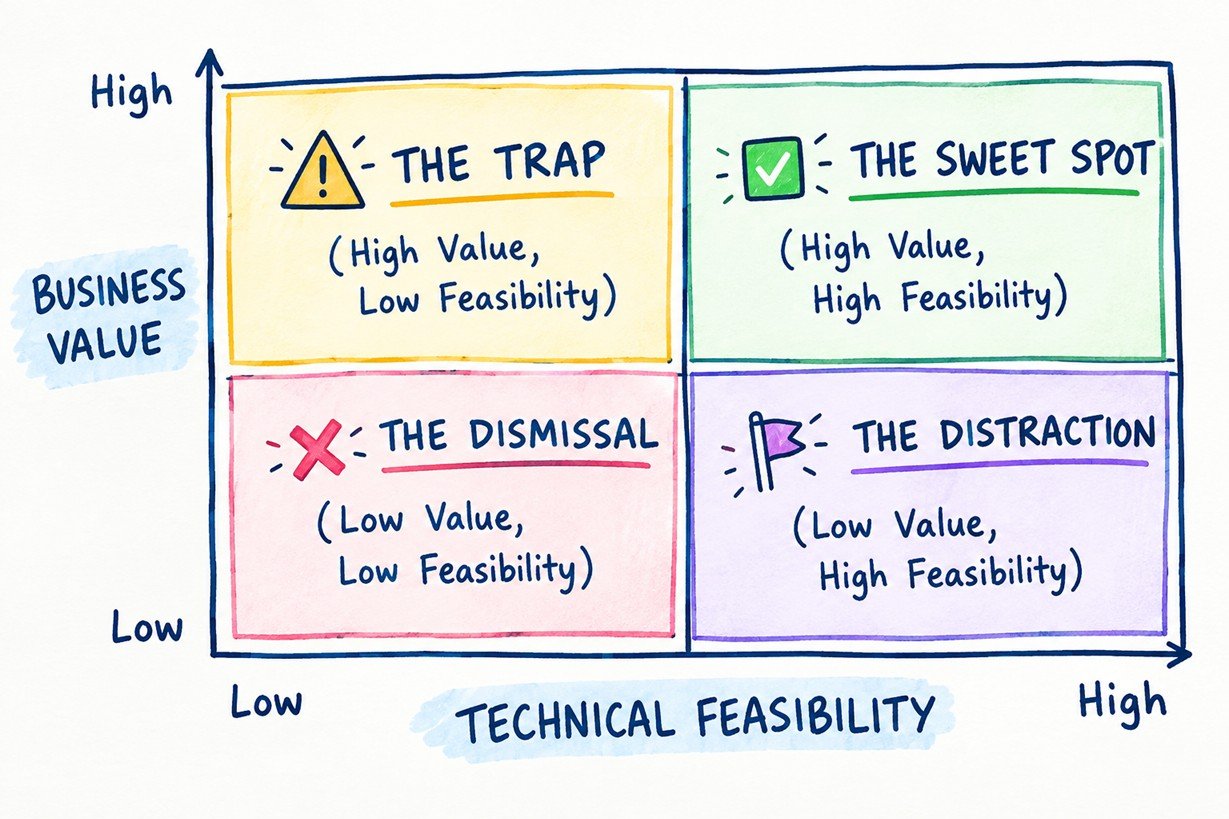
To ensure rigorous project selection, teams must abandon subjective intuition and evaluate initiatives using an objective, two-dimensional prioritization matrix.
1. The First Dimension: Quantifying Hard Business Value
Evaluating business value requires strict adherence to tangible, financial metrics. Relying on ambiguous indicators like "user happiness," "brand prestige," or "technological readiness" introduces subjectivity that can obscure poor investments. If an outcome cannot be calculated on a spreadsheet, it does not qualify as business value.
When auditing potential initiatives, value must be categorized into three hard operational outcomes:
- Direct Cost Reduction: The measurable elimination of overhead, software licensing, or material waste.
- Time and Labor Optimization: The calculation of exact hours saved across workflows, multiplied by the fully burdened cost of the labor recovered.
- Net New Revenue: Highly structured, conservative projections of new market capture, upselling pipelines, or conversion rate increases directly attributable to the system.
2. The Second Dimension: Auditing Technical Feasibility
Technical feasibility measures the realistic probability of successfully deploying and maintaining a solution within the constraints of your existing architecture. High business value means nothing if the underlying technological requirements are fundamentally unachievable or economically unsustainable to build.
A comprehensive technical audit must stress-test four structural vectors before writing a single line of code:
- Data Availability: Confirming whether the necessary data pipelines, historical logs, or required APIs actually exist, or if the project relies on non-existent information infrastructures.
- Data Quality: Assessing the cleanliness, structure, and reliability of the data. Systems built on fragmented, biased, or noisy data silos will reliably underperform.
- Model and System Capabilities: Evaluating whether current technologies can solve the specific problem without requiring custom research, massive breakthroughs, or unproven system architectures.
- Latency and Operational Requirements: Determining if the system can deliver outputs within the exact time windows required by the end-user or downstream applications without triggering exponential infrastructure costs.
3. Navigating the Quadrants: Avoiding Strategic Traps
Plotting proposals along these two dimensions reveals the exact strategic path forward, exposing hidden risks before they impact the balance sheet:
- The Sweet Spot (High Value / High Feasibility): These are your immediate priorities. They deliver clear financial returns and can be reliably executed using existing data structures and verified technical capabilities.
- The Distraction (Low Value / High Feasibility): These projects represent a subtle trap. Because they are easy to build, engineering teams are often tempted to pursue them. However, they waste valuable time on minor optimization efforts that do not move the needle on financial performance.
- The Trap (High Value / Low Feasibility): This is the most dangerous quadrant for an organization. These initiatives promise massive cost savings or hundreds of millions in new revenue, masking the fact that the required data does not exist or the latency expectations are mathematically impossible. Pursuing these projects results in endless proof-of-concept cycles that drain budgets without ever reaching deployment.
- The Dismissal (Low Value / Low Feasibility): These concepts should be filtered out immediately during initial scoping sessions, preventing any waste of corporate resources.
Organizations must enforce this dual-lens evaluation during every prioritization cycle. By demanding audited financial projections on one axis and strict engineering validation on the other, you protect your capital and ensure that technical execution directly drives bottom-line business health.