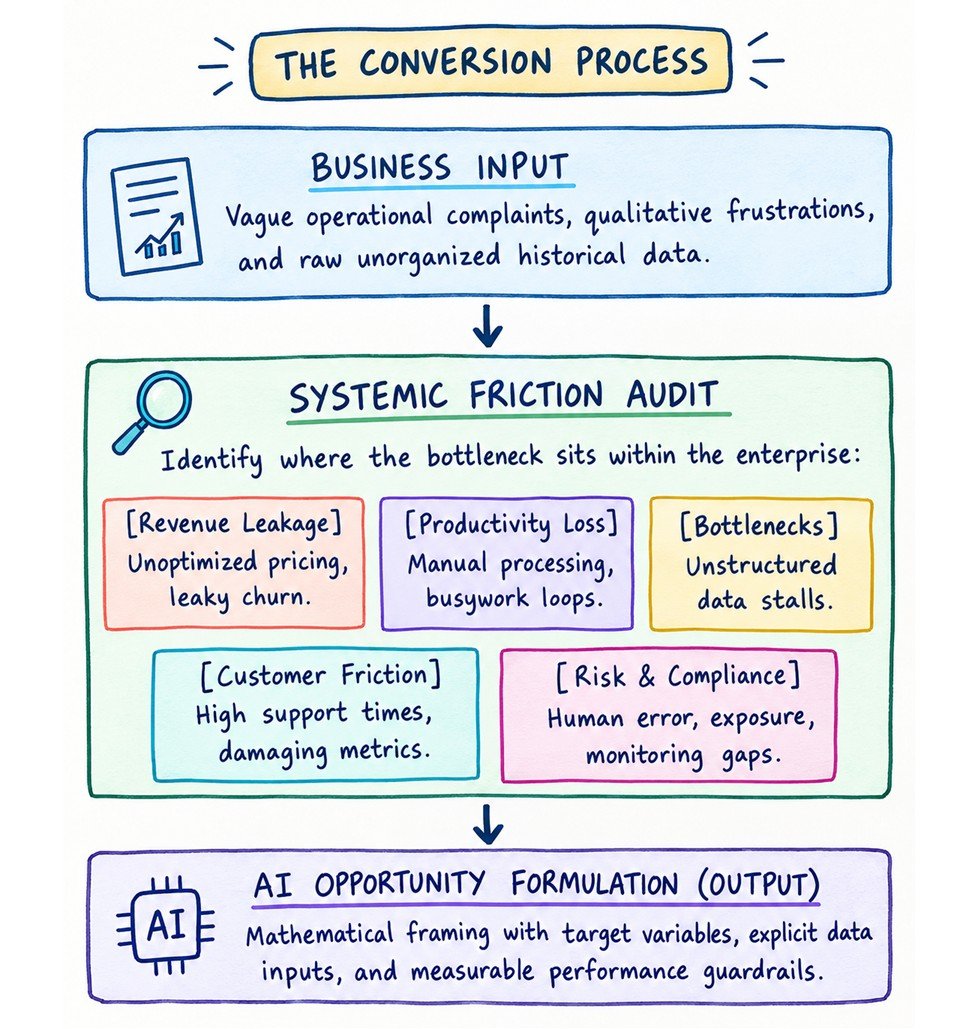
Business problem → AI opportunity
The most dangerous way to approach enterprise artificial intelligence is to start with the technology. When an executive opens a strategy meeting by declaring, "We need a Large Language Model," or "We must build a generative AI assistant," the initiative is already structurally flawed. Starting with the model treats AI as a decorative plug-in looking for a purpose, rather than what it actually is: a highly specialized mathematical tool designed to dissolve specific forms of friction.
Five domains of systemic friction
Every genuine AI opportunity originates from an existing business problem. To unlock real economic value, you must reverse the engineering process: ignore the algorithms, audit your operational systemic friction, and convert vague, emotional workplace complaints into precisely defined machine learning problems.
[ Vague Operational Complaint ] ──> [ Audit Systemic Friction ] ──> [ Define ML Target Variables ]
Vague operational complaints, such as "Our customer support is too slow" or "We are losing too many deals", are completely useless to a data scientist. They contain no target variables, no mathematical boundaries, and no clear data inputs. The core responsibility of a business leader transitioning to AI is to translate these frustrations into structural realities. This systemic friction almost always manifests within five distinct domains:
Revenue leakage occurs when a business loses capital it has already earned the right to capture, but drops due to sub-optimal calculation or poor timing. Operational teams usually complain that "pricing feels off" or "customers are leaving unexpectedly."
To turn this into an AI opportunity, the vague complaint must be reframed as a predictive or optimization problem. For instance, unrecovered customer churn becomes: “Predict the mathematical probability that a contract value exceeding ₹5,000,000 will cancel within the next 90 days, based on historical product usage logs and support ticket sentiment Analysis.” Missed cross-sell opportunities shift from sales intuition to a recommendation engine calculating real-time purchase probabilities at checkout.
Productivity loss is the silent tax paid when highly compensated employees spend their days acting as data conveyor belts. The cultural symptom is a team that complains they are "drowning in busywork" or "spending all day in spreadsheets."
The business must identify repetitive, unstructured text or data workflows. A complaint like "our analysts spend too much time reading long reports" translates into a precise machine learning specification: “Build a retrieval-augmented generation (RAG) pipeline to ingest 400-page regulatory filings and extract ten specific financial metrics into a structured JSON payload with a verifiable source citation.”
Processes stall entirely when a business workflow requires human cognitive processing to move data from step A to step B, but the sheer volume or speed of incoming unstructured information outpaces human capacity. The operational complaint sounds like: "Invoices are piling up," or "Vendor onboarding takes weeks."
The technical objective changes from "working harder" to automating classification and entity extraction. The problem becomes: “Classify incoming unstructured email attachments into five distinct document categories (Invoices, Receipts, Disputes, Contracts, W-9s) with a confidence score above 95%, routing anomalies directly to human exception queues.”
Customer friction is any barrier that forces a client to expend unnecessary effort to get value from your company, immediately dragging down your Net Promoter Score (NPS). The complaint is clear: "Customers are angry about long hold times."
Instead of deploying a generic, uncalibrated chatbot that frustrates users further, the operational friction is converted into an intent classification and automated resolution framework. The machine learning goal becomes: “Analyze incoming chat strings in real-time, accurately classify the customer’s intent out of 42 pre-defined categories, and instantly resolve the top five highest-volume transactional intents (e.g., refund status, password reset) without human agent intervention.”
Human beings are structurally unsuited for high-volume, low-variance monitoring tasks. When forced to review thousands of legal clauses or monitor thousands of transactions, fatigue introduces massive financial and legal exposure. The internal complaint usually surfaces after a crisis: "We missed a critical renewal clause," or "An auditor flagged an error."
The systemic friction is converted into an anomaly detection or zero-shot classification problem. The objective becomes: “Scan historical and active procurement contracts to flag any liability cap deviations that fall below standard corporate governance thresholds, calculating a risk probability score before the contract is executed.”
Mapping the Transition: A Strategic Reference
| Business Domain | Vague Operational Complaint | Precise Machine Learning Problem |
|---|---|---|
| Revenue Leakage | "We are losing too many subscribers to our competitors." | Predict subscriber churn probability within a 30-day window using engagement telemetry. |
| Productivity Loss | "Our team is completely overwhelmed by manual data entry." | Extract text from unstructured PDF receipts and map it directly to database schemas. |
| Operational Bottleneck | "Claims processing is backed up and slowing everything down." | Route inbound support emails to specialized departments via text intent classification. |
| Customer Friction | "Clients are complaining that our support response is too slow." | Automate resolution for high-frequency tier-1 support queries via deterministic semantic search. |
| Risk & Compliance | "We keep missing critical regulatory updates in our audits." | Identify anomalous compliance variances across multi-jurisdictional operational logs. |
By systematically marching every operational bottleneck through this analytical framework, you ensure your business never builds AI for the sake of novelty. You stop asking what the model can do, and begin demanding what the business needs solved.
Conversion process from a business problem to an AI opportunity