From Opportunity to Architecture: A Framework for AI & Technology Leaders

The best AI products do not begin with a model. They begin with an opportunity worth solving.
AI has made it remarkably easy to imagine what technology might do.
A new model appears. A new agent framework emerges. A new capability becomes possible. Almost immediately, organizations start asking:
What can we build with it?
That is often the wrong starting point.
For technology and AI leaders, the harder and more consequential question is:
Where is there a meaningful business opportunity, and what should we build around it?
The difference matters.
An impressive AI capability does not automatically become a valuable product. A compelling use case does not automatically become a scalable system. And an architecture diagram does not become useful simply because it contains the latest AI components.
The journey from AI possibility to production product requires a disciplined progression of decisions.
I use a simple framework:
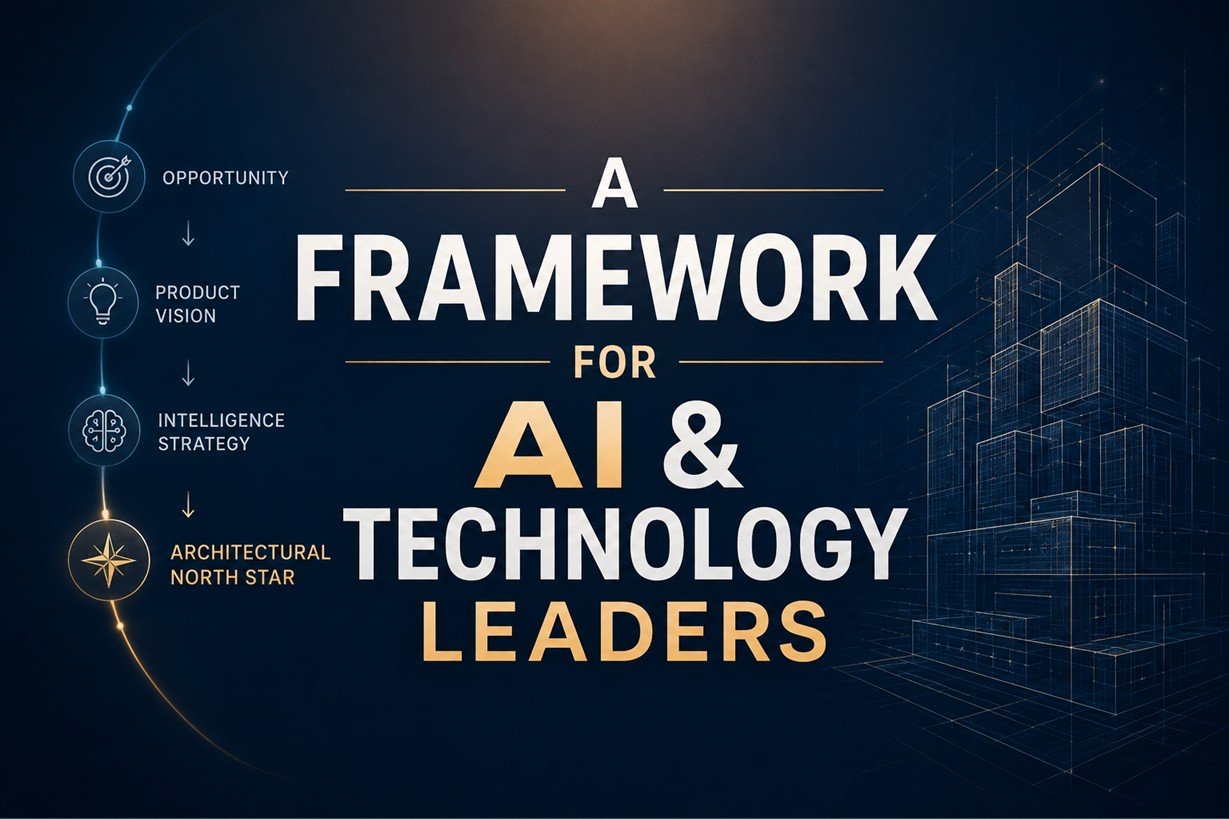
Opportunity → Product Vision → Intelligence Strategy → Architectural North Star
The purpose of this framework is not to replace detailed product development, architecture, or engineering practices. It is to establish the strategic and architectural direction before those disciplines go deep into implementation.
1. Define the Opportunity
What is worth solving?
Every AI product should begin with a meaningful problem rather than a technology.
Start by understanding where value is being lost.
That might be:
- A workflow that consumes significant human effort
- Decisions that take too long
- Information that is difficult to understand or act upon
- Revenue opportunities that are being missed
- Operational costs that continue to grow
- Risks that are difficult to detect or manage
- Customer experiences constrained by existing processes
The objective is not simply to identify something that AI could improve.
It is to determine whether there is a problem significant enough to justify building a product around it.
Understand the current reality
Before imagining the future state, understand the current workflow:
Trigger → Human/System Actions → Decision → Outcome
Who performs the work?
What information do they need?
Where are the bottlenecks?
Where does judgment enter the process?
Where do errors occur?
What happens when the process fails?
This baseline becomes critical later because the AI product should improve a measurable outcome, not simply introduce an AI component.
Determine where AI creates differentiated value
Not every problem requires AI.
If deterministic automation can solve the problem reliably, it may be the better solution.
AI becomes particularly interesting when the problem involves capabilities such as:
- Understanding unstructured information
- Reasoning across multiple sources
- Interpreting intent
- Generating or synthesizing information
- Making recommendations
- Adapting to changing context
- Supporting complex decisions
- Taking actions across multiple systems
The question is therefore not:
“Where can we use AI?”
It is:
“Where does AI fundamentally change what is possible?”
Opportunity Thesis
The output of this stage should be a concise opportunity thesis:
We believe [target user] has [problem], creating [business impact], and AI can create differentiated value by [AI-enabled capability].
If this statement is weak, there is little reason to move forward.
2. Shape the Product Vision
A use case is not a product.
Once an opportunity is established, the next question is:
What should we actually build?
This is where an AI opportunity becomes a product concept.
A product needs more than an AI capability. It needs a user, a purpose, a workflow, a differentiated value proposition, and measurable outcomes.
Define the product
At a high level, establish:
Who is the user?
What are they trying to accomplish?
What problem does the product solve?
What does the product enable that was difficult or impossible before?
What outcome should improve?
The product vision should be understandable without discussing models, vector databases, agents, or orchestration.
That separation is intentional.
First decide what the product should become.
Then determine how intelligence enables it.
Define the Jobs to Be Done
Features are not the starting point.
The user's job is.
For example:
“Help an operations leader determine why a critical service is degrading and recommend the most likely corrective action.”
is more useful than:
“AI-powered incident management.”
The first describes the outcome the product needs to deliver.
That outcome will later drive the intelligence strategy and architecture.
Establish differentiation
An AI product needs a reason to exist beyond “we added AI.”
Differentiation might come from:
- Proprietary data
- Deep domain context
- Better reasoning
- Workflow integration
- Personalization
- Faster decision making
- Continuous learning
- Superior recommendations
- Ability to take meaningful action
The key question is:
Why will this product be meaningfully better than the existing way of doing the job?
Define measurable outcomes
The product vision should ultimately connect to measurable impact.
For example:
Reduce investigation time from 45 minutes to 5 minutes.
Or:
Increase qualified decisions by 20%.
Or:
Reduce manual review volume by 60%.
The exact metric will vary by product, but the principle remains:
AI capability is not the outcome. Business and user impact is.
3. Define the Intelligence Strategy
This is where an AI product begins to diverge significantly from traditional software.
How should AI create value?
Once the product vision is clear, we can ask:
What intelligence does the product actually need?
This question is more useful than starting with a model selection.
An AI product may need to understand, reason, decide, recommend, act, or learn.
These are different capabilities and should be deliberately designed.
Decompose the intelligence
Consider the product's intelligence as a sequence:
Perceive → Understand → Reason → Decide → Act → Learn
Not every product requires every stage.
A product may only need understanding and recommendation.
Another may require multi-step reasoning and tool use.
Another may eventually become capable of taking autonomous action.
The architecture should emerge from these requirements.
Define the context
Intelligence without the right context is often unreliable.
Determine what the system needs to know:
- User context
- Enterprise knowledge
- Historical interactions
- Documents
- Real-time events
- Business rules
- External information
- Operational signals
Then ask:
What context is required at each point in the intelligence flow?
This becomes an important architectural input.
Define autonomy
One of the most consequential decisions in an AI product is determining what the system is allowed to do.
There is a significant difference between:
AI recommends → Human decides → System acts
and:
AI decides → System acts
Define the autonomy boundary deliberately.
The right answer may change as the product matures.
Define evaluation
Traditional software can often be evaluated through deterministic tests.
AI systems require a broader evaluation strategy.
Consider:
- Task success
- Accuracy
- Groundedness
- Reasoning quality
- Safety
- Human acceptance
- Action correctness
- Business outcome
The evaluation strategy should be designed alongside the intelligence strategy, not added after the system is built.
Intelligence Strategy
The output of this stage is a clear description of:
What the AI needs to understand, what it needs to reason about, what context it needs, what actions it can take, where humans remain involved, and how its performance will be evaluated.
Now we have enough information to begin architectural thinking.
4. Establish the Architectural North Star
What must the system fundamentally become?
This is where the previous decisions converge.
The Architectural North Star is not the detailed architecture.
It is the high-level architectural blueprint that connects product intent and intelligence strategy with engineering reality.
It establishes the major architectural building blocks, boundaries, flows, principles, and critical trade-offs that detailed architects and engineers can take forward.
Start with the intelligence flow
Instead of starting with infrastructure components, start with the product's intelligence:
Input → Context → Intelligence → Decision → Action → Feedback
Then determine what architectural capabilities are required to support that flow.
Identify the major building blocks
Depending on the product, the North Star may include:
User Experience
       ↓
Product Services
       ↓
AI Orchestration
       ↓
Intelligence Layer
       ↓
Context & Knowledge
       ↓
Enterprise Data & Systems
Supporting capabilities may include:
- Model services
- Retrieval
- Memory
- Tool integration
- Workflow orchestration
- Evaluation
- Observability
- Governance
- Security
- Human oversight
The exact components should never be predetermined.
The product and intelligence strategy should determine the architecture.
Establish trust boundaries
AI systems introduce new questions around authority and control.
The North Star should make clear:
What can the AI see?
What can it infer?
What can it recommend?
What can it execute?
Where is human approval required?
These aren't merely implementation details.
They are product and architectural decisions.
Make the major trade-offs explicit
A strong Architectural North Star does not hide uncertainty.
It makes important trade-offs visible.
For example:
Autonomy vs. control
Model capability vs. cost
Flexibility vs. predictability
Real-time intelligence vs. computational complexity
Centralized context vs. domain-specific context
AI-driven decisions vs. deterministic business rules
The goal isn't to pretend that every decision is obvious.
The goal is to show that the important decisions are deliberate.
The Architecture Should Be a Consequence
This is perhaps the most important principle in the framework.
Architecture should be a consequence of the product and intelligence strategy, not the starting point.
Consider the progression:
Business Opportunity
        ↓
   Product Vision
        ↓
 Intelligence Strategy
        ↓
Architectural North Star
        ↓
Detailed Architecture
        ↓
Engineering Execution
        ↓
   Business Impact
Each stage constrains and informs the next.
If the opportunity changes, the product may change.
If the product changes, the intelligence requirements may change.
If the intelligence strategy changes, the architecture may change.
This creates a traceable chain from business intent to technical design.
The Decision Gates
I find it useful to introduce a decision gate at each stage.
Gate 1 — Opportunity
Is this problem valuable enough to solve?
↓
Gate 2 — Product
Is there a compelling product here rather than merely an interesting AI use case?
↓
Gate 3 — Intelligence
Does AI create meaningful differentiation, and what intelligence does the product actually require?
↓
Gate 4 — Architecture
Can we establish a credible Architectural North Star capable of realizing the product vision?
↓
Engineering Handoff
Is the North Star concrete enough for architects and engineers to take into detailed design and implementation?
This final question is important.
The Architectural North Star should be ambitious enough to establish direction, but concrete enough that an engineering organization can act on it.
What the Architectural North Star Contains
At a high level, I expect a North Star to establish:
| Dimension | Question |
|---|---|
| Product intent | What must the system enable? |
| Intelligence flow | How does intelligence move through the product? |
| Data & context | What information does intelligence depend on? |
| Orchestration | How are reasoning, workflows, tools, and actions coordinated? |
| Evaluation | How do we know the system is working? |
| Trust boundaries | What can AI see, decide, and do? |
| Trade-offs | Which architectural choices matter most? |
| Evolution | How can the architecture mature with the product? |
That is the level at which I believe senior technology and AI leaders should engage before detailed architecture begins.
Where the Framework Stops
There is an intentional boundary to this approach.
The Architectural North Star is not intended to specify:
- Every service
- Every API
- Every database schema
- Every framework
- Every infrastructure component
- Every deployment configuration
- Every implementation detail
Those decisions belong to the architects and engineers who take the North Star forward.
The North Star establishes the intent, boundaries, major capabilities, architectural relationships, and critical decisions from which detailed architecture can be developed.
That boundary is not an omission.
It is intentional.
From Architecture to Impact
The ultimate measure of the framework is not the quality of the architecture diagram.
It is whether the architecture enables the product to create the outcome that justified building it in the first place.
The complete journey therefore becomes:
Opportunity → Product Vision → Intelligence Strategy → Architectural North Star → Engineering Execution → Business Impact
The first four stages establish the direction.
Engineering turns that direction into a working system.
The business outcome determines whether the entire journey was worthwhile.
The Principle I Would Carry Forward
AI gives organizations extraordinary new capabilities.
But capability alone does not create a product.
The real leadership challenge is connecting business opportunity, product vision, AI intelligence, and architecture into one coherent path toward execution.
That is the purpose of the Architectural North Star.
The opportunity tells us why to build.
The product vision tells us what to build.
The intelligence strategy tells us how AI creates value.
The Architectural North Star tells us what the system must become.
Engineering turns that direction into reality.
And that is where I believe AI Product Architecture should begin.