Why AI Systems That Work in Development Fail in Production
Bridging the Gap Between AI Experimentation and Production-Grade Engineering
AI in Production | Enterprise AI Architecture & Engineering
Abstract
Foundation models, managed inference services, retrieval-augmented generation (RAG), agentic frameworks, and AI-assisted development have sharply lowered the barrier to building intelligent applications. An impressive prototype can now be assembled in days.
Building an application that demonstrates intelligence, however, is fundamentally different from engineering a system that delivers reliable business outcomes under real-world conditions. An application that performs exceptionally in development can become unreliable when exposed to heterogeneous data, unpredictable users, concurrent workloads, evolving enterprise knowledge, adversarial inputs, infrastructure failures, and operational constraints.
These failures are frequently blamed on the model. In practice, many originate in system architecture, context management, integration design, evaluation practice, operational maturity, governance, and engineering discipline.
This article examines the structural differences between development and production AI systems, analyzes twelve recurring failure modes, presents the architectural patterns that address them, and proposes a practical framework for assessing enterprise AI production readiness.
The central argument is simple:
Production AI is not merely a model deployment problem. It is a systems engineering problem.
Reader’s Guide
- Sections 1–3 establish why the development-to-production gap exists and introduce a failure model.
- Sections 4–15 examine twelve failure modes. Each follows the same pattern: the problem, why development conceals it, the production consequences, and the architectural response.
- Sections 16–19 consolidate the responses into a reference architecture, an operating-envelope concept, service-level objectives, and a readiness framework.
- Sections 20–25 cover the delivery journey, a worked case study, anti-patterns, a checklist, leadership implications, and ten principles.
Terminology Used Throughout
| Term | Meaning in this article |
|---|---|
| Verified business outcome | A business result confirmed by evidence independent of the AI component that produced it |
| Operating envelope | The explicit set of conditions (scope, data, actions, load, risk, autonomy) within which a system is approved to operate |
| Runtime plane / control plane | The components that process requests, and the components that govern policies, artifacts, and lifecycle |
| Release envelope | The versioned set of compatible artifacts that together define a production release |
1. The Illusion of AI Readiness
1.1 When a Successful Demonstration Creates False Confidence
Consider an enterprise building an AI-powered customer service assistant. In development, the team shows that the assistant can:
- Understand customer questions.
- Retrieve relevant enterprise knowledge.
- Generate contextually appropriate answers.
- Access customer information.
- Recommend suitable resolutions.
- Execute selected business workflows.
The demonstration succeeds, stakeholders are impressed, and production deployment is approved.
Within weeks, a different picture emerges. Customers receive inconsistent answers. Retrieval occasionally surfaces outdated policies. Latency climbs during peak hours. Some requests incur unexpectedly high inference costs. External integrations fail intermittently. Certain customer journeys require manual intervention even though the AI system records them as completed.
The application is technically available, yet its business reliability is eroding. What changed? Often, not the model. What changed was the environment in which the system operates.
1.2 The Development-to-Production Divide
Development environments are designed to establish whether a capability works. Production environments must ensure the capability continues to work across a broad range of operating conditions, within acceptable limits of quality, reliability, security, cost, and risk.
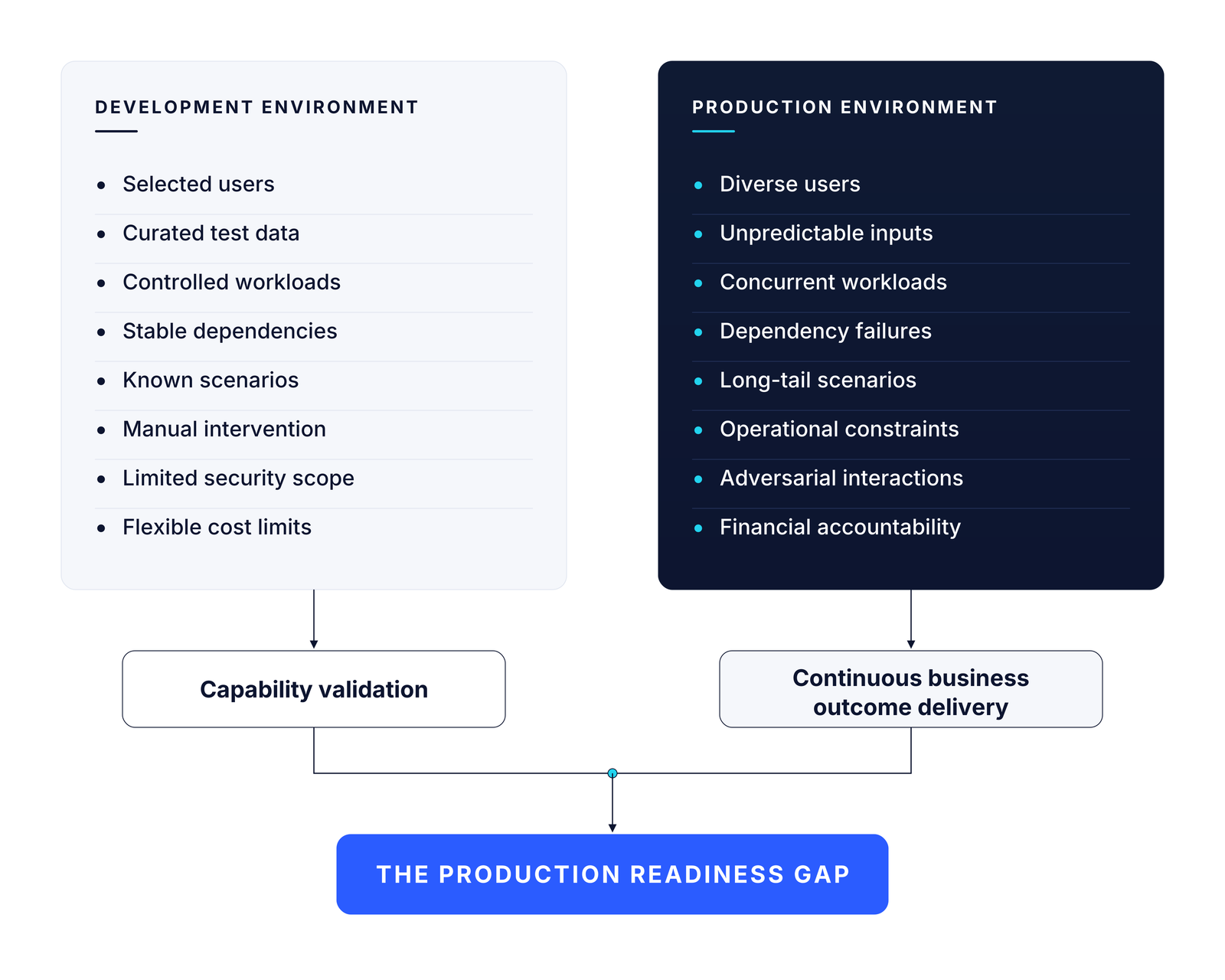
The distinction is not merely environmental; it changes the engineering objective itself.
| Dimension | Development | Production |
|---|---|---|
| Primary objective | Demonstrate capability | Deliver sustained business outcomes |
| Data | Curated and controlled | Dynamic, heterogeneous, imperfect |
| Workload | Limited and predictable | Concurrent, variable, bursty |
| AI behavior | Selected test scenarios | Open-ended real-world interactions |
| Availability | Best effort | Defined service objectives |
| Quality | Sample-based validation | Continuous evaluation |
| Security | Limited exposure | Continuous threat exposure |
| Failure handling | Manual intervention | Automated containment and recovery |
| Cost | Experimental expenditure | Sustainable unit economics |
| Governance | Informal oversight | Enforceable controls |
| Accountability | Development team | Business and operational ownership |
A prototype demonstrates possibility. A production system must demonstrate dependability.
2. AI in Production Is a Systems Engineering Discipline
2.1 The Model Is Only One Component
A recurring misconception is that an AI system is its model. An enterprise AI system is better understood as a distributed socio-technical system combining probabilistic intelligence, deterministic application logic, enterprise data, infrastructure, security controls, operational processes, and human participants. Its behavior emerges from the interaction of these parts.
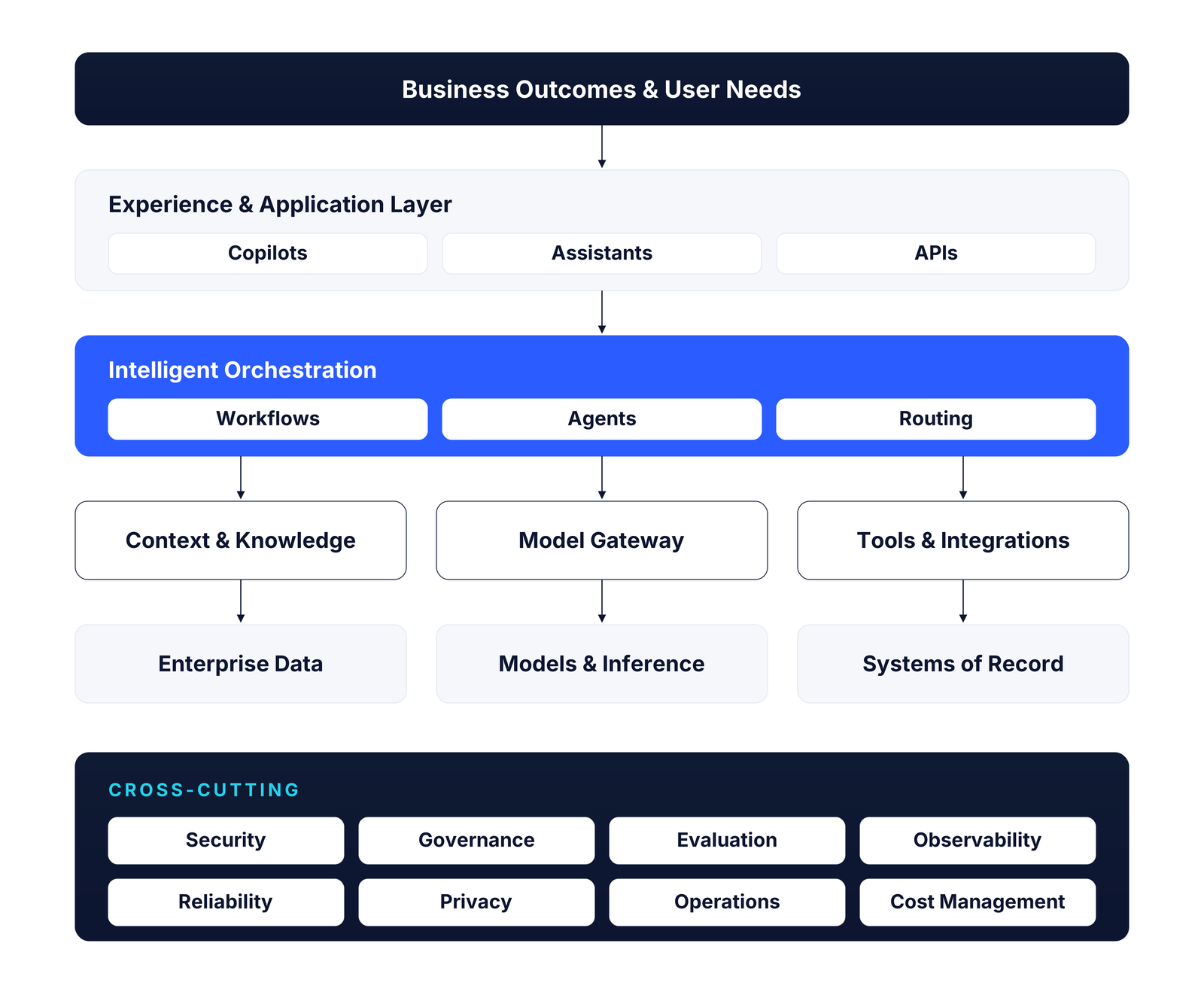
A failure at any layer can affect the business outcome even when the model behaves exactly as designed:
- A highly capable model cannot reliably compensate for unauthorized or outdated context.
- An accurate retrieval system cannot guarantee that the model faithfully uses the retrieved evidence.
- A successful tool invocation does not establish that the intended business outcome occurred.
- A resilient inference endpoint cannot compensate for an unreliable business integration.
- A compliant model does not make the surrounding application compliant.
The system must therefore be engineered and evaluated as an integrated whole.
This insight has deep roots. Research on hidden technical debt in machine learning systems identified system-level concerns such as data dependencies, entanglement, configuration complexity, feedback loops, and changing external conditions [1]. Generative and agentic systems add further dependencies: prompts, retrieval pipelines, model gateways, memory, tools, and autonomous execution.
2.2 Component Success Does Not Guarantee System Success
Consider a customer refund agent that performs five activities:
- Identify the customer.
- Retrieve the applicable refund policy.
- Determine eligibility.
- Submit the authorized refund transaction.
- Verify that the refund was processed.
Each component may perform excellently in isolation, yet the reliability of the workflow depends on their combined behavior. Suppose, for illustration, that each stage succeeds with probability 98%, conditional on all earlier stages succeeding. The probability that all five succeed is:
0.98⁵ ≈ 90.4%
Nearly one in ten complete workflows would fail to meet all success conditions. At 95% per stage, end-to-end success falls to about 77%.
Real systems are more complicated: failures can be correlated, retries can recover some stages, and workflows can have alternative paths. The architectural lesson nevertheless holds:
Component-level quality is necessary, but enterprise AI reliability must be measured at the business-workflow level.
3. The Fundamental Failure Dimensions of Production AI
Production AI failures rarely have a single cause. They emerge across interconnected architectural, engineering, operational, and organizational dimensions, which this article groups into three families: failures of intelligence, of systems, and of control.
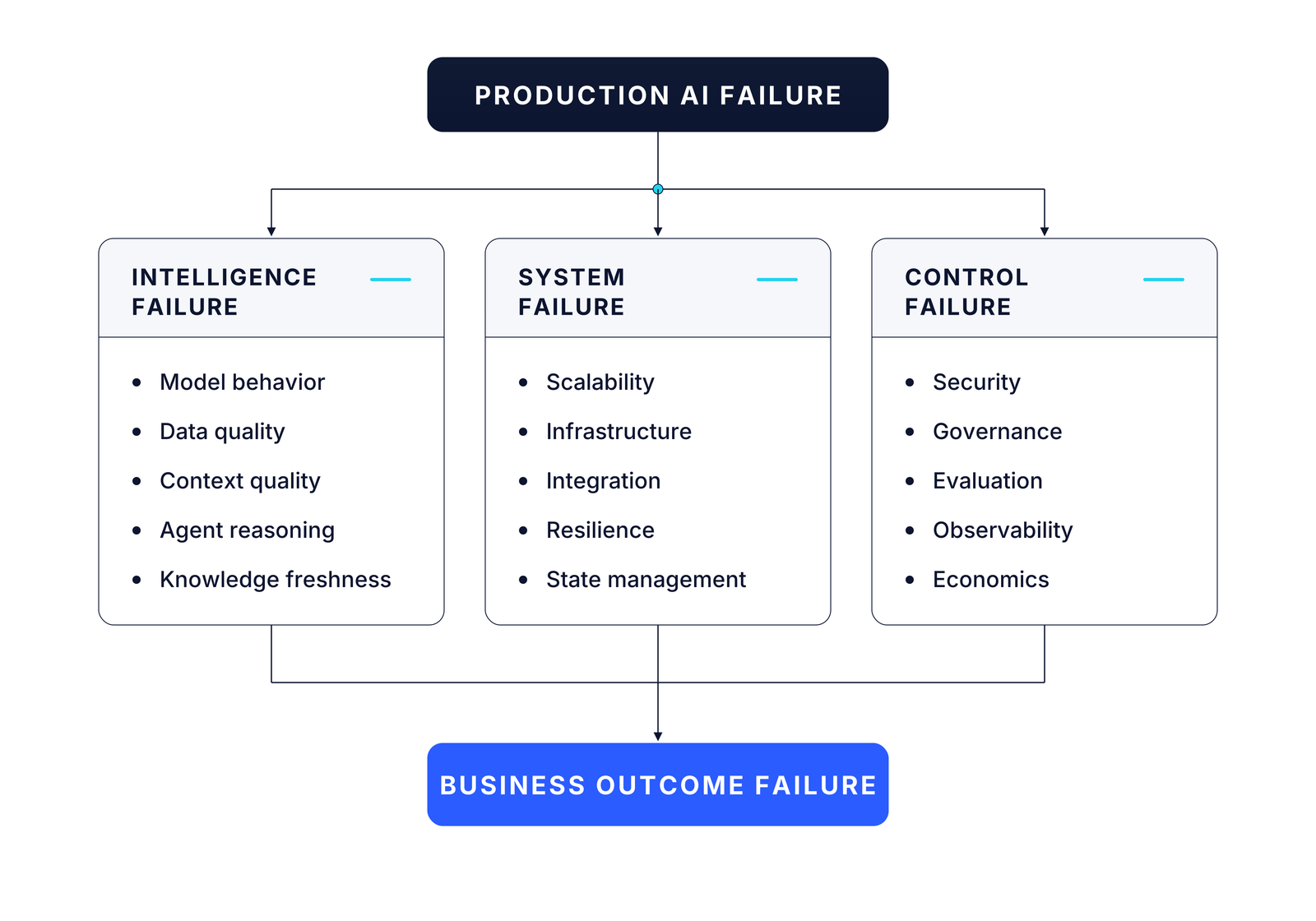
The twelve failure modes examined in Sections 4–15 map onto these families as follows.
| # | Failure mode | Primary family |
|---|---|---|
| 1 | Non-deterministic model behavior | Intelligence |
| 2 | Development data does not represent production reality | Intelligence |
| 3 | Context engineering breaks at enterprise scale | Intelligence |
| 4 | RAG works in a demo but fails at scale | Intelligence |
| 5 | Agentic complexity is underestimated | Intelligence / System |
| 6 | Infrastructure and scalability are afterthoughts | System |
| 7 | External dependencies create cascading failures | System |
| 8 | Evaluation is treated as a pre-deployment activity | Control |
| 9 | Traditional observability cannot explain AI failures | Control |
| 10 | Security and governance are added too late | Control |
| 11 | AI economics become unsustainable | Control |
| 12 | Operational ownership and change management are undefined | Control |
4. Failure Mode 1: Non-Deterministic Model Behavior
4.1 The Problem
Traditional software is built on explicit rules: given equivalent inputs and execution conditions, a deterministic function produces equivalent outputs.
Generative AI follows a different paradigm. Large language models generate responses from learned statistical relationships, supplied context, decoding strategy, and model-specific behavior. Output can vary across repeated requests, model versions, serving configurations, and context changes. Setting temperature to zero may reduce variability, but it does not universally guarantee identical responses across executions or serving environments.
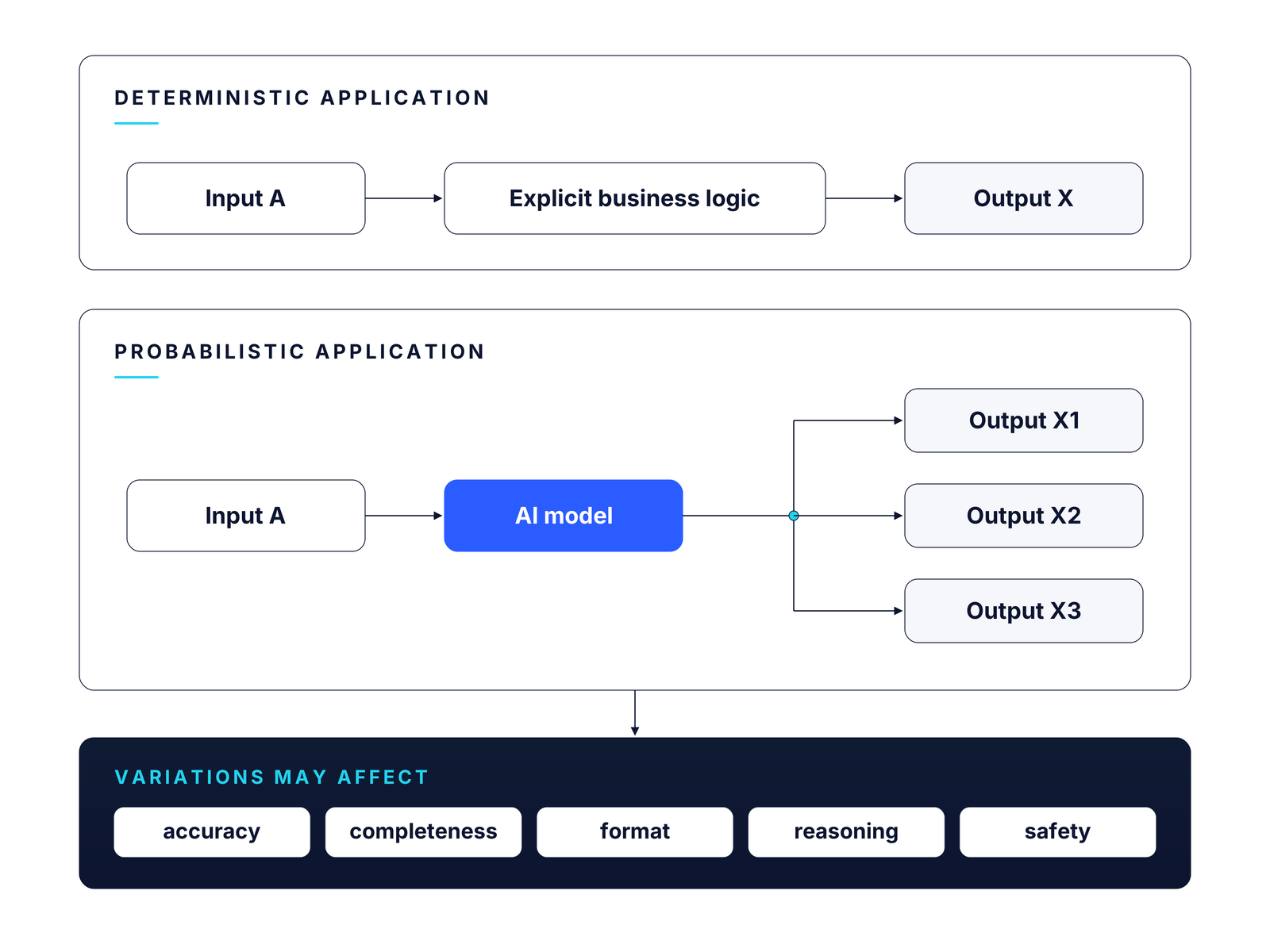
4.2 Why Development Conceals the Problem
Teams often validate an application against a small set of representative prompts. It can pass all of them while remaining vulnerable to paraphrased requests, ambiguous instructions, conflicting information, unusual context combinations, and previously unseen scenarios. A good response on one occasion is weak evidence that later responses will satisfy the same business requirements.
4.3 Production Consequences
- Inconsistent recommendations.
- Unpredictable output structures.
- Unsupported factual claims.
- Incorrect business decisions.
- Variable reasoning quality.
- Unreliable downstream automation.
- Eroded user trust.
4.4 Architectural Solutions
The architecture must draw a controlled boundary around probabilistic intelligence.
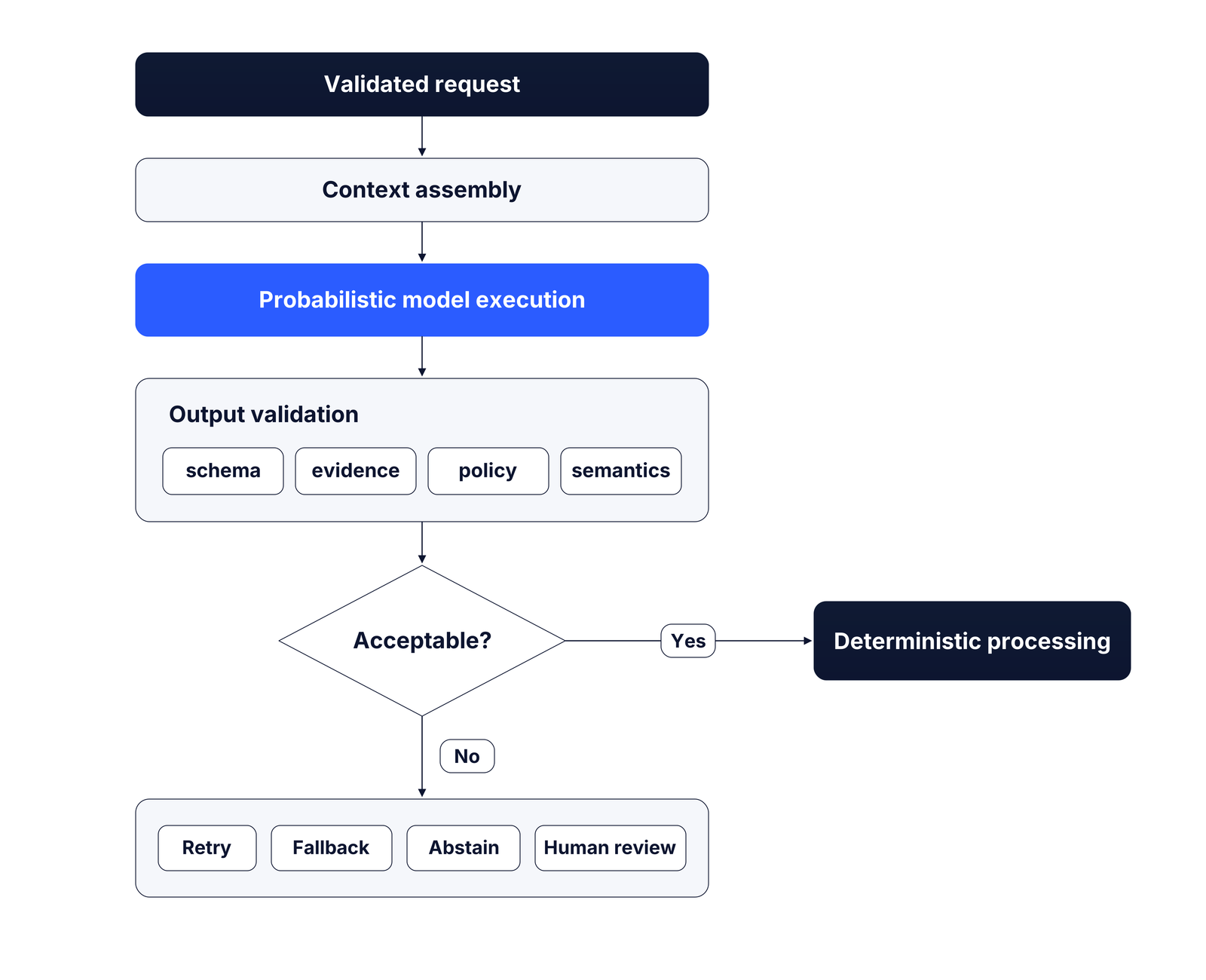
The principal solution patterns are:
- Structured output generation with schema validation.
- Deterministic business-rule enforcement.
- Evidence-based response validation.
- Risk-sensitive routing and escalation.
- Calibrated acceptance mechanisms, where feasible.
- Bounded retries and approved fallback models.
- Explicit abstention when evidence is insufficient.
- Human review for high-impact decisions.
Structured output guarantees neither factual accuracy nor business correctness. Structural, semantic, and policy validation are distinct concerns and must be engineered separately.
Architectural principle: Allow probabilistic intelligence inside the system, but enforce deterministic controls at critical business and security boundaries.
5. Failure Mode 2: Development Data Does Not Represent Production Reality
5.1 The Problem
Development datasets are typically selected, cleaned, and normalized to support rapid experimentation. Production data is far less accommodating. It may contain:
- Missing or incomplete information.
- Conflicting records.
- Outdated documents.
- Multiple document formats.
- Unusual terminology.
- Poor-quality images or scanned documents.
- Inconsistent metadata.
- New customer segments.
- Multiple languages.
- Sensitive or unauthorized information.
These differences create a distribution shift between the conditions under which the system was built and those under which it must operate.
5.2 Different Types of Change
| Change type | Description | Example |
|---|---|---|
| Data drift | Input characteristics change | New document formats enter a processing pipeline |
| Concept drift | The relationship between inputs and expected outcomes changes | Fraud patterns evolve |
| Knowledge drift | Authoritative facts or policies change | An enterprise updates its refund policy |
| Retrieval drift | Retrieved evidence quality or relevance changes | Newly indexed documents reduce search precision |
| Behavioral drift | Observable model or application behavior changes | A model update alters response characteristics |
| Workload drift | Request volume or composition changes | Longer conversations become more common |
These changes have different causes and remedies. No single generic drift metric can diagnose or resolve all of them.
5.3 Production Consequences
- A document-intelligence solution evaluated mainly on clean digital documents performs poorly on low-quality customer photographs.
- An enterprise knowledge assistant gives inaccurate answers after the document corpus changes.
- A predictive system degrades as customer behavior evolves.
5.4 Architectural Solutions
Establish a governed data lifecycle with:
- Data contracts and schema validation.
- Input quality assessment.
- Data lineage and provenance.
- Source ownership and stewardship.
- Representative evaluation datasets.
- Long-tail and edge-case test collections.
- Drift monitoring.
- Knowledge freshness objectives.
- Controlled dataset and knowledge versioning.
- Feedback and remediation workflows.
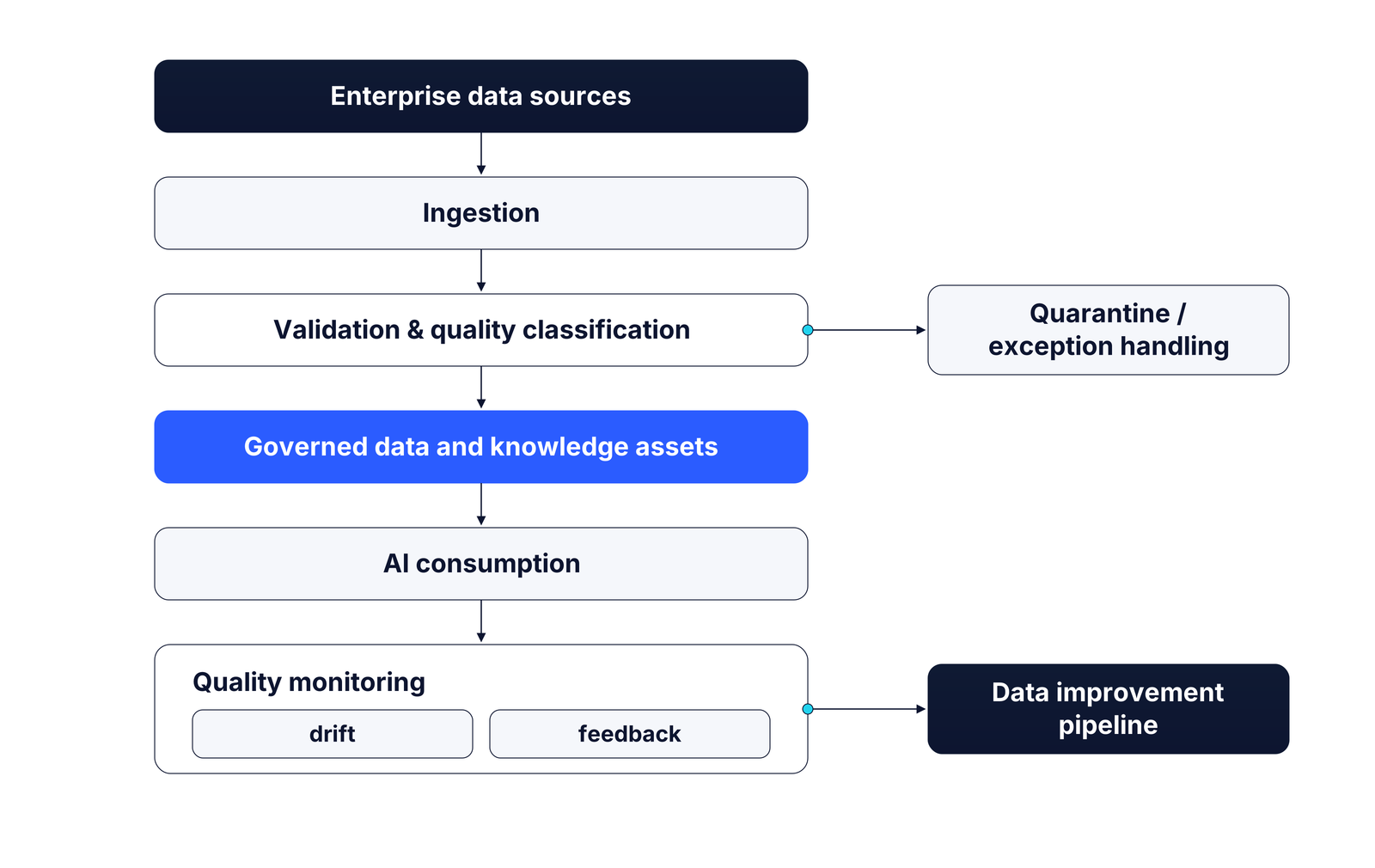
Data quality is an operational responsibility, not a one-time preprocessing step.
6. Failure Mode 3: Context Engineering Breaks at Enterprise Scale
6.1 The Problem
Generative AI quality depends heavily on the information supplied to the model at inference time. In development, context is usually assembled from a few carefully chosen documents, short conversation histories, and predictable requests.
Production systems must handle far richer context requirements:
- Large enterprise knowledge repositories.
- User identity and authorization.
- Tenant-specific information.
- Conversation and workflow state.
- Business policies.
- Dynamic tool responses.
- Historical interactions.
- Time-sensitive information.
- Model-specific context limits.
Adding more information to the context window does not guarantee better results. Excessive, irrelevant, contradictory, or unauthorized context can degrade quality while increasing latency, cost, and security exposure.
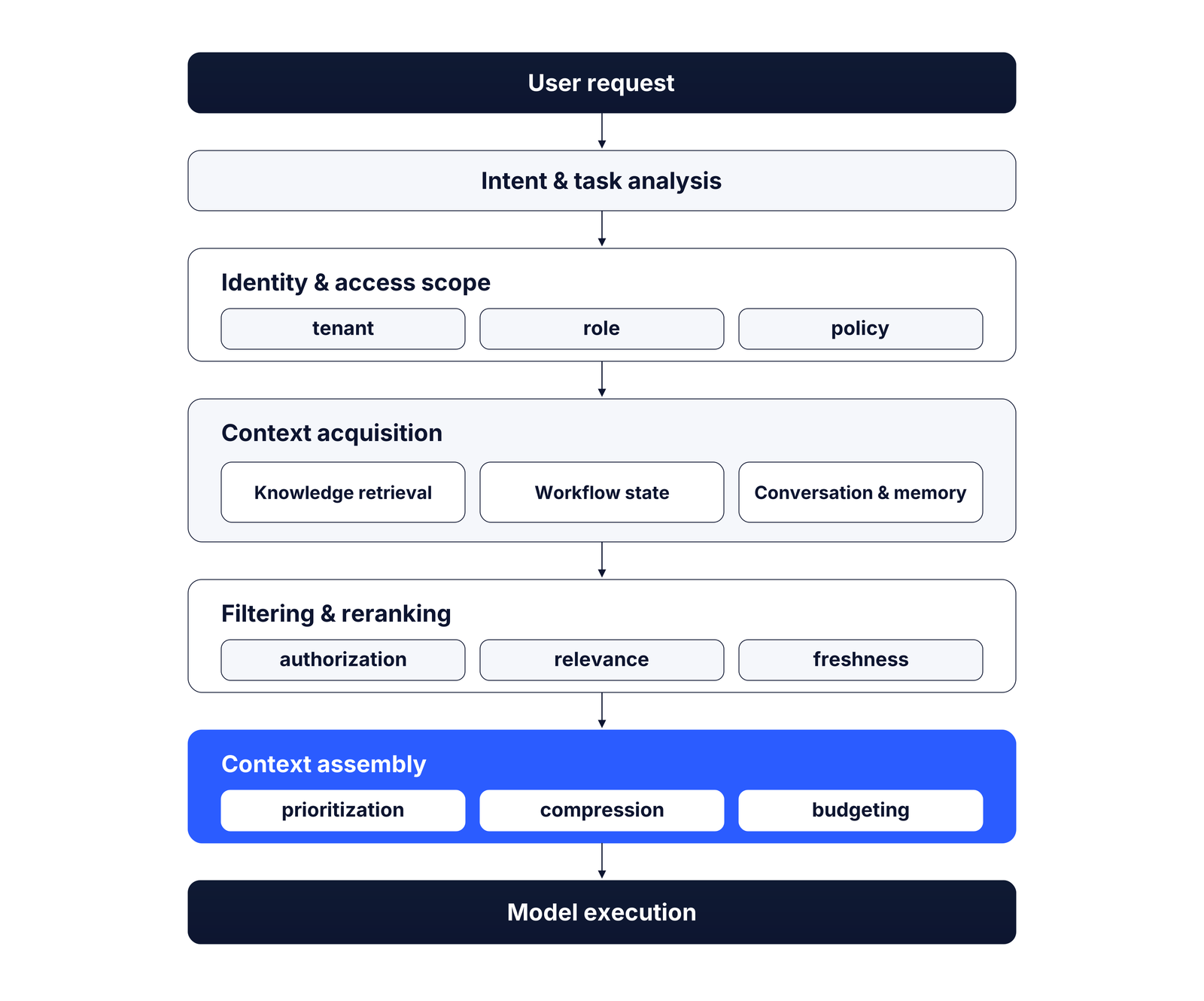
6.2 Context Engineering Is Not Merely Retrieval
Retrieval identifies potentially relevant information. Context engineering decides what the model should see, under which conditions, in what representation, with what priority, and within which operational constraints.
6.3 Common Production Failure Patterns
| Failure pattern | Business impact |
|---|---|
| Context pollution | Irrelevant information influences answers |
| Context explosion | Latency and inference costs increase |
| Stale context | Incorrect recommendations |
| Missing context | Unsupported or incomplete decisions |
| Context conflict | Inconsistent responses |
| Cross-tenant context leakage | Confidentiality breach |
| Memory contamination | Incorrect information persists across sessions |
| Context truncation | Critical instructions or evidence are lost |
6.4 Architectural Solutions
Production context engineering should incorporate:
- Authorization-aware retrieval.
- Hybrid retrieval and reranking, where appropriate.
- Document provenance and effective-date management.
- Context prioritization policies.
- Duplicate removal.
- Token budgeting.
- Controlled summarization.
- Memory lifecycle management.
- Tenant isolation.
- Evidence traceability.
- Context-specific evaluation.
The model should receive the context required for the current task, not unrestricted access to everything the enterprise knows.
Architectural principle: Context is a governed runtime dependency, not an arbitrary collection of tokens.
7. Failure Mode 4: Retrieval-Augmented Generation Works in a Demo but Fails at Scale
7.1 The Problem
A RAG prototype can be built by connecting a language model to a vector database holding a small document collection. An enterprise RAG system faces substantially different conditions: millions of documents, varying sensitivity levels, multiple document versions, complex access policies, and inconsistent information quality.
A technically functional retrieval pipeline can still retrieve the wrong evidence.
7.2 The RAG Failure Chain
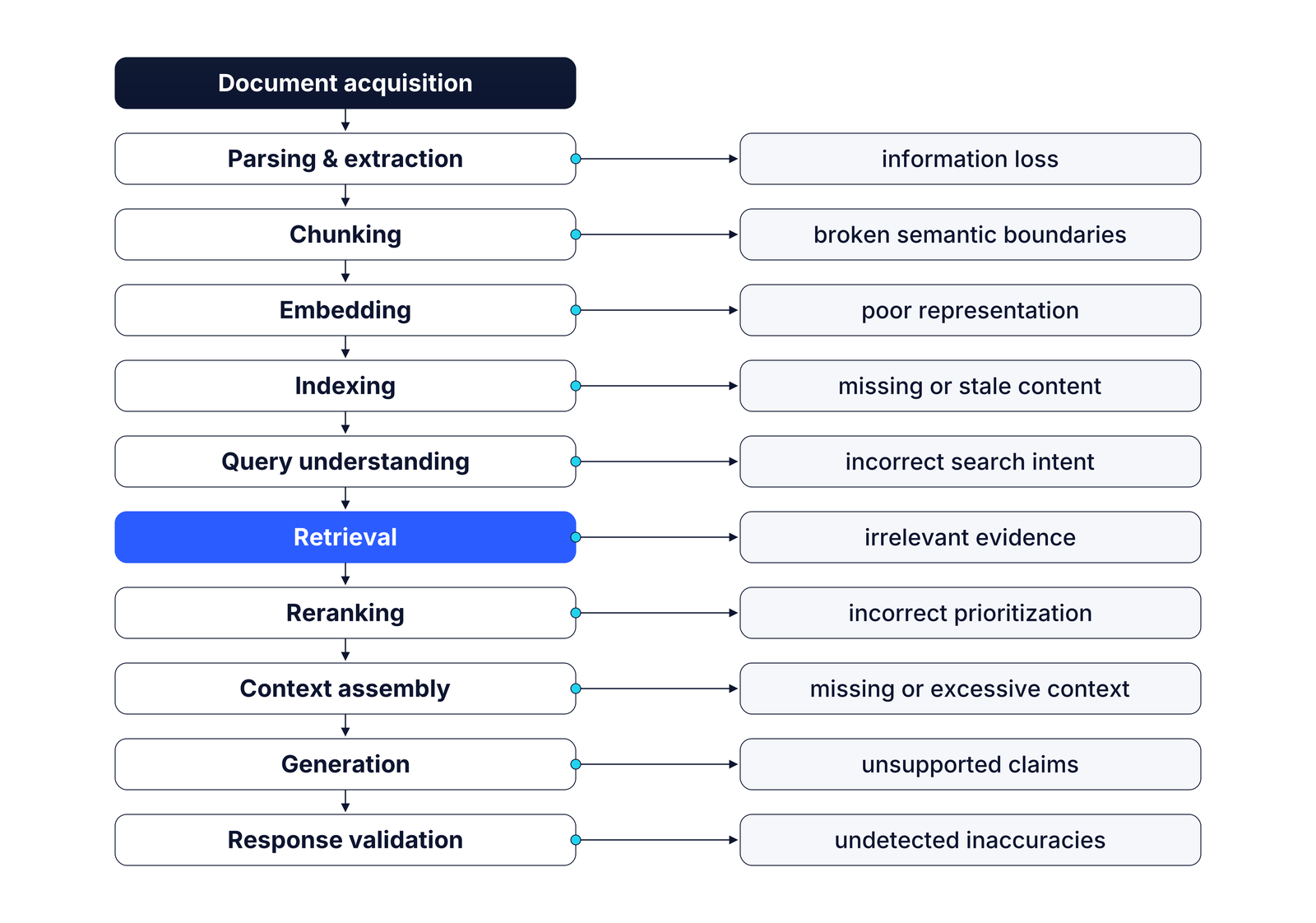
A user-facing hallucination may therefore originate in an upstream parsing, indexing, retrieval, or context-assembly defect rather than in generation alone. Diagnosing it requires visibility into every stage.
7.3 Production Solutions
A production RAG architecture must evaluate its ingestion pipeline and its query-time pipeline separately.
Ingestion-time capabilities
- Document classification.
- Structure-aware parsing.
- Appropriate chunking strategies.
- Metadata enrichment.
- Document-level authorization.
- Embedding version management.
- Index consistency.
- Incremental updates.
- Deletion propagation.
Query-time capabilities
- Intent detection.
- Query rewriting, where beneficial.
- Permission-aware hybrid retrieval.
- Reranking.
- Evidence quality assessment.
- Context assembly.
- Citation generation and validation.
- Evidence-grounded response assessment.
- Abstention and escalation.
Evaluation dimensions
| Metric | Purpose |
|---|---|
| Recall@K | Whether relevant evidence appears among the retrieved results |
| Precision@K | Proportion of retrieved results that are relevant |
| Mean Reciprocal Rank | Rank position of the first relevant result |
| Context relevance | Suitability of the selected context for the question |
| Faithfulness | Whether generated claims are supported by the supplied evidence |
| Citation correctness | Whether cited sources support their associated claims |
| Answer correctness | Whether the final answer satisfies the expected facts |
| Knowledge freshness | Whether current authoritative information is available |
Groundedness and correctness must be measured separately: a response can faithfully reflect an outdated source and still be wrong.
8. Failure Mode 5: Agentic Complexity Is Underestimated
8.1 The Problem
Agents go beyond question answering. They reason about objectives, select tools, maintain state, execute workflows, and perform actions that modify enterprise systems.
A successful agent demonstration usually follows a favorable execution path. Production agents must also handle alternative paths, dependency failures, uncertain results, partial execution, unexpected tool responses, and conflicting business conditions.
8.2 Agent Execution Is a Stateful Distributed Process
Consider an appointment-scheduling agent that must:
- Identify the customer.
- Understand scheduling preferences.
- Check availability.
- Reserve a time slot.
- Send confirmation.
- Update the enterprise system of record.
What if the reservation succeeds but the confirmation fails? What if the scheduling API times out after creating the appointment? What if the agent retries and creates a duplicate? What if it reports completion before the booking is confirmed?
These are classic distributed-systems problems, amplified by probabilistic decision-making.
8.3 Production-Grade Agent Execution Architecture
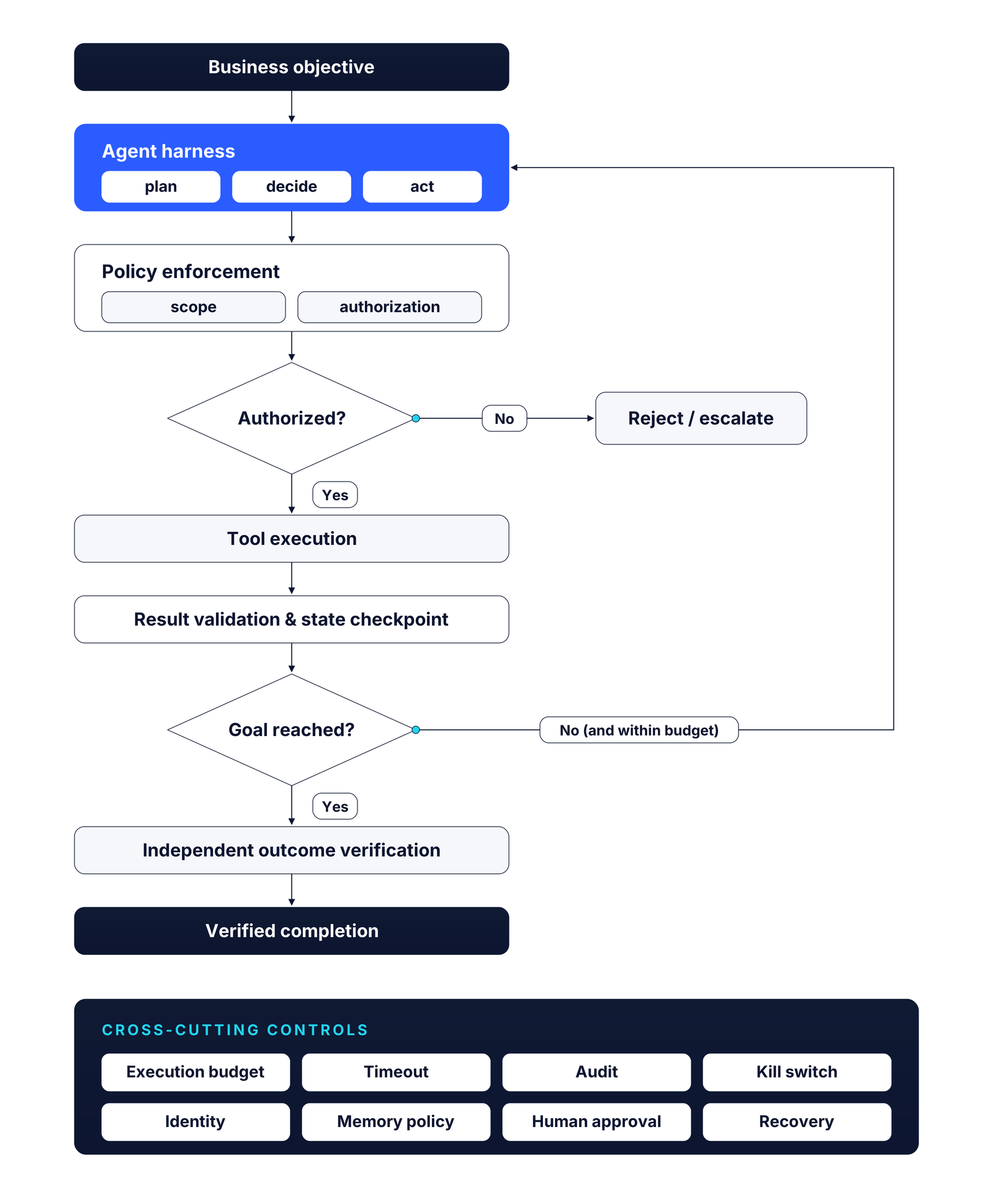
8.4 Required Engineering Controls
- Explicit execution state management.
- Durable checkpoints.
- Maximum execution steps.
- Time and cost budgets.
- Tool authorization.
- Idempotency keys.
- Retry policies.
- Compensation workflows.
- Human approval for consequential actions.
- Agent termination conditions.
- Independent outcome verification.
- Audit trails.
An agent must not grant itself broader permissions or decide which security controls it may bypass. It may propose an action; trusted application and policy components decide whether the action is permitted.
Architectural principle: Greater autonomy requires stronger control boundaries, not fewer controls.
9. Failure Mode 6: Infrastructure and Scalability Are Treated as Afterthoughts
9.1 The Problem
Development workloads usually involve few concurrent users and short interactions. Production systems encounter:
- Traffic spikes.
- Concurrent inference requests.
- Long-context processing.
- Streaming responses.
- Provider rate limits.
- GPU memory constraints.
- Queue buildup.
- Multi-tenant resource contention.
- Variable agent execution duration.
A system that serves individual requests flawlessly may fail when thousands of users interact with it at once.
9.2 AI Scalability Is Multidimensional
Requests per second remains useful but is insufficient. Two requests can have radically different resource demands depending on input tokens, output tokens, model size, retrieval complexity, tool invocations, and agent steps.
| Dimension | Measurement |
|---|---|
| Request throughput | Requests per second |
| Input workload | Input tokens per second |
| Output workload | Generated tokens per second |
| Concurrency | Simultaneous active requests |
| Prefill performance | Input processing latency |
| Generation performance | Inter-token latency and generation throughput |
| Responsiveness | Time to first token |
| User experience | End-to-end latency |
| Resource utilization | GPU utilization, memory, CPU, network |
| Agentic workload | Model and tool calls per completed workflow |
9.3 Production Inference Architecture
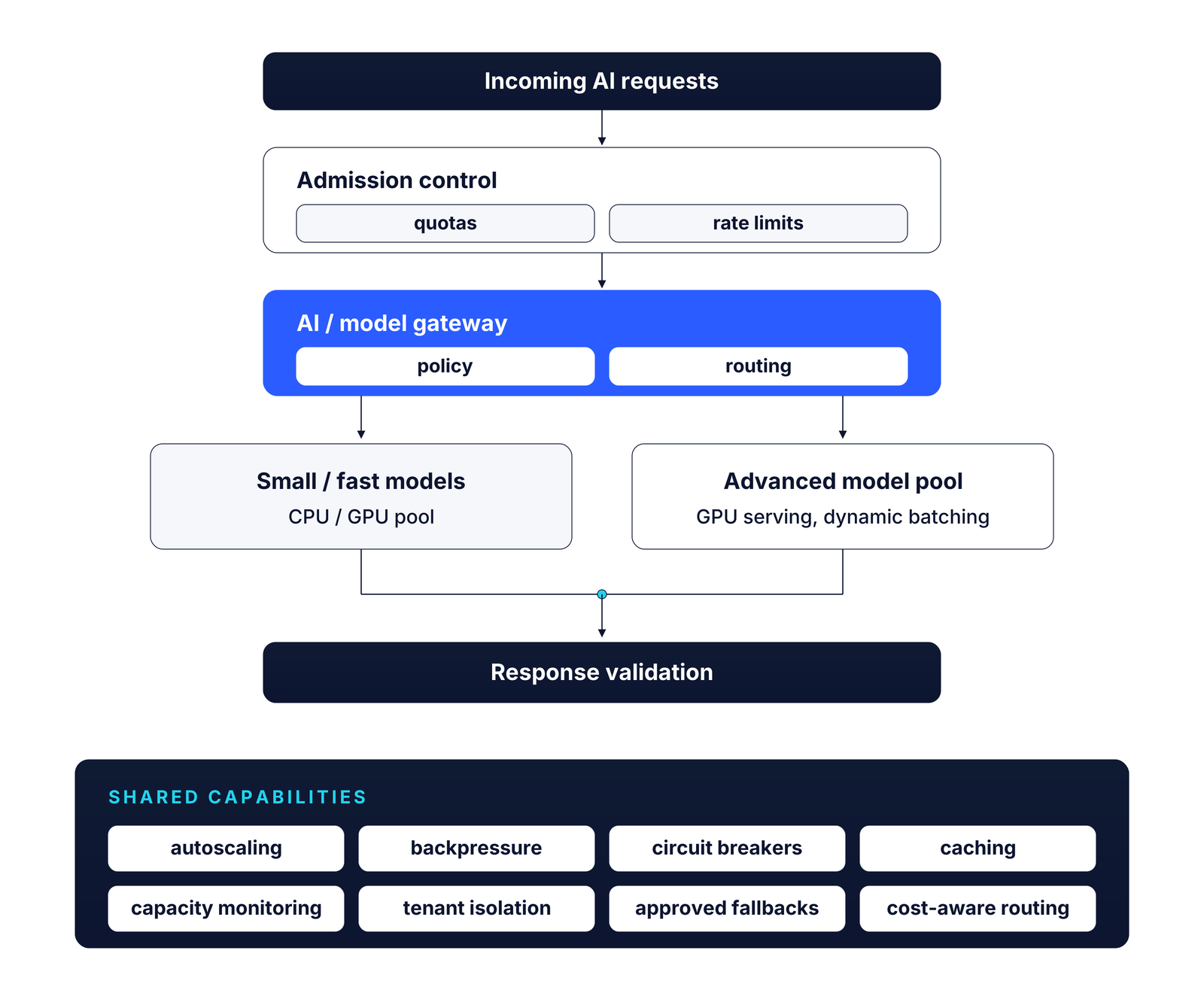
9.4 Architectural Solutions
- Workload-aware autoscaling.
- Appropriate model sizing.
- Token-aware capacity management.
- Dynamic batching, where supported.
- Queue-based workload buffering.
- Admission control and load shedding.
- Tenant-aware quotas.
- Model routing and fallback.
- Warm capacity for latency-sensitive workloads.
- Asynchronous processing for long-running tasks.
- Capacity reservations, where justified.
- Performance testing with representative request distributions.
Evaluate scalability against business workloads and service objectives, not merely the peak throughput of an inference endpoint.
10. Failure Mode 7: External Dependencies Create Cascading Failures
10.1 The Problem
Production AI applications routinely depend on:
- Foundation model providers.
- Vector databases.
- Document services.
- Enterprise APIs.
- Identity providers.
- Business systems.
- MCP servers and other external tools.
- Workflow engines.
Each dependency adds a failure boundary, and a slow or unavailable one can propagate failure across the entire application.
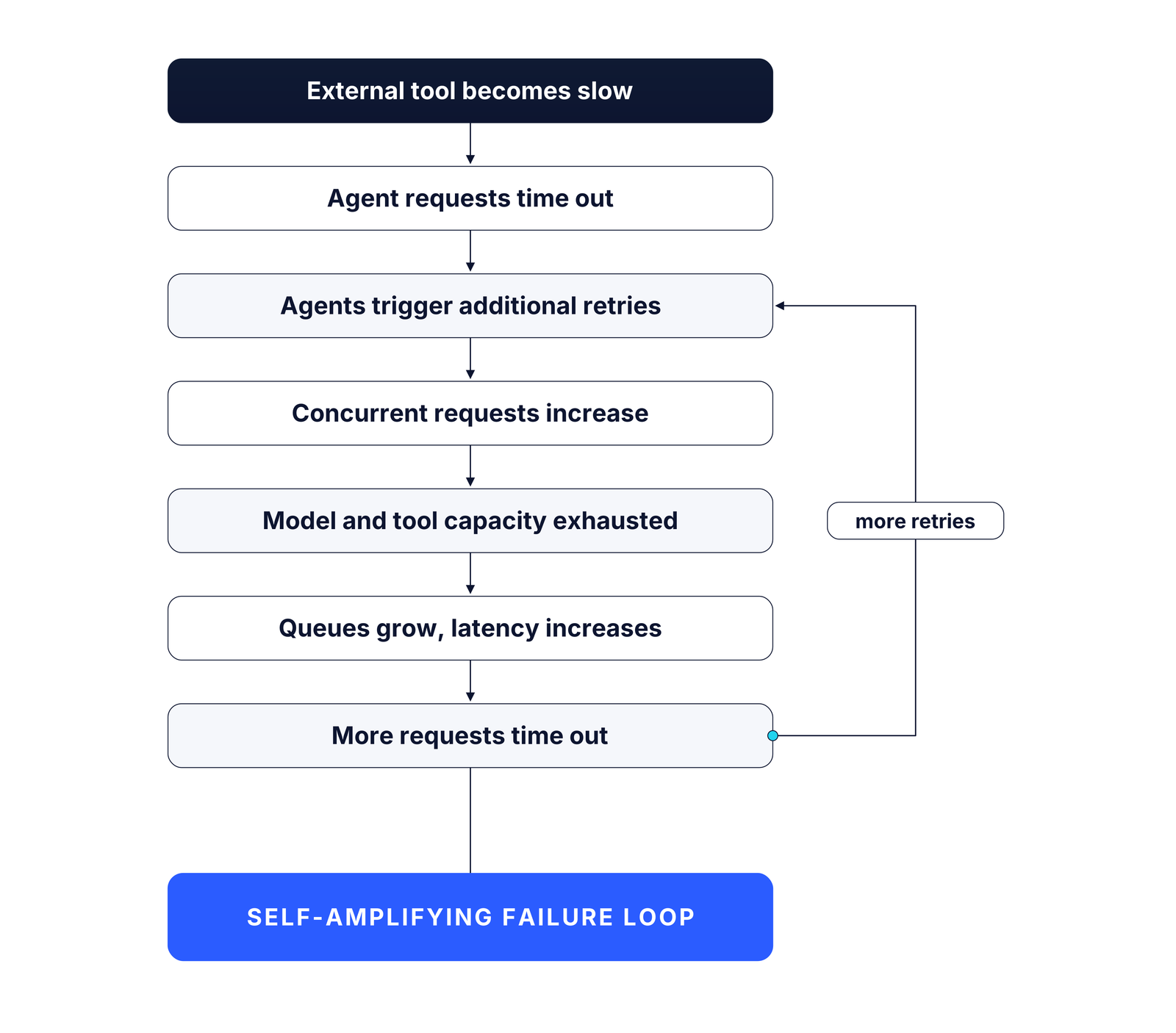
Uncoordinated retries are especially dangerous because they can turn a manageable dependency failure into a broader outage [4].
10.2 Failure Containment Patterns
| Pattern | Purpose |
|---|---|
| Timeout | Prevent indefinite waiting |
| Bounded retry | Recover from transient errors |
| Exponential backoff with jitter | Reduce synchronized retry pressure |
| Circuit breaker | Stop repeated calls to failing dependencies |
| Bulkhead | Isolate failures between workloads |
| Backpressure | Protect downstream systems from overload |
| Dead-letter queue | Isolate failed asynchronous messages |
| Idempotency | Prevent duplicate business effects |
| Checkpointing | Recover interrupted execution |
| Compensation | Address partially completed transactions |
| Graceful degradation | Preserve essential capabilities during disruption |
| Reconciliation | Resolve uncertain or inconsistent transaction state |
10.3 Graceful Degradation
A production system should define in advance what it can safely continue to do when capabilities become unavailable. A customer support copilot, for example, might degrade through these modes:
| Operating mode | Capability |
|---|---|
| Normal | Full AI-assisted customer resolution |
| Degraded level 1 | Approved alternative model |
| Degraded level 2 | Restricted knowledge-based responses |
| Degraded level 3 | Read-only assistance without transaction execution |
| Degraded level 4 | Transfer to human support |
Fallback models must satisfy applicable security, quality, residency, and contractual requirements. Availability alone does not justify routing to an alternative provider.
Architectural principle: Design AI systems to fail safely, recover predictably, and contain failures within defined boundaries.
11. Failure Mode 8: Evaluation Is Treated as a Pre-Deployment Activity
11.1 The Problem
Conventional software tests compare actual output with a precisely defined expected output. AI evaluation is harder: several responses may be acceptable, semantic equivalence often matters more than exact wording, and some failure conditions depend on business context.
A good benchmark result in development does not establish operational reliability.
11.2 The Production AI Evaluation Pyramid
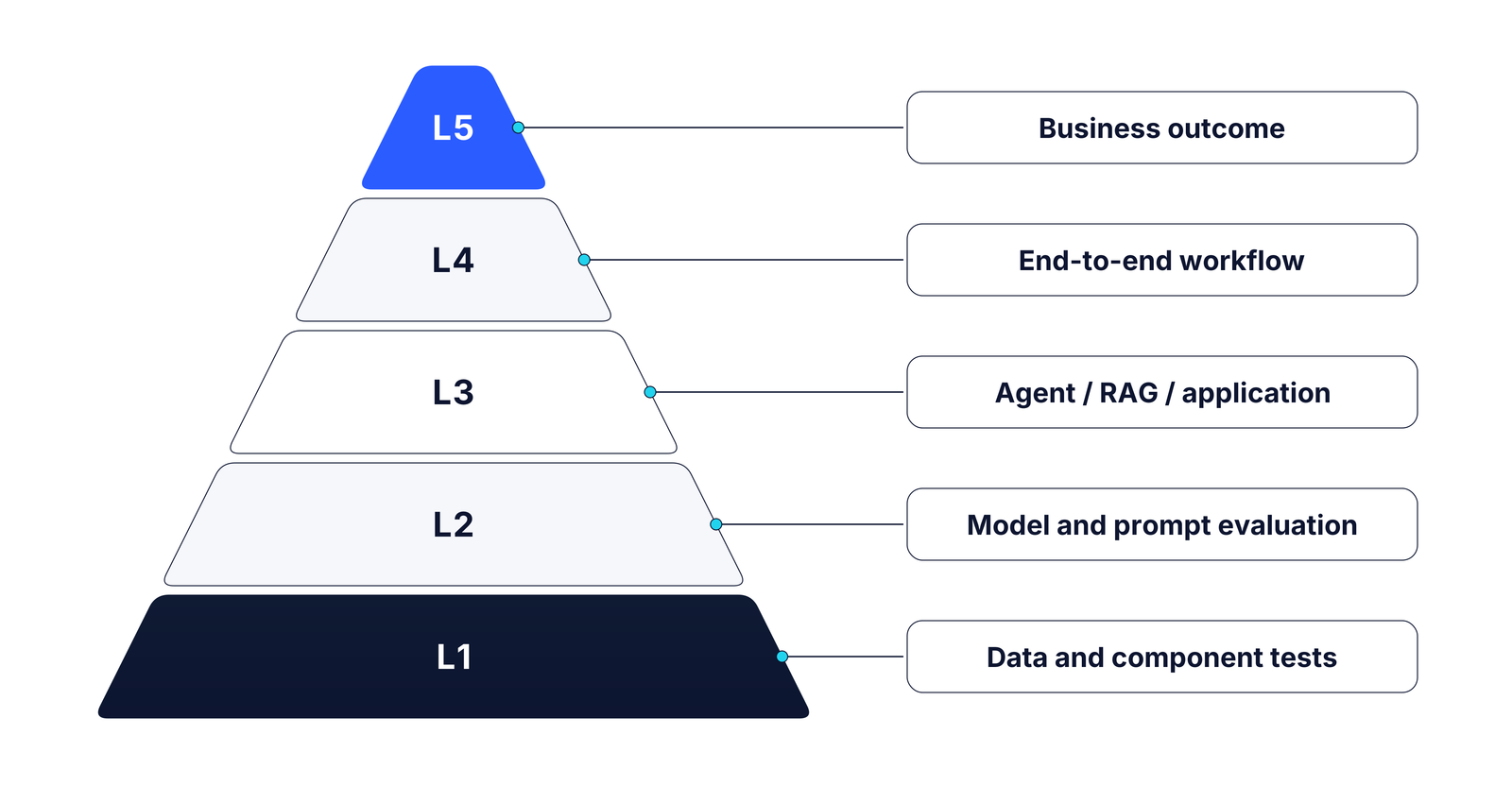
Level 1: Component and data evaluation. Validate data quality, API contracts, schemas, indexing, tool behavior, authorization, and deterministic components.
Level 2: Model and prompt evaluation. Evaluate factual accuracy, task completion, structured output, robustness, safety, latency, and cost.
Level 3: AI subsystem evaluation. Evaluate RAG pipelines, agent reasoning and tool selection, context assembly, memory behavior, and orchestration.
Level 4: End-to-end workflow evaluation. Evaluate complete business scenarios, including partial failures, recovery, human escalation, and security boundaries.
Level 5: Business outcome evaluation. Determine whether the system delivers the intended organizational outcome: resolved customer cases, completed transactions, reduced processing effort, or improved decision quality.
11.3 Continuous Evaluation Architecture
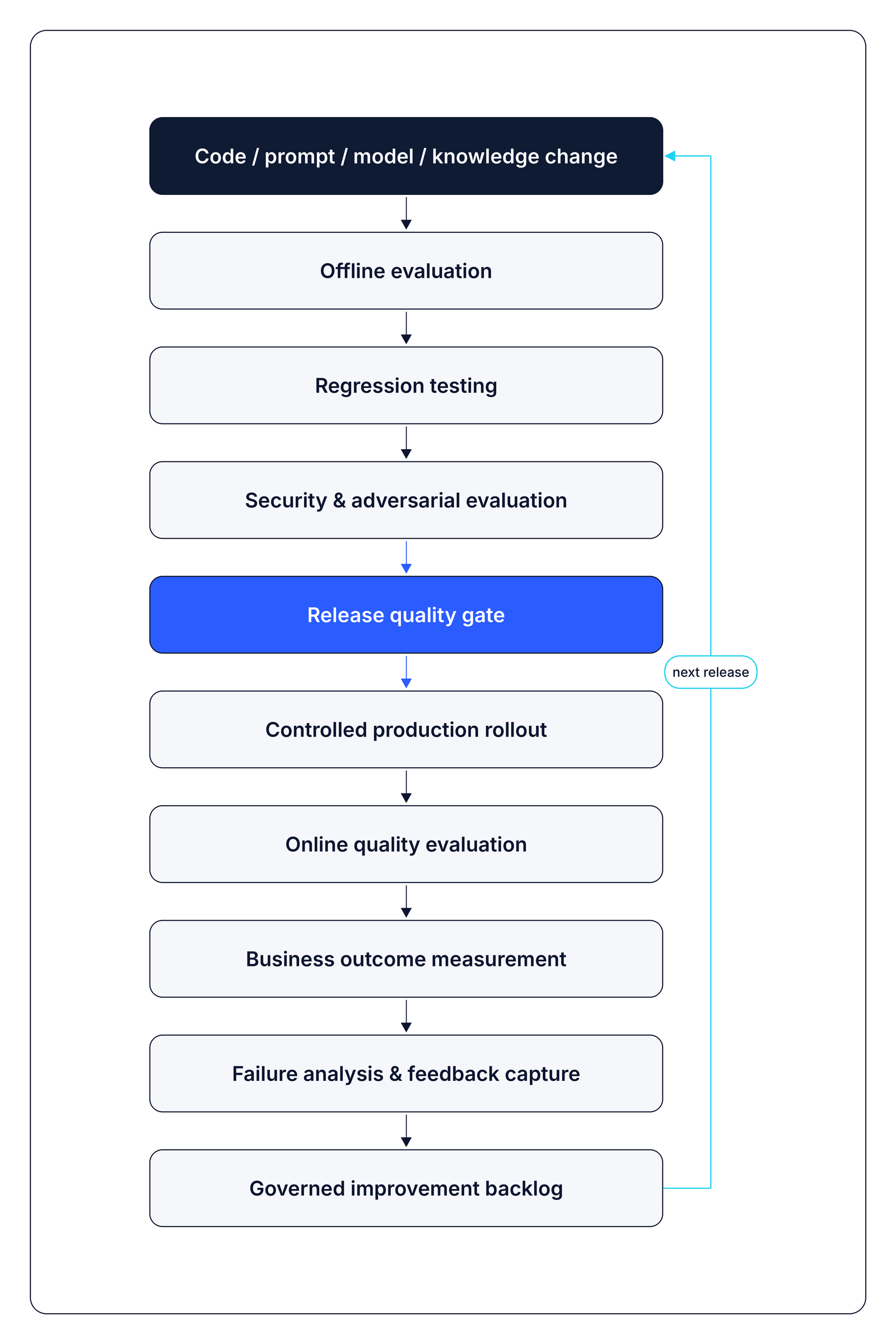
Continuous evaluation should combine deterministic checks, reference datasets, human assessment, statistical sampling, and model-based evaluators.
LLM-as-a-judge can scale semantic assessment, but it has its own limitations, including bias, inconsistency, and sensitivity to evaluation prompts. Validate evaluators against expert-reviewed examples before relying on them.
The ML production-readiness literature has long emphasized comprehensive testing and monitoring beyond offline model performance [2].
12. Failure Mode 9: Traditional Observability Cannot Explain AI Failures
12.1 The Problem
Traditional application monitoring focuses on infrastructure health and software execution:
- CPU utilization.
- Memory consumption.
- HTTP error rates.
- Database connectivity.
- Request latency.
- Service availability.
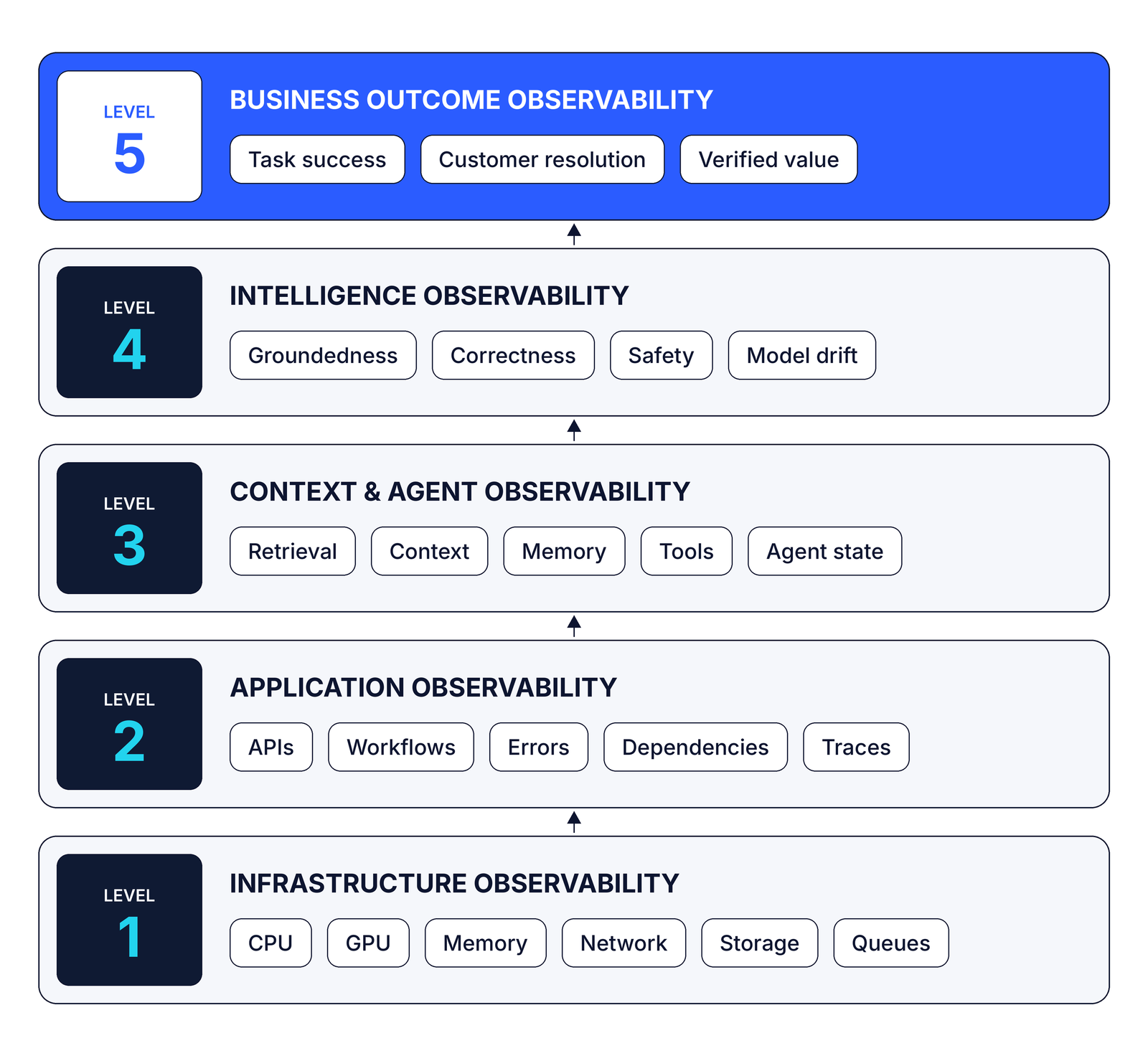
An AI application can show healthy infrastructure metrics while producing factually incorrect responses or failing its business objective. An HTTP 200 response means a request was processed at the protocol level; it says nothing about whether the AI-generated answer was correct.
12.2 The Five Levels of AI Observability
12.3 End-to-End AI Tracing
A production AI trace should let engineers reconstruct the relevant execution path of a request. An illustrative trace might contain:
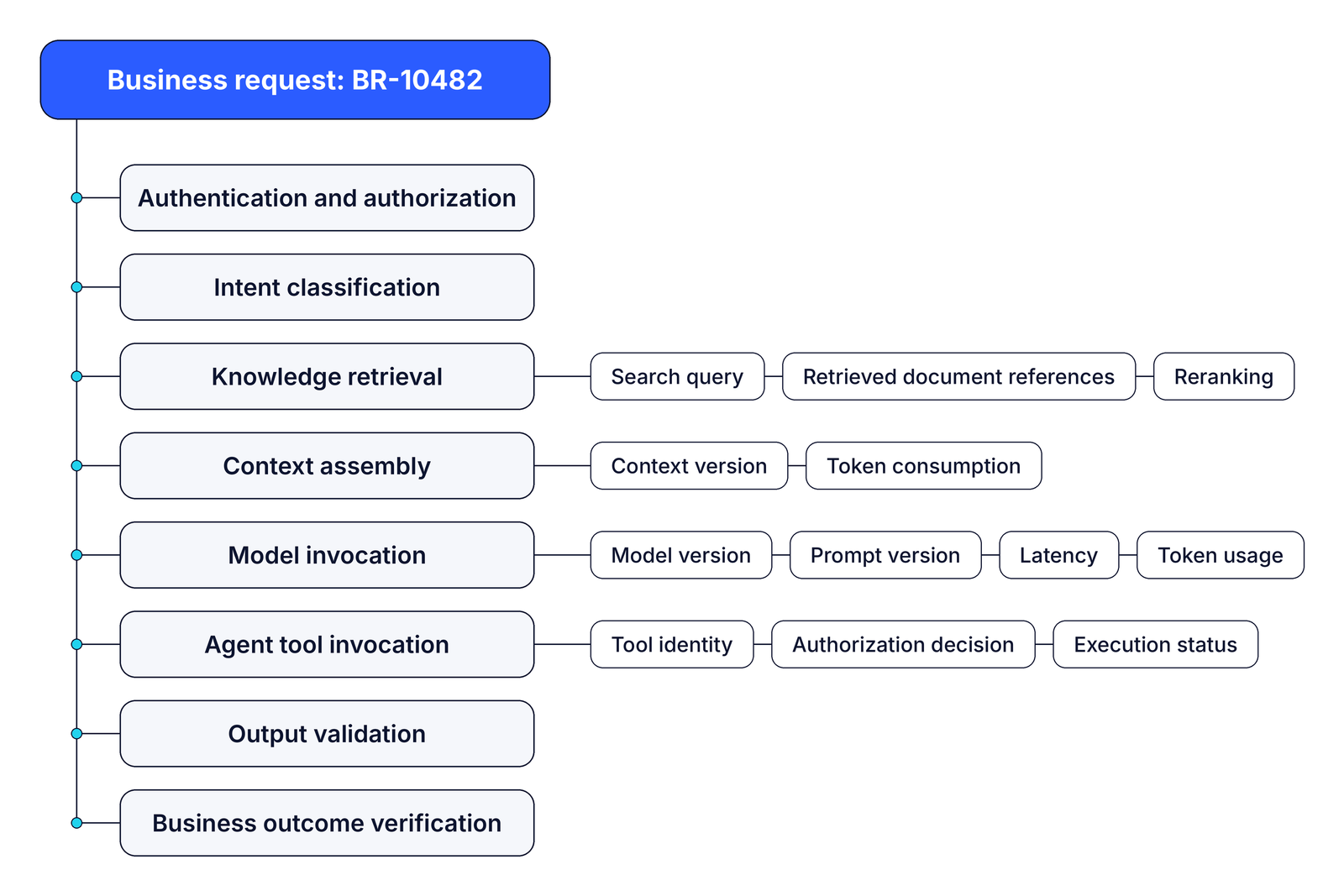
Trace data must itself be governed. Raw prompts, context, model outputs, credentials, and sensitive tool results should not be recorded indiscriminately. Apply redaction, access controls, retention policies, selective capture, and appropriate sampling.
12.4 Observability Versus Evaluation
Observability and evaluation are related but distinct capabilities.
| Observability | Evaluation |
|---|---|
| Explains what happened | Determines how well it happened |
| Captures execution evidence | Assesses execution quality |
| Supports diagnosis | Supports quality measurement |
| Measures behavior | Measures acceptability |
| Investigates incidents | Detects regressions and deficiencies |
Together they form the foundation for diagnosing and improving production AI systems.
13. Failure Mode 10: Security and Governance Are Added Too Late
13.1 The Problem
AI systems add attack surface beyond traditional application security. An attacker may try to manipulate model instructions, inject malicious content into enterprise knowledge, extract sensitive information, influence tool selection, or induce an agent to take unauthorized actions.
Development environments rarely reproduce the full adversarial exposure of enterprise production.
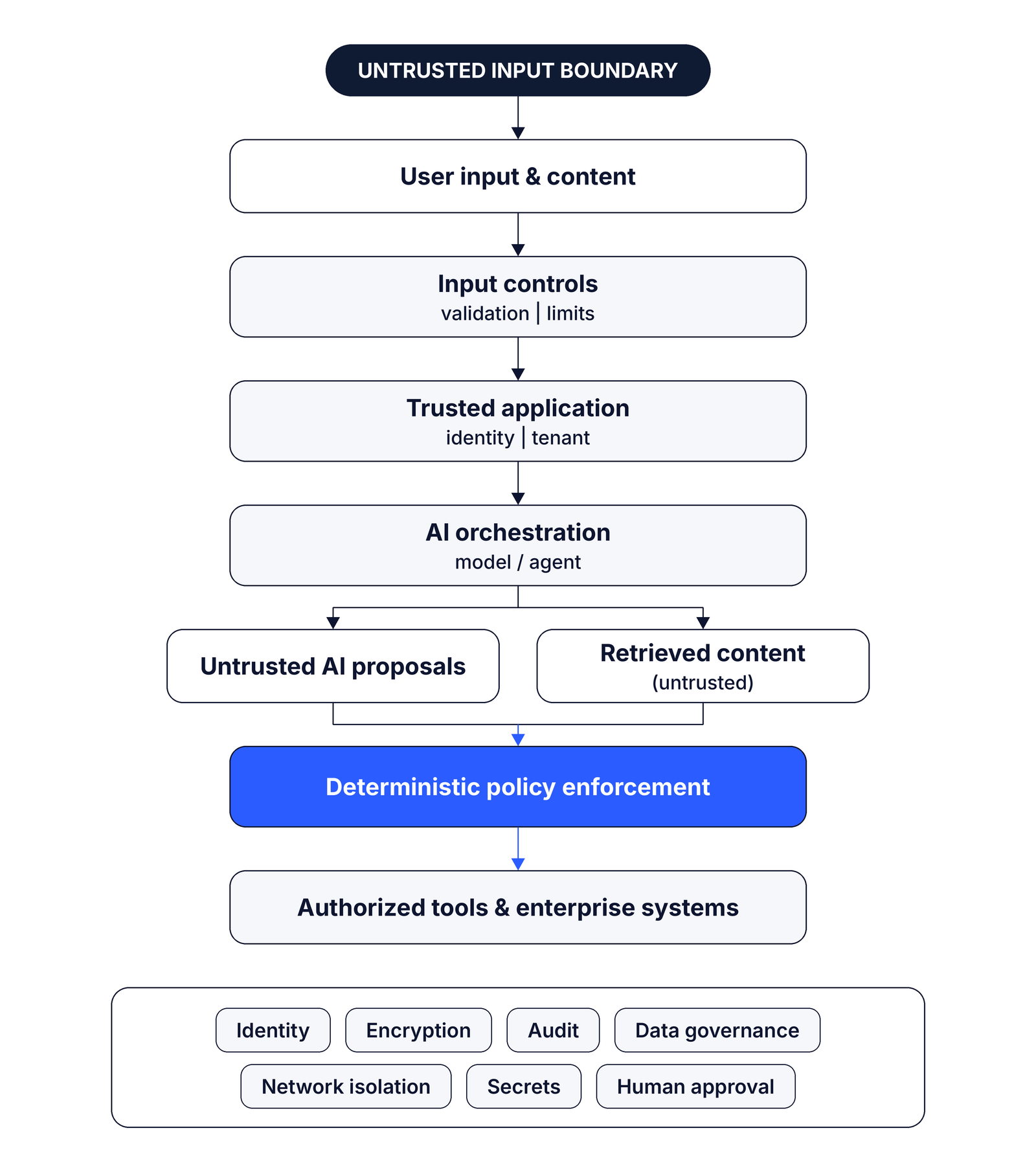
13.2 AI Trust Boundaries
13.3 Major Production AI Security Risks
| Risk | Architectural response |
|---|---|
| Prompt injection | Trust separation, constrained capabilities, adversarial testing |
| Sensitive data disclosure | Data minimization, access enforcement, output controls |
| Knowledge poisoning | Source validation, lineage, controlled ingestion |
| Excessive agency | Scoped permissions and autonomy boundaries |
| Improper output handling | Treat generated output as untrusted; validate before use |
| Cross-tenant leakage | Tenant-aware authorization and isolation |
| Supply chain compromise | Dependency, model, artifact, and tool provenance |
| Unbounded consumption | Rate limits, execution budgets, resource controls |
| Unauthorized tool execution | Independent runtime authorization |
OWASP identifies several of these risks explicitly in its guidance for large language model applications [6].
13.4 Responsible AI by Architecture
Responsible AI should be embedded throughout the system lifecycle, not appended at the end. It includes:
- Privacy protection.
- Risk classification.
- Fairness assessment, where relevant.
- Human oversight.
- Accountability.
- Explainability and evidence.
- Auditability.
- Safety evaluation.
- Incident management.
- Continuous governance.
The NIST AI Risk Management Framework and its Generative AI Profile offer complementary guidance for structuring these responsibilities [5].
Security and governance cannot be delegated entirely to model-level safety features. A model’s willingness to perform an action must never be mistaken for authorization to perform it.
14. Failure Mode 11: AI Economics Become Unsustainable
14.1 The Problem
In development, request volumes are small and inference costs can look negligible. Production changes the equation. Costs rise through:
- Larger models.
- Longer context windows.
- Repeated model invocations.
- Unnecessary tool calls.
- Agent execution loops.
- Inefficient retrieval.
- GPU underutilization.
- Excessive logging.
- Repeated evaluation.
- Human remediation.
- Failed or duplicated workflows.
An apparently successful implementation can become financially unsustainable at enterprise scale.
14.2 The Production AI Cost Model
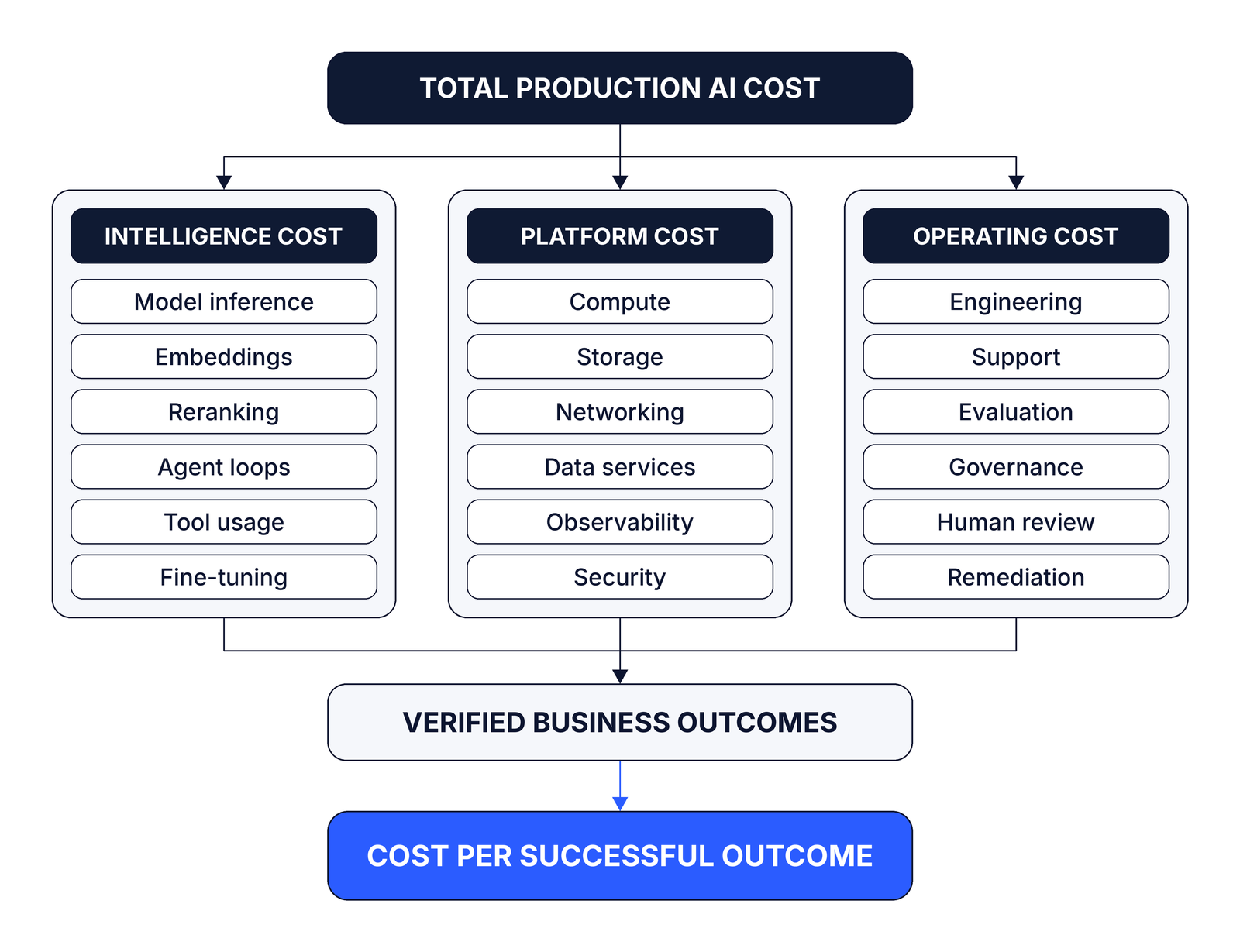
14.3 Move Beyond Cost per Token
Cost per token is an infrastructure-level metric. The more meaningful business metric is:
Cost per Successful Business Outcome = Total Attributable Operating Cost ÷ Verified Successful Outcomes
Consider two architectures for the same enterprise workflow.
| Metric | Architecture A | Architecture B |
|---|---|---|
| Monthly requests | 100,000 | 100,000 |
| Monthly attributable cost | $10,000 | $12,000 |
| Verified success rate | 60% | 90% |
| Successful outcomes | 60,000 | 90,000 |
| Cost per successful outcome | $0.167 | $0.133 |
Architecture B costs more in absolute terms but less per successfully completed outcome. The comparison assumes equivalent outcome definitions, business value, risk constraints, and cost-accounting boundaries.
14.4 Cost-Aware Architectural Patterns
- Intelligent model routing.
- Model cascading.
- Context compression.
- Appropriate model sizing.
- Permission-aware response caching.
- Embedding and retrieval optimization.
- Dynamic batching.
- Agent execution budgets.
- Asynchronous processing.
- GPU utilization optimization.
- Tenant-level cost attribution.
- Cost-aware quality thresholds.
The goal is not to minimize AI spending indiscriminately. It is to maximize acceptable business value relative to the total cost and risk of delivering it.
15. Failure Mode 12: Operational Ownership and Change Management Are Undefined
15.1 The Problem
Traditional applications evolve mainly through changes to source code, configuration, infrastructure, and data schemas. AI applications add many more independently evolving artifacts:
- Models and adapters.
- System prompts.
- Evaluation datasets.
- Embedding models.
- Vector indexes.
- Retrieval strategies.
- Knowledge repositories.
- Context assembly policies.
- Agent definitions.
- Tool contracts.
- Guardrail policies.
- Model routing configurations.
Any of these can change production behavior, so a regression can occur even when the application source code has not changed.
15.2 The AI Release Envelope
A production AI release should be represented by a reproducible collection of approved, compatible artifacts.
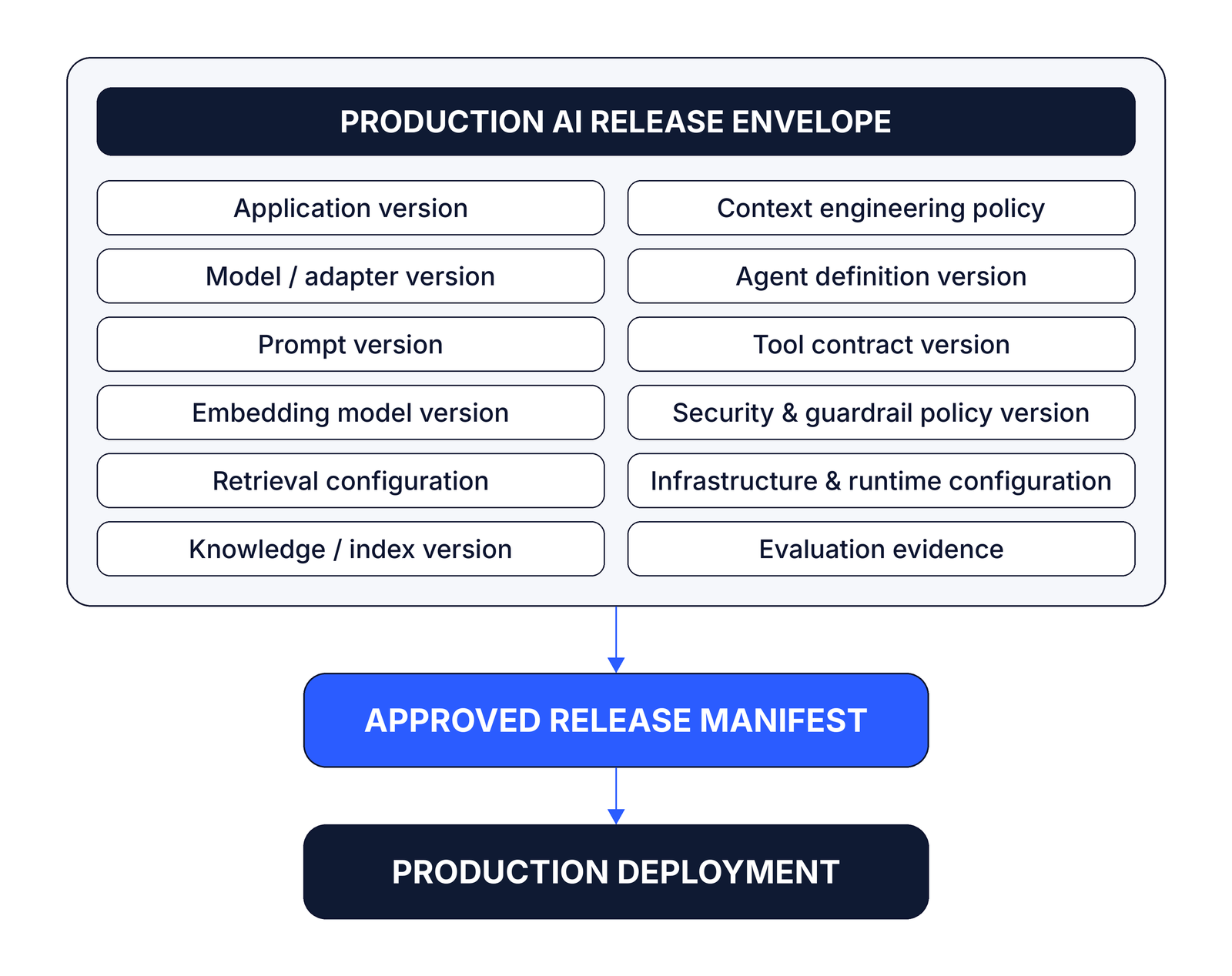
Not every artifact can be pinned indefinitely: managed model providers may change model lifecycles, and enterprise knowledge needs continuous updates. Where exact version control is unavailable, record the effective dependency identity, detect changes where possible, and maintain regression tests and mitigations.
15.3 AI-Native CI/CD
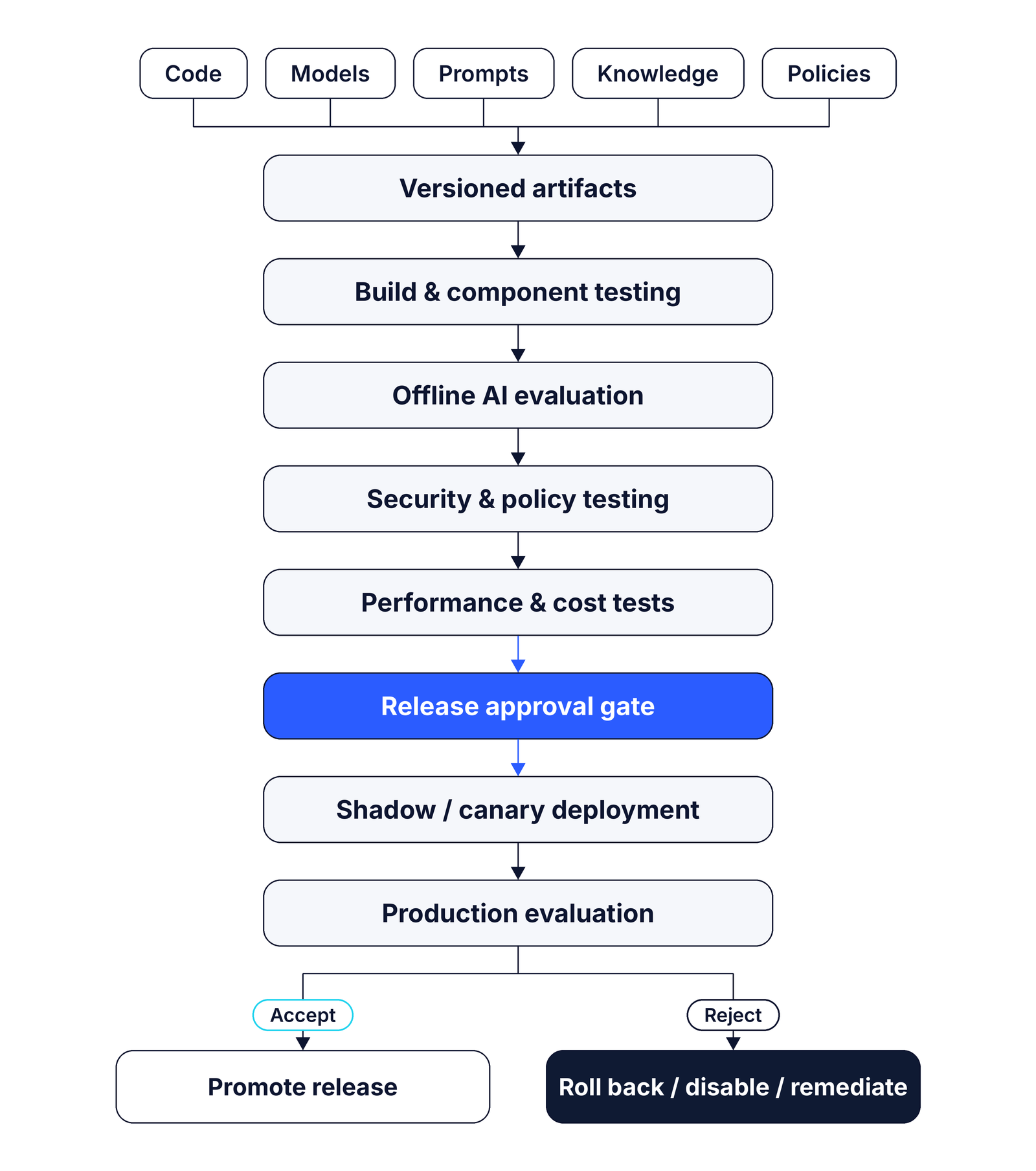
Production AI delivery must extend conventional DevSecOps with MLOps, LLMOps, RAGOps, and AgentOps capabilities as appropriate.
Rollback may involve more than reverting an application version: a previous model, prompt, index, or tool contract may be incompatible with current execution state. Recovery strategies must be designed and tested for the complete release envelope.
15.4 Operational Ownership
Every production AI system needs explicit ownership.
| Role | Primary responsibility |
|---|---|
| Business Owner | Business outcomes and acceptable business risk |
| AI Product Owner | Product objectives and prioritization |
| Principal Architect | Architectural integrity and trade-offs |
| AI Engineering Team | Intelligence and application capabilities |
| Data and Knowledge Team | Data quality, lineage, and freshness |
| AI Platform Team | Shared platform and runtime capabilities |
| SRE / Operations Team | Reliability and incident response |
| Security Team | Security controls and threat management |
| Responsible AI / Risk Team | Risk evaluation and governance oversight |
| FinOps Team | Cost visibility and financial accountability |
Without ownership, monitoring surfaces problems that no team is accountable for resolving.
16. The Enterprise AI Production Reference Architecture
The preceding sections establish a set of interconnected production requirements. They should be met through a coherent architecture rather than a collection of disconnected tools. The AWS Well-Architected Generative AI and Agentic AI Lenses offer complementary, vendor-specific guidance on many of these concerns [7][8].
16.1 Logical Reference Architecture
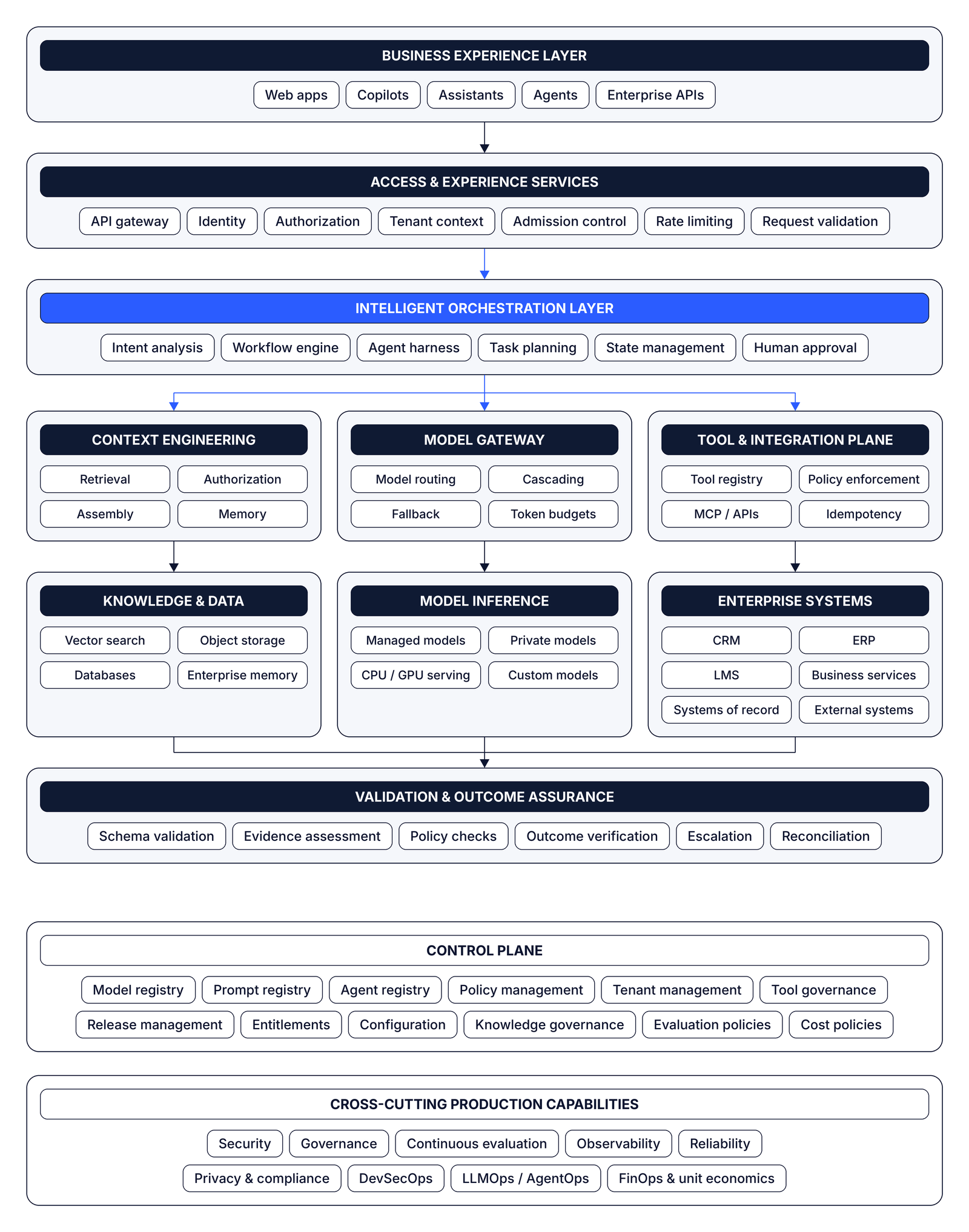
The diagram shows logical capability boundaries, not a mandatory deployment topology. Actual runtime interactions, service boundaries, and technology choices depend on workload requirements.
16.2 Architectural Separation of Concerns
Runtime plane. Processes business requests and executes AI-assisted capabilities: application services, agent and workflow execution, context engineering, model inference, tool execution, state management, and output validation.
Control plane. Manages policies, configurations, approved artifacts, entitlements, and lifecycle operations. It sets the conditions under which the runtime plane operates.
Evaluation and assurance capabilities. Determine whether the system’s intelligence, execution, and business outcomes satisfy defined requirements.
Operational capabilities. Maintain service reliability, infrastructure performance, security posture, cost visibility, and incident response.
This separation lets enterprise AI capabilities evolve without tightly coupling every architectural component to the application.
17. From Individual Components to Architectural Fitness
17.1 Defining an AI Production Operating Envelope
Production readiness is not a universal property. A system may be suitable for one operating environment and unsuitable for another. An internal document-summarization assistant has very different risk and reliability requirements from an agent authorized to execute financial transactions.
Every enterprise AI application should therefore define an explicit operating envelope.
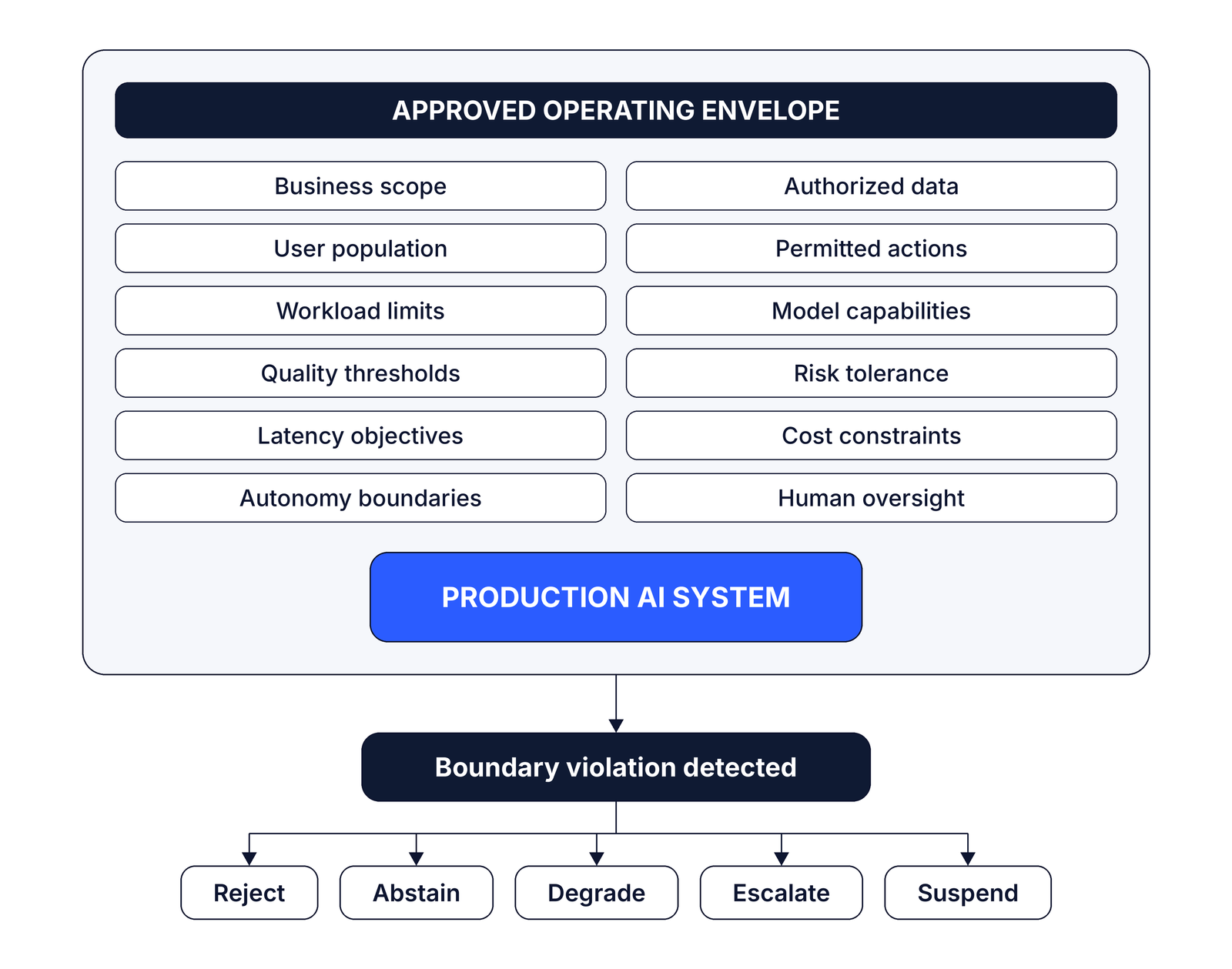
The envelope defines the conditions under which the system is approved to function. Wherever possible, express its requirements as measurable architectural contracts.
17.2 Architectural Fitness Functions
An architectural fitness function is an objective mechanism for assessing whether a system satisfies a required architectural property. For production AI, fitness functions might include:
| Architectural property | Example fitness function |
|---|---|
| Security | Cross-tenant access tests detect no unauthorized disclosures in the tested scenarios |
| Reliability | Required workflows meet the approved task success objective |
| Performance | P95 response latency stays within the defined target |
| Groundedness | Evidence-dependent responses meet the approved groundedness threshold |
| Cost efficiency | Cost per verified outcome stays within budget |
| Governability | All privileged tool actions have recorded authorization decisions |
| Recoverability | Injected dependency failures recover within the approved recovery objective |
| Maintainability | Releases contain traceable and compatible artifact versions |
| Knowledge quality | Critical source updates become available within the freshness objective |
Fitness functions convert architectural intent into verifiable evidence. Evaluate them continuously where practical rather than only at architecture review meetings.
18. Defining Production AI Service-Level Objectives
18.1 Why Availability Is Not Enough
A conventional availability target measures whether a service is accessible and operational by a defined criterion. For production AI, availability does not capture intelligence quality or business execution quality: an assistant may be available while giving incorrect answers, and an agent may run without infrastructure errors while failing its assigned objective.
A mature production AI system therefore defines service-level objectives (SLOs) across infrastructure, intelligence, and business dimensions. The general SLO discipline of choosing meaningful indicators, setting objectives, and managing error budgets remains the right starting point [3].
18.2 Illustrative Production AI SLOs
The targets below are examples, not industry standards. Actual thresholds must be derived from business impact, workload characteristics, empirical evaluation, and risk tolerance.
| Dimension | Service-level indicator | Illustrative objective |
|---|---|---|
| Availability | Valid requests successfully served | ≥99.9% |
| Latency | P95 end-to-end response time | ≤5 seconds for defined interactive tasks |
| Responsiveness | P95 time to first token | ≤1.5 seconds |
| Correctness | Correct responses in representative evaluations | ≥95% |
| Groundedness | Supported claims in evidence-dependent responses | ≥98% |
| Agent reliability | Verified eligible workflow completion | ≥95% |
| Tool reliability | Successful eligible tool invocations | ≥99% |
| Governance | Privileged actions with authorization records | 100% |
| Knowledge freshness | Critical content indexed after approved publication | Within 15 minutes |
| Economics | Cost per verified successful outcome | Within approved business budget |
| Recovery | Recovery from defined failure scenarios | Within workload-specific RTO |
Evaluation-based objectives must specify the dataset or sampled population, the measurement procedure, the acceptance criteria, and the statistical uncertainty. Security invariants, such as preventing unauthorized cross-tenant access, should not be treated as ordinary error-budget allowances.
18.3 Business Outcome Reliability
Teams should define a successful task in business terms. A refund agent’s success is not merely producing a refund recommendation or receiving a successful API response. Depending on the workflow boundary, success may require confirming that:
- The refund was authorized.
- The transaction was recorded.
- The payment provider accepted the transaction.
- Settlement was independently verified.
- Reconciliation was completed.
- The customer was appropriately notified.
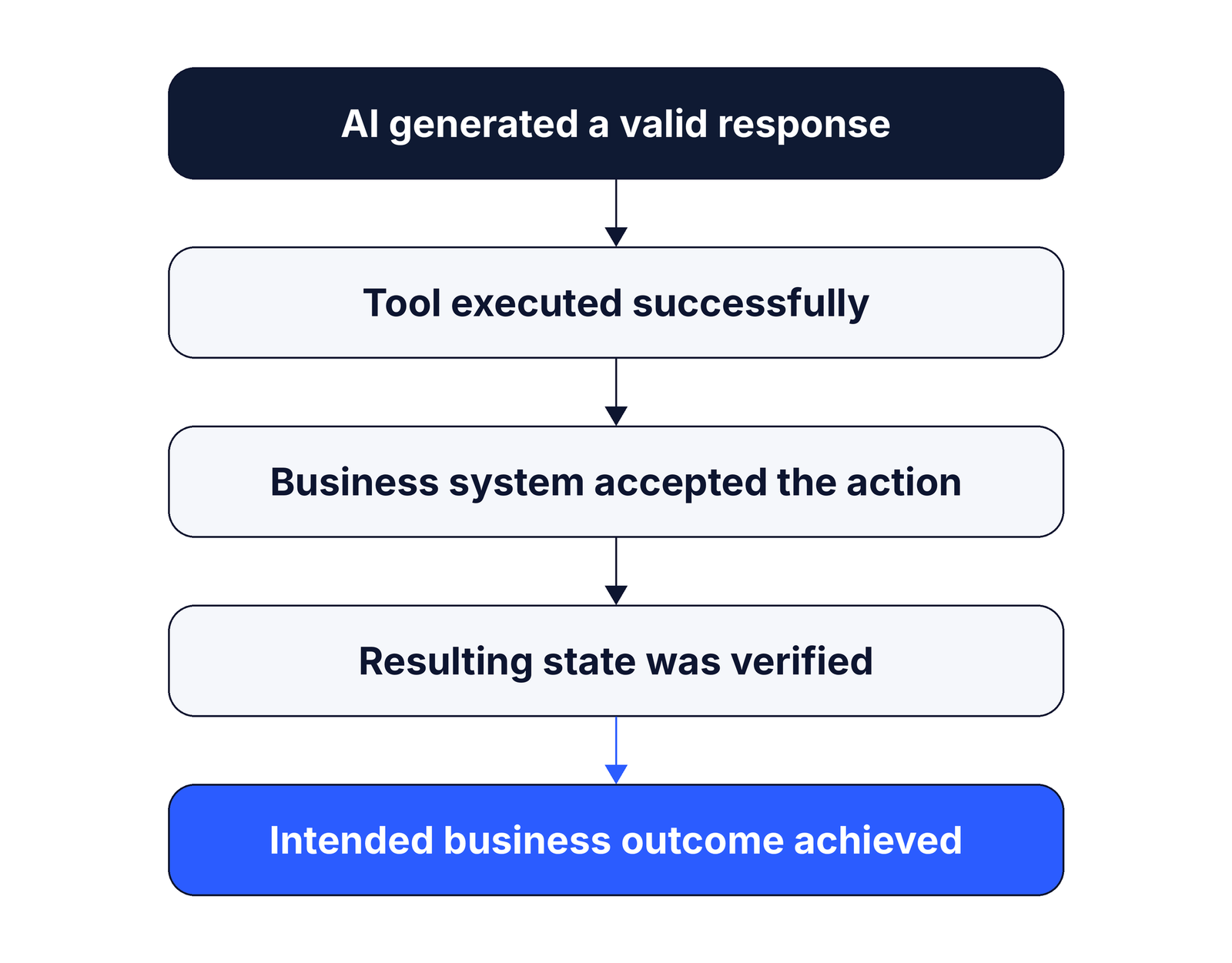
Each level provides progressively stronger evidence of success.
19. The Enterprise AI Production Readiness Framework
Production readiness should be assessed against explicit decision criteria rather than subjective confidence. The framework below is proposed as a practical assessment mechanism for architecture and engineering teams.
19.1 Twelve Production Readiness Domains
| Domain | Assessment question | Required evidence |
|---|---|---|
| 1. Business readiness | Is the intended business outcome measurable? | Business KPIs and acceptance criteria |
| 2. Architecture readiness | Is the end-to-end architecture validated? | Architecture decisions and fitness results |
| 3. Model readiness | Is model behavior acceptable for the intended task? | Evaluation and regression reports |
| 4. Data readiness | Is production data suitable and governed? | Quality, lineage, and access reports |
| 5. Context readiness | Is runtime context reliable and authorized? | Context evaluation and security tests |
| 6. Agent readiness | Are agent actions bounded and recoverable? | Scenario and failure-injection tests |
| 7. Infrastructure readiness | Can the workload meet capacity requirements? | Load tests and capacity analysis |
| 8. Reliability readiness | Can failures be contained and recovered from? | Resilience and recovery evidence |
| 9. Evaluation readiness | Can quality regressions be detected? | Evaluation pipelines and quality gates |
| 10. Security readiness | Are security and governance controls effective? | Threat models and security assessments |
| 11. Operational readiness | Can the system be operated and supported? | Runbooks, dashboards, and ownership |
| 12. Economic readiness | Is the workload financially sustainable? | TCO and unit-economics analysis |
Domains that genuinely do not apply should be documented as such, with the rationale approved by the relevant stakeholders.
19.2 Readiness Maturity Levels
| Level | Classification | Characteristics |
|---|---|---|
| 0 | Absent | Required capability is undefined or missing |
| 1 | Experimental | Capability exists in a development environment |
| 2 | Functional | Capability works under controlled conditions |
| 3 | Production validated | Capability has been tested against production requirements |
| 4 | Operationally managed | Capability is monitored, governed, and supported |
| 5 | Continuously optimized | Capability is systematically improved using operational evidence |
An enterprise can compute a weighted readiness score across the applicable domains, where wᵢ is the weight and rᵢ the maturity rating (0–5) of domain i:
Weighted Readiness Score = 100 × Σ(wᵢ × rᵢ) ÷ (5 × Σwᵢ)
Aggregate scores must never override critical controls. A system can post a high overall score while hiding an unacceptable authorization vulnerability or an untested recovery path.
19.3 Non-Negotiable Release Gates
Examples of hard release gates include:
- No known unresolved security vulnerabilities above the approved release threshold.
- Effective tenant isolation and authorization enforcement.
- Approved sensitive-data handling controls.
- Adequate evaluation against high-risk scenarios.
- Bounded agent execution.
- Tested recovery and rollback procedures.
- Defined human oversight for consequential decisions.
- Established operational ownership.
- Acceptable business outcome quality.
A failed mandatory gate produces a no-go decision for the affected deployment scope, regardless of the aggregate score.
19.4 Production Readiness Decision Matrix
| Readiness score | Mandatory gates | Illustrative decision |
|---|---|---|
| Below 60% | Any status | Not ready for production |
| 60–79% | All passed | Consider a restricted, supervised pilot |
| 80–89% | All passed | Controlled production rollout |
| 90–100% | All passed | Eligible for broader rollout following risk approval |
| Any score | One or more failed | No-go for the affected scope |
These thresholds are proposed starting points. Organizations should calibrate them to workload criticality and governance requirements.
20. Transitioning from Development to Production
Production readiness should be engineered progressively across the AI delivery lifecycle, not inspected at the end.
20.1 The Production Maturity Journey
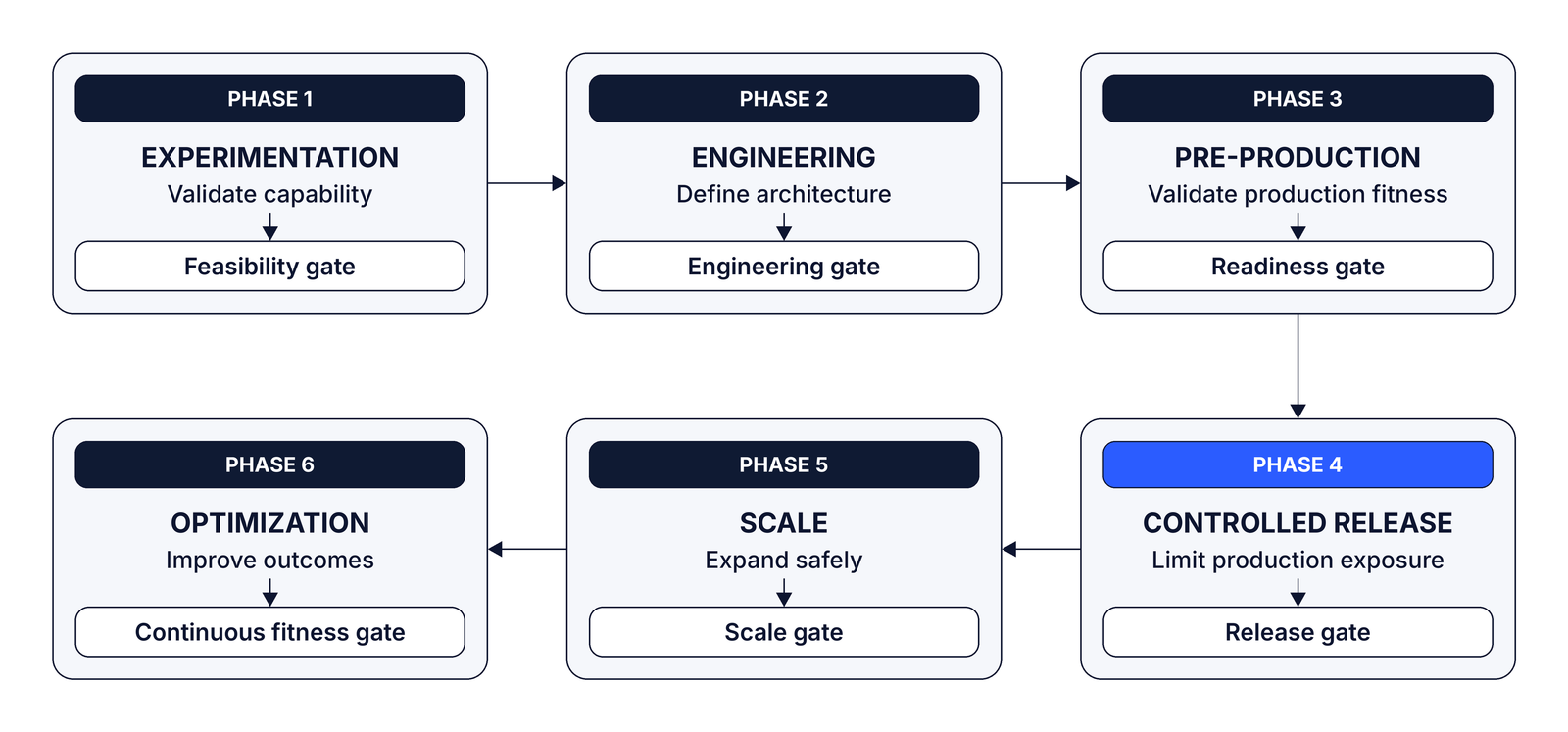
20.2 Phase 1: Experimentation
Objective: Establish technical feasibility and business potential.
- Define the business problem.
- Identify candidate AI capabilities.
- Evaluate model suitability.
- Develop prototypes.
- Establish initial quality baselines.
- Estimate potential business value.
- Identify major risks and constraints.
Exit criterion: Evidence supports further investment in the use case.
20.3 Phase 2: Production Engineering
Objective: Build an architecture suited to the intended operating environment.
- Define functional and non-functional requirements.
- Establish architectural boundaries.
- Design data and context pipelines.
- Implement security and governance controls.
- Engineer resilience and state management.
- Establish evaluation and observability.
- Design deployment and recovery mechanisms.
- Establish initial cost models.
Exit criterion: The architecture and implementation satisfy the agreed engineering requirements.
20.4 Phase 3: Pre-Production Validation
Objective: Establish evidence of production fitness.
- End-to-end scenario testing.
- Model and prompt regression testing.
- RAG and context evaluation.
- Adversarial security testing.
- Load and stress testing.
- Failure injection.
- Recovery and rollback testing.
- Cost analysis.
- Operational readiness assessment.
- Business acceptance testing.
Exit criterion: Mandatory release gates pass and residual risks are accepted by authorized stakeholders.
20.5 Phase 4: Controlled Production Release
Objective: Validate behavior under limited real-world exposure.
- Release to a restricted user population.
- Apply feature flags and traffic controls.
- Use shadow evaluation where appropriate.
- Monitor quality and operational metrics.
- Validate real business outcomes.
- Capture user feedback.
- Investigate unexpected failure modes.
- Maintain rapid disablement and recovery mechanisms.
For state-changing agents, shadow execution must avoid creating unintended production side effects.
Exit criterion: Evidence supports expanding the approved operating envelope.
20.6 Phase 5: Production Scale
Objective: Expand adoption without compromising quality, reliability, security, or economics.
- Increase workload and user coverage progressively.
- Validate multi-tenant isolation.
- Expand infrastructure capacity.
- Optimize model routing.
- Refine service objectives.
- Establish sustainable operational support.
- Monitor business value realization.
Exit criterion: Production systems consistently meet approved service and business objectives at the intended scale.
20.7 Phase 6: Continuous Optimization
Objective: Improve the production system using operational evidence.
- Analyze failure patterns.
- Expand representative evaluation datasets.
- Improve retrieval and context quality.
- Optimize models and inference.
- Reduce unnecessary execution.
- Improve business workflow completion.
- Update security and governance controls.
- Reassess architectural fitness.
Production readiness is not a one-time certification. It is a continuously maintained property.
21. Enterprise Case Study: From AI Prototype to Reliable Customer Operations
21.1 Business Scenario
Consider a hypothetical enterprise deploying an AI-powered customer operations platform that combines:
- A conversational assistant.
- Enterprise RAG.
- Customer information retrieval.
- Refund eligibility assessment.
- Appointment scheduling.
- Business workflow execution.
The prototype performs well against selected development scenarios. After deployment, several problems emerge.
21.2 Production Symptoms
| Symptom | Underlying cause |
|---|---|
| Incorrect refund recommendations | Outdated policy documents |
| Slow responses during peak hours | Inference saturation and queue buildup |
| Duplicate refund requests | Missing idempotency controls |
| High inference costs | Excessive context and repeated model calls |
| Inconsistent policy interpretation | Business rules delegated entirely to the model |
| Confidential information exposure | Missing authorization-aware retrieval |
| Failed cases reported as completed | No independent outcome verification |
| Difficult incident investigation | Incomplete AI execution traces |
Model fine-tuning alone cannot resolve these issues.
21.3 Architectural Transformation
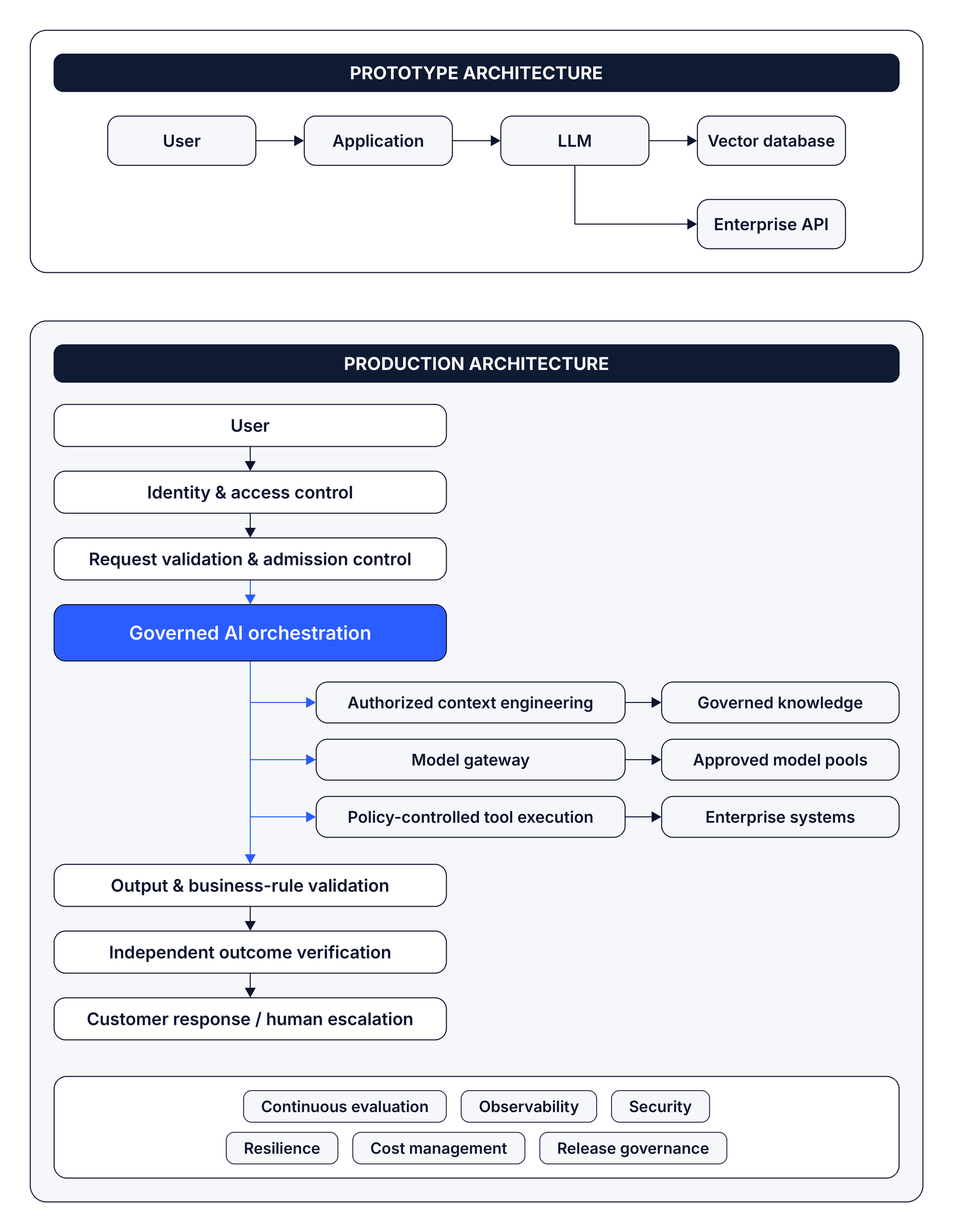
21.4 Solution Mapping
| Production issue | Architectural remediation |
|---|---|
| Outdated policies | Knowledge freshness management and effective-date filtering |
| Inference saturation | Token-aware capacity planning and admission control |
| Duplicate transactions | Idempotency and transaction-state reconciliation |
| Excessive costs | Context budgeting and model cascading |
| Inconsistent eligibility | Deterministic policy engine |
| Unauthorized information | Identity-aware and tenant-aware retrieval |
| Incorrect completion status | Independent business outcome verification |
| Limited diagnostics | End-to-end AI execution tracing |
21.5 Illustrative Outcomes
The figures below are hypothetical. They show how improvements might be measured and are not empirical results from a real implementation.
| Metric | Initial architecture | Engineered architecture |
|---|---|---|
| Verified workflow success | 72% | 96% |
| P95 response latency | 18 seconds | 5 seconds |
| Groundedness assessment | 78% | 97% |
| Cost per successful workflow | $0.42 | $0.19 |
| Duplicate transactions per 10,000 | 35 | 1 |
| Unauthorized disclosures in security test suite | 7 | 0 detected |
Such measurements would need equivalent workloads, consistent evaluation procedures, representative sampling, and appropriate statistical analysis before supporting a real production decision.
The example illustrates that substantial improvements can come from architectural and engineering interventions without changing the underlying foundation model.
22. Production AI Anti-Patterns
Architecture reviews should explicitly look for patterns that create avoidable production risk.
| Anti-pattern | Recommended alternative |
|---|---|
| Assuming model accuracy guarantees system quality | End-to-end business outcome evaluation |
| Treating prompts as unversioned application strings | Governed prompt lifecycle |
| Giving agents broad tool permissions | Least-privilege runtime authorization |
| Adding all available information to the context window | Context prioritization and budgeting |
| Treating vector search as the complete RAG architecture | Governed ingestion and retrieval pipelines |
| Using retries as the only failure strategy | Bounded retries and failure containment |
| Monitoring only infrastructure health | Intelligence and outcome observability |
| Assuming an HTTP 200 response means task success | Semantic and business outcome validation |
| Deploying model updates without regression tests | Evaluation-driven release gates |
| Selecting models solely by benchmark performance | Workload-specific evaluation of quality, latency, risk, and cost |
| Logging all prompts and outputs indiscriminately | Governed, privacy-aware telemetry |
| Scaling infrastructure without evaluating economics | Outcome-oriented capacity and cost management |
| Allowing an agent to determine its own authorization | Independent policy enforcement |
| Treating production readiness as a launch milestone | Continuous architectural fitness assessment |
23. Enterprise AI Production Readiness Checklist
Before approving an enterprise AI system for production, technology leaders and architecture teams should be able to answer the following questions with evidence.
23.1 Business and Architecture
- Is the intended business outcome clearly defined?
- Are business success and technical success distinguished?
- Is the approved operating envelope documented?
- Are architecture decisions and trade-offs recorded?
- Are critical architectural fitness functions established?
23.2 Models and Intelligence
- Has the model been evaluated against representative production scenarios?
- Are unacceptable outputs detected and handled?
- Are model versions and effective configurations traceable?
- Are approved fallback and abstention mechanisms defined?
- Are regression tests integrated into release pipelines?
23.3 Data, Knowledge, and Context
- Are data quality and knowledge freshness monitored?
- Are retrieval operations authorization-aware?
- Is context assembly governed?
- Are tenant boundaries enforced?
- Are knowledge sources and evidence traceable?
- Are drift detection and remediation processes established?
23.4 Agentic Execution
- Are agent permissions scoped?
- Are execution budgets enforced?
- Are tool contracts validated?
- Are state-changing operations idempotent or otherwise protected against duplicate effects?
- Are human approvals enforced where required?
- Are checkpointing and recovery tested?
- Are business outcomes independently verified?
23.5 Infrastructure and Reliability
- Has representative load testing been completed?
- Are service-level objectives defined?
- Are timeouts and retry budgets configured?
- Are dependency failures contained?
- Are graceful degradation mechanisms tested?
- Are recovery objectives validated?
23.6 Evaluation and Observability
- Is continuous evaluation implemented?
- Are AI quality metrics monitored?
- Are end-to-end execution traces available?
- Are evaluators independently validated?
- Are business outcome metrics captured?
- Are incident diagnosis procedures documented?
23.7 Security and Governance
- Has AI-specific threat modeling been completed?
- Has adversarial testing been performed?
- Are sensitive-data controls effective?
- Are tool permissions independently enforced?
- Are audit records available?
- Are responsible AI requirements satisfied?
23.8 Operations and Economics
- Is operational ownership clearly defined?
- Are incident response runbooks available?
- Are AI artifacts and configurations versioned?
- Have recovery and rollback procedures been tested?
- Is cost attributed to workloads or tenants?
- Is cost per verified successful outcome measurable?
- Is there a continuous improvement process?
A checklist is not a substitute for evidence. Each affirmative answer should be backed by a test result, architecture artifact, operational demonstration, or approved control.
24. Strategic Implications for Technology Leaders
Production AI demands organizational transformation as well as technical engineering. Different leadership roles own complementary parts of the readiness challenge.
| Leadership role | Fundamental responsibility |
|---|---|
| CTO | Establish sustainable enterprise AI technology capabilities |
| Head of AI | Ensure AI capabilities deliver measurable and responsible business value |
| Head of Technology | Integrate AI into enterprise technology ecosystems |
| Head of AI Engineering | Establish production-grade AI engineering practices |
| Engineering Director | Ensure delivery quality, operational maturity, and execution accountability |
| Enterprise Architect | Align AI capabilities with enterprise architecture and governance |
| Principal Architect | Engineer architectural fitness and system-wide quality attributes |
| Solution Architect | Translate business requirements into implementable production solutions |
Leadership should shift the conversation from model adoption to production capability. The questions are no longer limited to:
- Which model should we use?
- Which framework should we adopt?
- How quickly can we build a prototype?
Leaders must also ask:
- Under what conditions can this system be trusted?
- How do we know its outputs are acceptable?
- How do we prevent unauthorized actions?
- How do we contain and recover from failures?
- How do we continuously detect quality degradation?
- How do we establish that the intended business outcome occurred?
- How do we sustain economics as adoption grows?
These are architectural, engineering, operational, and business questions. No individual model or framework can answer them on the enterprise’s behalf.
25. Ten Architectural Principles for AI in Production
The analysis in this article consolidates into ten foundational principles.
Principle 1: Architect for business outcomes, not model responses. A successful inference request is not necessarily a successful business transaction.
Principle 2: Bound probabilistic intelligence with deterministic controls. Critical policies, permissions, and business invariants must remain enforceable.
Principle 3: Treat data and context as governed runtime dependencies. AI quality depends on the correctness, relevance, freshness, and authorization of the information supplied.
Principle 4: Assume dependencies will fail. Production architectures must contain failures, recover predictably, and degrade safely.
Principle 5: Make evaluation continuous. Every material change to AI behavior should undergo appropriate quality validation.
Principle 6: Make intelligence observable. The system must provide enough execution evidence to diagnose failures and assess quality.
Principle 7: Constrain autonomy according to risk. Agent capabilities, permissions, execution budgets, and oversight must reflect potential business impact.
Principle 8: Engineer for sustainable economics. Optimize the total cost of delivering verified business outcomes, not isolated infrastructure costs.
Principle 9: Treat AI changes as governed production releases. Models, prompts, knowledge, tools, policies, and context configurations all need lifecycle management.
Principle 10: Maintain production readiness continuously. Production fitness must be reassessed as workloads, knowledge, models, dependencies, threats, and business requirements evolve.
26. Conclusion
The greatest challenge in enterprise AI is no longer gaining access to intelligence. It is engineering that intelligence into systems that can be trusted, governed, operated, scaled, and sustained economically.
Development environments establish whether an AI capability is possible. Production environments establish whether it is dependable. The gap between the two is closed by architectural discipline, systems engineering, data governance, context engineering, reliability engineering, security, continuous evaluation, operational maturity, and organizational accountability.
Organizations that treat production AI as model deployment will repeatedly meet failures that larger or more capable models cannot fix. Organizations that treat it as a holistic systems engineering discipline will be better placed to turn AI capability into enduring enterprise value.
The future of enterprise AI will be determined not only by the intelligence of its models but by the architectural and engineering maturity of the systems around them.
A successful prototype demonstrates what AI can do. A successful production system demonstrates what an enterprise can depend on AI to do.
References and Further Reading
- Sculley, D., et al. (2015). Hidden Technical Debt in Machine Learning Systems. Advances in Neural Information Processing Systems, 28. https://research.google/pubs/hidden-technical-debt-in-machine-learning-systems/
- Breck, E., Cai, S., Nielsen, E., Salib, M., and Sculley, D. (2017). The ML Test Score: A Rubric for ML Production Readiness and Technical Debt Reduction. IEEE International Conference on Big Data. https://research.google/pubs/the-ml-test-score-a-rubric-for-ml-production-readiness-and-technical-debt-reduction/
- Google. Site Reliability Engineering: Service Level Objectives. https://sre.google/sre-book/service-level-objectives/
- Google. Site Reliability Engineering: Addressing Cascading Failures. https://sre.google/sre-book/addressing-cascading-failures/
- National Institute of Standards and Technology (2024). Artificial Intelligence Risk Management Framework: Generative Artificial Intelligence Profile. NIST AI 600-1. https://doi.org/10.6028/NIST.AI.600-1
- OWASP. Top 10 for Large Language Model Applications and Generative AI. https://genai.owasp.org/llm-top-10/
- Amazon Web Services. AWS Well-Architected Framework — Generative AI Lens. https://docs.aws.amazon.com/wellarchitected/latest/generative-ai-lens/
- Amazon Web Services. AWS Well-Architected Framework — Agentic AI Lens. https://docs.aws.amazon.com/wellarchitected/latest/agentic-ai-lens/
AI in Production — Real Production Problems. Deep Architectural Analysis. Practical Engineering Solutions.