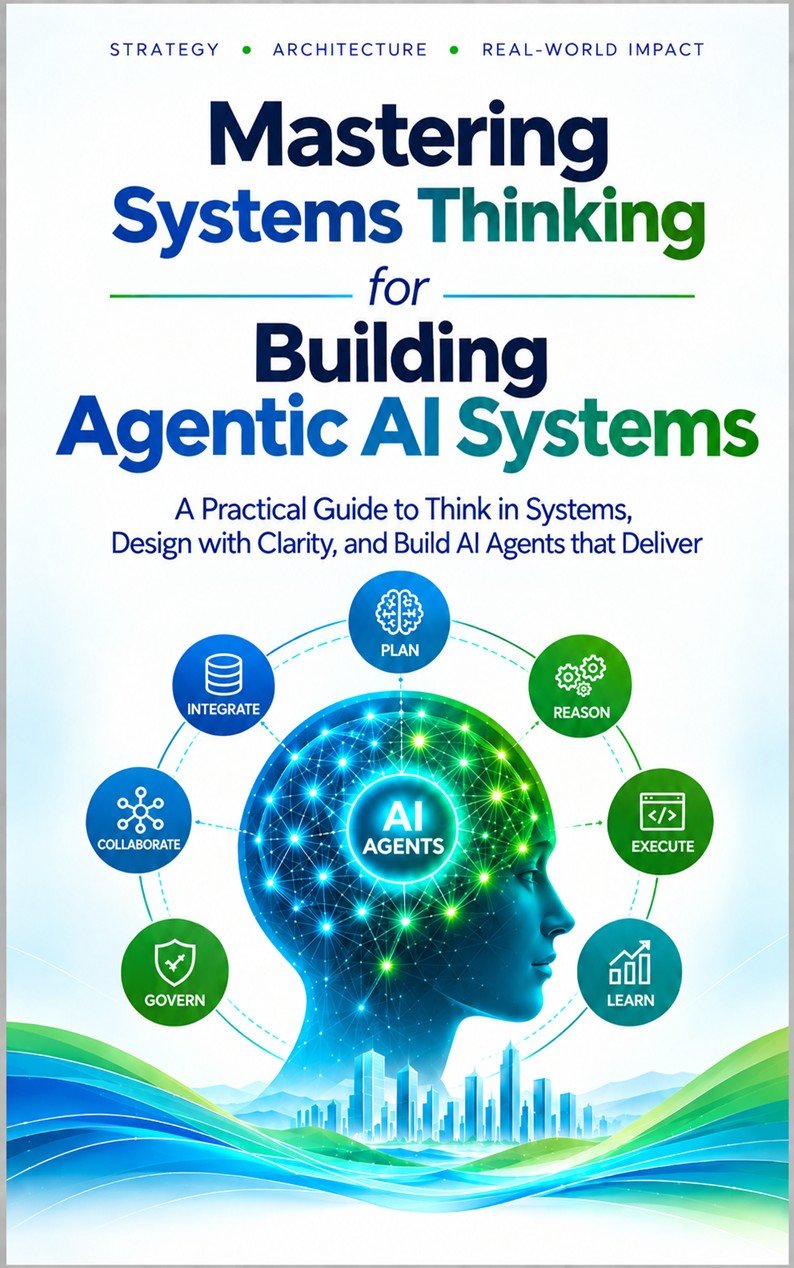
Mastering Systems Thinking for Building Agenttic AI Systems
From Intelligent Agents to Systems That Work in the Real World
✍️ About the Author
Sanjoy Kumar Malik — Senior Engineering & Technology Leader, Enterprise Solution & Technology Architect, and Enterprise AI Strategist with 20+ years of corporate IT experience and 27+ years of total professional experience, spanning enterprise solution architecture, technology strategy, digital transformation, application modernization, enterprise integration, distributed systems, security, and AI-native architecture. He is a TOGAF 10 Certified Enterprise Architecture Practitioner and AWS Certified Solutions Architect – Professional.
He is the creator of The 28-Category AI Architecture Decision Framework (28-CAADF), a systematic approach to making AI architecture decisions in an era where intelligence itself is becoming an architectural capability.
Launching late December 2026
Overview
A systems-thinking approach to architecting reliable, secure, scalable, and adaptive enterprise agentic AI systems.
Agentic AI is changing how software systems reason, coordinate, make decisions, and act. But as AI systems become more autonomous and interconnected, their complexity extends far beyond individual models, prompts, and agents.
An agent may perform well in isolation and still contribute to a system that fails.
Why? Because system-level outcomes depend on interactions, feedback loops, shared state, dependencies, execution constraints, knowledge quality, and the behavior that emerges when these elements operate together.
Mastering Systems Thinking for Building Agentic AI Systems explores how to understand, design, engineer, govern, and evolve these systems as coherent architectural wholes.
This is a book for architects and technology leaders who want to move beyond assembling AI components and develop the architectural judgment required to build enterprise-grade agentic systems.
Currently under construction. More details will be shared as the book takes shape.
Your Agents Work. But Will Your System?
Building an individual AI agent is one challenge. Building a system of interacting agents that operates reliably within a real enterprise is an entirely different problem.
Consider what happens when an agentic system enters production:
- One agent produces an incorrect conclusion that influences several downstream agents.
- Parallel execution improves response time but creates contention for shared resources.
- Retries amplify a temporary failure into a cascading failure.
- Stale memory or incomplete context leads to decisions that appear reasonable but are operationally wrong.
- Autonomous execution crosses a boundary that should have required authorization or human approval.
- A change to one agent alters the behavior of the wider system in unexpected ways.
- Increasing the number of agents raises coordination overhead without improving business outcomes.
- A locally successful workflow creates unacceptable cost, latency, risk, or operational complexity at the system level.
These are not merely model-quality problems. They are problems of system behavior, architecture, control, coordination, and governance.
Traditional component-by-component thinking is insufficient when system behavior depends on interactions that evolve over time.
The architectural challenge is no longer just how to build intelligent agents. It is how to engineer the system in which those agents operate.
The Missing Discipline: Systems Thinking
Systems Thinking shifts the focus from individual components to relationships, interactions, feedback, constraints, and outcomes.
Applied to agentic AI, it helps architects ask deeper questions:
- What is the system's purpose, and where are its boundaries?
- Which responsibilities should be autonomous, coordinated, deterministic, or human-controlled?
- How do context, memory, state, and knowledge influence system behavior?
- Where can feedback loops stabilize execution, and where can they amplify errors?
- How can failures propagate across agents, workflows, tools, and enterprise systems?
- Which architectural interventions provide the greatest improvement in reliability, safety, and economics?
- How can the system evolve without compromising its invariants or enterprise responsibilities?
These questions matter because an agentic system must be engineered for the behavior of the whole, not merely the capabilities of its parts.
This book brings systems thinking into the architectural discipline of building complex agentic AI systems.
What This Book Will Help You Master
1. Understand the System Before Decomposing It
Learn to define system boundaries, purpose, context, dependencies, and architectural constraints before deciding how to divide responsibilities among agents and services.
Explore causal reasoning, feedback loops, system dynamics, leverage points, and complex adaptive behavior to understand why apparently sensible local decisions can produce undesirable system-level outcomes.
2. Architect the Interactions Between Agents
Move beyond treating multi-agent architecture as a collection of specialized agents.
Understand how to reason about:
- Agent boundaries and responsibility allocation.
- Orchestration, coordination, delegation, and control flow.
- Shared knowledge, context, memory, and durable state.
- Inter-agent dependencies and coordination overhead.
- Enterprise tools, external systems, and consequential actions.
- Human oversight and the boundaries of delegated authority.
The objective is not to maximize the number of agents. It is to establish the right system structure for the required business outcomes.
3. Engineer for Stability, Reliability, and Recovery
Understand how interacting components behave under normal operation, degraded conditions, and failure.
Explore feedback control, execution bounds, retry behavior, failure propagation, resource contention, observability, evaluation, verification, and recovery.
Learn to distinguish a component that appears successful from a system that consistently delivers correct, authorized, and recoverable business outcomes.
4. Govern Autonomy Without Eliminating Its Value
Design architectural boundaries that allow AI systems to act while preserving enterprise control.
Explore identity, tenant isolation, tool governance, policy enforcement, human approval, auditability, risk controls, and controlled system evolution.
The goal is neither unrestricted autonomy nor excessive human intervention. It is bounded autonomy within explicit, enforceable architectural constraints.
5. Optimize the System, Not Individual Components
A faster model does not necessarily produce a faster workflow. A cheaper model does not necessarily reduce the cost of successful task completion. More parallel agents do not necessarily create more business value.
Learn to reason about the interactions between quality, latency, cost, resource consumption, human intervention, reliability, and business outcomes.
Make architecture decisions based on system-level trade-offs rather than isolated component metrics.
6. Design Systems That Can Evolve
Agentic systems operate in changing environments. Models, tools, policies, data, workflows, workloads, and business expectations evolve.
Explore evolutionary architecture, architecture fitness, controlled deployment, continuous evaluation, investment prioritization, and adaptive operating models.
Build a foundation for systems that can change deliberately without losing control of their behavior.
A Practical Journey Across Six Parts
The book is organized into six parts and 18 chapters, moving from foundational systems concepts to enterprise-scale agentic architecture.
PART I: The Foundations of Systems Thinking
Understand the principles before applying them.
Establish the conceptual foundations needed to reason about intelligent systems as interconnected wholes.
- From Intelligent Components to Intelligent Systems
- Systems Thinking, Cybernetics, and Complex Adaptive Systems
- Causal Reasoning, Leverage Points, and Architectural Intervention
What you gain: A foundation for analyzing system behavior, identifying architectural leverage points, and understanding why component-level optimization can fail at the system level.
PART II: Modeling the Agentic System
Define what the system is and how its parts relate.
Examine system boundaries, enterprise context, interaction architecture, state, memory, and distributed system dynamics.
- System Boundaries, Context, and Enterprise Knowledge
- Interaction Architecture and System Decomposition
- State, Memory, and Distributed System Dynamics
What you gain: A structured way to reason about agent responsibilities, context dependencies, shared state, system decomposition, and the relationships that shape overall behavior.
PART III: Engineering Coordination and Execution
Turn architectural intent into controlled execution.
Explore how agentic systems coordinate decisions, delegate responsibilities, interact with enterprise systems, and operate within defined authority boundaries.
- Cognitive Orchestration and Control-Flow Architecture
- Multi-Agent Coordination and Collective Behavior
- Enterprise Actuation, Tool Governance, and Human Oversight
What you gain: Architectural principles for coordinating agents, governing execution, managing delegation, and controlling consequential enterprise actions.
PART IV: Controlling Complexity and Ensuring Reliability
Design for failure, uncertainty, and operational reality.
Investigate feedback control, stability, failure propagation, observability, evaluation, verification, and continuous assurance.
- Feedback Control, Stability, and Failure Propagation
- Observability and Operational Intelligence for Agentic Systems
- Evaluation, Verification, and Continuous Assurance
What you gain: A system-level approach to understanding failures, detecting behavioral changes, evaluating outcomes, and engineering recoverable, observable systems.
PART V: Enterprise Governance and Economic Optimization
Make autonomy accountable and economically sustainable.
Connect technical architecture to risk, resource constraints, investment decisions, business value, and enterprise accountability.
- Enterprise AI Governance and Risk Architecture
- Agentic Economics, Capacity Planning, and Cost Optimization
- Architecture Strategy, Investment Prioritization, and Value Realization
What you gain: A framework for balancing autonomy, risk, quality, operational cost, capacity, and measurable business outcomes.
PART VI: Architecting the Adaptive Enterprise
Design for long-term evolution, not just initial deployment.
Bring the preceding concepts together to address organizational structures, evolutionary architecture, and the architecture of enterprise agentic systems.
- The Human-Agent Enterprise: Organizational Design and Operating Models
- Evolutionary Architecture and Adaptive Agentic Systems
- The Enterprise Agentic Reference Architecture
What you gain: A broader architectural perspective that connects system design, organizational responsibility, controlled evolution, and enterprise-scale adoption.
From Theory to Architectural Practice
Systems Thinking becomes valuable when it changes the decisions architects make.
This book is being developed around practical architectural reasoning, reusable modeling techniques, decision frameworks, and production-oriented examples.
The supporting material is intended to help readers translate concepts into tangible architectural work, including:
- Systems-thinking models: Causal relationships, feedback loops, dependencies, delays, and leverage points.
- Architecture decision records: Explicit alternatives, trade-offs, assumptions, constraints, and decision criteria.
- Risk and production-readiness assessments: Structured ways to identify architectural weaknesses and readiness gaps.
- Metrics and evaluation catalogs: Definitions and measurement approaches for task success, cost, latency, intervention, and operational reliability.
- Reference architecture and deployment patterns: Practical approaches to orchestration, tenant isolation, governed tool execution, durable workflows, evaluation, and observability.
- Glossary and further reading: A terminology reference and curated learning paths spanning systems thinking, agentic architecture, reliability, and enterprise governance.
The emphasis is on understanding why an architectural decision matters, when it is appropriate, what trade-offs it introduces, and how its consequences can be evaluated.
One Continuous Case Study: An Enterprise AI-Native BDC Platform
Throughout the book, a multi-tenant Business Development Center (BDC) platform serves as a recurring architectural case study.
The platform supports activities such as account discovery, research, lead qualification, opportunity analysis, outreach preparation, and governed CRM operations.
Its architecture must address practical enterprise constraints:
- Multiple tenants with different business requirements and information boundaries.
- Specialized agent responsibilities and coordinated workflows.
- Enterprise knowledge retrieval, evidence validation, and contextual decision-making.
- Durable execution, bounded autonomy, and recoverable failures.
- Governed CRM operations, with the CRM remaining the system of record for designated business records.
- Human approval for selected consequential actions.
- Evaluation, observability, auditability, resource controls, and cost management.
- Continuous improvement without compromising security or governance.
The case study illustrates how systems-thinking principles influence architecture decisions across the lifecycle, from defining boundaries and allocating responsibilities to managing feedback, failure, risk, and evolution.
It is not intended to prescribe one mandatory implementation. The architectural principles are the focus; deployment choices depend on the system's requirements and constraints.
Who Is This Book For?
This book is intended for professionals responsible for the architecture, engineering, governance, or strategic direction of complex AI systems.
AI Architects
Develop a system-level perspective for making architecture decisions across agents, models, context, orchestration, execution, and control.
Enterprise and Solution Architects
Extend established architectural disciplines to probabilistic, stateful, interconnected AI systems and their enterprise dependencies.
Heads of AI Engineering and AI Practice
Establish reusable design principles, engineering standards, governance mechanisms, and evaluation practices for complex agentic platforms.
CTOs, Chief AI Officers, and Technology Leaders
Understand the architectural trade-offs that influence reliability, scalability, security, operating cost, risk, and long-term business value.
Senior Engineers
Move beyond implementing individual agents toward reasoning about coordination, distributed behavior, failure modes, and system-level outcomes.
This is particularly relevant if you are responsible for systems in which multiple agents, enterprise tools, shared context, long-running workflows, and human decisions interact.
This Is Not Another Agent Framework Tutorial
This book is not primarily about writing prompts, calling an LLM API, or learning the syntax of a particular orchestration framework.
Those implementation skills can be useful, but they do not replace architectural reasoning.
Frameworks change. Models evolve. New execution patterns emerge.
The need to understand system boundaries, causal relationships, feedback, state, coordination, authority, reliability, and economic trade-offs remains.
The central question is not simply:
How do I build an agent that can perform this task?
It is:
How do I architect a system in which intelligent components can work together to deliver reliable, governed, and measurable outcomes?
That is the problem this book sets out to address.
The Architectural Shift
The next stage of agentic AI will require more than increasingly capable models and more sophisticated agents.
It will require a deeper understanding of the systems in which intelligence operates.
An agent is a component. An agentic workflow is a coordinated sequence of activities. An agentic platform is a larger system of interactions, state, policies, dependencies, and feedback.
The architecture must account for all three.
Mastering Systems Thinking for Building Agentic AI Systems is being developed to help architects and technology leaders make that shift: from designing intelligent components to understanding and engineering intelligent systems.
The Book Is Under Construction
The book is currently under development.
The goal is to provide a rigorous, practical resource for professionals who want to understand not only how agentic AI systems are assembled, but how they behave, how they fail, how they can be controlled, and how they can evolve.
If you are architecting the next generation of enterprise agentic systems, follow the development of this book for future updates.
Think beyond agents. Architect the system.
Follow Sanjoy on LinkedIn and receive updates about Mastering Systems Thnking for Building Agentic AI Systems through his LinkedIn post.